
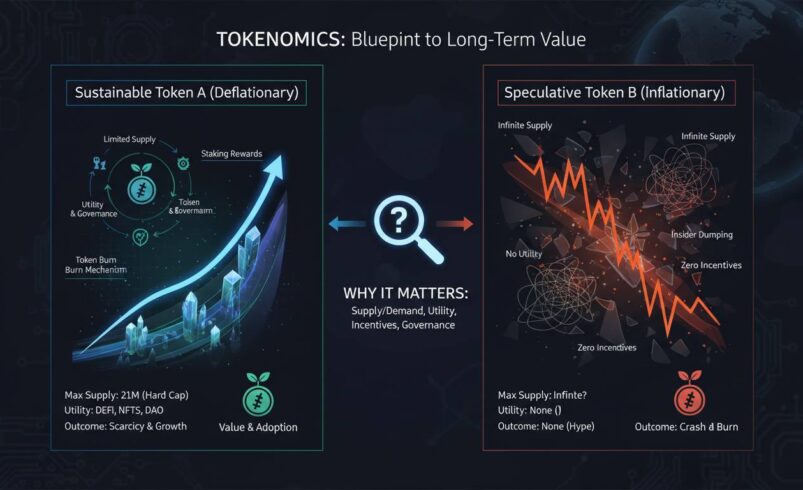

If you’re investing in cryptocurrency without understanding tokenomics, you’re essentially buying a company stock while ignoring its balance sheet, revenue model, and shareholder structure. The economics underlying a crypto token determine whether that digital asset will appreciate over time or gradually dissolve into worthlessness. Yet most retail investors proceed without ever examining the fundamental economic design of the tokens they hold.
Tokenomics—the combination of “token” and “economics”—describes the structural mechanics that govern how a cryptocurrency functions as an asset. It covers everything from how many tokens exist to how new tokens enter circulation, what purposes those tokens serve, and what incentives drive holder behavior. These factors together determine whether a token has genuine long-term value or whether its price is sustained purely by speculation and hype.
This guide breaks down the critical components of tokenomics, explains why they matter for your portfolio, and provides a practical framework for evaluating any cryptocurrency’s economic design before you invest.
What Is Tokenomics?
Tokenomics refers to the study and design of a cryptocurrency’s economic model. It includes the rules governing token supply, distribution, inflation or deflation mechanisms, utility functions, and incentive structures that influence how participants interact with the network.
At its core, tokenomics answers fundamental questions: What is this token actually for? How many exist? Who owns them? What happens to the supply over time? How are new tokens created and distributed? These aren’t secondary considerations—they’re the primary determinants of whether a token can sustain value over years and decades.
A token with poorly designed tokenomics might experience catastrophic inflation, where the supply expands so rapidly that each token becomes progressively less scarce. Conversely, a token with deflationary mechanics might become so scarce that it hinders network participation and growth. The ideal tokenomics design aligns the economic incentives of all participants—miners, validators, developers, and holders—toward the long-term success of the network.
Understanding tokenomics isn’t optional for serious crypto investors. It’s the equivalent of reading a company’s financial statements before buying stock.
The Five Key Components of Tokenomics
Every cryptocurrency’s economic model can be analyzed through five interconnected components. These elements work together to determine the token’s behavior as an asset.
Total Supply and Circulating Supply
Total supply represents the maximum number of tokens that will ever exist according to the protocol’s design. Bitcoin’s total supply is capped at 21 million—a limit hardcoded into its consensus rules. Ethereum, in contrast, has historically had no capped supply, though EIP-1559 introduced burn mechanics that can make the token deflationary under certain conditions.
Circulating supply, however, is what actually matters for market dynamics. This figure represents the number of tokens currently available for trade. The gap between total and circulating supply can be substantial when significant token allocations remain locked in vesting schedules, treasury holdings, or staking contracts. When those tokens eventually unlock and enter circulation, they can create substantial selling pressure that suppresses price.
Consider a token with a 1 billion total supply where only 100 million currently trade on exchanges. The remaining 900 million will eventually reach the market—typically through team allocations, investor unlock schedules, or ecosystem grants. Understanding when and how those tokens will be released is essential for anticipating future supply shocks.
Token Distribution and Allocation
How tokens are initially allocated and subsequently distributed across the holder base profoundly affects price stability and network governance. Ideally, tokens should be distributed across a wide base of participants rather than concentrated in a small number of addresses.
The initial allocation typically includes categories such as:
- Community and ecosystem rewards: Tokens allocated for airdrops, grants, and incentive programs
- Team and founders: Compensation for the development team, usually subject to vesting schedules
- Early investors: Venture capital firms and early backers who provided capital during development
- Foundation or treasury: Tokens held by the organization for ongoing development and operations
Concentration risk emerges when a small number of wallets control a disproportionate share of supply. These “whale” holders can dramatically influence price through coordinated buying or selling. Examining the top 10 or top 100 holder addresses provides insight into distribution. A healthy token might have no single address controlling more than 5% of circulating supply, with the top 100 holders collectively representing under 50%.
Inflation and Deflation Mechanics
Inflation in cryptocurrency operates differently than in traditional fiat systems. Protocol-level inflation typically rewards network participants—miners or validators—for securing the blockchain. This inflation rate is usually expressed as an annual percentage and may decrease over time through predetermined emission schedules.
Bitcoin’s inflation schedule follows a halving cycle that reduces block rewards approximately every four years. When Bitcoin launched in 2009, block rewards were 50 BTC; as of the 2024 halving, block rewards stand at 3.125 BTC. This declining emission schedule creates progressive scarcity that distinguishes Bitcoin from assets with perpetual inflation.
Deflationary tokens implement mechanisms to reduce circulating supply over time. The most common approach is token burning, where a portion of transaction fees are permanently removed from circulation. Ethereum’s EIP-1559 upgrade implemented a base fee burn that has, during periods of high network activity, exceeded the issuance of new ETH—making Ethereum technically deflationary. Some tokens incorporate buyback-and-burn mechanisms where protocol revenue purchases tokens from the market and destroys them.
The inflation or deflation rate directly impacts holder returns. A token with 10% annual inflation effectively dilutes the value of existing holdings by 10% each year, requiring corresponding price appreciation just to maintain current value.
Token Utility and Use Cases
Utility defines what holders can actually do with a token beyond speculation. Tokens with genuine use cases tend to maintain value better than those existing purely as speculative instruments because demand for the token stems from functional necessity rather than price expectations alone.
Common utility functions include:
- Transaction fees: Paying for network computation and bandwidth
- Staking: Locking tokens as collateral to participate in network consensus
- Governance: Voting on protocol upgrades and parameter changes
- Access: Gating access to services, features, or exclusive content
- Collateral: Serving as backing for loans or other financial products
The strength of utility correlates with sustainable demand. A token used for paying transaction fees experiences demand that scales with network activity. A token used for governance creates vested interest among holders in the protocol’s success. A token that merely promises future utility without current functional demand is speculative rather than functional.
Staking and Governance Rights
Proof-of-stake networks and many Layer 1 protocols incorporate staking mechanisms that require token holders to lock their holdings as collateral. In return, stakers receive staking rewards—typically newly minted tokens—and often gain voting rights on protocol governance proposals.
Staking creates economic incentive for long-term holding rather than short-term trading. When tokens are staked, they cannot be sold on exchanges. This reduces circulating supply while simultaneously aligning holder interests with network security and performance. The staking yield—annual percentage return for locking tokens—serves as a baseline return that can attract institutional capital seeking yield in crypto markets.
Governance rights extend this alignment further. Token holders who can vote on protocol upgrades, treasury spending, or parameter changes have direct influence over the network’s trajectory. This creates a stakeholder dynamic where holders benefit from network growth and suffer from network decline—same as shareholders in a company.
Not all governance is meaningful, however. Some protocols implement voting mechanisms that appear democratic but offer limited real power, or where voting turnout is so low that a small coalition can effectively control outcomes.
Incentives and Tokenomics Design
The most sophisticated tokenomics designs create self-reinforcing incentive loops that drive network growth while maintaining economic sustainability. These incentive structures determine participant behavior across the ecosystem.
Consider liquidity mining programs, where protocols reward users who provide capital to decentralized exchanges. These incentives can rapidly bootstrap liquidity but often attract yield farmers who depart once rewards diminish—creating instability when the incentive structure proves unsustainable.
Sustainable tokenomics designs front-load incentives to attract early participants while building mechanisms that reduce dependency on perpetual token emissions. Protocols that can transition from inflationary rewards to sustainable revenue models tend to outperform those requiring infinite token printing to maintain functionality.
The design philosophy matters. Tokens created primarily to enrich founders through token sales often exhibit aggressive inflation schedules and minimal utility. Tokens designed to fund genuine network development typically incorporate meaningful utility, controlled inflation, and vesting schedules that align team compensation with long-term project success.
Why Tokenomics Matters for Long-Term Value
The economic design of a token fundamentally shapes its investment thesis. Without understanding tokenomics, you’re essentially betting on price appreciation without understanding the structural forces that will either support or undermine that appreciation over time.
How Supply Dynamics Affect Price
Basic economics teaches that price responds to supply and demand. In cryptocurrency, supply dynamics often dominate price formation because demand for any given token fluctuates within a relatively narrow range while supply changes are predictable and sometimes dramatic.
A token with a fixed or declining supply has a built-in tailwind for price appreciation if demand grows. Bitcoin’s capped supply of 21 million means that as adoption increases, each BTC becomes progressively scarcer relative to demand. This structural scarcity is why many investors view Bitcoin as “digital gold.”
The contrast with tokens lacking supply caps is stark. While Ethereum’s unlimited supply might concern some investors, the deflationary mechanics introduced by EIP-1559 partially address this. Tokens with explicit inflationary schedules—continuously expanding supply—face persistent headwinds unless demand grows faster than emission.
The timing of supply changes matters enormously. Tokens with large unlock schedules approaching in the next 12-24 months face predictable selling pressure that may not be reflected in current prices. Conversely, tokens that have already completed major unlocks may be undervalued if the market hasn’t recognized the reduced future supply expansion.
Distribution Risks and Whale Concentration
The distribution of tokens across addresses reveals critical information about future price dynamics. Highly concentrated ownership creates risk that a small number of large holders—whales—can manipulate markets or exit their positions in ways that devastate smaller holders.
Examining on-chain data for top holder addresses provides insight into these risks. A token where the top 10 addresses control 80% of supply carries substantially different risk characteristics than one where those same addresses control 30%. The former could experience dramatic dumps whenever major holders decide to liquidate positions; the latter offers more resilience against individual large sales.
Vesting schedules—time-locked allocations that release tokens to team members and investors over predetermined periods—create predictable supply additions. A token with $500 million in tokens scheduled to unlock over the next six months faces mechanical selling pressure that will likely suppress price unless demand grows to absorb that supply. Understanding unlock schedules is essential for timing entry points and managing position sizing.
Sustainability of Token Incentives
Many cryptocurrency networks rely on token incentives to attract participants—validators, liquidity providers, developers. The sustainability of these incentive programs determines whether the network can maintain its functionality over time.
The critical question is: what happens when token rewards eventually diminish or end? Networks that successfully transition to sustainable revenue models—where network fees cover operational costs without requiring perpetual token issuance—will survive. Those that remain dependent on inflation to incentivize participation may struggle as rewards decline.
This is particularly relevant for proof-of-stake networks where validator rewards come from new token issuance. As issuance rates decline (often built into the protocol design), validators must receive sufficient fees from transaction processing to maintain operations. Networks with insufficient transaction volume relative to validator costs face centralization risk as smaller validators exit due to unprofitability.
Evaluating sustainability requires projecting future network revenue against required security costs. A tokenomics model that works when chain activity is high may fail during market downturns when transaction volumes decline.
How to Analyze Tokenomics Before Investing
Approaching tokenomics analysis systematically helps identify red flags and opportunities that might otherwise go unnoticed. Here’s a practical framework for evaluating any cryptocurrency’s economic design.
Key Questions to Answer
Before purchasing any token, investigate the following:
What is the total supply, and is it capped? Capped supplies create scarcity; uncapped supplies expose holders to infinite dilution. Understand whether the token has a maximum supply, an inflationary schedule that decreases over time, or perpetual inflation.
What is the current circulating supply relative to total supply? Large gaps indicate future dilution from unlocks. Calculate what percentage of total supply is currently free-floating versus locked.
Who are the largest holders, and what are their unlock schedules? Identify team, investor, and foundation allocations. Determine when these tokens become liquid and in what quantities.
What utility does the token serve? Beyond speculation, what can holders actually do with the token? Greater utility creates organic demand independent of price speculation.
What is the inflation or deflation rate? Determine the annual issuance or burn rate. Calculate what return you need just to maintain your ownership percentage against inflation.
Are incentives aligned with long-term holding? Consider whether the tokenomics design rewards long-term participation or incentivizes short-term flips.
Tokenomics Red Flags
Certain patterns should immediately increase skepticism:
- No clear use case: Tokens without defined utility are purely speculative
- Team allocations exceeding 30%: Excessive team ownership often signals extractive tokenomics
- No vesting schedules: Tokens without time-locks for team and investor allocations can be immediately dumped
- Perpetual inflation without clear endpoint: Unlimited supply expansion without burn mechanisms erodes holder value
- Unrealistic yield promises: Returns far above sustainable levels typically indicate Ponzi dynamics
- Sudden tokenomics changes: Protocols that repeatedly alter economic parameters suggest unstable design
- Anonymous teams: While not always problematic, anonymous founders limit accountability when tokenomics go poorly
Tools for Research
Several resources assist tokenomics analysis:
- On-chain explorers: Etherscan, Solscan, and similar block explorers reveal holder addresses, supply data, and transaction history
- Token unlock calendars: Platforms like Token Unlocks track upcoming vesting unlocks
- DeFiLlama and CoinGecko: Provide supply data, market cap calculations, and token distribution estimates
- Protocol documentation: The official documentation should detail emission schedules, allocation percentages, and utility functions
Never rely on a single source. Cross-reference data across multiple platforms and verify claims through official protocol documentation rather than marketing materials.
Real Examples: Tokenomics Case Studies
Examining how different tokens implement tokenomics reveals the spectrum of design approaches and their consequences.
Bitcoin Tokenomics
Bitcoin represents the most conservative tokenomics design in cryptocurrency. The 21 million cap creates absolute scarcity—a fundamentally different economic proposition than any fiat currency. The emission schedule reduces block rewards by 50% approximately every four years, creating predictable and decreasing inflation.
Currently, Bitcoin’s inflation rate sits around 1.7% annually, declining with each halving. When the last Bitcoin is mined around 2140, inflation will reach zero. This design creates strong deflationary pressure as adoption grows while supply growth diminishes.
The distribution of Bitcoin has also evolved. Early miners accumulated substantial positions when Bitcoin had negligible value. Over time, as those coins moved on exchanges or were sold, distribution has become more dispersed. The top 100 addresses still hold a significant percentage, but this concentration largely represents long-term holder wallets rather than active traders.
Bitcoin’s tokenomics is intentionally simple. It serves primarily as a store of value and medium of exchange rather than granting holders governance rights or complex utility. This simplicity is arguably a feature—complex tokenomics creates attack surfaces and unexpected behaviors.
Ethereum Tokenomics
Ethereum’s tokenomics has evolved substantially since its 2014 launch. Initially, ETH had no supply cap and used a proof-of-work consensus mechanism. The transition to proof-of-stake with the Merge in September 2022, followed by EIP-1559 in August 2021, fundamentally changed ETH’s economic properties.
Ethereum’s current tokenomics incorporates several mechanisms:
- Staking rewards: Validators receive approximately 4-5% annual yield for securing the network
- Base fee burn: Each transaction burns a portion of ETH, removing it from circulation permanently
- Variable issuance: The ETH issuance rate adjusts based on the number of active validators
During periods of high network activity, burn rates have exceeded staking issuance, making ETH deflationary. This creates a unique dynamic where network usage directly reduces supply—unlike traditional assets where greater usage typically requires more supply.
Ethereum’s tokenomics supports its role as infrastructure for decentralized applications. Users pay ETH for transaction fees (gas), stake ETH to secure the network, and use ETH as collateral for decentralized finance applications. This multi-faceted utility creates diverse demand sources beyond pure speculation.
Examples of Problematic Tokenomics
Not all tokenomics designs serve holder interests. Several patterns have repeatedly demonstrated problematic outcomes.
Rug pulls and honeypots: Scam tokens often create tokenomics designed to trap buyers. The contract allows purchasing but prevents selling once the developer has accumulated sufficient liquidity. These aren’t tokenomics failures—they’re outright fraud—but they illustrate how economic design can be weaponized.
Incentive misalignments: Some tokens create yield farming programs so generous that they’re mathematically unsustainable. When rewards inevitably decline, participants exit, liquidity evaporates, and price collapses. The tokenomics appeared attractive during the incentive period but proved temporary.
Excessive team allocations: Tokens that allocate 40-50% of supply to founders and early investors often experience perpetual sell pressure as those allocations unlock. Even successful projects can underperform because the token supply expansion outpaces value creation.
Untested inflation models: Some protocols experiment with novel tokenomics mechanisms that behave unpredictably under different market conditions. What works in bull markets can fail catastrophically during downturns when assumptions no longer hold.
The lesson isn’t that tokenomics is inherently risky—it’s that the specific implementation matters enormously. Thoughtful tokenomics design creates tokens that appreciate as networks grow. Careless design creates tokens that structurally favor insiders at the expense of ordinary investors.
Conclusion
Tokenomics isn’t an abstract academic concept—it’s the fundamental economic structure that determines whether a cryptocurrency can sustain value over time. The supply mechanics, distribution patterns, inflation rates, utility functions, and incentive structures all combine to create an economic environment that either supports or undermines long-term holder returns.
The investors who understand tokenomics have a significant advantage over those who treat cryptocurrency purely as price speculation. They can anticipate unlock-driven selling pressure before it arrives. They recognize when token incentives create unsustainable yield expectations. They identify whale concentration that threatens price stability.
What remains genuinely unresolved in the crypto markets is how valuation models will ultimately incorporate tokenomics fundamentals. Traditional financial analysis has established frameworks for evaluating stocks—price-to-earnings ratios, discounted cash flows, comparable company analysis. Cryptocurrency lacks equivalent consensus methodologies. The relationship between tokenomics metrics and price discovery is still being discovered through market experimentation.
For now, the most prudent approach is to treat tokenomics analysis as essential due diligence rather than optional research. Every token in your portfolio should have tokenomics that you genuinely understand and believe can sustain long-term value. If you can’t explain how the token’s economic design supports its price, you shouldn’t be holding it.