
The stock market is a marketplace where buyers and sellers trade ownership shares in companies. When you buy a stock, you become a partial owner of that company, entitled to a share of its profits and assets. For millions of Indians, understanding the stock market represents the first step toward building long-term wealth and achieving financial independence.
This guide breaks down everything you need to know about how the stock market works, why it matters, and how you can start investing with confidence.
📊 STATS
• 7+ crore Indians actively invest in the stock market
• 23% annual returns historically generated by the Indian stock market over long periods (Sensex historical data)
• 2,000+ listed companies on NSE and BSE combined
• ₹4 lakh crore+ traded daily on Indian stock exchanges (NSE Monthly Statistics)
Key Takeaways
• Stock markets facilitate the buying and selling of company shares
• Primary exchanges in India include NSE and BSE, regulated by SEBI
• Trading hours are 9:15 AM to 3:30 PM IST, Monday to Friday
• Demat accounts are required to hold shares electronically
• Long-term investing historically outperforms short-term trading
Understanding the stock market opens doors to wealth creation, but approaching it without proper knowledge can lead to significant losses. This article provides the foundational knowledge every Indian investor needs before entering the market.
Understanding the Stock Market
What Is a Stock Market?
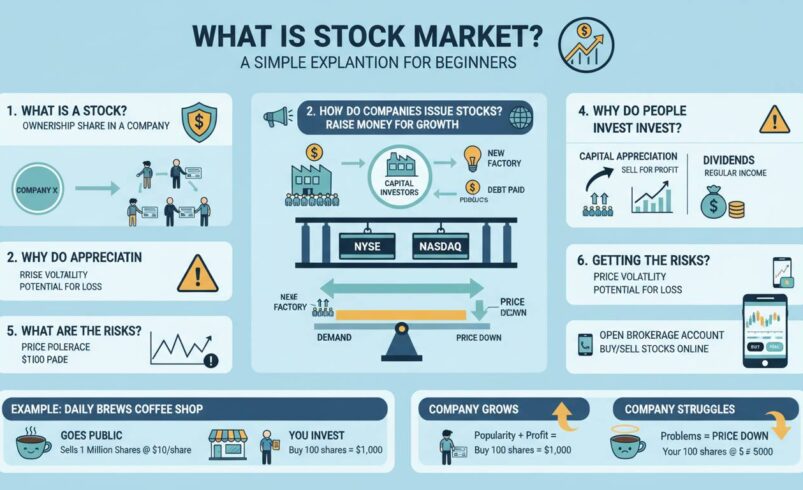
A stock market is a collection of markets where stocks (pieces of ownership in companies) are bought and sold. It serves as a platform connecting companies seeking capital with investors looking for growth opportunities.
Think of it as a digital marketplace—similar to Amazon or Flipkart, but instead of buying products, you’re purchasing tiny pieces of companies. Just as a local vegetable market sets prices based on supply and demand, stock markets determine share prices through continuous trading between buyers and sellers.
The two primary stock exchanges in India are:
- National Stock Exchange (NSE) – Founded in 1992, India’s largest stock exchange by trading volume
- Bombay Stock Exchange (BSE) – Asia’s oldest stock exchange, established in 1875
Both exchanges operate under the regulation of the Securities and Exchange Board of India (SEBI), which protects investor interests and maintains fair trading practices.
How Stock Markets Work
The stock market operates through a sophisticated network of exchanges, brokers, and regulatory bodies. Here’s the basic flow:
For Companies:
A company decides to raise money by selling part of its ownership to the public. This process is called an Initial Public Offering (IPO). After the IPO, the company’s shares begin trading on the stock exchange.
For Investors:
Individual investors open trading and demat accounts with registered brokers. When you place a buy order, your broker executes it on the exchange. The shares are then held electronically in your demat account.
Price Determination:
Share prices fluctuate based on supply and demand. If more people want to buy a stock than sell it, the price rises. Conversely, if more people want to sell than buy, the price falls.
💡 STAT: The Nifty 50 index (top 50 NSE companies) has delivered approximately 12-15% annualized returns over the past two decades (NSE Historical Data).
Key Participants in the Indian Stock Market
| Participant | Role |
|---|---|
| SEBI | Regulator protecting investor interests |
| Stock Exchanges (NSE, BSE) | Platform for trading shares |
| Depositories (CDSL, NSDL) | Hold shares electronically |
| Brokers | Execute buy/sell orders for investors |
| Asset Management Companies | Manage mutual funds and ETFs |
| Investors | Buy shares expecting returns |
Why Does the Stock Market Exist?
Benefits for Companies
Companies use the stock market to raise capital for expansion, research, debt repayment, and acquisitions. Unlike bank loans, selling shares doesn’t require fixed interest payments. Instead, companies share future profits with shareholders.
Advantages for Businesses:
• Access to large pools of capital
• Enhanced visibility and credibility
• Ability to use stock for acquisitions
• Diversified investor base rather than debt dependence
Benefits for Investors
For individual investors, the stock market offers several compelling advantages:
1. Wealth Creation
Stocks have historically outperformed other asset classes like fixed deposits, gold, and real estate over the long term. The Indian Sensex has grown from around 100 points in 1979 to over 80,000 in 2024—a remarkable growth story.
2. Ownership in Growing Companies
When you invest in successful companies like Infosys, TCS, or HDFC Bank, you directly benefit from their growth and profitability.
3. Dividends
Many profitable companies share a portion of their earnings with shareholders through dividends, providing regular income alongside capital appreciation.
4. Liquidity
Unlike real estate or fixed deposits, stocks can be sold quickly during market hours, providing flexibility when you need money.
5. Index Funds and ETFs
Beginners can invest in the entire market through index funds, reducing risk through diversification.
📈 CASE: An investor who put ₹1 lakh into Sensex at its inception in 1979 would have seen it grow to over ₹80 lakhs by 2024—a testament to long-term equity investing power.
How to Start Investing in the Indian Stock Market
Prerequisites Before You Begin
Documents Required:
– Aadhaar card (for KYC)
– PAN card (mandatory for trading)
– Bank account
– Cancelled cheque or bank statement
– Passport-sized photographs
Accounts You Need:
1. Demat Account – Electronic storage for your shares (provided by CDSL or NSDL)
2. Trading Account – For buying and selling shares (provided by brokerage firms)
3. Bank Account – For fund transfers
Popular brokers in India include Zerodha, Upstox, Angel One, ICICI Direct, and HDFC Securities. Many offer zero-account opening charges and low brokerage fees.
Steps to Start Investing
Time: 2-3 days for account setup | Cost: ₹0-₹300 for account opening
Step 1: Complete KYC
Visit your broker’s website or app, fill in your details, upload documents, and complete e-verification. This process typically takes 24-48 hours.
Step 2: Link Bank Account
Add your primary bank account for seamless fund transfers. Ensure the name matches your Demat account exactly.
Step 3: Fund Your Account
Transfer money from your bank account to your trading account using UPI, net banking, or NEFT/RTGS.
Step 4: Start with Blue-Chip Stocks
Begin with established companies (Reliance, TCS, Infosys, HDFC Bank) that have proven track records. These are called “blue-chip” stocks.
Step 5: Learn Technical and Fundamental Analysis
Before buying any stock, understand what you’re investing in. Analyze company financials, profit growth, debt levels, and industry position.
⏱ Tip: Start with SIP (Systematic Investment Plan) in index funds if you’re unsure about picking individual stocks.
Common Mistakes to Avoid
| Mistake | Impact | Solution |
|---|---|---|
| Investing without research | 📉 30-50% potential losses | Always analyze before buying |
| Following tips blindly | 📉 Losses when tips fail | Do your own analysis |
| Trying to time the market | 📉 Missed opportunities | Invest regularly via SIP |
| Putting all money in one stock | 📉 High risk exposure | Diversify across sectors |
| Panic selling during downturns | 📉 Locking in losses | Stay focused on long-term goals |
⚠️ CRITICAL: Never invest money you cannot afford to lose. The stock market involves risk, and past performance doesn’t guarantee future results. Start with small amounts and gradually increase as you gain experience.
Understanding Stock Market Terminology
Essential Terms Every Beginner Should Know
1. Sensex
The benchmark index of 30 stocks listed on BSE, representing the top Indian companies across sectors.
2. Nifty 50
The benchmark index of 50 stocks listed on NSE, serving as the standard for Indian market performance.
3. Bull Market
A market condition where prices are rising or expected to rise. Investors are optimistic and buying aggressively.
4. Bear Market
A market condition where prices are falling or expected to fall. Investors are pessimistic and selling.
5. IPO (Initial Public Offering)
The first time a company offers its shares to the public. This is how companies list on the stock exchange.
6. Dividend
A portion of company profits distributed to shareholders, usually quarterly or annually.
7. FII (Foreign Institutional Investor)
Overseas funds investing in Indian markets. Their activities significantly impact market movements.
8. DII (Domestic Institutional Investor)
Indian institutions like mutual funds, insurance companies, and pension funds that invest in Indian markets.
9. Market Capitalization
The total value of a company’s shares (Current Share Price × Total Outstanding Shares). Companies are classified as large-cap, mid-cap, or small-cap based on this.
10. P/E Ratio (Price-to-Earnings)
A measure of how expensive a stock is relative to its earnings. A high P/E suggests the stock is expensive; a low P/E may indicate undervaluation.
Different Types of Investments in the Stock Market
Individual Stocks
Buying shares of specific companies gives you direct ownership and voting rights. This requires research and monitoring but offers the highest potential returns.
Best For: Investors with time and knowledge to analyze companies
Risk Level: High
Minimum Investment: ₹10-₹500 (price varies by stock)
Mutual Funds
Professionally managed pools of money invested in stocks, bonds, or other securities. SIPs (Systematic Investment Plans) allow you to invest fixed amounts monthly.
Best For: Beginners wanting diversification without research
Risk Level: Medium to High
Minimum Investment: ₹500/month via SIP
Exchange Traded Funds (ETFs)
Similar to mutual funds but traded like stocks on exchanges. Index ETFs track benchmarks like Nifty 50 or Sensex.
Best For: Low-cost diversification
Risk Level: Medium
Minimum Investment: Price of one unit (₹100-₹1000 typically)
Index Funds
Mutual funds that replicate a specific index like Nifty 50. They offer broad market exposure with low fees.
Best For: Long-term passive investors
Risk Level: Medium
Minimum Investment: ₹500/month
Comparison Table
| Investment Type | Risk | Potential Returns | Management Required |
|---|---|---|---|
| Individual Stocks | High | 15-25%+ | High |
| Mutual Funds | Medium-High | 10-18% | Low |
| ETFs | Medium | 10-15% | Very Low |
| Index Funds | Medium | 10-15% | Very Low |
When to Buy and Sell Stocks
Strategies for Beginners
1. Long-Term Investment (Buy and Hold)
Hold quality stocks for 5-10+ years, ignoring short-term fluctuations. This strategy has historically worked well in India.
2. Value Investing
Buy fundamentally strong companies trading below their intrinsic value. Wait for the market to recognize their true worth.
3. Growth Investing
Focus on companies with high growth potential, even if they trade at premium valuations.
Signs It’s Time to Sell
- Company fundamentals deteriorate significantly
- Stock reaches your target price
- Better investment opportunity emerges
- You need the money for other purposes
- Company faces ethical or legal issues
Warning Signs to Avoid
❌ Don’t sell just because prices dropped temporarily
❌ Don’t sell based on market panic or negative news
❌ Don’t sell to “buy cheaper” — timing the market rarely works
Expert Insights
👤 Vijay K. Thakar, Certified Financial Planner
“Beginners should start with index funds and SIPs. Trying to beat the market without experience leads to losses. Patience and discipline beat speculation every time.”
👤 Dr. P. Saravanan, Finance Professor, IIM
“The Indian market has shown resilience and growth potential. Young investors have a long horizon—utilize it. Compounding works best over decades, not months.”
📊 BENCHMARKS
| Metric | Average Investor | Top 10% Investors |
|——–|—————–|——————-|
| Holding Period | 2-3 years | 7-10+ years |
| Returns | 8-10% | 15-20% |
| Portfolio Diversification | 3-5 stocks | 15-25 stocks |
| Research Time/Week | 30 mins | 5-10 hours |
Frequently Asked Questions
Q1: What is the minimum amount required to start investing in the stock market?
You can start investing in the Indian stock market with as little as ₹100-₹500, depending on the stock price. Many brokers allow account opening with zero balance. However, it’s advisable to start with at least ₹5,000-₹10,000 to build a diversified portfolio.
Q2: Is the stock market safe for beginners?
The stock market carries inherent risks, but it’s safe when approached with knowledge and caution. SEBI regulations protect investor interests. Start with blue-chip stocks and index funds, avoid speculative trading, and never invest money you cannot afford to lose.
Q3: What is the difference between NSE and BSE?
Both are Indian stock exchanges. NSE (National Stock Exchange) is newer (1992) and has higher trading volume. BSE (Bombay Stock Exchange) is Asia’s oldest (1875). Stocks listed on one exchange can be traded on both. The key indices are Nifty 50 (NSE) and Sensex (BSE).
Q4: How do I choose which stocks to buy?
Start by researching companies you understand—products you use, industries you work in. Look for strong fundamentals: consistent revenue growth, manageable debt, good profit margins, and competent management. Use financial ratios like P/E, ROE, and debt-to-equity for comparison.
Conclusion
The stock market represents one of the most accessible pathways to building long-term wealth in India. While it involves risks, proper understanding and disciplined investing can help you achieve financial goals that savings accounts and fixed deposits cannot match.
Start your journey by opening a demat and trading account, begin with index funds or established companies, and commit to continuous learning. Remember that successful investing is a marathon, not a sprint—patience and consistency beat speculation every time.
As the Indian economy continues to grow, opportunities in the stock market will expand accordingly. By understanding the fundamentals outlined in this guide, you’re now better equipped to make informed investment decisions and work toward your financial aspirations.
The key is to start small, stay informed, and think long-term. Your future self will thank you for beginning today.