
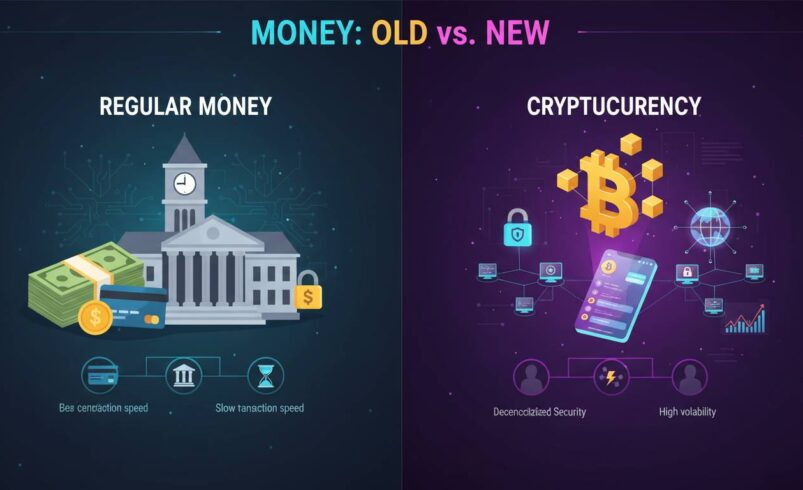

In 2009, someone (or some group) operating under the name Satoshi Nakamoto launched Bitcoin—and the financial world hasn’t been the same since. Most people still don’t understand what cryptocurrency actually is, how it works, or why it matters. That’s a problem, because whether you invest in it or not, digital money is changing how we think about currency itself. This guide breaks down cryptocurrency in plain English and shows you exactly how it differs from the dollars, euros, and yen sitting in your bank account.
What Is Cryptocurrency?
Cryptocurrency is a digital form of money that operates without any central authority like a bank or government. Transactions are recorded on a distributed ledger called a blockchain, which is maintained by a network of computers rather than a single entity. This architecture is what makes cryptocurrency fundamentally different from every other form of money humans have ever created.
The word “cryptocurrency” combines “crypto” (meaning hidden or encrypted) with “currency” (money). The encryption part refers to the cryptographic techniques that secure the network and verify transactions. When you send Bitcoin, the network uses advanced mathematics to confirm the transaction is legitimate without requiring a bank to step in and approve it.
Several characteristics define cryptocurrency:
- Decentralization: No single organization controls the network
- Transparency: All transactions are publicly visible on the blockchain
- Security: Cryptographic encryption makes the system extremely difficult to hack
- Global accessibility: Anyone with an internet connection can use it
- Scarcity: Most cryptocurrencies have a fixed supply cap built into their code
The first and most famous cryptocurrency, Bitcoin, was created as an alternative to traditional money after the 2008 financial crisis. The creator(s) wanted to build a currency that couldn’t be devalued by central banks printing too much of it. Whether that’s actually achieved is debated, but the underlying technology has spawned thousands of other digital currencies, each with different features and purposes.
How Cryptocurrency Works: The Blockchain Explained
Understanding cryptocurrency requires understanding blockchain, the technology that makes it possible. A blockchain is essentially a digital ledger that records every transaction ever made with a particular cryptocurrency. Unlike a bank’s ledger, which lives on centralized servers controlled by that bank, a blockchain is copied onto thousands of computers (called nodes) around the world.
When you send cryptocurrency to someone, your transaction request gets broadcast to the network. Computers on the network, called miners or validators, compete to solve a complex mathematical puzzle. The first one to solve it verifies the transaction and groups it with other recent transactions into a “block.” That block gets added to the chain of previous blocks—hence the name blockchain.
Once a block is added, it’s essentially permanent. Altering any historical transaction would require controlling more than half of the network’s computing power, which is practically impossible for any individual or organization. This immutability is what gives blockchain its security reputation.
Each cryptocurrency holder has a “wallet” identified by a string of letters and numbers—a public address. You also have a private key, which is essentially a password that proves you control the funds in your wallet. If someone gets access to your private key, they can take your cryptocurrency. There’s no bank to call to reverse the transaction.
The system sounds complicated, but for users, it’s actually simpler than traditional banking in some ways. You don’t need to provide identification or pass background checks. You don’t need permission from any institution to create a wallet. You just download software, generate your keys, and you’re ready to send and receive money globally.
How Is Cryptocurrency Different from Regular Money?
The differences between cryptocurrency and regular money—often called “fiat currency” because governments declare it legal tender—run much deeper than physical versus digital. Understanding these differences helps explain both the appeal and the criticism of cryptocurrency.
Control and Authority
Regular money is controlled by central banks and governments. The Federal Reserve in the United States, the European Central Bank, the Bank of Japan—all these institutions have power over how much money exists and how it’s managed. They can raise or lower interest rates, print more money during economic crises, and impose regulations on how you use your funds.
Cryptocurrency has no central authority. No CEO, no government department, no board of directors makes decisions about Bitcoin or Ethereum. Changes to the network require consensus among thousands of participants, which is both a strength and a weakness. It means no single entity can unilaterally decide to freeze your funds or devalue the currency, but it also means the system can be slow to adapt when problems arise.
This decentralization is ideological for many crypto supporters. They see central bank control as inherently suspect, arguing that governments have repeatedly debased currencies throughout history. Whether you agree with that perspective or not, it’s the core philosophical difference driving cryptocurrency adoption.
Transaction Methods
When you pay with regular money, you’re typically using a payment network like Visa or Mastercard, or simply transferring between bank accounts. These transactions often take days to settle, especially for international transfers. They can be reversed if fraud occurs. They reveal your identity to banks and payment processors.
Cryptocurrency transactions typically take minutes to hours, regardless of where in the world you’re sending funds. Once confirmed on the blockchain, they’re irreversible—there’s no chargeback mechanism. They’re also pseudonymous: transactions are linked to wallet addresses, not names, though sophisticated analysis can often trace identities.
For cross-border payments, cryptocurrency has obvious advantages. Sending $500 to someone in another country through a bank might cost $25-50 in fees and take 3-5 business days. Sending the same amount in Bitcoin might cost a few dollars in network fees and arrive within an hour.
Supply and Inflation
Most fiat currencies have no fixed supply limit. Central banks can and do create more money whenever they decide it’s necessary. This is called monetary expansion, and it’s one of the primary tools governments use to manage economies. The trade-off is that increasing the money supply can lead to inflation—your existing money becomes worth less.
Many cryptocurrencies, including Bitcoin, have a fixed supply built into their code. Bitcoin’s supply is capped at 21 million coins, and the network is designed to gradually release new coins until that limit is reached around the year 2140. This scarcity is intentional and mimics precious metals like gold.
The argument from crypto proponents is that fixed-supply currencies can’t be debased by governments printing money. Critics point out that this inflexibility removes important tools for managing economic crises. Both perspectives have merit—this is genuinely one of the unresolved debates in monetary economics.
Security and Transparency
Bank accounts are protected by law, and banks carry insurance (like FDIC coverage in the US) that protects deposits up to certain limits. If a hacker steals from your bank account, you have recourse. Banks employ thousands of security experts and spend billions annually on protecting your money.
Cryptocurrency security works differently. The blockchain itself is extremely secure—the mathematical encryption protecting Bitcoin has never been broken. However, the human element is often the weakest link. If you lose your private key, your money is gone forever. If hackers compromise an exchange where you’ve stored cryptocurrency, you might lose everything with no guarantee of recovery.
The transparency angle cuts both ways. Every cryptocurrency transaction is publicly visible on the blockchain. Law enforcement can trace transactions to fight crime, which advocates see as a feature. But this transparency also means there’s no real financial privacy unless you take elaborate precautions.
What Are the Main Cryptocurrencies?
The cryptocurrency market contains thousands of different digital currencies, but a small number dominate by market value and adoption.
Bitcoin (BTC) remains the largest and most recognized cryptocurrency, often called “digital gold.” It was the first, created in 2009, and now has a market cap exceeding $1 trillion. Its primary use case is as a store of value and decentralized money, though it’s increasingly used for payments as well.
Ethereum (ETH) is the second-largest cryptocurrency and represents a different approach. While Bitcoin is primarily a digital currency, Ethereum is a platform for decentralized applications—software that runs without any central server. Its cryptocurrency, Ether, is used to pay for computing on the network. Ethereum introduced “smart contracts,” which are self-executing agreements that automatically enforce terms when conditions are met.
Beyond these two, dozens of cryptocurrencies serve specific purposes. Tether (USDT) and USD Coin (USDC) are “stablecoins” designed to maintain a fixed value of $1, bridging cryptocurrency with regular money. Solana and Cardano are blockchain platforms competing with Ethereum. XRP is focused on facilitating cross-border payments between banks.
Newer categories have emerged as well. Memecoins like Dogecoin and Shiba Inu began as jokes but have accumulated significant market value. Each carries different risk profiles and use cases, making the ecosystem complex for newcomers.
Is Cryptocurrency Safe to Use?
Safety in cryptocurrency depends heavily on what you mean by “safe.” The underlying technology is secure—blockchains have never been hacked in the way that compromises their fundamental integrity. The risks come from how people interact with cryptocurrency.
Exchange risk is significant. Cryptocurrency exchanges where people buy and sell digital currency have been repeatedly hacked. Mt. Gox, once the largest Bitcoin exchange, collapsed in 2014 after losing 850,000 Bitcoin (worth billions at today’s prices) to hackers. More recently, exchanges like FTX have imploded due to fraud and mismanagement. Keeping large amounts of cryptocurrency on exchanges is genuinely risky.
Personal security is entirely your responsibility. If you store cryptocurrency in a “hot wallet” (software connected to the internet), it’s vulnerable to hackers. “Cold storage” methods like hardware wallets keep your keys offline and are much more secure, but introduce their own risks—you can lose the device or forget your recovery phrase.
Volatility is perhaps the biggest risk for most users. Bitcoin has experienced crashes of 50% or more multiple times in its history. In 2022, the total cryptocurrency market lost approximately $2 trillion in value. If you invest money you can’t afford to lose in cryptocurrency, you’re taking serious financial risk.
Regulatory uncertainty adds another layer of danger. Governments worldwide are still figuring out how to tax, regulate, and control cryptocurrency. Sudden regulatory changes can crash markets overnight.
For most people, cryptocurrency is safest when treated as a high-risk investment or used for specific purposes where its advantages (cross-border transactions, financial privacy) outweigh the risks. Treating cryptocurrency as “easy money” or “the future of finance” without understanding these dangers is a recipe for financial loss.
Can You Convert Cryptocurrency to Cash?
Yes, you can convert cryptocurrency to regular money, and there are several ways to do it.
Cryptocurrency exchanges are the most common method. Platforms like Coinbase, Kraken, and Binance allow you to sell your cryptocurrency for fiat currency (dollars, euros, etc.), which you can then withdraw to your bank account. This process typically takes 1-5 business days depending on the platform and your bank. Most exchanges require identity verification and charge fees ranging from 0.1% to 1% or more per trade.
Peer-to-peer (P2P) platforms connect buyers and sellers directly, sometimes with lower fees. These can be useful in regions where exchanges are restricted or unavailable. However, they require more trust between parties since there’s no intermediary holding funds during the trade.
Bitcoin ATMs exist in many cities worldwide. These machines allow you to insert cash and receive Bitcoin, or vice versa. They’re convenient for small transactions but often charge fees of 5-10% or higher.
Stablecoins offer another pathway. If you want to hold cryptocurrency but avoid volatility, you can convert to a stablecoin like USDC, which maintains a $1 value. Later, you can convert that stablecoin back to regular currency through an exchange.
The ease of converting cryptocurrency to cash has improved dramatically since the early days. However, liquidity varies by cryptocurrency—Bitcoin and Ethereum are easy to sell almost anywhere, while smaller or newer cryptocurrencies may have limited buyers and wide price spreads.
Frequently Asked Questions
What is cryptocurrency in simple terms? Cryptocurrency is digital money that works without banks or governments. Instead of trusting a central authority, it uses cryptography and a distributed network of computers to verify transactions and create new units of currency.
How does cryptocurrency work? Cryptocurrency uses blockchain technology—a decentralized ledger that records every transaction across thousands of computers. When you send crypto, the network verifies the transaction through cryptographic algorithms and adds it to the blockchain permanently.
Is cryptocurrency real money? Cryptocurrency has properties of money: it’s divisible, portable, scarce, and can be used as a medium of exchange. Whether it qualifies as “real” money depends on your definition. Most central banks and economists consider it a digital asset rather than legal tender, though some countries have begun recognizing it as currency.
Can you lose all your money in cryptocurrency? Yes. Cryptocurrency prices are extremely volatile, and there’s no safety net. Exchanges can be hacked or collapse. You can lose access to your wallet if you forget your private keys. Many people have lost significant money investing in cryptocurrency.
Is cryptocurrency anonymous? Partially. Transactions are pseudonymous—linked to wallet addresses rather than names—but sophisticated analysis can often trace identities. Some cryptocurrencies like Monero and Zcash are designed specifically for enhanced privacy.
Conclusion: What This Means for You
Cryptocurrency represents a genuinely new approach to money—one that challenges assumptions we’ve held for centuries about how currency should work and who should control it. The technology behind it is remarkable, and the problems it attempts to solve (financial privacy, cross-border payments, central bank overreach) are real.
But it’s important to be honest: cryptocurrency also carries substantial risks that aren’t always obvious from the hype. Volatility can destroy wealth overnight. Scams are endemic. The lack of consumer protections means you’re largely on your own if something goes wrong. And the “utility” of cryptocurrency for everyday purchases remains limited despite years of development.
Whether cryptocurrency becomes a permanent part of the financial system or eventually fades as a technological dead-end is genuinely uncertain. What’s clear is that understanding it is becoming necessary for anyone who wants to follow the future of money—even if that future turns out to look very different from what today’s advocates predict.