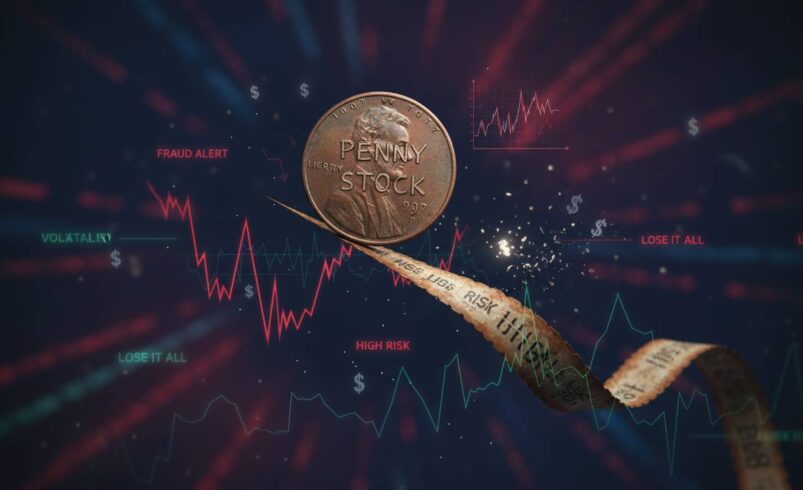

Penny stocks attract investors with their promise of massive returns from a small initial investment. A $500 position in a stock trading at $0.25 can theoretically become worth thousands if the price jumps just a few dollars. That math is seductive, and it’s exactly why the SEC has repeatedly warned that penny stocks destroy more investor wealth than almost any other asset class. Understanding what penny stocks actually are, how they function, and why they demand exceptional caution is essential for anyone considering adding them to a portfolio.
This guide breaks down everything you need to know about penny stocks, from their technical definition to the real-world mechanics that make them extraordinarily risky. You’ll learn why professional investors approach these securities with extreme skepticism, what red flags to watch for, and how to protect yourself if you decide to explore this corner of the market.
Definition and Price Threshold
A penny stock refers to a security that trades at a low price, typically below $5 per share. However, the definition varies depending on who you ask. The Securities and Exchange Commission defines a penny stock as any equity security that trades below $5, except those listed on major exchanges like the New York Stock Exchange or NASDAQ. Most penny stocks trade on over-the-counter markets, including the OTC Bulletin Board and the less regulated Pink Sheets.
The $5 threshold isn’t arbitrary. It represents a regulatory dividing line. Companies listed on major exchanges must meet substantial financial requirements, file regular reports, and maintain certain governance standards. Penny stocks bypass most of these requirements. A company can be technically valid—incorporated, filing basic documents—while providing minimal financial transparency to investors.
Note that “penny stock” describes a price category, not a company size. Some penny stocks represent tiny startups with a few hundred thousand dollars in assets. Others belong to former major companies that have collapsed from their former heights. The common thread is simply the low share price and the absence of listing on a major exchange.
The definition matters because regulatory protections scale with this classification. Rules that require extensive disclosure for $50 stocks often don’t apply to $0.50 stocks. That regulatory gap is intentional—Congress and the SEC have decided that sophisticated investors can handle these securities without the same protections afforded to mainstream investments. Whether that assumption holds up in practice is another question entirely.
How Penny Stocks Trade
Penny stocks don’t trade on centralized exchanges with visible order books and regulated market makers. Instead, they circulate through fragmented dealer networks where buyers and sellers find each other through phone calls, electronic communication networks, and broker-dealer platforms. This structure creates significant friction in the trading process.
When you place an order to buy a penny stock, your broker may not immediately find a matching seller. Instead, the broker might fill your order from their own inventory or search for a counterparty willing to take the other side. This dealer intermediary role means you’re rarely seeing the true supply and demand for a security—you see whatever price your broker offers.
The lack of a centralized exchange also means price discovery is weak. In Apple stock, millions of shares trade daily, creating a price that reflects collective investor judgment about the company’s value. In a penny stock trading 10,000 shares per day, a single large purchase can move the price dramatically. That volatility works both ways—a sudden selling pressure can crush the price just as quickly as buying can inflate it.
Trading hours can also differ from mainstream stocks. While most major exchanges operate from 9:30 AM to 4 PM Eastern, some penny stock activity extends outside these windows. Early morning and after-hours trading in these securities tends to be even thinner and more volatile than regular sessions.
The practical result is that executing a trade in a penny stock can be surprisingly difficult. You might place an order at a certain price and find it executes at a significantly different price due to slippage—the difference between your expected price and the actual execution price. In fast-moving markets, this gap can be substantial.
Key Characteristics That Define Penny Stocks
Beyond the low price, several characteristics distinguish penny stocks from their more established counterparts. Understanding these features is crucial because they directly impact your ability to exit positions, assess value, and avoid fraud.
Liquidity is perhaps the most critical difference. A stock like Microsoft trades millions of shares daily—you can buy or sell almost instantly at the quoted price. Many penny stocks trade mere thousands of shares per day, and some barely register activity for weeks. This illiquidity means you might hold a position you cannot easily sell. When you finally find a buyer, they may offer substantially less than the last traded price.
Transparency is dramatically reduced. Major exchange companies must file quarterly and annual reports, disclose material events, and maintain audited financial statements. Penny stock companies may provide minimal information, file reports late or not at all, and operate with little oversight. Researching these companies is notoriously difficult because the data simply doesn’t exist in reliable form.
Volatility is endemic. While all stocks fluctuate, penny stocks experience extreme price swings that can happen in hours or even minutes. A stock that doubles in a day can lose half its value the next. This volatility isn’t necessarily driven by news or fundamentals—often it’s simply the result of thin trading creating disproportionate price movements from small transaction volumes.
The shareholder base tends to be concentrated. Unlike Apple or Amazon, where millions of shareholders spread ownership, penny stocks often have a small group of holders controlling most shares. This concentration creates opportunities for manipulation—when a few large holders coordinate buying or selling, they can move prices dramatically for their own benefit.
Bid-ask spreads are notoriously wide. The bid is what buyers are willing to pay; the ask is what sellers want. In liquid stocks, this difference might be pennies. In penny stocks, the spread can represent 10% or more of the share price. That means you’re starting at a significant disadvantage just to enter the position.
High Volatility Risk
The price movements in penny stocks aren’t merely larger than those in mainstream stocks—they’re qualitatively different. In a $50 stock, a 5% move is notable. In a $0.50 stock, a 50% move can happen on ordinary trading volume with no particular news catalyst.
Consider a hypothetical example. A company announces it has received regulatory approval for a product. Its $0.75 stock might jump to $1.25—an extraordinary 67% gain. But that same announcement could trigger profit-taking the following day, sending the stock back to $0.80. Someone who bought at $0.75 and sold at $0.80 made modest gains. Someone who bought at $1.10 during the peak would be sitting on a loss.
This volatility is particularly dangerous because it creates false signals. Traders who see a stock jumping 30% in an hour might assume they’re witnessing a genuine opportunity. Often, they’re watching the natural oscillation of an illiquid market where small trades create large percentage moves. Chasing these moves frequently leads to buying at the top.
The psychological toll compounds the financial risk. Watching a position swing 20% in either direction within hours triggers emotional decision-making. Investors end up buying out of greed when prices rise and selling out of fear when they fall—exactly the opposite of sound strategy. Professional traders develop strict rules to manage this psychological pressure, but individual investors rarely have such discipline.
Liquidity Concerns
The inability to exit a position is perhaps the most underappreciated risk in penny stocks. When you own shares of Apple, you can sell within seconds at the market price. When you own shares of a thinly traded penny stock, finding a buyer can take days or weeks—and you may need to accept a significant discount to attract interest.
This illiquidity creates a trap. Imagine you bought 10,000 shares at $1.00, investing $10,000. The stock briefly touched $1.50, and you’re sitting on potential gains. But when you try to sell, you discover that only 500 shares trade daily on average. You can either wait indefinitely for a buyer or slash your price to attract more urgent buyers. In practice, many investors end up holding positions they can only exit at substantial losses.
Market makers—the firms that facilitate trading in securities—often refuse to make markets in thinly traded penny stocks. Without a market maker, there’s no guarantee you can execute a trade at any price. Your broker might tell you there’s no buyer for your shares at any reasonable price.
The flash crash phenomenon is particularly relevant here. In March 2024, several micro-cap stocks experienced sudden crashes where prices dropped 90% or more within minutes. Investors who thought they could exit at the pre-crash price discovered there was simply no buyer at any price. Their holdings became effectively worthless overnight.
This isn’t hypothetical. It’s a structural feature of markets for low-priced, thinly traded securities. If you cannot tolerate the possibility that your entire investment might become unsellable, penny stocks are not appropriate for your portfolio.
Fraud Risks in the Penny Stock Space
The SEC has repeatedly identified penny stocks as one of the most prevalent venues for investment fraud. The combination of low regulatory oversight, unsophisticated investors, and opaque company operations creates an environment where bad actors thrive.
Pump and dump schemes remain the most common manipulation. Here’s how it works: Coordinated traders accumulate positions in a penny stock quietly. They then spread positive rumors—through spam emails, social media posts, or paid promotional articles—creating buzz about an “undiscovered gem.” As the price rises on this artificial demand, they sell their positions at the peak, leaving later buyers holding losses when the price collapses.
The promotional ecosystem actively enables these schemes. Numerous websites and newsletters exist specifically to promote penny stocks, often without adequately disclosing that they’re being paid for their coverage. A “free” recommendation to buy a stock at $0.80 might follow a press release that cost the company $50,000 in promotional fees. By the time retail investors see the promotion, the people who arranged it are often already selling.
Other fraud patterns include phantom companies that exist only on paper, management teams with histories of fraud or regulatory sanctions, and “boiler room” operations where brokers use high-pressure sales tactics to move unsuitable securities. FINRA maintains a list of penny stock companies with disciplinary histories, but cross-referencing every potential investment against this database is time-consuming and imperfect.
The boiler room tactic deserves specific attention. Investors have reported receiving unsolicited calls urging immediate purchase of “the next big penny stock opportunity.” These callers often use scripted pitches, create false urgency, and provide little time for due diligence. Legitimate investment opportunities don’t require immediate decisions. When someone pressures you to buy immediately, that’s often a sign something is wrong.
Limited Information Available
Researching a penny stock company is fundamentally different from researching Microsoft or Amazon. For major companies, you can access audited financial statements, analyst reports, conference call transcripts, and years of historical data. For many penny stock companies, the information available is sparse at best.
Companies trading on the OTCBB must file reports with the SEC if they have more than $10 million in assets or 500+ shareholders, but compliance is inconsistent. Some companies file reports late; others stop filing entirely while continuing to trade. The SEC’s EDGAR database might show a company’s last financial statement from two years ago, making meaningful analysis impossible.
Even when financial data exists, quality is suspect. Audit standards for penny stock companies are often minimal or nonexistent. A company might report “revenue” that consists of related-party transactions with no genuine business purpose. Balance sheets might include assets valued at management’s discretion with little basis in market reality.
News coverage is similarly limited. Major financial media ignore penny stocks almost entirely. What coverage exists often comes from the promotional services mentioned earlier—websites paid to generate enthusiasm rather than objective analysis. Separating legitimate information from paid promotion requires substantial effort and skepticism.
This information void makes valuation essentially impossible. In traditional investing, you compare a stock’s price to earnings, revenue, assets, or growth metrics to determine whether it’s overvalued or undervalued. When a company doesn’t provide reliable numbers, or when those numbers might be fabricated, you cannot make an informed decision. You’re essentially gambling rather than investing.
Examples of Penny Stock Pitfalls
Real-world examples illustrate how these risks materialize. The case of a company called ZZZZZ Best became a classic fraud case study. In the 1980s, the company claimed to be a restoration business with lucrative contracts. It raised millions from investors, including funds from a prominent investment bank. The entire business was fictional—a Ponzi scheme built on fake insurance claims and fabricated documents. When the truth emerged, investors lost virtually everything.
More recently, the pharmaceutical sector has seen repeated penny stock fraud. Companies announce seemingly promising drug trial results, stock prices spike on the news, and insiders sell positions before the market realizes the results were exaggerated, falsified, or misrepresented. Retail investors who bought at the peak are left with holdings that subsequently collapse.
The cryptocurrency exchange collapse in 2022 offers a modern parallel. While not penny stocks per se, many of the associated tokens traded at penny-level prices. The lesson is similar: when regulatory oversight is minimal and investor enthusiasm is high, fraud flourishes. Billions were lost by investors who assumed that because something traded on an exchange, it must be legitimate.
Perhaps most instructive are the quiet losses—the thousands of investors who buy penny stocks that simply fade away over months or years. No fraud, no dramatic collapse, just gradual decline as the company burns through cash without ever generating meaningful revenue. The stock drifts from $0.50 to $0.30 to $0.10 to nothing. Investors never get a clear explanation because there’s often nothing to explain—the company simply failed.
Tips for If You Choose to Invest
Given all these risks, a reasonable person might conclude that penny stocks should be avoided entirely. That’s actually sound advice for most investors. However, some individuals may still choose to allocate a small portion of their portfolio to this asset class. If you fall into that category, following these guidelines won’t eliminate risk but will reduce some of the most obvious dangers.
Allocate only money you can afford to lose entirely. This isn’t hyperbole—treat every penny stock investment as if it could go to zero. If losing the full amount would materially impact your financial situation, the investment is inappropriate regardless of potential returns.
Use a specialized broker that provides proper execution and reporting. Not all brokerage firms handle penny stock orders equivalently. Look for firms with experience in micro-cap stocks, transparent pricing, and clear confirmation of your trades.
Research the company extensively before buying. Search for SEC filings on EDGAR, review any news coverage from legitimate sources, check FINRA’s disciplinary database for the company and its management, and look for red flags like frequent stock promotions or management turnover.
Understand exactly where your order will execute. Use limit orders rather than market orders to control your entry price. Be realistic about the bid-ask spread and factor that cost into your expected returns.
Never follow hot tips or promotional recommendations. If someone is actively promoting a stock to you, they’ve likely already bought their position and are looking to sell into the enthusiasm you’re generating. This isn’t always true, but it’s true often enough that following promotions is essentially borrowing trouble.
Consider position sizing strictly. A common rule among those who trade penny stocks is to never allocate more than 1-2% of your portfolio to any single position. This limits the damage from total losses while preserving upside potential.
Conclusion
Penny stocks occupy a legitimate but dangerous corner of the financial markets. They’re not inherently scams—some companies genuinely attempt to build businesses and create shareholder value at low price points. But the structural features that define this market segment—limited liquidity, reduced transparency, thin trading, and minimal regulatory oversight—combine to create an environment where the odds systematically favor sophisticated players over individual investors.
The question isn’t really whether you should invest in penny stocks. For most people, the answer is a clear no. The more useful question is what to do when you encounter them: whether in a colleague’s excitement about a “sure thing,” a promotional email promising explosive gains, or a Reddit thread about the next big opportunity. Understanding the risks outlined here gives you the framework to evaluate those situations honestly.
If you do decide to explore this space, approach it with the same rigor you’d apply to any high-risk activity. Assume you’ll lose money on most positions. Research relentlessly. Size positions to survive total failure. And remember that the investors making the loudest profits are often the ones whose gains came from selling to someone just like you—someone who saw the same opportunity and arrived slightly too late.