
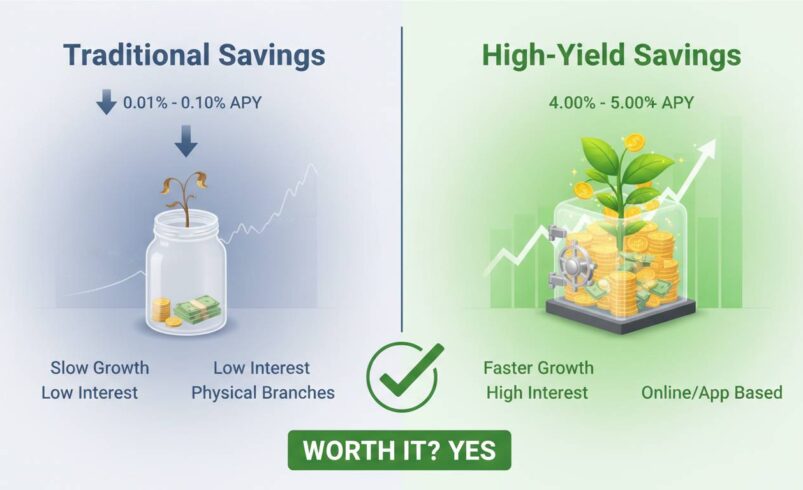

The best high-yield savings accounts now offer annual percentage yields (APYs) in the 4.00% to 5.00% range—a dramatic contrast to the 0.01% or 0.02% that most traditional brick-and-mortar banks pay on standard savings accounts. If you’re still letting your emergency fund or savings goals languish in an account earning nearly nothing, you’re leaving hundreds of dollars on the table every year. This isn’t financial hyperbole; it’s simple arithmetic.
High-yield savings accounts have become one of the most practical tools for Americans who want to grow their cash without accepting investment risk. But they come with trade-offs that deserve honest examination before you move your money. This guide explains how these accounts work, where the catches actually are, and whether opening one makes sense for your financial situation.
What Is a High-Yield Savings Account?
A high-yield savings account is a type of savings account that earns a significantly higher interest rate than a traditional savings account. The difference is substantial: while the national average savings rate hovers around 0.45% APY at traditional banks, the best high-yield accounts consistently offer rates that are 10 to 20 times higher. As of early 2025, competitive high-yield savings accounts are advertising APYs between 4.00% and 5.25%, though these rates fluctuate based on the Federal Reserve’s monetary policy and each bank’s own funding needs.
The mechanics work identically to a regular savings account. You deposit money, earn interest on your balance, and can withdraw funds—though federal regulations limit you to six convenient withdrawals or transfers per statement cycle. The critical difference is that your money grows considerably faster.
These accounts are typically offered by online banks and credit unions that operate with lower overhead costs than their branch-based competitors. Without the expense of maintaining physical locations, these institutions can pass the savings along to customers in the form of higher interest rates. Some of the most well-known providers include Marcus by Goldman Sachs, Ally Bank, Synchrony Bank, and various credit unions that have expanded their membership beyond local communities.
One thing to know: “high-yield” is a relative term. What qualifies as high-yield changes as interest rates rise and fall. An account paying 3.00% would have been considered excellent in 2021 but would be underwhelming today. The key insight is that these accounts use variable rates, meaning the APY you see today isn’t locked in forever.
How Does a High-Yield Savings Account Work?
The fundamental mechanism is straightforward: you deposit money, and the bank pays you interest expressed as an annual percentage yield. This interest compounds, meaning you earn interest on your interest—a powerful effect that accelerates your money’s growth over time.
Most high-yield savings accounts compound interest daily or monthly, then credit it to your account monthly. To understand why this matters, consider the difference between simple and compound interest. If you deposited $10,000 in an account earning 4.50% APY, you wouldn’t simply multiply $10,000 by 0.045 to get $450 in a year. Instead, you’d earn interest on your growing balance throughout the year, resulting in approximately $460 in interest by year’s end—a meaningful difference that grows more pronounced over longer time horizons.
The interest rate itself is variable, which is the most important characteristic to understand about these accounts. Unlike certificates of deposit (CDs), which lock in a rate for a specified term, high-yield savings accounts can change their APY at any time. When the Federal Reserve adjusts the federal funds rate, banks typically respond by adjusting their savings rates within days or weeks. This means if rates fall, your earnings will decrease. Conversely, when rates rise, your APY will likely increase.
Accessing your funds is relatively easy, though not as flexible as a checking account. Federal Regulation D historically limited savings account withdrawals to six per cycle, and while this enforcement has softened, many banks still impose the restriction or charge fees for exceeding it. The practical implication is that a high-yield savings account works best for money you don’t need immediate, daily access to—such as an emergency fund, down payment savings, or goals you’re working toward over the next several months or years.
Pros of High-Yield Savings Accounts
The primary advantage is mathematically undeniable: significantly higher interest earnings. If you have $25,000 in savings, the difference between earning 0.01% and 4.50% amounts to approximately $1,122 in interest over a single year. That’s money working for you with zero effort, no market risk, and no expertise required. Over five years, assuming rates remain reasonably stable, you’re looking at nearly $6,000 in extra growth compared to a typical traditional savings account.
FDIC insurance provides peace of mind that investments cannot match. Every dollar in a high-yield savings account at an FDIC-insured institution is protected up to $250,000 per depositor, per account ownership category. This guarantee, backed by the full faith and credit of the U.S. government, means your principal is absolutely safe regardless of what happens in the financial markets. You cannot say the same about stocks, bonds, or mutual funds.
The account opening process has become remarkably convenient. Most online banks allow you to fund your account within minutes using a mobile app or website, with transfers from your existing bank typically completing within one to three business days. There are no branches to visit, no business hours to worry about, and most institutions offer robust mobile banking with features like goal tracking and automatic savings rules.
Fee structures at the best high-yield savings accounts are minimal or nonexistent. Unlike traditional banks that often charge monthly maintenance fees ranging from $5 to $25 (and sometimes charge you extra if your balance falls below a minimum threshold), most high-yield accounts charge no monthly fees and require no minimum balance. This matters because fees at a traditional bank can effectively erase your interest earnings entirely.
Cons and Drawbacks to Consider
The variable rate structure cuts both ways. While you’ve benefited from the recent rate increases that made high-yield accounts attractive, there’s no guarantee these rates will persist. If inflation moderates and the Federal Reserve cuts rates, your APY will likely decline—potentially to levels that are less compelling. You should not open a high-yield savings account assuming today’s 4.50% or 5.00% rates will last forever. They won’t.
Online banks can feel impersonal if you prefer in-person banking relationships. If you value walking into a branch and speaking with a banker face-to-face, or if you prefer handling cash deposits directly, an online-only institution may feel uncomfortable. While some online banks accept cash deposits through partner networks (like ATMs or retail locations), the process is less convenient than branch banking.
The six-withdrawal limit can create genuine friction. If you’re using your savings for regular expenses or need to move money frequently, the federal transaction limit can become constraining. While you can technically withdraw more by visiting a branch or using an ATM, doing so regularly defeats the purpose of having the money in a savings vehicle in the first place.
Some accounts come with promotional rates that expire. A bank might advertise 5.25% APY but bury in the fine print that this rate applies only for the first three or six months, after which it drops to a considerably lower “standard” rate. Always read the account agreement carefully and understand what your ongoing rate will be after any promotional period ends.
Is a High-Yield Savings Account Worth It?
For most Americans with savings they don’t need for daily expenses, the answer is a qualified yes—and the qualification matters less than you might think.
The people who benefit most from high-yield savings accounts include anyone building or maintaining an emergency fund. If you’re working toward three to six months of living expenses in a safety net, keeping that money in an account earning 4.50% rather than 0.02% can add hundreds or thousands of dollars to your balance over just a few years without adding any risk.
Savers accumulating for specific goals—weddings, home down payments, vacations, major purchases—also benefit enormously. The money grows faster while you save, and because you have a defined timeline, the variable rate concern is less pressing. You’re not locking this money away for decades; you’re using it within a known timeframe.
Here’s a concrete example: suppose you’re saving $500 per month for a wedding two years away. At 0.02% APY, you’d have approximately $12,002 after 24 months. At 4.50% APY, you’d have approximately $12,566—an extra $564 for doing nothing differently except choosing a better account. That’s a meaningful amount of money for most households.
The only scenario where a high-yield savings account makes less sense is if you’re pursuing long-term wealth building where compound growth over decades matters. In that case, investments with higher expected returns (and correspondingly higher risk) would likely serve you better. But for money you need to access within the next several years, or money you cannot afford to risk, high-yield savings accounts represent the optimal balance of growth and safety.
Here’s an honest admission: the actual dollar difference in many cases won’t transform your financial life. If you have $2,000 in savings, the difference in interest between a traditional account and a high-yield account might be $90 per year—not nothing, but not life-changing either. The real value proposition becomes compelling when you’re saving substantial sums: $25,000, $50,000, or more. At those balances, the interest difference becomes genuinely significant.
How to Choose the Right High-Yield Savings Account
Don’t simply chase the highest advertised APY. That’s a common mistake that can cost you money.
Start by looking at the ongoing rate, not the promotional rate. Many banks advertise an attractive rate that applies only for a limited time—often three to six months—before dropping to a considerably lower figure. Check the bank’s current “standard” or “base” APY, which should be clearly disclosed in the account details.
Examine the fee schedule with the same scrutiny. Even though most high-yield accounts promote themselves as fee-free, some impose charges for wire transfers, excessive withdrawals, or account closure within a short period of opening. These fees are typically small but can add up or create headaches if you need to move your money.
Consider the institution’s stability and reputation. The accounts discussed here are FDIC-insured, so your deposits are protected up to $250,000 regardless of the bank’s financial health. However, dealing with a struggling bank can still create complications if the institution is acquired, undergoes a rebranding, or experiences service disruptions. Established online banks like Marcus, Ally, and Discover generally offer the most reliable experience.
Evaluate the mobile and online experience, particularly if you’re comfortable with technology. The best high-yield savings accounts offer intuitive apps, easy fund transfers, and useful features like sub-accounts for different savings goals. If you’re less comfortable with digital banking, look for an institution that offers strong customer service options, including phone support.
Current High-Yield Savings Account Rates
Rates vary significantly across institutions and change frequently based on economic conditions. The following table illustrates the types of rates available as of early 2025:
| Institution | Approximate APY | Notes |
|---|---|---|
| Marcus by Goldman Sachs | 4.40% | No fees, no minimums |
| Ally Bank | 4.25% | Extensive mobile features |
| Synchrony Bank | 4.75% | Strong promotional offers |
| Discover Bank | 4.30% | No monthly fees |
| Capital One 360 | 4.35% | Extensive ATM network |
| Various Credit Unions | 4.50% – 5.25% | Membership may be required |
These rates are illustrative and subject to change. The most accurate approach is to check current rates directly with each institution before opening an account. Rate comparison websites like Bankrate and NerdWallet maintain regularly updated lists of competitive rates.
One thing to understand: the difference between a 4.30% account and a 4.80% account matters less than you might expect. On a $10,000 balance, that’s only $50 per year. Instead of obsessing over the highest possible rate, focus on finding an account with a competitive rate, minimal fees, and a user experience you find comfortable.
High-Yield Savings Account FAQs
Are high-yield savings accounts safe?
Yes, if the institution is FDIC-insured—which virtually all reputable high-yield savings accounts are. The Federal Deposit Insurance Corporation protects your deposits up to $250,000 per depositor, per account type, at each insured institution. This protection means you won’t lose your principal even if the bank fails. Simply confirm that the institution displays the FDIC logo and that your deposits fall within the insurance limits.
How much can I put in a high-yield savings account?
There’s no legal maximum you can deposit in a high-yield savings account. However, FDIC insurance covers only up to $250,000 per depositor, per institution, per ownership category. If you need to deposit more than that amount, you can open accounts at multiple FDIC-insured institutions or use different account ownership types (individual, joint, retirement) to maximize your coverage.
Do I pay taxes on high-yield savings account interest?
Yes, interest you earn from a high-yield savings account is taxable income. The bank will send you a Form 1099-INT at the end of each year if you earned $10 or more in interest. This interest must be reported on your federal and state tax returns. The tax treatment is identical to interest from a traditional savings account—the only difference is the amount you’ll receive.
What’s the catch with high-yield savings accounts?
The honest answer is that there isn’t a dramatic catch, which is precisely why these accounts have become so popular. The trade-offs are relatively minor: variable rates (which can decrease), limited withdrawal flexibility (six per cycle), and the absence of in-person banking (if you prefer that). The “catch” that does exist is that these accounts require you to be comfortable with digital banking and understand that today’s attractive rates will eventually decline when interest rate conditions change.
Conclusion
High-yield savings accounts represent one of the simplest, most effective ways to increase your savings returns without accepting investment risk. For emergency funds, short-term savings goals, and cash you’re accumulating for major purchases, they’re clearly worth using. The gap between earning 0.02% and 4.50% on your money is too large to ignore.
That said, these accounts aren’t a complete wealth-building solution. They won’t help you retire early or fund a child’s college education decades in advance. For those goals, you’ll need investment vehicles with higher expected returns—even though they come with the possibility of loss. The smart approach is to use high-yield savings accounts for what they do well: providing safe, accessible, higher-yielding storage for money you need to keep liquid.
The one unresolved question worth sitting with is how banks will compete for your deposits when interest rates eventually fall from their current elevated levels. Some institutions may find ways to maintain competitive rates through improved efficiency; others may let their rates drift down while hoping customers don’t notice. Your job as a saver is simple: periodically reassess where your cash is sitting, compare it to what’s available, and move your money accordingly. The days of accepting near-zero interest on savings are over—and that’s a change worth embracing.