

Most people understand that stocks can make money through price appreciation, but there’s another way companies return value to shareholders: dividends. If you’ve ever wondered why some stocks consistently appear in retirement portfolios or how Warren Buffett’s Berkshire Hathaway has paid shareholders for decades, you’re looking at dividends. This guide walks through everything you need to know about how dividends work, why companies pay them, and how to evaluate whether dividend stocks belong in your portfolio.
What Is a Dividend?
A dividend is a payment made by a corporation to its shareholders, typically as a distribution of profits. When a company earns money and decides it doesn’t need to reinvest all of those profits back into the business, it can share a portion of those earnings directly with the people who own its stock.
Here’s how this works in practice. Imagine Company XYZ earns $10 million in profit during a quarter. After paying taxes and setting aside money for operations and growth, the company’s leadership decides there’s $2 million left over. Rather than letting that cash sit on the balance sheet, they approve a dividend payment. If the company has 1 million shares outstanding, that $2 million translates to $2 per share in dividends. If you own 100 shares of Company XYZ, you receive $200.
This is different from capital gains, which require you to sell your shares to realize profits. Dividends put actual cash in your hands (or more commonly today, into your brokerage account) while you continue holding your shares. That’s why income-focused investors, particularly retirees, gravitate toward dividend-paying stocks.
Not all companies pay dividends. Growth-oriented companies like Amazon or Tesla have historically reinvested all their profits back into the business rather than distributing cash to shareholders. This isn’t necessarily a sign of weakness—it often means the company sees opportunities to grow faster than it could by paying out cash. Meanwhile, established companies in mature industries like utilities, consumer staples, and banks are more likely to pay consistent dividends because they generate more cash than they can profitably reinvest.
How Do Dividends Work?
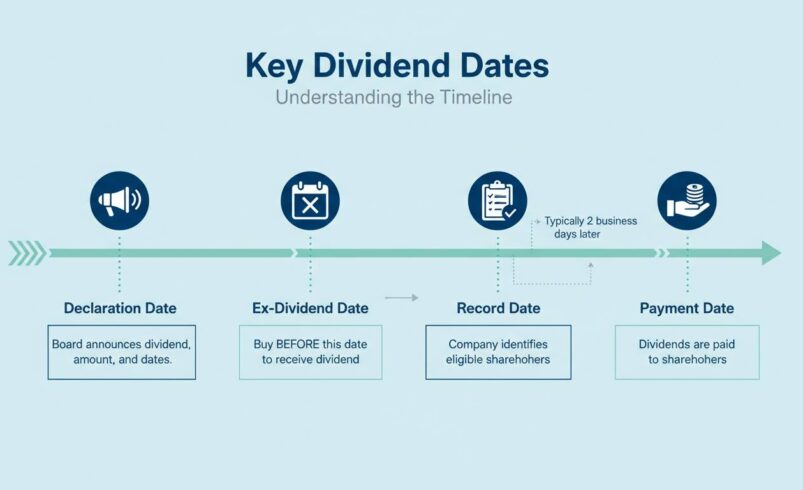
The dividend payment process follows a specific timeline that every investor should understand. Companies don’t just wake up one day and send out payments—there are several key dates that determine who receives what.
First comes the declaration date, when the company’s board of directors officially announces the dividend. This announcement includes the amount per share, the payment date, and a record date determining which shareholders are eligible to receive the payment.
The ex-dividend date is arguably the most critical date for investors. If you purchase shares on or after this date, you won’t receive the upcoming dividend. This is why dividend investors pay close attention to ex-dividend dates—a stock often drops by approximately the dividend amount on this date, because buyers understand they won’t collect the payment.
The record date is when the company reviews its books to identify eligible shareholders. This typically falls one business day after the ex-dividend date.
Finally, the payment date is when the money actually reaches shareholder accounts. This usually comes two to four weeks after the declaration date.
Here’s a concrete example. On January 15, Company ABC declares a quarterly dividend of $0.50 per share, with a record date of February 1 and a payment date of February 15. The ex-dividend date would be set one business day before the record date—so likely January 30. If you owned shares on January 29, you receive the $0.50 dividend. If you bought on January 30 or later, the seller gets the dividend instead.
Understanding this timing matters because dividend capture strategies attempt to buy shares just before the ex-dividend date and sell immediately after. In practice, this rarely works as intended because the stock price drops by roughly the dividend amount on the ex-dividend date, erasing any advantage.
Types of Dividends
While most people think of cash when they hear “dividend,” companies actually have several ways to distribute value to shareholders.
Cash dividends are exactly what they sound like—a direct payment in dollars. This is the most common form and what most brokerage accounts show when tracking dividend income. Cash dividends can be paid quarterly, monthly, semi-annually, or annually depending on the company.
Stock dividends involve issuing additional shares to shareholders instead of cash. If a company declares a 5% stock dividend and you own 100 shares, you receive 5 additional shares. This doesn’t change your ownership percentage—the company simply splits the pie into more pieces. Stock dividends are more common among companies wanting to preserve cash while still returning value to shareholders.
Property dividends are rarer and involve distributing physical assets or securities of another company. A holding company might distribute shares of a subsidiary company to its shareholders rather than selling that subsidiary and distributing cash.
Scrip dividends give shareholders the option to receive cash or additional shares. This provides flexibility while giving the company options around cash management.
For most individual investors, cash dividends are what matter. The key distinction worth understanding is between qualified dividends and ordinary dividends for tax purposes, which I cover later in this guide.
How to Earn Dividends
Earning dividends requires owning dividend-paying stocks. The process is straightforward: open a brokerage account, purchase shares of a company that pays dividends, and hold those shares through the ex-dividend date.
But there’s more strategy involved than simply buying any dividend stock. Understanding the difference between dividend yield and dividend growth helps investors make better decisions.
The dividend yield tells you how much a company pays in dividends relative to its stock price. A stock trading at $100 that pays $4 annually has a 4% yield. Comparing yields across stocks helps you understand the income potential, but yield alone is misleading—very high yields sometimes signal that the market expects the dividend to be cut.
Dividend growth matters equally, perhaps more so. A company paying $1 per share today that grows its dividend to $2 over ten years provides increasing income even if its yield percentage stays constant. This growth compounds over time, which is why dividend growth strategies have historically outperformed high-yield strategies over long periods.
Dividend reinvestment plans (DRIPs) allow you to automatically use dividend payments to purchase additional shares. Many brokerage firms offer this functionality. When a company pays you $100 in dividends, rather than receiving cash, your brokerage automatically uses that $100 to buy more shares—often fractional shares—at the current price. Over decades, this reinvestment compounds dramatically. The S&P 500 has returned roughly 10% annually over long periods, and reinvesting dividends accounts for a significant portion of that return.
Let me show you the math on reinvestment. Suppose you invest $10,000 in a stock with a 3% dividend yield. In year one, you receive $300 in dividends. If you reinvest that $300 and the stock price stays flat, you now own $10,300 worth of stock. Year two’s dividend is 3% of $10,300, or $309. Year three: $318. After 20 years without any price appreciation, your investment has grown to about $18,060 from dividend reinvestment alone. Add even modest stock price growth, and the numbers become more compelling.
Dividend Yield Explained
Dividend yield is calculated by dividing the annual dividend per share by the stock price per share, then multiplying by 100 to get a percentage. If Company A pays $2 per share annually and trades at $50, the yield is ($2 ÷ $50) × 100 = 4%.
This calculation seems simple, but investors frequently misinterpret yield. Here’s what you need to know.
High yields aren’t always good. A stock trading at $20 that pays $4 annually has a 20% yield—but that yield might exist because the stock price collapsed from $100 to $20, and the $4 dividend may be unsustainable. Companies that slash dividends see their stock prices plummet, leaving income investors worse off than before.
A “good” yield depends on context. As of early 2025, the S&P 500 average dividend yield hovers around 1.4%. Utility companies often yield 3-5%, while riskier REITs might yield 6% or more. A “good” yield is one that the company can sustainably maintain while continuing to grow. A utility with a 4% yield and a 60-year history of paying and growing dividends is often a better income investment than a REIT with a 9% yield and a spotty track record.
Yield on cost measures your original purchase price against current dividends. If you bought Apple at $10 per share decades ago, your yield on cost on a $0.96 annual dividend is nearly 10%—even though the current yield based on today’s price is under 1%. This is why long-term dividend investors emphasize buying quality companies and holding them.
The yield trap catches investors who chase high yields without understanding the underlying business. A bank stock yielding 8% might be pricing in expected loan losses. A retailer’s 7% yield might reflect a dying business model. Always investigate why a yield is high before buying.
Key Dates Every Dividend Investor Should Know
Beyond the ex-dividend date I covered earlier, understanding these four dates helps you time purchases and avoid mistakes:
The declaration date is when the company announces the dividend amount. This is public information, and the stock price often moves slightly on this announcement, particularly if the dividend is higher or lower than expected.
The ex-dividend date is the cutoff. To receive the dividend, you must own the stock before this date. The stock typically falls by approximately the dividend amount on this date, reflecting that new buyers won’t receive the payment.
The record date is when the company determines exactly who receives the dividend. This is typically one business day after the ex-dividend date.
The payment date is when money actually arrives in your account. This can be weeks after the ex-dividend date.
These dates matter most for income-focused investors building positions. If you need the dividend payment to arrive in March, you need to own the stock before the February ex-dividend date.
Tax Implications of Dividends
Dividends receive different tax treatment depending on whether they’re classified as qualified or ordinary.
Qualified dividends are taxed at the lower capital gains rates—0%, 15%, or 20% depending on your income level. To qualify, the dividend must come from a U.S. corporation or a qualified foreign corporation, and you must hold the stock for more than 60 days during the 121-day period surrounding the ex-dividend date.
Ordinary dividends are taxed at your regular income tax rate. These include dividends from REITs, master limited partnerships (MLPs), and certain foreign corporations.
Most dividends from U.S. large-cap stocks that you’ve held for more than 60 days qualify as qualified dividends. This is one reason dividend investing is particularly tax-efficient—you’re often paying 15% or less on dividend income rather than your marginal income tax rate, which could be 32%, 35%, or 37%.
One more nuance: dividend reinvestment creates a tax liability even if you never received cash. When your brokerage uses dividends to buy more shares, that’s a taxable event (except in tax-advantaged accounts like IRAs or 401(k)s). In taxable accounts, DRIPs generate ongoing tax obligations.
This is why holding dividend stocks in tax-advantaged accounts makes sense for most investors. Your IRA or 401(k) can grow tax-deferred regardless of whether you receive dividends or reinvest them.
Common Questions About Dividend Stocks
Are dividend stocks worth it?
Dividend stocks can be worth it for investors seeking income or wanting to reduce portfolio volatility. Historically, dividend-paying stocks have shown lower volatility than non-dividend payers, and dividend growth strategies have delivered competitive returns. However, dividend stocks aren’t universally superior—the highest-growth technology companies often don’t pay dividends because they reinvest profits for growth. Whether dividend stocks make sense depends on your income needs, time horizon, and overall portfolio strategy.
How often are dividends paid?
Most U.S. companies pay quarterly dividends—four times per year. Some pay monthly, particularly real estate investment trusts (REITs) and some utility companies. A smaller number pay semi-annually or annually. The payment frequency matters less than the total annual yield and the company’s commitment to maintaining or growing the dividend.
What is a good dividend yield?
A “good” dividend yield depends on the sector and the company’s sustainability. The S&P 500 average yield of around 1.4% represents a reasonable baseline. Utilities and consumer staples often yield 3-4% with stable businesses. REITs commonly yield 5-8% but carry specific risks. The key isn’t the yield percentage alone—it’s whether the company can maintain that yield while continuing operating profitably.
Do dividend stocks still pay during market downturns?
Companies that have paid dividends through multiple economic cycles tend to maintain payments during downturns, though no guarantee exists. During the 2008 financial crisis and the 2020 pandemic, several companies cut or suspended dividends. Blue-chip dividend stocks with strong balance sheets, like Johnson & Johnson or Procter & Gamble, have paid uninterrupted dividends for over 50 years—even through recessions. The lesson: not all dividend stocks are created equal. Prioritize companies with long dividend histories and sustainable payout ratios.
Building a Dividend Strategy
Understanding dividends is one thing; building them into an investment strategy requires additional decisions.
Dividend growth investing focuses on companies that consistently increase their dividends year after year. These companies tend to be profitable, well-managed, and in stable industries. The idea is that a 3% yield today that grows to 6% or 10% over decades provides escalating income without requiring you to take on more risk. Companies like Coca-Cola, Johnson & Johnson, and Microsoft have increased dividends for 50+ consecutive years.
High-yield investing focuses on maximum current income, accepting higher risk in exchange. This approach requires careful research—yield often correlates inversely with company health. Many high-yield ETFs focus on specific sectors like utilities, REITs, or financials.
Index fund investing provides broad dividend exposure without picking individual stocks. Funds like the Vanguard Dividend Appreciation ETF (VIG) or iShares Select Dividend ETF (DVY) offer diversified exposure to dividend-paying companies. This approach reduces company-specific risk while capturing the dividend market’s returns.
The best approach depends on your income needs, risk tolerance, and investment knowledge. For most beginning investors, a low-cost dividend index fund provides excellent diversification and consistent income without requiring extensive research into individual companies.
The reality is that dividend investing isn’t a magic formula—it requires the same fundamental analysis as any stock investment. Companies can cut dividends when profits decline, and high yields sometimes mask underlying problems. But for investors who understand what they’re buying, dividend stocks offer a proven path to generating portfolio income that doesn’t depend entirely on finding someone to pay a higher price for your shares. Whether that’s right for your portfolio depends on what you’re trying to achieve over the next decade, not the next quarter.