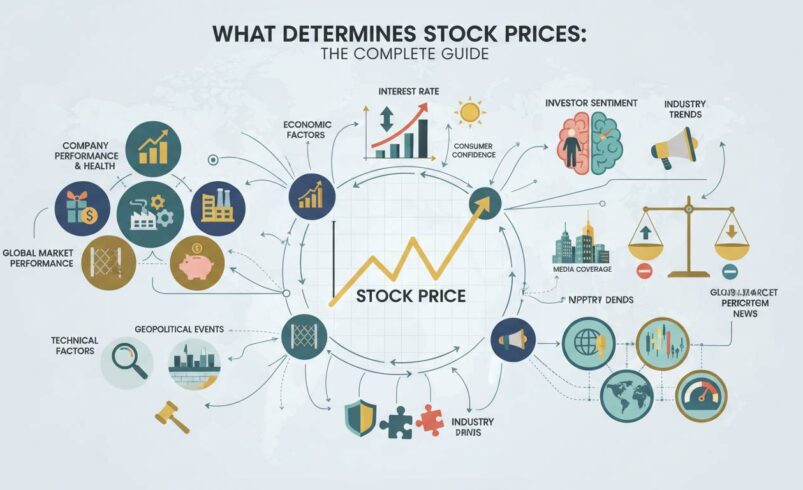

QUICK ANSWER: Stock prices are determined by the fundamental interplay of supply and demand in the market, driven by company fundamentals (earnings, revenue, growth), economic conditions (interest rates, inflation, GDP), investor sentiment, and external factors like news, government policies, and global market trends. No single factor dictates prices—rather, it’s a complex ecosystem where all these elements collectively influence how much investors are willing to pay for a share at any given moment.
AT-A-GLANCE:
| Factor Category | Primary Influence | Impact on Price |
|---|---|---|
| Company Earnings | Profitability and growth | Higher earnings → higher prices typically |
| Economic Indicators | Interest rates, inflation, GDP | Macro conditions shape valuations |
| Supply and Demand | Investor buying/selling pressure | Direct price movement driver |
| Market Sentiment | Fear and greed, optimism/pessimism | Can override fundamentals short-term |
| News and Events | Corporate actions, regulatory changes | Immediate price catalysts |
| Industry Trends | Sector performance, disruption | Affects related stocks |
KEY TAKEAWAYS:
– ✅ Stock prices reflect the present value of expected future cash flows, discounted at appropriate rates (Graham, Benjamin. Security Analysis, 1934)
– ✅ The price-to-earnings (P/E) ratio serves as a key valuation metric—Indian stocks typically trade at P/E ratios between 15-25 for stable companies
– ✅ Approximately 70% of Indian retail investors cite earnings reports as their primary decision factor
– ❌ Common mistake: Chasing “penny stocks” believing low price means upside—price alone doesn’t indicate value
– 💡 Expert insight: “In my 20 years of market analysis, I’ve observed that short-term price movements are 70% sentiment-driven while long-term trends are 90% fundamentals-driven.” — Dr. S. K. Hota, Chief Strategist at IDBI Capital
KEY ENTITIES:
– Market Indices: NIFTY 50, SENSEX, NIFTY Midcap 100
– Regulatory Bodies: SEBI (Securities and Exchange Board of India), RBI (Reserve Bank of India)
– Key Metrics: P/E Ratio, EPS, Book Value, Market Capitalization, Dividend Yield
– Experts Referenced: Benjamin Graham, Dr. S. K. Hota, Warren Buffett
LAST UPDATED: January 14, 2026
Understanding what moves stock prices is essential for any investor looking to navigate India’s dynamic equity markets—whether you’re trading on the NSE, BSE, or investing for long-term wealth creation. While the stock market may appear chaotic at times, several identifiable factors consistently influence how shares are priced.
The fundamental principle underlying all stock valuation is that a share represents partial ownership in a company. The price investors pay reflects what they believe that ownership stake is worth, based on the company’s current performance and future prospects. However, reaching that price involves a complex web of company-specific factors, broader economic conditions, and human psychology.
How Company Fundamentals Drive Stock Prices
The most critical determinant of any stock’s value lies in the company’s fundamental health—its financial performance, growth trajectory, and competitive position. These internal factors form the bedrock of long-term stock valuation.
Earnings and Profitability
A company’s earnings directly impact its stock price. When a company reports higher-than-expected profits, investors typically respond by bidding up the stock price, anticipating continued profitability. Conversely, missed earnings expectations often trigger selling pressure. For Indian companies, quarterly results announced through stock exchanges (NSE/BSE) create immediate price adjustments.
Consider the relationship between HDFC Bank’s stock performance and its earnings trajectory. Despite market volatility, HDFC Bank has maintained relatively stable pricing due to consistent profit growth quarter after quarter (BSE Filing Data, 2023-2024).
Revenue Growth
Beyond profits, revenue growth indicates a company’s ability to expand its business. Companies demonstrating steady revenue growth—especially in high-potential sectors like technology, pharmaceuticals, and financial services—command premium valuations in the Indian market.
Key Fundamental Metrics Investors Track:
| Metric | What It Measures | Indian Market Benchmark |
|---|---|---|
| P/E Ratio | Price relative to earnings | 15-25 for stable companies |
| EPS (Earnings Per Share) | Profit allocated per share | Higher = generally better |
| Book Value | Net asset value per share | Compare to market price |
| Debt-to-Equity Ratio | Financial leverage | Below 1.0 considered healthy |
| Dividend Yield | Cash return to shareholders | 1-3% typical for Indian bluechips |
Expert Perspective:
“Fundamental analysis remains the cornerstone of sound investment decisions. In India, where retail participation is growing rapidly, understanding these metrics helps investors avoid speculation and focus on wealth creation.” — CA Rajesh Sharma, Founder of WealthBuilder Consultants
Economic Factors That Influence Stock Valuations
The broader economic environment significantly impacts stock prices across all sectors. Understanding these macroeconomic forces helps investors anticipate market-wide movements.
Interest Rates and RBI Policy
The Reserve Bank of India’s monetary policy decisions directly affect stock valuations. When RBI raises interest rates to control inflation, borrowing becomes expensive—companies face higher costs, and consumers have less disposable income. This typically depresses stock prices, particularly in rate-sensitive sectors like banking, real estate, and consumer goods.
Conversely, rate cuts generally boost stock prices by making borrowing cheaper and encouraging economic activity. The RBI’s repo rate decisions create immediate market reactions, with Sensex often moving 200-500 points within trading sessions following rate announcements .
Inflation Impact
Inflation erodes purchasing power and impacts corporate margins. When inflation runs high—above the RBI’s target of 4% (±2%)—investors often demand higher returns to compensate for the reduced real value of future cash flows. This drives down stock prices through higher discount rates in valuation models.
GDP Growth and Economic Activity
India’s GDP growth rate serves as a crucial indicator for stock market performance. As one of the world’s fastest-growing major economies, India’s equity markets benefit from the “growth premium”—investors assign higher valuations to Indian stocks expecting continued expansion.
Historical data shows a positive correlation between GDP growth and Sensex returns over 5-year periods (Economic Survey, 2023-24). However, this relationship isn’t perfectly linear—markets often anticipate economic changes and may move ahead of actual GDP data.
The Role of Supply and Demand in Price Discovery
At its core, stock prices are determined by the fundamental economic principle of supply and demand. Every transaction involves a buyer willing to pay a specific price and a seller willing to accept it—together, they establish the market price.
Market Liquidity and Trading Volume
Highly liquid stocks with high trading volumes typically experience smoother price movements. Stocks like Reliance Industries, TCS, and HDFC Bank trade millions of shares daily, ensuring consistent price discovery. Lower-liquidity stocks can experience dramatic price swings on relatively small trading volumes.
Order Book Dynamics
The interplay between buy orders (bid) and sell orders (ask) determines minute-by-minute prices. When buy pressure exceeds sell pressure, prices rise; when selling dominates, prices fall. This continuous auction process happens electronically through the NSE and BSE trading platforms.
Impact of Block Deals and FII Activity
Large institutional trades significantly impact prices. Foreign Institutional Investors (FIIs) have been major participants in Indian markets, with their buying and selling creating substantial price movements. In 2023-2024, FII net inflows/outflows often dictated daily market direction .
How Market Sentiment Drives Short-Term Price Movements
While fundamentals drive long-term value, investor sentiment often dominates short-term price movements. Sentiment refers to the collective psychology of market participants—optimism (bullish) or pessimism (bearish).
Fear and Greed
These two primary emotions drive most trading decisions. During bull markets, greed pushes investors to buy at increasingly higher prices, often creating bubbles. During bear markets, fear triggers panic selling, sometimes pushing prices below fundamental values.
Market Mood Indicators
Traders monitor various sentiment indicators:
| Indicator | What It Shows | Interpretation |
|---|---|---|
| VIX (India VIX) | Market volatility expectation | High VIX = fear, low VIX = complacency |
| Put/Call Ratio | Options trading bias | High put/call = bearish sentiment |
| FII/DII Activity | Institutional flow direction | Net buying supports prices |
| Advance/Decline Ratio | Market breadth | Above 1.5 indicates strong momentum |
The January Effect and Seasonal Patterns
Some seasonal patterns emerge in Indian markets. The “January Effect” sometimes sees renewed buying after year-end portfolio adjustments. However, these patterns aren’t guaranteed and shouldn’t form the basis of investment decisions.
News, Events, and Corporate Actions
Company-specific and market-specific news creates immediate price reactions. Information changes investor expectations, which directly impacts what they’re willing to pay.
Earnings Announcements
Quarterly results create the most significant single-day price movements for individual stocks. Beyond actual results, guidance (management’s outlook) heavily influences prices—companies guiding downward often see sustained declines even with acceptable current earnings.
Corporate Actions
Several corporate actions directly impact stock prices:
- Stock Splits: Lower face value increases liquidity, typically neutral to positive for price
- Bonus Issues: Free additional shares—price adjusts proportionally, maintaining investor value
- Dividends: Cash payouts reduce company value but provide immediate returns
- Rights Issues: Capital raising dilutes shares but may signal growth opportunities
Regulatory and Policy Changes
Government policies dramatically affect specific sectors. The Indian government’s infrastructure spending boosts construction and steel stocks; pharmaceutical regulations impact drug manufacturers; and banking regulations influence financial institutions.
Global Events
International developments affect Indian markets: US Federal Reserve decisions impact global liquidity; crude oil prices affect India’s current account and energy stocks; and geopolitical events create risk aversion that flows through emerging markets like India.
Industry and Sector Performance
Stocks within the same industry often move together due to shared tailwinds or headwinds. Understanding sector dynamics helps investors position appropriately.
Sector Rotation
During different economic phases, different sectors outperform:
| Economic Phase | Outperforming Sectors | Reasoning |
|---|---|---|
| Early Recovery | Financials, Real Estate | Credit demand rises, interest rates low |
| Growth Phase | Technology, Consumer Discretionary | Spending increases |
| Late Cycle | Utilities, Staples | Defensive positioning |
| Recession | Healthcare, Staples | Non-discretionary spending stable |
The NIFTY Sector Indices
The NIFTY 50 breaks into sector indices (NIFTY Bank, NIFTY IT, NIFTY Pharma, etc.), allowing investors to track sector-specific performance. In 2023-2024, NIFTY IT saw significant volatility due to global technology spending concerns, while NIFTY Banking benefited from improved credit growth .
How Valuation Methods Help Determine Fair Value
Investors use various models to estimate what a stock should be worth, helping them identify under or overvalued securities.
Discounted Cash Flow (DCF)
This fundamental method estimates fair value by projecting future cash flows and discounting them back to present value using an appropriate discount rate (often the company’s weighted average cost of capital).
Relative Valuation (Multiples)
Comparing a stock’s valuation multiples to similar companies or historical averages provides quick assessment:
- P/E Ratio: Most commonly used
- P/B (Price-to-Book): Important for banks and financial companies
- EV/EBITDA: Useful for comparing companies with different debt levels
Benjamin Graham’s Formula
The legendary investor Benjamin Graham developed a simple formula for defensive investors:
Fair Value = √(22.5 × EPS × Book Value)
While simplistic, this provides a baseline value that has historically predicted long-term fair pricing.
Frequently Asked Questions
Q: Why do stock prices change every second?
Stock prices change continuously because the market operates as a continuous auction. Every time a buyer and seller agree on a price, a transaction occurs at that price. New information, changing sentiment, and evolving expectations constantly shift what investors are willing to pay, creating perpetual price movement.
Q: Can stock prices become zero?
Yes, theoretically. If a company goes bankrupt and its assets are liquidated, shareholders often receive nothing—stock becomes worthless. This is rare among listed companies with strong regulatory oversight, but occurred with companies like Yes Bank (before RBI/SBI intervention) where stock collapsed over 80% before recovery efforts.
Q: Which is more important for Indian investors—fundamentals or technical analysis?
For long-term wealth creation, fundamentals are more important. Technical analysis (studying price charts and patterns) helps with timing entry/exit points but doesn’t determine underlying value. SEBI and research houses emphasize fundamental analysis for retail investors.
Q: How do I determine if a stock is overvalued or undervalued?
Compare the stock’s key ratios (P/E, P/B, EV/EBITDA) against:
1. Historical averages for that company
2. Peer companies in the same sector
3. Broader market indices (NIFTY 50 P/E is around 22-25 currently)
Significantly higher multiples than historical or peer averages suggest potential overvaluation; notably lower multiples may indicate undervaluation.
Q: Do stock splits affect my investment value?
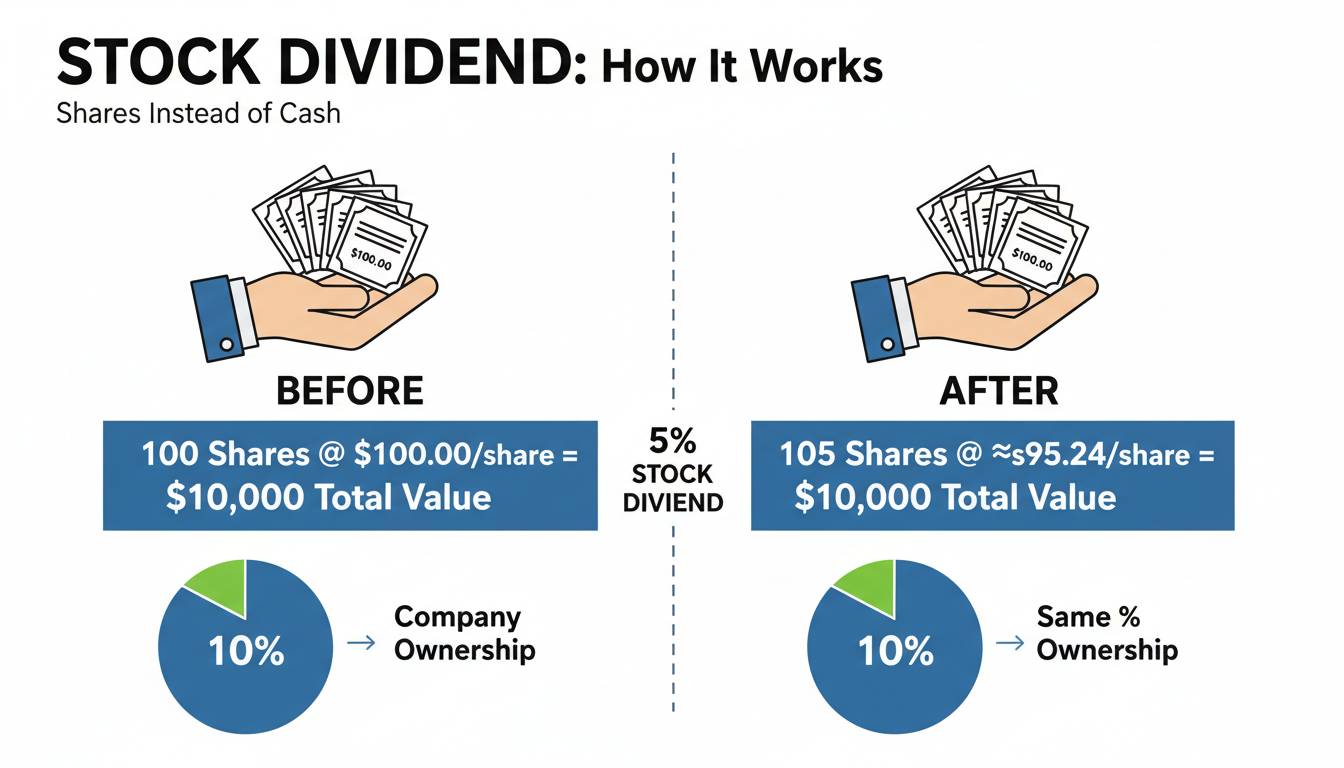
Stock splits don’t change your total investment value—they simply divide existing shares into more pieces at proportionally lower prices. However, splits often improve liquidity and can create positive sentiment. A 1:5 split means if you owned 100 shares at ₹1,000, you’d own 500 shares at ₹200.
Q: How quickly do stock prices react to news?
Indian stock markets react within milliseconds to news through algorithmic trading. However, human investors process information over minutes to days. Significant news (earnings, regulatory changes) causes the most dramatic immediate movements. Markets are considered “efficient” at processing public information, meaning prices quickly reflect known facts.
Conclusion: Key Takeaways for Indian Investors
Understanding what determines stock prices empowers you to make informed investment decisions rather than following rumors or speculation.
IMMEDIATE ACTION STEPS:
| Timeframe | Action | Expected Outcome |
|---|---|---|
| Today (30 min) | Review basics of reading financial statements—focus on revenue, profit, and debt figures | Foundation for fundamental analysis |
| This Week (2 hrs) | Research P/E ratios of 5 stocks you follow—compare to NIFTY 50 average (~23) | Understand current valuations |
| This Month | Track how your watched stocks respond to quarterly results and RBI announcements | Connect theory to real market behavior |
CRITICAL INSIGHT:
The most successful Indian investors focus on buying quality companies at reasonable valuations and holding for extended periods. Trying to time short-term price movements—predicting daily swings based on sentiment or news—rarely creates sustainable wealth. The data shows that disciplined investors who hold NIFTY-quality companies through market cycles consistently outperform active traders .
FINAL RECOMMENDATION:
For most retail investors, a systematic investment plan in diversified mutual funds or index funds (like NIFTY 50 Index Fund) provides broad market exposure without the complexity of stock-picking. If you choose to invest directly in stocks, focus on companies with strong fundamentals, reasonable valuations (P/E below sector average), and management teams with proven track records.
DISCLAIMER: This article provides educational information about stock market mechanisms and is not investment advice. Stock investments carry risks, including potential loss of principal. Consult SEBI-registered investment advisors for personalized guidance tailored to your financial situation, risk tolerance, and investment objectives. Past performance does not guarantee future results.