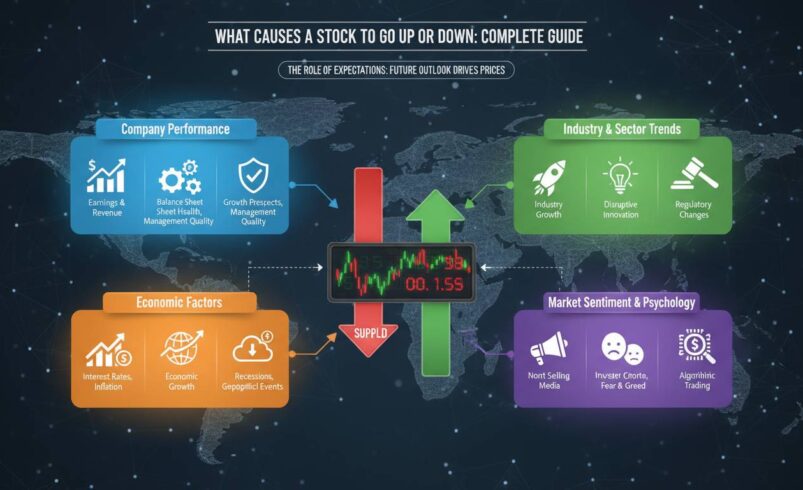

Stock prices fluctuate constantly, driven by a complex interplay of financial metrics, economic conditions, investor psychology, and global events. Understanding why shares rise or fall is essential for anyone looking to build wealth through equity investments—whether you’re a beginner opening your first demat account in India or an experienced trader analyzing market movements.
The fundamental principle is straightforward: stock prices move based on supply and demand. When more investors want to buy a stock than sell it, the price rises. When more investors want to sell than buy, the price falls. However, the forces that create this imbalance are multifaceted and often interconnected.
This guide breaks down the primary factors that cause stock prices to change, providing Indian investors with actionable insights to better understand market movements and make informed investment decisions.
Supply and Demand: The Core Driver
At its most basic level, every stock trade involves a buyer and a seller. The price at which they agree to transact reflects the collective assessment of the company’s value by all market participants. When demand exceeds supply, buyers compete to acquire shares, pushing prices upward. When supply exceeds demand, sellers lower their asking prices to attract buyers, driving prices down.
Key Insight: Supply and demand isn’t just about quantity—it’s about urgency and conviction. A stock with moderate trading volume can still experience significant price swings if institutional investors are actively buying or selling.
In India, the Securities and Exchange Board of India (SEBI) regulates market participants to ensure fair and orderly trading. The National Stock Exchange (NSE) and Bombay Stock Exchange (BSE) provide the platform where millions of trades occur daily, with liquidity varying significantly between large-cap stocks like Reliance Industries and smaller mid-cap or small-cap companies.
Company Financial Performance
A company’s fundamental financial health is perhaps the most significant long-term driver of its stock price. Investors continuously evaluate earnings, revenue growth, profit margins, and cash flow to determine a company’s intrinsic value.
Earnings Reports and Revenue Growth
Quarterly earnings reports serve as major catalysts for stock price movement. When a company reports earnings that exceed analyst expectations, the stock typically rises. Conversely, missing earnings expectations often triggers a sell-off.
In the Indian market, companies listed on the BSE and NSE are required to publish quarterly results within 45 days of quarter-end. During these reporting seasons, volatility increases significantly as investors digest the new information.
What to Watch For:
- Quarterly revenue compared to previous periods and analyst estimates
- Earnings per share (EPS) growth year-over-year
- Profit margins and operating efficiency
- Guidance for future quarters
Dividend Announcements
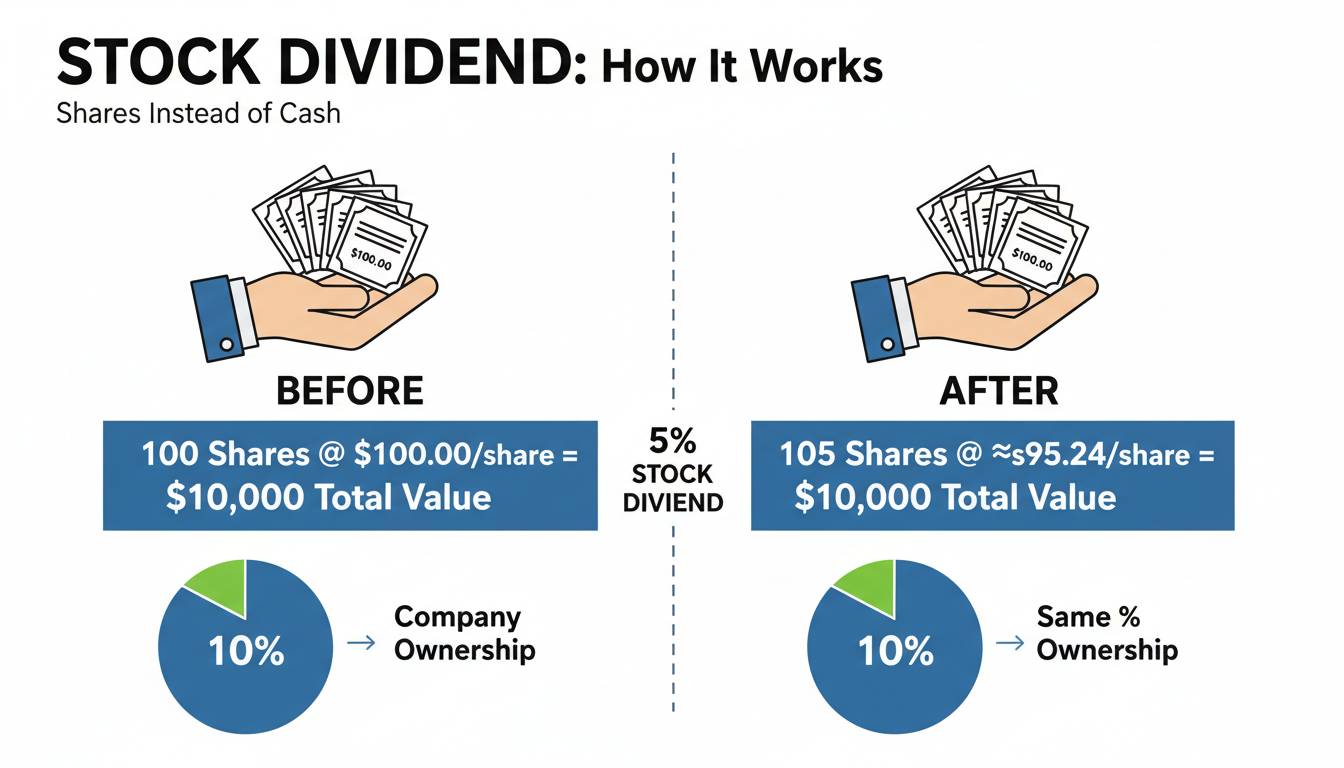
Companies that pay regular dividends often see their stock prices respond to dividend announcements. A dividend increase signals management confidence in sustained profitability, while a dividend cut or omission typically leads to price declines.
In India, companies like Hindustan Unilever, TCS, and HDFC Bank have long histories of consistent dividend payments, making them attractive to income-focused investors.
Economic Factors and Macroeconomic Conditions
The broader economic environment significantly influences stock prices across all sectors. Understanding these macroeconomic factors helps investors anticipate market-wide movements.
Interest Rates and RBI Policy
The Reserve Bank of India’s monetary policy decisions have profound effects on stock markets. When the RBI raises interest rates, borrowing becomes expensive for companies, potentially reducing expansion plans and profits. Higher rates also make fixed-income investments like bonds more attractive relative to stocks, prompting some investors to shift allocation.
Conversely, rate cuts typically boost stock prices by making borrowing cheaper and making equities more attractive compared to fixed-income alternatives.
Current Context: The RBI’s monetary policy committee meets multiple times annually to review the repo rate, and market participants closely analyze every policy statement for hints about future rate movements.
Inflation Trends
Inflation erodes purchasing power and affects corporate profit margins. Moderate inflation is generally considered healthy for equity markets, but high inflation can lead to increased costs for companies and pressure on consumer spending.
The Wholesale Price Index (WPI) and Consumer Price Index (CPI) in India serve as key inflation indicators that investors monitor.
GDP Growth and Economic Output
India’s GDP growth rate directly impacts corporate earnings potential. A growing economy means increased consumer spending, business investment, and export opportunities—all of which translate to higher revenues and profits for companies.
When economic growth slows or contracts, investors typically see reduced earnings growth potential, leading to lower stock valuations.
Market Sentiment and Investor Psychology
Beyond fundamentals, investor emotions and collective psychology significantly drive short-term stock price movements. Fear and greed are powerful forces that can cause stocks to trade above or below their intrinsic values.
Fear and Greed Cycles
Market participants often react emotionally to news and events. During periods of optimism, greed drives buying enthusiasm, pushing prices to unsustainable levels—creating bubbles. During periods of pessimism, fear triggers panic selling, driving prices below fair value.
The India VIX, often called the “fear index,” measures market volatility expectations. High VIX readings indicate increased fear and typically coincide with market declines, while low VIX readings suggest complacency.
Herd Behavior
Investors frequently follow the crowd, especially during uncertain times. This herd behavior amplifies price movements in both directions. Understanding this psychological tendency helps investors avoid making impulsive decisions based on market noise.
Company-Specific News and Events
Individual stock prices react strongly to news directly affecting the company. These catalysts can be positive or negative and often cause immediate price adjustments.
Corporate Announcements
- Mergers and Acquisitions: When a company announces acquisition plans, both the acquiring and target companies often experience price movements based on deal terms and strategic rationale.
- Management Changes: Leadership transitions can significantly impact investor confidence, particularly in companies where the founder or long-time CEO departs.
- Product Launches: Successful product launches can drive stock prices higher, while product failures or delays have the opposite effect.
- Legal and Regulatory Issues: Lawsuits, regulatory investigations, or compliance problems can significantly impact stock valuations.
Sector-Specific Developments
Events affecting entire industries ripple through all companies in that sector. For example, changes in government infrastructure spending affect construction and cement stocks, while policy shifts in renewable energy impact solar and wind power companies.
Government Policies and Regulations
Government decisions at both central and state levels directly impact specific sectors and the overall market.
SEBI Regulations
The Securities and Exchange Board of India continuously updates regulations affecting listed companies, market intermediaries, and investors. Regulatory changes can create opportunities or challenges for specific sectors.
For instance, SEBI’s insider trading regulations and disclosure requirements aim to create a level playing field for all investors.
Fiscal Policy and Taxation
The Union Budget annually announces fiscal policy decisions including corporate tax rates, import duties, and sector-specific incentives. Changes in capital gains tax rates or securities transaction tax directly impact investment returns and behavior.
Industry-Specific Policies
Government initiatives like Make in India, Production Linked Incentive (PLI) schemes, and sector-specific reforms create opportunities in relevant industries. Conversely, restrictive regulations or bans can devastate certain businesses.
Competition and Industry Dynamics
Companies don’t operate in vacuums—they compete for market share, talent, and investor capital. Industry dynamics significantly influence individual stock performance.
Competitive Landscape
When a company loses market share to competitors, investors often punish the stock even if overall revenues remain stable. Conversely, market share gains can drive price appreciation.
In India’s fast-moving consumer goods (FMCG) sector, companies like ITC, HUL, and Nestle India constantly compete for shelf space and consumer loyalty.
Industry Trends
Technological disruption can create or destroy entire business models. The shift from feature phones to smartphones impacted companies like Nokia and Micromax, while the rise of e-commerce has transformed retail dynamics across India.
Trading Volume and Liquidity
Trading volume represents the number of shares traded during a specific period. High-volume stocks tend to have narrower bid-ask spreads and more stable pricing, while low-volume stocks can experience significant price swings from relatively small trades.
Liquidity Impact
Highly liquid stocks like those forming part of the Nifty 50 or Sensex allow investors to enter and exit positions easily. Thinly traded stocks may experience price gaps between trading sessions, making them riskier for average investors.
Volume as a Signal
Unusual trading volume often signals significant investor interest—either positive or negative. Sudden volume spikes frequently accompany major news announcements or earnings releases.
Technical Factors and Market Mechanics
Beyond fundamentals, technical analysts study price patterns and trading statistics to predict future price movements.
Price Trends and Patterns
Technical analysis identifies trends, support levels, and resistance levels based on historical price data. Moving averages, relative strength index (RSI), and other indicators help traders identify potential entry and exit points.
Market Capitalization Effects
Stock prices don’t tell the complete story—a company’s market capitalization (stock price multiplied by shares outstanding) determines its actual size. A ₹100 stock with 100 crore shares outstanding has a larger market cap than a ₹500 stock with 10 crore shares.
In India, stocks are categorized by market capitalization:
| Category | Market Cap Range |
|---|---|
| Large Cap | ₹20,000 crore+ |
| Mid Cap | ₹5,000-20,000 crore |
| Small Cap | Below ₹5,000 crore |
Global Factors and International Interconnectedness
In today’s interconnected world, events in major economies like the United States, China, or Europe impact Indian markets.
Foreign Institutional Investment
Foreign institutional investors (FIIs) are significant participants in Indian equity markets. When global risk appetite decreases or when US Treasury yields become attractive, FIIs often reduce their Indian holdings, putting downward pressure on stock prices.
Currency Movements
The USD-INR exchange rate affects companies differently. IT services companies benefit from a stronger US dollar, while companies relying on imported raw materials face margin pressure when the rupee weakens.
Commodity Prices
India imports significant quantities of crude oil, gold, and other commodities. Changes in global commodity prices impact companies across sectors—from oil marketing companies to steel manufacturers.
Building Your Investment Strategy
Understanding what causes stocks to go up or down provides the foundation for making informed investment decisions. However, successfully navigating markets requires more than just knowledge of these factors.
Due Diligence Practices
Before investing in any stock, research the company’s financial health, competitive position, management quality, and growth prospects. Annual reports, quarterly results, and investor presentations provide valuable information.
Time Horizon Considerations
Different factors matter over different time horizons. Long-term investors should focus on company fundamentals and industry trends, while short-term traders must also consider technical factors and market sentiment.
Diversification Benefits
No single factor determines portfolio success. Holding stocks across different sectors and market capitalizations helps manage risk while capturing opportunities across the market.
Frequently Asked Questions
What is the single biggest factor that causes stock prices to change?
Supply and demand is the fundamental driver—all other factors ultimately influence stock prices by affecting how investors perceive a company’s value. When investors collectively believe a stock is worth more than its current price, they buy, pushing prices up. When they believe it’s overvalued, they sell, causing prices to fall.
How quickly do stock prices respond to news?
Stock prices can react within seconds to minutes of news becoming public, especially with today’s high-frequency trading algorithms. However, the full impact of significant news often plays out over days or weeks as more investors digest and react to the information.
Do stock prices always reflect a company’s true value?
Not always. Due to behavioral factors, information asymmetry, and market inefficiencies, stocks can trade significantly above or below their intrinsic values for extended periods. This is why value investing—buying stocks trading below their fundamentals—can be profitable over the long term.
Should I buy a stock when its price falls significantly?
Not necessarily. A falling stock price might indicate fundamental problems with the company, or it might represent a buying opportunity if the decline is overdone. Always analyze why the price fell before making an investment decision.
How do I analyze which stocks will go up?
There’s no guaranteed method, but successful investors typically analyze a combination of factors: financial performance (earnings growth, profit margins), competitive positioning, industry trends, management quality, and valuation metrics. Both fundamental analysis and technical analysis have their advocates.
Does high trading volume always mean a stock will go up?
No—high volume simply indicates strong investor interest. This interest could be from buyers or sellers. You need to analyze the price direction alongside volume to understand whether the movement represents accumulation or distribution.
Conclusion
Stock prices move based on the collective decisions of millions of investors weighing countless factors—from company earnings and economic conditions to emotional reactions and global events. Understanding these drivers helps you make more informed investment decisions and avoid common pitfalls like panic selling during market downturns or FOMO-driven buying at market peaks.
Successful investing in Indian markets requires patience, discipline, and continuous learning. Focus on understanding businesses rather than predicting short-term price movements. Stay informed about macroeconomic trends, regulatory changes, and industry developments that might affect your investments.
Remember that stock market investments carry inherent risks, and past performance doesn’t guarantee future results. By building a diversified portfolio based on sound research and your personal financial goals, you can work toward long-term wealth creation despite the inevitable short-term market fluctuations.