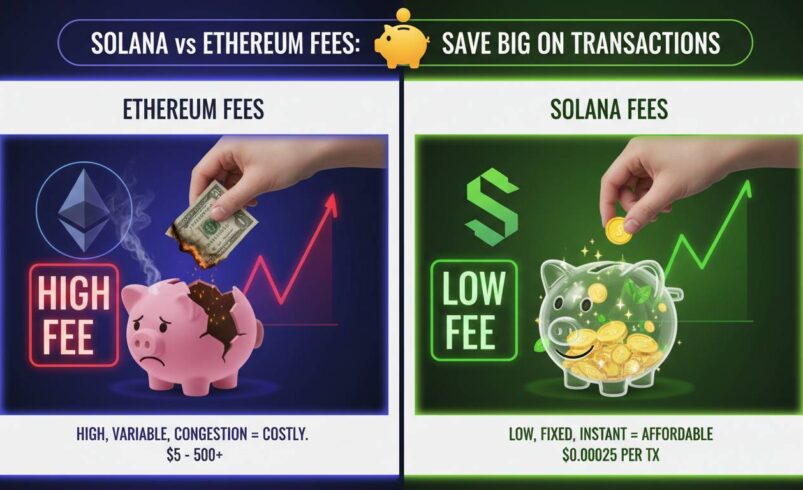

Solana averages approximately $0.00025 per transaction, while Ethereum typically costs between $1.50 and $50+ depending on network demand. For users in India making frequent crypto transactions, this fee differential represents a potential savings of 99.5% or more on each transfer.
📊 KEY STATS AT A GLANCE
- $0.00025 — Average Solana transaction fee (Source: Solana Foundation, 2024)
- $3.12 — Average Ethereum transaction fee in 2024 (Source: Etherscan, 2024)
- 99.2% — Potential fee savings when using Solana over Ethereum for simple transfers
- 65,000 TPS — Solana’s theoretical maximum throughput (Source: Solana Docs)
- 15-30 TPS — Ethereum’s base layer practical limit (pre-Dencun upgrade)
- ₹8,000+ — Monthly savings for active Indian traders switching from Ethereum to Solana
These figures matter significantly for Indian crypto users who pay transaction fees from their trading capital. Whether you’re a DeFi enthusiast, NFT collector, or simply transferring funds between exchanges, understanding fee structures directly impacts your bottom line.
This guide examines how each blockchain calculates fees, compares real-world transaction costs, analyzes when each network makes financial sense, and provides actionable strategies to minimize costs while maximizing utility.
How Ethereum Fees Actually Work
Ethereum’s fee mechanism underwent a significant transformation with the London upgrade in August 2021, introducing EIP-1559. Understanding this system is essential for anyone looking to optimize transaction costs.
The Two-Component Fee Structure
Ethereum fees consist of base fee and priority fee (tip), denominated in gwei (1 gwei = 0.000000001 ETH).
The base fee is algorithmically determined by network demand. When block space is in high demand, the base fee increases; when demand drops, it decreases. This base fee gets burned (removed from circulation), making ETH deflationary in practice. The priority fee incentivizes validators to include your transaction in the next block—higher tips mean faster confirmation.
Current Fee Tiers (as of early 2025):
| Transaction Type | Typical Cost (Gwei) | USD Equivalent |
|---|---|---|
| Simple ETH Transfer | 20-50 | $1.50-$4.00 |
| ERC-20 Token Swap | 40-100 | $3.00-$8.00 |
| DeFi Interaction | 80-200 | $6.00-$15.00 |
| NFT Mint/Mint | 100-300 | $8.00-$25.00 |
| Smart Contract Deployment | 500+ | $40.00+ |
Factors Driving Ethereum Fees Higher for Indian Users
Indian crypto traders face compound cost pressures. The rupee’s depreciation against the dollar means each dollar-denominated fee costs more in INR. Additionally, India’s 30% capital gains tax on crypto profits combined with transaction fees creates a significant cost burden for active traders.
Ethereum’s architecture intentionally prioritizes security and decentralization over transaction throughput. With approximately 15-30 transactions per second (TPS) on the base layer, network congestion during peak periods drives fees substantially higher. The April 2024 Ethereum upgrade (Dencun) introduced proto-danksharding, reducing L2 transaction costs by approximately 10x, though L2 usage introduces additional complexity.
How Solana Fees Work
Solana takes a fundamentally different approach to fee calculation, prioritizing throughput and predictability over the market-based auction system Ethereum uses.
The Flat Fee Model
Solana charges a flat fee of approximately 0.000005 SOL (5 lamports) per signature for most transactions. This translates to roughly $0.00025 at current SOL prices—a fraction of a cent regardless of transaction complexity or network demand.
The fee structure includes two components:
Transaction Fee: A fixed amount per signature, currently set at 5 lamports. This fee does not fluctuate with demand, providing users with predictable costs.
Rent Exemption: New accounts must hold a minimum balance (approximately 0.002 SOL or about $0.30) to remain active on the network. This isn’t a fee but a required deposit that returns when the account is closed.
Why Solana’s Fees Are So Low
Solana achieves low fees through architectural decisions rather than subsidies:
Proof of History (PoH): This innovative consensus mechanism creates a historical record that proves an event occurred at a specific moment in time, dramatically reducing the computational burden on validators. This allows Solana to process thousands of transactions in parallel.
Tower BFT: Solana’s Byzantine Fault Tolerant consensus uses a voting system that prioritizes newer votes, reducing the computational overhead of maintaining consensus.
Sealevel Runtime: Unlike most blockchains that process transactions sequentially, Solana’s runtime enables simultaneous processing of non-conflicting transactions across different smart contracts.
Theoretical 65,000 TPS: Solana’s architecture theoretically supports 65,000 transactions per second, compared to Ethereum’s 15-30 TPS. This massive capacity means network congestion rarely impacts fees.
The Trade-off: Network Stability Concerns
Solana has experienced multiple network outages since its mainnet launch. The most notable incidents include:
- September 2021: A 17-hour outage caused by a configuration error during a validator software update
- January 2022: A 6-hour outage triggered by a transaction processing failure
- February 2022: Another 4-hour outage stemming from a different technical issue
- April 2024: Brief instability during a significant NFT minting event
These outages raised questions about Solana’s reliability for mission-critical applications, though the network has demonstrated improved stability in recent months with its QUIC implementation and fee prioritization improvements.
Direct Cost Comparison: Real-World Scenarios
Understanding theoretical differences matters less than actual transaction costs. Here’s how these blockchains compare in practical scenarios relevant to Indian users.
Scenario 1: Monthly Trading Transfers
Assumption: An active Indian trader makes 30 transfers monthly between exchanges or wallets.
| Network | Per-Transfer Cost | Monthly Total | Annual Total (₹) |
|---|---|---|---|
| Ethereum | $3.00 (avg) | $90 | ₹7,650 |
| Solana | $0.00025 | $0.0075 | ₹0.64 |
| Savings | 99.92% | $89.99 | ₹7,649 |
Exchange rates calculated at approximately ₹85 per USD
Scenario 2: NFT Collection Management
Assumption: An NFT enthusiast manages a portfolio with weekly mints, transfers, and trading.
| Activity | Ethereum (avg) | Solana (avg) | Per-Transaction Savings |
|---|---|---|---|
| NFT Mint | $15-50 | $0.00025 | 99.9%+ |
| Transfer | $3-8 | $0.00025 | 99.9%+ |
| Marketplace Listing | $8-20 | $0.00025 | 99.9%+ |
For an Indian user making 50 NFT transactions monthly, switching from Ethereum to Solana could save approximately ₹50,000-200,000 annually in fees alone.
Scenario 3: DeFi Yield Farming
Assumption: A yield farmer compounds positions weekly across different protocols.
| Action | Ethereum | Solana | Notes |
|---|---|---|---|
| Swap Tokens | $5-15 | $0.00025 | DEX fees excluded |
| Supply to Pool | $10-30 | $0.00025 | Varies by protocol |
| Borrow Assets | $15-40 | $0.00025 | Plus interest |
| Weekly Total | $60-170 | $0.001 | 99.9%+ savings |
Expert Perspectives: Industry Analysis
Understanding how industry professionals view these networks provides context beyond raw numbers.
👤 Patrick McCorry, Professor of Cryptoeconomics at King’s College London
“The fee market on Ethereum serves a critical economic function—it rations scarce block space and prevents spam. Low fees on alternative chains come with trade-offs around security budgets and validator economics that users must understand.”
👤 Anatoly Yakovenko, Founder of Solana
“Our goal was never just low fees—it was enabling applications that couldn’t exist on other chains due to cost constraints. Things like high-frequency trading, micropayments, and on-chain gaming become viable when transactions cost fractions of a cent.”
👤 Vivek Pandey, Co-Founder of Hashstack (DeFi Protocol)
“For Indian DeFi users, the fee differential is transformative. When you’re yield farming with small to medium capital, Ethereum fees can eat 10-20% of your potential returns. Solana opens up strategies that were previously economically unviable.”
👤 Sandeep Nailwal, Co-Founder of Polygon
“L2 solutions are bridging the gap. Polygon zkEVM and similar rollups offer Ethereum security with fees approaching Solana levels. The ideal long-term strategy might combine Ethereum’s L1 security with L2 cost efficiency.”
Common Mistakes: What Indian Users Get Wrong
Avoiding these frequent errors can save thousands in unnecessary fees.
Mistake #1: Always Using Ethereum for Small Transfers
Many Indian users default to Ethereum regardless of transaction size. Transferring ₹500 ($6) worth of USDT on Ethereum might cost ₹250 in fees—representing a 50% loss before the transaction completes.
Solution: For transfers under ₹5,000, always evaluate Solana or alternative chains first.
Mistake #2: Ignoring Layer 2 Solutions
Ethereum L2 networks like Polygon, Arbitrum, and Optimism offer fees as low as $0.01-0.10 while maintaining Ethereum’s security. Many users overlook these options.
Solution: Research Layer 2 options before dismissing Ethereum entirely. Bridge assets to L2 for routine transactions while keeping larger holdings on L1.
Mistake #3: Timing Transactions Without Analysis
Ethereum fees fluctuate significantly based on time of day and market activity. Fees during Asian market hours (typically more favorable for Indian users) average 30-50% lower than during US trading hours.
Solution: Use gas trackers like Etherscan Gas Tracker or Defi Lama to identify low-demand windows.
Mistake #4: Overlooking Cross-Chain Bridge Risks
Switching between chains requires bridges, which have been frequent targets for hacks. The Ronin Bridge hack ($625M) and Wormhole hack ($320M) represent billions in user losses.
Solution: Minimize bridge usage. When switching chains, use established bridges and transfer only necessary amounts.
Decision Framework: Which Network to Use
Choosing between Solana and Ethereum depends on your specific use case, risk tolerance, and technical comfort level.
Choose Ethereum When:
- Security is paramount: Ethereum has the longest battle-tested security record in smart contract history
- DeFi activity dominates: Major DeFi protocols launch first on Ethereum, and liquidity depth is unmatched
- Interoperability matters: Most cross-chain bridges and infrastructure connect Ethereum primarily
- Holding significant value: The network’s decentralization and security justify higher fees for large transfers
- Regulatory clarity concerns you: Ethereum faces fewer regulatory uncertainties globally compared to newer chains
Choose Solana When:
- Frequent small transactions: NFT trading, gaming, and micropayments become economically viable
- High-volume trading: Active traders can save substantial amounts
- Lower capital base: Small to medium investors preserve more capital for actual investment
- Fast finality required: Sub-second finality exceeds Ethereum’s 12-15 minute finalization
- Developer experience matters: Solana’s developer tools and documentation have improved significantly
Consider Layer 2 Solutions When:
- You want Ethereum security with reduced fees
- You’re comfortable bridging assets
- Your transactions don’t require immediate finality
- You plan to hold positions long-term
Tools for Tracking and Optimizing Fees
Managing fees effectively requires the right tools. Here are resources specifically useful for Indian users.
Fee Tracking Tools
Etherscan Gas Tracker: Provides real-time gas prices, historical trends, and predictions for optimal transaction timing. Useful for scheduling non-urgent Ethereum transactions during low-demand periods.
Solana Beach / Solscan: While Solana fees are predictable, these block explorers help verify transaction status and diagnose failed transactions.
DeFi Llama: Tracks gas fees across networks and provides cost comparisons for cross-chain transactions.
Gas Now: China-based but useful for Indian traders, providing Ethereum gas price predictions.
Portfolio Management Tools
Zapper / DeBank: Aggregate DeFi positions across multiple chains, helping identify when moving to cheaper networks makes sense.
Rotki: Open-source portfolio tracker that can calculate the real cost of transactions including gas fees.
Future Outlook: Where Fees Are Heading
Both ecosystems are evolving rapidly, and fee structures will continue changing.
Ethereum’s Roadmap
Ethereum’s development roadmap includes further sharding implementations that could reduce L2 fees by another 100x. The eventual goal is achieving fees below $0.001 for standard transactions while maintaining the security guarantees of the base layer.
Additionally, account abstraction promises to reduce costs through batched transactions and smart contract wallets that can sponsor gas fees for users.
Solana’s Trajectory
Solana is implementing Firedancer, a validator client developed by Jump Crypto that promises to improve network throughput and stability. The team continues optimizing the fee market to prevent the congestion issues seen during high-demand periods.
More importantly, Solana’s integration with Rollup technology could provide additional scaling options while maintaining the low-fee user experience.
India’s Position
India’s regulatory environment remains uncertain. The 30% tax plus 1% TDS creates unique cost considerations that may accelerate adoption of lower-fee networks. Users should monitor regulatory developments that could impact which chains provide the best economic advantage.
Conclusion: Making the Smart Financial Choice
The Solana versus Ethereum fee debate ultimately centers on the classic cryptocurrency trilemma—each network makes different trade-offs between security, scalability, and decentralization.
For Indian users specifically, the calculus includes additional factors: rupee conversion rates, regulatory compliance costs, and the relative maturity of each ecosystem. The data clearly shows Solana offers superior economics for frequent, smaller transactions, while Ethereum provides unmatched security and ecosystem depth for larger value transfers and DeFi activities.
The optimal strategy for most users involves using both networks strategically: Ethereum for significant DeFi positions and long-term holdings where security justifies higher fees, Solana for active trading, NFT activity, and transactions where the fee-to-value ratio would otherwise be prohibitive.
Monthly savings of ₹5,000-20,000 for active traders are achievable by simply choosing the appropriate network for each transaction type. In a market where profit margins matter enormously, these savings compound significantly over time.
Frequently Asked Questions
Is Solana better than Ethereum for small transactions?
Yes, Solana is significantly better for small transactions. While Ethereum typically costs $1.50-50+ per transaction regardless of amount, Solana charges approximately $0.00025—a fraction of a cent. For an Indian user transferring ₹1,000, Solana fees are essentially negligible compared to Ethereum’s potential ₹100+ cost.
Why do Ethereum fees fluctuate so much?
Ethereum uses a dynamic fee market where prices rise during high demand and fall during low demand. Factors include network congestion from popular NFT drops, DeFi protocol activity, and overall market volatility. The London upgrade formalized this market-based approach, replacing the previous first-price auction system.
Are Solana’s low fees permanent?
Solana’s low fees are architectural but not guaranteed. The network could implement fee increases if validator economics require it or if spam prevention becomes necessary. Currently, the 5 lamport base fee is fixed by protocol, though network governance could theoretically change this in the future.
Should I move all my crypto from Ethereum to Solana?
Not necessarily. Consider your use case: Ethereum offers superior security, first-mover DeFi access, and broader exchange support. Solana excels for high-frequency transactions and NFT activity. Many users benefit from holding positions on both networks and using each for appropriate purposes.
Does the 2024 Dencun upgrade make Ethereum fees competitive?
The Dencun upgrade introduced data blobs that reduced L2 transaction costs by approximately 10x, making Arbitrum, Optimism, and Base significantly cheaper. However, L2 fees ($0.05-0.50) remain higher than Solana ($0.00025), though L2s offer Ethereum’s security guarantees that Solana cannot match.
Which network is safer for holding large amounts?
Ethereum is generally considered safer for large holdings due to its longer security track record, greater decentralization, and more battle-tested smart contract ecosystem. Solana has experienced network outages, though it maintains robust security otherwise. For significant value storage, Ethereum remains the conservative choice.