
Solana (SOL) has emerged as one of the most talked-about layer-1 blockchain networks, positioning itself as a high-speed, low-cost alternative to Ethereum. With its innovative Proof of History consensus mechanism and rapidly growing ecosystem, Solana has captured significant attention from Indian crypto investors and developers alike. This comprehensive analysis examines Solana’s technology, market performance, competitive positioning, and future outlook specifically for the Indian market context.
What Makes Solana Different from Other Blockchains?
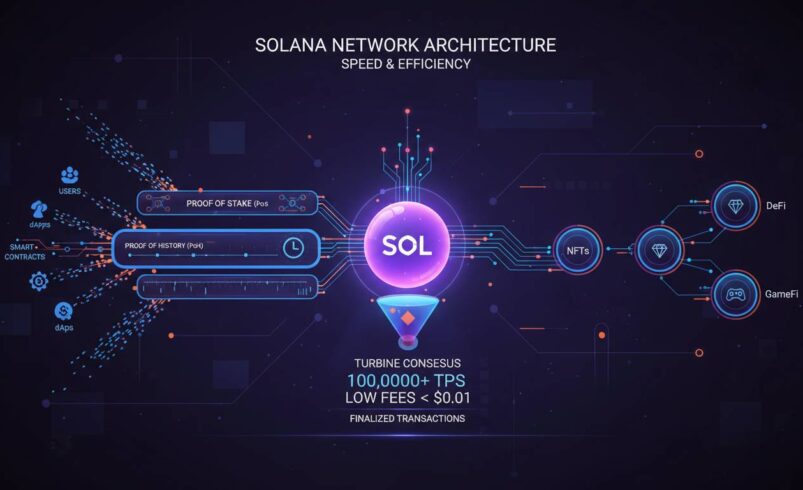
Solana distinguishes itself through its unique technical architecture designed for exceptional speed and scalability. The blockchain was founded by Anatoly Yakovenko, a former Qualcomm engineer, with co-founder Greg Fitzgerald, and officially launched its mainnet in March 2020. The project’s primary innovation lies in its Proof of History (PoH) consensus mechanism, which creates a historical record that proves that an event has occurred at a specific moment in time.
The technical foundation enables Solana to process approximately 65,000 transactions per second (TPS) under ideal conditions, compared to Ethereum’s 15-30 TPS and Bitcoin’s 7 TPS. This dramatic performance difference stems from several interconnected technical components: Tower BFT (Byzantine Fault Tolerance), Turbine block propagation, Gulf Stream transaction forwarding, and Sealevel parallel processing.
Transaction costs on Solana average approximately $0.001 to $0.01 per transaction, making it significantly more affordable than Ethereum, where gas fees frequently exceed $10-$50 during network congestion. For Indian users accustomed to dealing with varying transaction costs on domestic payment systems, this cost structure represents a substantial advantage for microtransactions and frequent trading activities.
The network’s architecture supports over 50 validator nodes globally, with substantial infrastructure presence across data centers in the United States, Europe, and Asia. Indian validators and RPC (Remote Procedure Call) providers have also begun establishing presence, improving network accessibility for domestic users.
Solana Price History and Market Performance
Solana’s price trajectory has reflected the broader crypto market’s volatility while demonstrating unique patterns that merit analysis. The token launched at approximately $0.50 in early 2020 and remained relatively obscure during its initial development phase. The price began ascending in 2021 as the broader crypto bull market accelerated.
November 2021 marked Solana’s all-time high of $259.99, representing a staggering 52,000% return from launch prices. This surge coincided with increased institutional attention to alternative layer-1 blockchains and the DeFi (Decentralized Finance) ecosystem expansion on Solana’s network. During this period, total value locked (TVL) in Solana-based protocols peaked at over $14 billion.
The subsequent market correction proved severe for Solana holders. By late 2022, the token had declined to approximately $8-10, representing a 96% drawdown from its peak. This decline paralleled the broader crypto market contraction following the collapse of Terra/Luna and subsequent contagion effects across the industry.
The year 2023 brought gradual recovery, with Solana reclaiming the $100 level by late November as market sentiment improved. The network also demonstrated notable technical improvements, including reduced downtime incidents that had plagued the platform in previous years. By early 2024, Solana’s price had stabilized in the $100-$120 range, representing a market capitalization among the top five cryptocurrencies.
For Indian investors, understanding this volatility pattern proves essential. The Securities and Exchange Board of India (SEBI) has yet to provide comprehensive regulatory clarity for crypto assets, making it crucial for investors to assess risk tolerance appropriately before allocating capital to volatile assets like Solana.
Network Outages and Reliability Concerns
Prospective investors must acknowledge Solana’s operational challenges, which have historically included several significant network outages. In September 2021, the network experienced a 17-hour outage caused by a distributed denial-of-service (DDoS) attack that flooded the network with spam transactions. A similar incident occurred in February 2022, lasting approximately 12 hours.
More recently, the network faced performance issues in early 2024, though these were addressed more rapidly than previous incidents. The Solana Foundation has invested substantially in network resilience, implementing improvements to validator coordination and introducing features like local fee markets to prevent transaction spam from impacting overall network functionality.
The Indian developer community has responded to these challenges by building local RPC infrastructure and improving node distribution across the region. Several Indian blockchain startups have emerged to provide Solana-based services, including wallet solutions and DeFi protocol interfaces tailored to domestic users.
The practical implication for users is straightforward: while Solana offers superior transaction speeds and costs, those requiring absolute certainty of transaction confirmation should consider the timing of their activities and potentially use backup networks for critical operations.
Ecosystem and Use Cases
Solana’s ecosystem has grown substantially since its launch, encompassing multiple sectors relevant to Indian crypto users:
Decentralized Finance (DeFi): Protocols like Raydium (automated market maker), Orca ( DEX), and Marinade Finance (liquid staking) provide trading, yield farming, and staking services comparable to Ethereum-based alternatives but with significantly lower costs.
NFT Marketplace: Solanart and Magic Eden have established themselves as prominent NFT marketplaces, with significantly reduced minting and trading costs compared to Ethereum’s OpenSea. This advantage has attracted Indian digital artists and collectors seeking affordable entry points into NFT ecosystems.
Gaming and Web3: Several gaming projects have launched on Solana, leveraging the network’s speed for real-time in-game transactions. Projects like Star Atlas and Aurory have built gaming experiences on Solana’s infrastructure.
Mobile and Consumer Apps: Solana’s mobile initiative, including the Saga phone, aims to bring Web3 experiences to mainstream users. This approach resonates with India’s rapidly smartphone-adopting population seeking next-generation mobile experiences.
Payment Solutions: For Indian merchants and users, Solana’s low transaction fees make it viable for micropayments and everyday transactions, a use case that remains impractical on Ethereum due to high gas costs.
The ecosystem’s diversity provides Indian users with multiple entry points depending on their interests and technical sophistication. Beginners might start with simple wallet-to-wallet transfers or use established DEXs, while advanced users can explore yield farming, liquid staking, and NFT trading.
Regulatory Landscape for Indian Investors
The regulatory environment for cryptocurrency in India remains a critical consideration for potential Solana investors. The Indian government imposed a 30% tax on cryptocurrency gains in 2022, followed by a 1% tax deduction at source (TDS) on crypto transactions, creating one of the most comprehensive tax frameworks globally.
SEBI has expressed concerns about cryptocurrency speculation while acknowledging blockchain technology’s potential benefits. The Reserve Bank of India (RBI) has issued periodic warnings about crypto risks but has not implemented an outright ban, maintaining a stance of cautious observation.
For Indian investors, key considerations include:
Tax Implications: Every Solana transaction may trigger tax reporting requirements. The 1% TDS applies to exchanges, while capital gains from SOL price appreciation require reporting as part of annual income tax filings.
Exchange Availability: Major Indian exchanges including WazirX, CoinDCX, and ZebPay list Solana (SOL). Users should verify current listing status and withdrawal capabilities before planning large transactions.
Banking Relationships: Some Indian banks have restricted cryptocurrency transactions, though this has loosened compared to the restrictions seen in 2018-2019. Users should maintain relationships with crypto-friendly banking partners.
Self-Custody Considerations: Given regulatory uncertainty, some Indian investors prefer self-custody solutions using hardware wallets, reducing dependence on regulated exchanges. Solana is compatible with major hardware wallets including Ledger and Trezor devices.
The regulatory framework continues evolving, with potential future developments that could impact Solana investment strategies. Indian users should stay informed about SEBI and RBI announcements that might affect crypto ownership and trading.
Competitive Analysis: Solana vs. Ethereum and Others
Understanding Solana’s market position requires comparison with competing layer-1 blockchains:
| Feature | Solana | Ethereum | Polygon | Avalanche |
|---|---|---|---|---|
| Transaction Speed | 65,000 TPS | 15-30 TPS | 7,000 TPS | 4,500 TPS |
| Avg. Transaction Cost | $0.001-0.01 | $10-50 | $0.01-0.05 | $0.02-0.10 |
| Consensus Mechanism | PoH + PoS | PoS | PoS + PoA | PoS |
| Smart Contract Language | Rust, C, C++ | Solidity | Solidity | Go, Rust |
| TVL (2024) | ~$8-10B | ~$50B | ~$1B | ~$0.8B |
Ethereum maintains its position as the dominant smart contract platform with the largest ecosystem and developer community. However, Ethereum’s success has created congestion issues that Solana directly addresses. The two networks have begun converging functionally, with Ethereum’s upcoming upgrades (including data sharding) aimed at improving scalability.
Polygon provides Ethereum Layer-2 scaling solutions rather than a direct blockchain competitor, making it complementary to Ethereum rather than substitutive. Avalanche and Solana compete more directly for similar user segments, with Avalanche emphasizing subnet flexibility and institutional features.
For Indian users, the choice often depends on specific use cases. Ethereum remains preferred for complex DeFi interactions requiring maximum security and network effects. Solana offers superior cost efficiency for frequent transactions and micropayments. The networks are not mutually exclusive, and many sophisticated users maintain positions across multiple chains.
Investment Considerations and Risk Assessment
Indian investors evaluating Solana should consider multiple factors:
Volatility Risk: SOL remains among the more volatile major cryptocurrencies. Price swings of 10-20% within 24 hours are not uncommon. Investors should allocate only capital they can afford to lose entirely.
Technical Risk: Network outages, while decreasing in frequency, remain a consideration. The centralized validator structure has drawn criticism from purists who prefer more distributed network architectures.
Competition Risk: Ethereum’s continued development, including Layer-2 solutions and future sharding, may diminish Solana’s technical advantages. Other competitors like Aptos and Sui offer similar high-performance narratives.
Regulatory Risk: India’s regulatory position could shift unexpectedly, potentially restricting cryptocurrency ownership or trading. While current indications suggest tolerance, political changes could alter the landscape.
Counterparty Risk: For users holding SOL on exchanges, exchange security and solvency remain concerns. The collapse of exchanges like FTX (which had Solana exposure) highlighted these risks.
Despite these risks, Solana’s technological differentiation, growing ecosystem, and market position suggest continued relevance in the blockchain space. The network’s improvements in reliability since 2022 have addressed some early concerns, though past performance does not guarantee future results.
Technical Analysis and Price Forecast
Technical analysis for cryptocurrencies carries significant limitations, particularly for volatile assets like Solana. However, several patterns merit discussion:
Support and Resistance Levels: Key support zones exist around $80-90 and $100-110, while resistance appears at $150-180 and previous all-time highs near $260.
Moving Average Analysis: SOL currently trades above its 200-day moving average, historically considered a bullish indicator. However, cryptocurrency markets frequently violate traditional technical analysis principles.
On-Chain Metrics: Network activity, including unique addresses and transaction counts, provides ecosystem health indicators. Solana’s address growth has shown recovery since 2022 lows, though below 2021 peaks.
Any price predictions should be viewed with extreme skepticism given cryptocurrency markets’ inherent unpredictability. Rather than attempting to time market movements, investors benefit from dollar-cost averaging strategies that reduce exposure to volatility.
Frequently Asked Questions
Is Solana a good investment for Indian users in 2024?
Solana offers compelling technical advantages including low transaction costs and high speed, making it suitable for users who plan to actively use the network for DeFi, NFT trading, or other applications. However, as a speculative investment, SOL carries substantial volatility risk. Indian users should assess their risk tolerance, understand the 30% tax implications on gains, and invest only capital they can afford to lose. The investment suitability depends entirely on individual financial circumstances and investment objectives.
How do I buy Solana in India?
Solana can be purchased on major Indian cryptocurrency exchanges including WazirX, CoinDCX, and ZebPay. Users must complete KYC verification as required by Indian regulations. After purchasing, users can either maintain holdings on the exchange or transfer to self-custody wallets like Phantom (software) or Ledger/Trezor (hardware) for enhanced security. Always verify current exchange listings before initiating transfers, as availability may change.
What are the tax implications for Solana gains in India?
Solana gains are classified as virtual digital assets and subject to a 30% income tax on gains, introduced in the Union Budget 2022. Additionally, a 1% TDS applies to crypto transactions conducted through regulated exchanges. Short-term gains (held less than 36 months) are taxed as income, while long-term gains may qualify for indexation benefits. Users must maintain detailed transaction records for tax filing purposes.
Is Solana better than Ethereum for Indian users?
The answer depends on use case. For Indian users planning frequent transactions, DeFi interactions, or NFT activities, Solana’s lower fees (often under $0.01 vs. $10-50 on Ethereum) make it more practical. Ethereum offers superior network effects, security, and ecosystem maturity, particularly for complex financial applications. Many users maintain portfolios across both networks rather than choosing exclusively.
What happens if Solana experiences network outages?
During network outages, transactions may fail or remain unconfirmed until the network recovers. Users should avoid initiating critical transactions during known outage periods. Solana has improved its incident response time significantly since early outages, with most recent issues resolved within hours. For time-sensitive requirements, users should maintain backup options or consider alternative networks.
Can Indian businesses accept Solana payments?
Yes, Indian businesses can accept Solana payments by integrating payment processors that support cryptocurrency. Several global payment gateways accept SOL, and developers can implement direct wallet integrations. The low transaction fees make SOL particularly suitable for microtransactions. However, businesses must consider tax implications, accounting treatment, and price volatility management when accepting cryptocurrency payments.
Conclusion
Solana represents a technically differentiated blockchain platform offering compelling advantages for users who prioritize transaction speed and cost efficiency. Its ecosystem has matured significantly since the challenging period of 2021-2022, with improved network reliability and continued protocol development.
For Indian investors, Solana presents both opportunities and risks. The low transaction costs align well with India’s price-sensitive market, while the growing ecosystem provides practical use cases beyond pure speculation. However, regulatory uncertainty, historical network issues, and inherent cryptocurrency volatility warrant cautious approach.
The optimal strategy involves understanding personal use cases—whether interest lies in DeFi participation, NFT activities, or simple holding—and allocating capital accordingly. Maintaining diversified portfolios across multiple chains, rather than concentrating in any single asset, represents prudent risk management.
As blockchain technology continues evolving, Solana’s market position will depend on its ability to maintain technical advantages while scaling responsibly. Indian users benefit from observing network developments, regulatory clarifications, and personal requirements before making investment decisions in this dynamic space.