
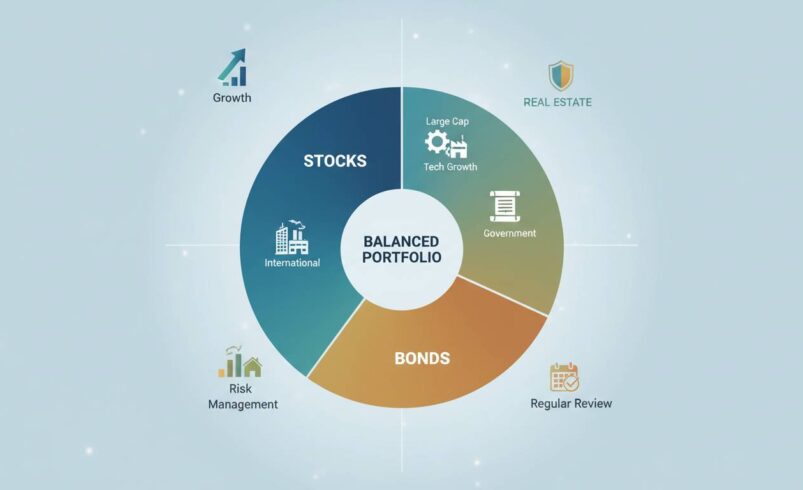

Portfolio rebalancing is essential for maintaining your intended risk exposure over time. What many investors don’t realize is that the conventional approach—selling overweighted positions and buying underweighted ones—often creates unnecessary tax liabilities and transaction costs that eat into returns. After working with enough portfolios, I’ve seen the “sell and rebuy” method work perfectly fine on paper but cost investors real money in practice. The good news is that you can rebalance effectively while keeping your existing positions intact. These are legitimate methods that sophisticated investors have used for years to maintain their target allocations without triggering taxable events.
Traditional rebalancing works like this: you compare your current allocation to your target, identify positions that have drifted beyond your chosen threshold, and sell enough of the overweighted holdings to bring them back in line. Then you use the proceeds to buy more of the underweighted positions. Simple in theory, costly in practice.
When you sell appreciated securities, you realize capital gains. In a taxable account, those gains become taxable income. The IRS wants its share, and the bill can be substantial depending on how long you’ve held the position and your income bracket. Short-term capital gains are taxed at your ordinary income rate, which can reach 37% for high earners. Long-term gains get preferential treatment at 0%, 15%, or 20%, but even that 15% or 20% adds up significantly on large positions.
Beyond taxes, there’s the problem of transaction costs. Even with commission-free trading common today, bid-ask spreads and market impact on larger trades can nibble away at your returns. More importantly, when you sell a position that’s performing well, you’re reducing your exposure to something that was working for you—not always a smart move just because the allocation drifted.
The methods explained below solve these problems by using new money and natural portfolio flows to shift your allocation gradually rather than through forced sales.
Method 1: Direct New Contributions
The simplest way to rebalance without selling is to direct all new contributions toward your underweighted positions. This approach works particularly well if you’re consistently adding money through 401(k) contributions, IRA deposits, or regular brokerage investments.
Here’s how it works. Suppose your target allocation is 60% stocks and 40% bonds, but after a strong equity market run, your portfolio has drifted to 70% stocks and 30% bonds. Rather than selling stocks to buy bonds, you simply direct all new money into bonds until they return to your 40% target. If you’re adding $1,000 monthly to a $100,000 portfolio, you’d allocate that entire $1,000 to bonds until the drift corrects itself.
This method has several advantages. You avoid all capital gains taxes because you’re not selling anything. You continue participating in any further stock market gains while building your bond position. The gradual approach also reduces the risk of poor timing—you’re dollar-cost averaging into underweighted positions rather than making a large lump-sum change.
The limitation is obvious: this only works if you’re regularly contributing new capital. If your portfolio is fully funded and you’re not adding money, this approach won’t help you rebalance without selling. For investors still in the accumulation phase, though, it’s often the best first option to consider.
Method 2: Dividend Reinvestment Plans
If you own dividend-paying stocks or funds in taxable accounts, you have a powerful rebalancing tool already built into your portfolio: the dividend reinvestment decision.
Most brokerage accounts offer automatic dividend reinvestment, called DRIP. When enabled, dividends are automatically used to purchase additional shares of the same security. This is actually the default behavior that causes most portfolios to drift further from their targets—your dividends buy more of whatever just paid them, reinforcing the overweighted positions.
The smarter approach is to manually reinvest dividends. When a dividend payment arrives, you don’t automatically buy more of that same security. Instead, you direct that cash toward whatever asset class is most underweighted relative to your target allocation.
Consider an investor with a three-fund portfolio containing US stocks, international stocks, and bonds. International stocks have drifted to 12% when the target is 20%. When the US stock fund pays a dividend, the investor takes that cash and buys more international stocks. When the bond fund pays, the same approach applies—direct the proceeds to whichever position needs it most.
This method requires some attention and manual management, but it works well. You’re using money that would have been reinvested automatically anyway, just pointing it in a different direction. The tax treatment remains the same—dividends are taxed whether you reinvest them or not—but you’re not creating new taxable events through trades.
One caveat: this works best in taxable accounts where you receive actual dividend payments. In tax-advantaged accounts like IRAs or 401(k)s, dividend reinvestment happens automatically and you can’t redirect it without doing a full rebalance anyway.
Method 3: Systematic Cash Flow Allocation
This method extends the contribution approach to include any money leaving or entering your portfolio, not just new contributions. It works particularly well for investors who take regular withdrawals or who have predictable cash flows.
The core principle is straightforward: every dollar that enters or exits your portfolio gets directed to maintain or restore your target allocation rather than following the path of least resistance.
Here’s a practical example. An investor takes $4,000 monthly withdrawals from a $500,000 portfolio for retirement living expenses. The monthly withdrawal provides an opportunity for rebalancing. When it’s time to take $4,000, instead of simply selling whatever holdings are convenient, the investor sells from the overweighted positions specifically. If stocks have grown to 70% of the portfolio when the target is 60%, the withdrawal comes primarily from stocks, reducing them toward the target while leaving bonds untouched.
The same logic applies in reverse with any cash inflow. When you receive a bonus, an inheritance, or proceeds from selling a property, that money doesn’t automatically go wherever you typically invest it. You direct it strategically toward underweighted positions.
This approach works because it treats every transaction as a rebalancing opportunity. You’re constantly nudging the portfolio back toward target rather than waiting for annual or semi-annual reviews when the drift has become severe.
The limitation is that this requires you to be engaged with your portfolio at least monthly and to make deliberate decisions about every transaction. For hands-off investors, this level of attention may not be practical.
Method 4: Tax-Loss Harvesting Integration
Tax-loss harvesting is a technique where you sell securities at a loss to offset capital gains elsewhere in your portfolio, reducing your overall tax bill. When integrated with rebalancing, it becomes a powerful tool for adjusting your allocation without the usual tax consequences.
The integration works like this: when you identify positions that are both overweighted relative to your target and currently showing a loss, you can sell them to realize the loss while simultaneously buying a similar (but not identical) investment that fills the same allocation role. The loss provides a tax benefit while your actual market exposure remains unchanged.
For example, suppose you’ve drifted to 75% stocks when your target is 60%. You have a significant position in a total US stock market index fund that’s currently down 10% from your cost basis. You sell that fund and immediately buy a different US stock index fund—say, one that tracks the S&P 500 rather than the total market. The two funds are highly correlated, so your investment risk remains similar, but you’ve realized a loss that can offset gains or reduce your tax bill.
This method requires care to avoid the wash-sale rule, which prohibits claiming a loss if you buy a “substantially identical” security within 30 days before or after the sale. Using different funds that track different indices generally avoids this issue, but you need to be deliberate about the substitution.
This method works best when you actually have losses to harvest. If all your positions are in gains, you’re creating taxable events rather than avoiding them. However, in bear markets or when specific positions have underperformed, this becomes an exceptionally powerful rebalancing tool.
Choosing the Right Rebalancing Method
Selecting the best approach depends on your specific situation. Here’s a framework that helps most investors decide which methods to prioritize.
If you’re still adding money to your portfolio regularly—whether through retirement accounts or taxable investing—Method 1 should be your first approach. It’s the simplest, requires the least ongoing attention, and avoids all tax consequences. There’s no reason to sell anything when you can simply direct new money where it’s needed.
If you have substantial dividend-paying positions in taxable accounts, Method 2 provides ongoing rebalancing without additional capital. This works especially well for retirees or income-focused investors who are already receiving regular dividend payments.
If you’re taking withdrawals, Method 3 becomes highly effective. Every dollar that leaves your portfolio can be structured to reduce overweighted positions while maintaining your overall strategy.
Method 4 is situational but powerful when applicable. It works best when markets have pulled back, specific positions have underperformed, or you have other capital gains to offset.
Most investors will use some combination of these methods. A retiree taking withdrawals might primarily use Method 3 while also employing Method 2 for dividend payments. An accumulator might rely on Method 1 for new contributions while using Method 2 for reinvested dividends.
How Often Should You Rebalance
The standard advice—rebalance annually or when allocations drift 5% from target—assumes you’re using the traditional sell-and-rebuy method. With the approaches outlined above, frequency matters less because you’re not fighting massive drift through dramatic interventions.
That said, you still need to monitor your allocation periodically. I recommend reviewing your portfolio allocation quarterly to identify which positions are drifting and whether your methods are working to correct them. Monthly is probably excessive unless you’re making frequent trades anyway, and annual reviews risk letting drift get too far before addressing it.
The threshold that should trigger action isn’t a specific percentage deviation but rather a clear mismatch between your intended risk exposure and your actual risk exposure. If your target is 60% stocks and you’ve drifted to 70%, that 10 percentage point gap matters far more for a conservative investor than for an aggressive one. The more aggressive your target allocation, the less concerned you should be about stock-heavy drift. The more conservative your target, the more quickly you should act when equities grow beyond their intended weight.
I don’t pretend to know whether rebalancing actually improves returns. The academic evidence is genuinely mixed. Some studies show modest improvements; others show no significant difference; some even show slight underperformance compared to a buy-and-hold approach. What rebalancing definitely does is maintain your intended risk level. If you want consistent risk exposure regardless of market conditions, you need to rebalance. If you’re comfortable with your risk level changing as markets move, you can be more passive. Neither approach is objectively wrong—it’s a personal preference based on how much volatility you can sleep well with.
Frequently Asked Questions
How do I rebalance without selling? You can rebalance by directing new contributions, dividend payments, and other cash flows toward underweighted positions rather than automatically reinvesting in the same securities. This gradually shifts your allocation without triggering taxable sales.
What percentage deviation triggers rebalancing? There’s no universal rule, but many financial advisors recommend reviewing your allocation when any position drifts more than 5 percentage points from its target. More conservative investors may prefer a 3-5% threshold, while aggressive investors comfortable with equity exposure might tolerate 10% or more.
Does rebalancing hurt returns? Research is mixed. Rebalancing typically reduces volatility more than it improves total returns, though it can capture gains from rebalancing into asset classes that have fallen out of favor. The primary benefit is maintaining consistent risk exposure rather than maximizing returns.
What is the tax consequence of rebalancing? Traditional rebalancing through selling creates taxable capital gains. The methods outlined in this article—using new money, dividends, and cash flows—allow you to rebalance without creating taxable events. Tax-loss harvesting does create losses that can offset gains, potentially reducing your overall tax bill.
The Honest Truth About Portfolio Management
These rebalancing methods work, but I should be transparent about their limitations. The no-sell approaches are slower than traditional rebalancing. If your portfolio has drifted dramatically—say, from 60% stocks to 85% stocks during a prolonged bull market—waiting for new money to gradually restore your target could take years. At some point, the gap between your actual risk exposure and your intended risk exposure becomes too large to ignore.
There’s also a psychological component worth acknowledging. Watching your portfolio drift away from your target allocation can be uncomfortable, even when you know you’re avoiding taxes. The urge to “fix it” by selling winners is strong, and fighting that urge requires discipline. These methods work best for investors who genuinely care more about long-term outcomes than about maintaining precise allocation at every moment.
If your situation has changed—a retirement date is approaching, you received a large inheritance, your income has changed significantly—these gradual approaches may not be sufficient. Sometimes you need to rebalance aggressively despite the tax consequences because your time horizon or risk tolerance has fundamentally changed. That’s when the traditional approach makes sense.
The investors who do best are those who pick a sensible allocation, automate what they can, and resist the urge to overmanage. These no-sell rebalancing methods fit that philosophy perfectly. They’re not about maximizing every opportunity; they’re about maintaining discipline without creating unnecessary costs. That’s worth far more than any individual trade could ever deliver.