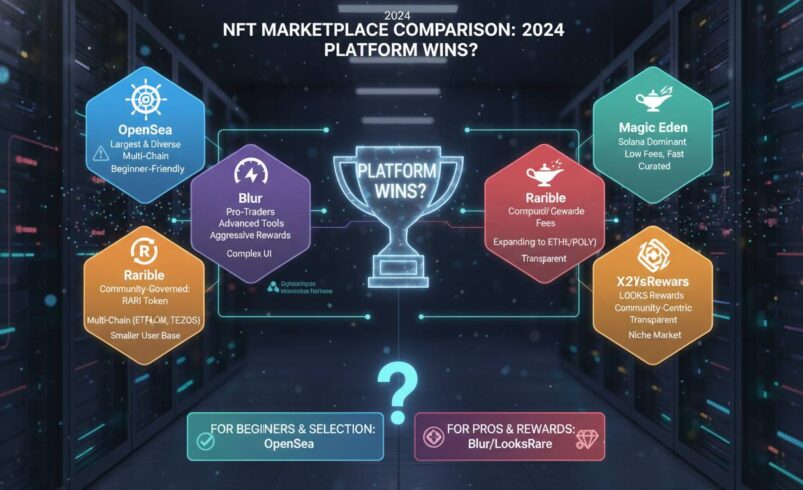

Quick Answer: OpenSea remains the dominant global NFT marketplace with the largest volume and community, but Indian users should consider factors like transaction fees (gas costs), payment method compatibility, and regulatory clarity when choosing a platform. For most Indian creators and collectors, OpenSea offers the best overall balance of liquidity and features, though Blur excels for professional traders seeking zero platform fees, and Magic Eden provides a cost-effective alternative on the Solana blockchain.
The Indian NFT market has experienced significant growth despite regulatory uncertainties, with platforms witnessing increased participation from Indian creators and collectors. Understanding which marketplace aligns with your specific needs—whether you’re minting, trading, or collecting—can save substantial costs and maximize your NFT experience.
Understanding the NFT Marketplace Landscape in 2024
The NFT marketplace ecosystem has evolved dramatically since the 2021-2022 boom, with multiple platforms competing for users through reduced fees, better curation, and enhanced creator tools. For Indian users specifically, the decision involves additional considerations: cryptocurrency exchange accessibility, transaction costs in Indian Rupees equivalent, and compliance with evolving regulatory frameworks.
Key Market Stats:
– Global NFT trading volume reached approximately $4.6 billion in 2023
– India ranks among the top 5 countries globally for NFT interest and search volume
– Ethereum remains the dominant blockchain for NFT transactions, though Solana has gained significant traction due to lower fees
– Average Ethereum gas fees for NFT transactions range from $5-$50 depending on network congestion, while Solana transactions typically cost $0.01 or less
The marketplace you choose impacts not just the upfront costs but also your access to buyers, the type of NFTs available, and the overall security of your transactions. This comparison examines the leading platforms through the lens of an Indian user priorities.
Top NFT Marketplaces Ranked by Relevance for Indian Users
1. OpenSea
Overview: OpenSea is the largest and most established NFT marketplace globally, serving as the primary platform for most NFT collections and creators.
Key Features:
– Supports Ethereum, Polygon, Solana, and Avalanche blockchains
– Offers both fixed-price and auction listings
– Provides API access for developers
– Extensive collection verification system
Fees:
– Platform fee: 2.5% on secondary sales
– Gas fees vary by blockchain (Ethereum: $5-$50+, Polygon: ~$0.01, Solana: ~$0.001)
Best For: Beginners, collectors seeking diversity, creators launching new projects
Pros:
– Largest user base and liquidity
– Wide variety of NFT collections
– User-friendly interface
– Strong security track record
– Supports multiple blockchains
Cons:
– Higher platform fees compared to competitors
– Ethereum gas fees can be prohibitive during congestion
– Customer support response times can be slow
2. Blur
Overview: Blur emerged as a professional-focused marketplace challenging OpenSea’s dominance, particularly among traders and flippers.
Key Features:
– Aggregates listings from multiple marketplaces
– Real-time floor price analytics
– Portfolio tracking tools
– Zero platform fees for traders
Fees:
– Platform fee: 0% (competitive maker-taker fee structure)
– Ethereum gas fees apply
Best For: Active traders, professional NFT flippers, analytics-focused users
Pros:
– Industry-leading analytics dashboard
– Zero platform fees attract volume traders
– Fast execution and clean interface
– Active community and airdrops
Cons:
– Steeper learning curve for beginners
– Less focus on casual collectors
– Requires ETH holdings for transactions
3. Magic Eden
Overview: Magic Eden dominates the Solana NFT ecosystem and has expanded to support multiple blockchains, becoming a top choice for cost-conscious users.
Key Features:
– Strong focus on gaming and entertainment NFTs
– Launchpad for new Solana projects
– Cross-chain support (Solana, Ethereum, Polygon)
– Mobile application available
Fees:
– Platform fee: 2% on secondary sales
– Minimal transaction costs (Solana: ~$0.001)
Best For: Budget-conscious users, gaming NFT enthusiasts, those seeking low-cost transactions
Pros:
– Extremely low transaction fees
– Strong gaming ecosystem presence
– Growing multi-chain support
– Active community in Asian markets
Cons:
– Smaller Ethereum collection compared to OpenSea
– Liquidity concerns for rare/expensive NFTs
– Still building brand trust compared to established platforms
4. Rarible
Overview: Rarible operates as a multi-chain NFT marketplace with its own governance token, offering unique community-driven features.
Key Features:
– Multi-chain support (Ethereum, Flow, Tezos, Polygon)
– Native $RARE token for governance
– Creator-focused royalty system
– Community curation features
Fees:
– Platform fee: 2.5% secondary sales
– Gas fees vary by blockchain chosen
Best For: Creators seeking customizable storefronts, multi-chain explorers, community-oriented users
Pros:
– Multi-chain flexibility
– Lower fees on networks like Polygon
– Creator-centric features
– Governance token benefits
Cons:
– Lower trading volume than OpenSea
– Some features require holding $RARE
– Interface can feel dated compared to competitors
5. Foundation
Overview: Foundation positions itself as a curated, premium marketplace focusing on high-quality digital art and verified creators.
Key Features:
– Invitation-only creator onboarding
– Curated auction system
– Strong emphasis on digital art
– Cult-like community following
Fees:
– Platform fee: 5% on secondary sales
– Gas fees (Ethereum network)
Best For: Serious digital art collectors, artists seeking premium placement, high-value transactions
Pros:
– High-quality, curated collections
– Strong reputation in the art world
– Transparent auction mechanism
– Active collector community
Cons:
– High platform fees
– Limited to Ethereum
– Barriers to entry for new creators
– Not suitable for budget beginners
Comparative Analysis: Which Platform Offers Indian Users the Best Value?
| Factor | OpenSea | Blur | Magic Eden | Rarible | Foundation |
|---|---|---|---|---|---|
| Platform Fee | 2.5% | 0% | 2% | 2.5% | 5% |
| Min Gas Cost (Ethereum) | $5-50+ | $5-50+ | N/A* | $5-50+ | $5-50+ |
| Min Gas Cost (Alt Chains) | ~$0.01 (Polygon) | N/A | ~$0.001 (Solana) | ~$0.01 (Polygon) | N/A |
| INR Payment Support | Limited | Limited | Limited | Limited | Limited |
| Best For | All-round | Traders | Budget users | Multi-chain | Premium art |
| Difficulty | Beginner | Intermediate | Beginner | Intermediate | Advanced |
| Indian User Rating | ⭐⭐⭐⭐ | ⭐⭐⭐⭐ | ⭐⭐⭐⭐⭐ | ⭐⭐⭐ | ⭐⭐⭐ |
*Magic Eden uses Solana, which has minimal fees compared to Ethereum
Critical Factors for Indian NFT Users
Transaction Costs and Gas Fees
For Indian users, transaction fees represent a significant consideration due to cryptocurrency price volatility and INR conversion rates. Ethereum gas fees, denominated in ETH, can fluctuate dramatically—during peak network congestion, a single transaction could cost ₹3,000-₹5,000, making small-value NFT trading impractical.
Strategic Approach:
– High-value NFTs: Ethereum-based platforms (OpenSea, Foundation) offer the best liquidity
– Low-budget trading: Polygon or Solana-based platforms minimize costs
– Batch transactions: Consolidate multiple operations to reduce per-transaction costs
Payment Methods and Accessibility
Indian users face unique challenges regarding cryptocurrency acquisition:
– Most major exchanges (CoinDCX, WazirX, ZebPay) support INR deposits via UPI, bank transfer, and cards
– Converting INR to USDT or ETH is straightforward, but users must complete KYC verification
– Direct NFT purchases with INR remain limited; cryptocurrency conversion is almost always required
Regulatory Considerations in India
The regulatory landscape for NFTs in India remains evolving:
– The Indian government has shown interest in regulating virtual digital assets
– TDS (Tax Deducted at Source) applies to crypto transactions, including NFT trades
– Users should maintain proper documentation of all transactions for tax purposes
– Operating within established, reputable platforms provides better legal protection
Common Mistakes Indian Users Should Avoid
Mistake 1: Ignoring Gas Fees When Pricing NFTs
Many new sellers list NFTs without accounting for gas costs, resulting in net losses on sales. Always calculate total costs (platform fee + gas + any listing fees) before minting or listing.
Mistake 2: Choosing Volume Over Security
Some platforms attract high trading volume but lack robust security measures. The 2022 OpenSea phishing attacks resulted in millions in losses. Enable two-factor authentication, use hardware wallets when possible, and verify all transaction details.
Mistake 3: Not Verifying Collection Authenticity
Scam collections appear regularly on major platforms. Verify collection age, creator verification status, and community engagement before purchasing. Tools like OpenSea’s verified badge and floor price tracking help identify legitimate projects.
Mistake 4: Overlooking Alternative Blockchains
While Ethereum dominates NFT volume, Polygon and Solana offer substantially lower costs. For Indian users operating on tighter budgets, these chains provide viable alternatives for learning and experimenting.
How to Choose Your NFT Marketplace
Choose OpenSea if:
– You want the largest selection and highest liquidity
– You’re new to NFT trading and need a user-friendly platform
– You plan to hold or trade valuable, established collections
Choose Blur if:
– You’re an active trader seeking analytics tools
– Zero platform fees are a priority
– You already hold ETH and understand gas fee dynamics
Choose Magic Eden if:
– Transaction costs are your primary concern
– You’re interested in gaming NFTs or Solana-based projects
– You want a mobile-friendly trading experience
Choose Rarible if:
– You want to explore multiple blockchains
– You prefer community-driven platforms
– You’re a creator wanting customizable storefronts
Choose Foundation if:
– You’re a serious art collector seeking curation quality
– You’re an established artist wanting premium market placement
– High-value transactions are your norm
Frequently Asked Questions
1. Which NFT marketplace is best for beginners in India?
OpenSea remains the best starting point for Indian beginners due to its intuitive interface, extensive educational resources, and large community. The platform supports Polygon, allowing users to start with minimal transaction costs while learning the ropes.
2. Can I buy NFTs in India using INR directly?
Currently, no major NFT marketplace supports direct INR payments. Indian users must first purchase cryptocurrency (typically USDT, ETH, or SOL) through Indian exchanges like CoinDCX or WazirX using UPI or bank transfer, then connect their wallet to an NFT marketplace.
3. What are the tax implications for NFT trading in India?
As of 2024, NFTs are treated as virtual digital assets in India. Profits from NFT trading are subject to capital gains tax. Additionally, TDS (Tax Deducted at Source) applies to crypto transactions. Users must report gains in their annual tax returns and maintain records of all transactions.
4. Which blockchain offers the lowest fees for NFT transactions in India?
Solana and Polygon offer the lowest transaction fees. A Solana NFT transaction typically costs less than $0.01, while Polygon transactions cost approximately $0.01-$0.05. Ethereum transactions, while offering better liquidity, can cost $5-$50+ depending on network congestion.
5. Is it safe to use NFT marketplaces in India?
Using established marketplaces like OpenSea, Blur, Magic Eden, and Rarible is generally safe, but users must take personal security precautions: enable two-factor authentication, use hardware wallets for significant holdings, verify collection authenticity before purchasing, and avoid clicking suspicious links or sharing seed phrases.
Conclusion
The “best” NFT marketplace ultimately depends on your specific priorities: trading frequency, budget constraints, blockchain preferences, and experience level. For most Indian users, OpenSea provides the optimal balance of accessibility, security, and liquidity despite higher fees. However, active traders should consider Blur for zero platform fees, while budget-conscious users will find Magic Eden on Solana most cost-effective.
The Indian NFT market continues to mature, with increasing institutional interest and regulatory clarity expected in the coming years. Start with a established platform, begin with small transactions to understand the mechanics, and scale your involvement as you gain confidence. Remember that transaction costs (gas fees) can significantly impact profitability, so always factor these into your trading strategy.
For Indian creators specifically, the key is choosing a platform that matches your audience and collection type. OpenSea’s broad reach remains valuable for visibility, while dedicated communities like Foundation offer premium positioning for high-quality digital art.
Final Recommendation:
– Casual Users/Newcomers: Start with OpenSea using Polygon network
– Active Traders: Use Blur with Ethereum, monitor gas fees
– Budget-Conscious: Magic Eden on Solana
– Digital Artists: Foundation for premium placement, OpenSea for reach