
The battery industry is at an inflection point. For decades, lithium-ion technology has powered everything from electric vehicles to grid storage, but a challenger is emerging that could reshape the economics of energy storage. Sodium-ion batteries, once dismissed as a laboratory curiosity, are now moving toward commercial production — and investors need to understand what this means for their portfolios.
This isn’t a simple story of one technology replacing another. The reality is messier and more opportunity-rich than the binary narrative you’ll find in most investment coverage. Lithium remains essential to the near-term battery supply chain, but sodium’s entry creates a genuine fork in how energy storage scales over the next decade. Understanding the technical differences, company positions, and realistic timelines for commercialization will determine whether you capture value or get caught in hype cycles.
The Fundamental Technical Differences
The core distinction between lithium and sodium batteries comes down to chemistry. Lithium-ion batteries move lithium ions between the cathode and anode during charge and discharge cycles. Sodium-ion batteries do the same thing, except with sodium ions — which are larger and behave differently at the atomic level.
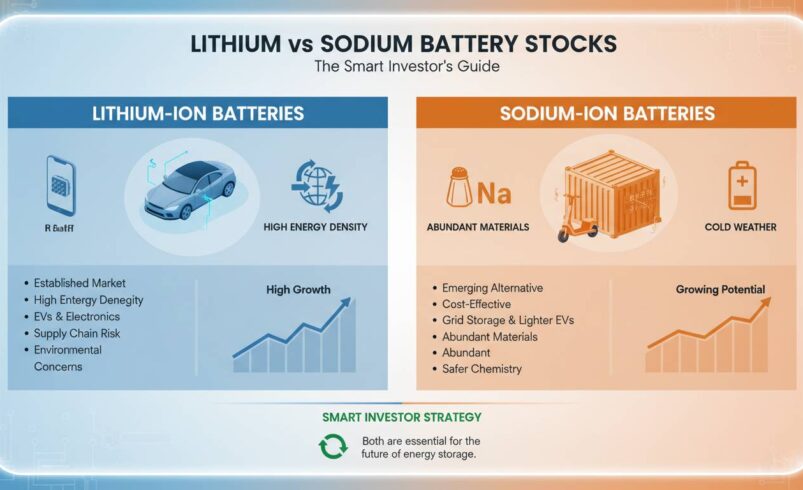
This matters for investors because the physical properties of sodium create specific trade-offs. Sodium-ion batteries currently achieve energy densities in the range of 140-160 Wh/kg, compared to lithium-ion cells that routinely hit 250-300 Wh/kg for consumer electronics and 200-250 Wh/kg for automotive applications. That gap matters significantly for electric vehicles, where range anxiety remains a concern. A sodium-ion battery pack would need to be physically larger and heavier than a lithium-ion pack to store the same amount of energy.
However, sodium offers advantages that investors should weigh properly. Sodium is abundant — it’s the sixth most common element in the Earth’s crust and can be extracted from seawater. Lithium, by contrast, remains concentrated in specific regions: the “lithium triangle” of Chile, Argentina, and Bolivia contains roughly 58% of global reserves, and extraction involves either hard-rock mining in Australia or brine evaporation in South America. The geopolitical concentration of lithium supply creates real procurement risks that have already shown up in price volatility.
Sodium carbonate currently trades at roughly $200-300 per ton, while lithium carbonate peaked above $80,000 per ton in 2022 before crashing to around $15,000-20,000 in 2024. Even at today’s depressed lithium prices, the raw material cost differential remains substantial. This is the central thesis behind sodium-ion adoption: cheaper, more geographically distributed inputs could eventually drive down battery costs enough to offset performance penalties.
Why This Matters for Investors Now
The timing matters because sodium-ion technology has crossed a threshold that makes it relevant to investment decisions — not as a distant possibility, but as an emerging commercial reality.
CATL, the world’s largest battery manufacturer, announced mass production of sodium-ion batteries in 2023 and began shipping to automotive customers in early 2024. BYD has announced plans to incorporate sodium-ion batteries in some vehicles. In Europe, Faradion (acquired by Reliance Industries in 2022) has been developing sodium-ion technology for over a decade. The Chinese market has seen particular acceleration, with multiple manufacturers announcing GWh-scale production capacities.
This matters for investors because it suggests the technology is moving beyond proof-of-concept into the scaling phase where company revenues and profitability become relevant — not just speculation about future potential. The question is no longer whether sodium-ion batteries will exist, but how quickly they can capture market share from lithium-ion and which companies are best positioned to benefit.
The Lithium Investment Landscape
Lithium remains the dominant battery chemistry and will continue to be for the foreseeable future. Any investor strategy that ignores this reality is incomplete.
The lithium investment universe breaks down into three main categories: producers, processors, and battery makers. Each carries different risk profiles and exposure to the underlying commodity.
Lithium producers are the most direct play on lithium demand. Albemarle (ALB) is the largest lithium producer globally, with operations in Chile, Australia, and the United States. The company expanded dramatically during the 2021-2022 lithium boom, adding significant production capacity just as prices collapsed. This created a painful margin compression that continues to affect the stock. SQM (Sociedad Química y Minera de Chile, ticker: SQM) is the second-largest producer, also based in Chile, with a focus on brine-based extraction. Both stocks have declined significantly from their 2022 peaks, and current valuations reflect much lower lithium price expectations.
Lithium processors convert raw lithium into battery-grade materials. Livent (LTHM) falls into this category, focusing on lithium hydroxide production for high-nickel cathode applications. The processing segment has faced its own challenges as battery manufacturers vertically integrate and Chinese processing capacity has expanded rapidly.
Battery manufacturers like Tesla (TSLA), Panasonic (PC), and LG Energy Solution expose investors to battery technology broadly but remain heavily weighted toward lithium-ion in their current product lines. CATL deserves particular attention as the largest battery manufacturer globally, with significant exposure to both lithium-ion dominance and early sodium-ion production.
The lithium sector faces a genuine supply-demand imbalance that investors must understand. Multiple new lithium projects are coming online in 2024-2025, particularly in Australia and Africa, while demand growth from EVs has slowed from the explosive rates of 2021-2022. This suggests lithium prices may remain depressed for longer than many investors expect, which pressures producer margins but could also create opportunity if prices eventually find a floor.
The Sodium Battery Investment Landscape
Investing in sodium-ion batteries is structurally different from investing in lithium — the companies involved are often smaller, younger, and less established, which means both higher risk and potentially higher reward.
The most direct pure-play exposure to sodium-ion technology comes from companies actually manufacturing the batteries. CATL leads this space, having announced the first generation of sodium-ion cells in 2021 and beginning mass production in 2023. The company’s sodium-ion batteries achieve energy densities around 160 Wh/kg — lower than lithium-ion but competitive for certain applications, particularly lower-speed vehicles and stationary storage.
Faradion, now a subsidiary of Reliance Industries , represents another significant player. The UK-based company has been developing sodium-ion technology since 2010 and holds important patents in the space. Reliance’s $135 million acquisition in 2022 signaled serious industrial intent, and the company has announced plans to build GWh-scale production capacity in India.
Tiamat Energy is a French startup that has received significant backing for its sodium-ion technology. The company has partnerships with automotive suppliers and has announced plans for commercial production. While not publicly traded, investors can gain indirect exposure through strategic investors.
Natron Energy is a US-based company taking a different approach, focusing on sodium-ion batteries for data center and industrial backup power applications. The company uses Prussian blue analog chemistry, which offers extremely fast charging but lower energy density. Natron has received funding from energy industry investors and is scaling production.
In the materials space, companies producing sodium precursors could benefit from sodium-ion adoption. Aluminum producers like Alcoa (AA) could see marginal demand benefits, as sodium-ion batteries use aluminum current collectors instead of copper (which lithium-ion batteries use for anodes), reducing costs. However, this represents a small portion of overall demand.
The Competitive Threat Nobody’s Talking About
Here’s where I want to push back on the conventional narrative: the lithium-versus-sodium framing misses the most important dynamic in the battery industry right now, which is the actual competitive threat to both technologies.
Lithium-ion and sodium-ion batteries are both intercalation chemistries — they work by moving ions in and out of layered materials. The genuine disruption coming in battery technology isn’t sodium-ion versus lithium-ion; it’s solid-state batteries, which could offer dramatically higher energy density, faster charging, and improved safety. Companies like QuantumScape (QS), Solid Power (SLDP), and Toyota (TM) are investing billions in solid-state development.
This matters for investors because capital allocated to sodium-ion production could ultimately be stranded if solid-state technology achieves commercialization before sodium-ion captures significant market share. The timeline for solid-state remains uncertain — Toyota has suggested 2027-2028 for initial automotive deployment, which may prove optimistic, but the technical challenges are being addressed.
The practical implication: don’t think of this as a binary choice between lithium and sodium. Think of it as a portfolio allocation question where lithium provides near-term exposure to a mature industry, sodium provides exposure to an emerging alternative that may capture specific market segments, and solid-state represents a tail-risk, high-upside option if the technology delivers on its promise.
Market Projections and Commercialization Timeline
Current market projections suggest sodium-ion batteries will remain a minority technology through at least 2030, but the absolute scale of battery demand is so large that even a small percentage represents meaningful market opportunity.
Benchmark Mineral Intelligence projects sodium-ion deployments reaching approximately 70-80 GWh by 2030, compared to total battery demand exceeding 3,000 GWh. At the cell level, this suggests sodium-ion captures roughly 2-3% of the overall battery market — significant for the companies involved but not transformative for the broader lithium market.
The applications where sodium-ion makes the most economic sense are becoming clearer. Stationary grid storage is perhaps the most compelling use case: energy density matters less when batteries are sitting in a warehouse or container, while cost and supply chain security matter more. Sodium-ion batteries could compete effectively for grid storage applications where lithium-ion prices remain too high for many deployments.
Low-speed electric vehicles represent another natural market. Chinese automakers have been particularly aggressive here, deploying sodium-ion batteries in electric scooters and low-speed vehicles where the range requirements are modest and cost sensitivity is high.
Urban delivery vehicles and short-range logistics vehicles could similarly benefit from sodium-ion economics, particularly for fleet operators focused on total cost of ownership rather than maximum range.
The timeline for these applications moving from pilot to scale deployment is roughly 2025-2027, with significant commercial volume likely appearing in 2026-2028. Investors should be cautious about companies claiming they will be “the first to mass produce” — the distinction between pilot production, limited commercial production, and true volume manufacturing is enormous, and companies often blur these lines in press releases.
Risk Assessment for Each Technology
Lithium investment carries several distinct risks that investors must evaluate. Price volatility remains the most significant — lithium has experienced boom-bust cycles before and will likely do so again. The 2022 price spike and subsequent collapse demonstrated how quickly sentiment can shift. Demand risk also matters: if EV adoption slows more than expected, lithium demand projections could prove too optimistic. Finally, technology substitution risk is real, though perhaps limited in the near term.
Sodium-ion carries different risk profiles. Technology risk remains meaningful — the energy density gap versus lithium-ion may prove harder to close than optimistic projections suggest. Scale-up risk is significant: moving from laboratory demonstration to mass production with consistent quality is notoriously difficult in battery manufacturing. Market acceptance risk applies if automotive companies and consumers remain skeptical of the technology’s suitability for their needs.
The most underappreciated risk, in my view, is execution risk at the company level. Many of the companies positioning themselves as sodium-ion leaders are either startups without long operating histories or large conglomerates where sodium-ion represents a tiny portion of overall business. Evaluating management quality, manufacturing capability, and genuine strategic commitment is difficult for outside investors.
Making Investment Decisions in This Space
Given these dynamics, how should investors actually approach this sector?
First, recognize that the battery industry is not a monolith. The supply chain is long and differentiated, with different segments offering different risk-return profiles. Lithium producers offer direct commodity exposure; battery makers offer execution exposure on the manufacturing side; and materials companies offer exposure to the intermediate processing layer.
Second, consider your time horizon carefully. If you’re looking for shorter-term opportunities, lithium producers currently trade at depressed valuations reflecting near-term price weakness — but the timing of any recovery is genuinely uncertain. Sodium-ion opportunities are more suitable for longer-term investors who can tolerate the uncertainty inherent in emerging technologies.
Third, look beyond the ticker symbols to understand what actually drives company value. For lithium producers, this means understanding production costs, reserve quality, and expansion plans. For battery manufacturers, it means understanding manufacturing scale, customer relationships, and technology roadmaps. The narrative around a company matters less than the fundamentals.
Fourth, consider diversification across the technology spectrum. Holding positions in both lithium leaders and emerging sodium players provides exposure to multiple outcomes. The risk of picking the “wrong” technology is reduced if you hold exposure to both.
FAQ: Common Investor Questions
Is sodium better than lithium for batteries?
The answer depends entirely on the application. Sodium-ion batteries offer lower cost and better supply chain geography, but lower energy density. For applications where weight and space are critical — like passenger EVs — lithium-ion retains meaningful advantages. For stationary storage and low-speed vehicles, sodium-ion can be competitive or superior on a total cost of ownership basis.
Which battery stocks are investing in sodium technology?
CATL is the clear leader in actual production. BYD has announced sodium-ion integration in some vehicles. Faradion (Reliance Industries) and various Chinese manufacturers are scaling production. Among US-listed companies, exposure is more limited — most sodium-ion development is happening at privately-held companies or through foreign subsidiaries.
When will sodium batteries be commercialized?
Sodium-ion batteries are already being produced commercially. CATL began shipping in early 2024. The question is not whether commercialization occurs but how quickly production scales and how much market share sodium-ion captures. Expect meaningful deployment in stationary storage and low-speed vehicles through 2025-2027, with broader adoption dependent on continued cost improvements.
Are sodium batteries ready for mass production?
The technology has moved from laboratory to initial production, but “mass production” in battery industry terms means GWh-scale manufacturing with consistent quality and costs competitive with lithium-ion. This transition is ongoing and will likely take several more years to fully realize. The 2025-2027 period will be critical for demonstrating whether sodium-ion can achieve the manufacturing scale needed for widespread deployment.
What are the main advantages of sodium over lithium?
Cost is the primary advantage: sodium carbonate is dramatically cheaper than lithium carbonate, and sodium is more geographically distributed. Sodium-ion batteries also charge faster and perform better at low temperatures. The disadvantages are primarily energy density and cycle life, though both are improving with continued development.
Where This Leaves Investors
The battery technology landscape is evolving faster than most investment coverage acknowledges. Sodium-ion is no longer a speculative possibility — it’s an emerging commercial reality that investors must factor into their thinking about the energy storage sector. But it’s not a simple story of replacement or disruption.
The most likely outcome over the next decade is coexistence: lithium-ion retains its dominant position in high-performance applications while sodium-ion captures market share in cost-sensitive, energy-density-flexible applications. Both technologies will benefit from the overall growth in battery demand, even as they compete in specific segments.
What remains unresolved is how quickly sodium-ion can close the energy density gap, whether solid-state technology will disrupt both approaches before sodium-ion achieves full scale, and which companies will emerge as the manufacturing leaders. These are the questions that will determine investment returns, and they don’t have clear answers yet.
The investors who do well in this space will be those who understand the nuance — who recognize that the lithium-versus-sodium framing is useful but incomplete, who dig into company-specific fundamentals rather than chasing sector narratives, and who maintain the discipline to adjust as the technology and market evolve. That’s harder than picking a side, but it’s also where the actual opportunity lies.