
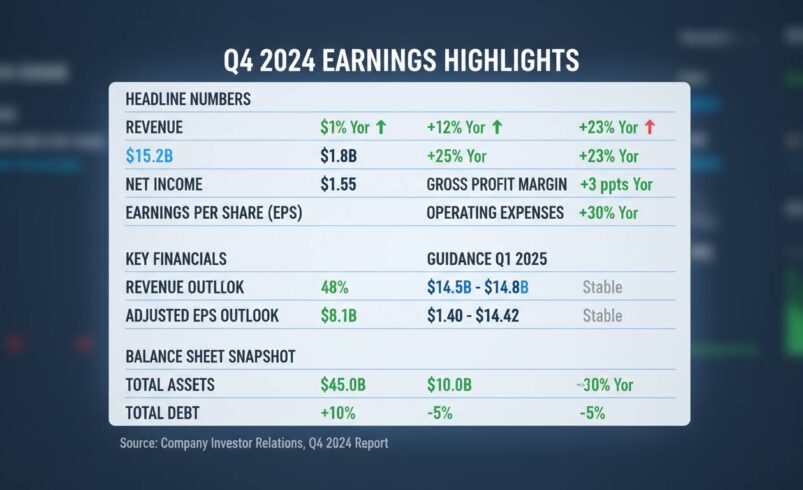

Most investors glaze over at the sight of a 50-page earnings report, check only the headline revenue and EPS numbers, and then wonder why they keep getting surprised by stock movements. The actual story lives in the sections everyone skips—the footnotes, the management discussion, the guidance revisions. I’ve spent over a decade analyzing financial statements for institutional investors, and I can tell you that the difference between amateur and professional analysis isn’t about having more data; it’s about knowing which numbers actually move the needle and what questions to ask when something looks off.
This guide walks you through everything that matters in an earnings report, from the income statement down to the often-overlooked MD&A section. You’ll learn what to prioritize, what to question, and how to connect the numbers into a coherent narrative about where the company is headed.
Understanding the Core Documents
Before diving into specific metrics, you need to understand what you’re actually looking at. A quarterly earnings report typically consists of three financial statements—the income statement, balance sheet, and cash flow statement—plus supporting sections including the notes to financial statements and the Management Discussion and Analysis (MD&A). The 10-Q is filed quarterly for most public companies, while the 10-K is the comprehensive annual filing that includes audited statements.
The income statement shows revenue and expenses over a specific period, essentially answering “did they make money?” The balance sheet provides a snapshot of assets, liabilities, and equity at a single point in time—what the company owns versus what it owes. The cash flow statement bridges the gap between accrual accounting (used on the income statement) and actual cash movements, which matters far more than most retail investors realize.
Apple’s 2024 10-K ran over 80 pages. Most individual investors read the press release headline, saw $391 billion in revenue, and moved on. But the real insights—the shift in services revenue mix, the gross margin compression from product mix changes, the capital return strategy detailed in the notes—require going deeper. That’s where professional analysis begins.
Revenue: The Top Line Isn’t Optional
Revenue seems straightforward: it’s total sales. But understanding revenue requires digging into how it’s recognized, what drove the change, and whether the trajectory supports the current valuation. Companies can book revenue legitimately in ways that don’t reflect cash coming in immediately, which is why looking at revenue in isolation without context is dangerous.
What drove the revenue change? Was it volume, price increases, or acquisitions? For Apple, when services revenue grew 14% year-over-year in fiscal 2024 while iPhone sales grew only 6%, that shift signaled a fundamental business model evolution that mattered more than the headline number. A company achieving revenue growth through price increases in a competitive market faces different risk profiles than one growing through volume expansion.
Compare the reported revenue to analyst consensus estimates. Earnings reports typically show whether the company beat, met, or missed Wall Street expectations. But here’s what most people miss: the magnitude of the beat or miss matters less than the underlying trend. Amazon beating expectations by 2% after guiding higher for three consecutive quarters tells a different story than a company that beat by 2% after guiding lower.
Earnings Per Share: Look Beneath the Headline
EPS gets the most attention in earnings season, and that’s partly because it’s the number most directly tied to analyst estimates and stock price movements in the short term. But EPS is also the most manipulated figure in financial reporting, and understanding what drives it separates serious analysts from casual observers.
Basic EPS is simply net income divided by shares outstanding. But diluted EPS accounts for securities that could convert into shares—stock options, convertible bonds, warrants. Always use diluted EPS for valuation purposes. Berkshire Hathaway’s 2024 annual report made this crystal clear when they detailed how share-based compensation added significant dilution that basic EPS calculations ignored.
The more important analysis involves understanding what drove EPS changes. Did earnings improve because the core business generated more profit, or because the company reduced shares through buybacks? Buybacks boost EPS mathematically—fewer shares divided into the same earnings—but they don’t create value if the shares were purchased at inflated prices. Microsoft spent over $56 billion on share repurchases in fiscal 2024. That drove EPS higher, but the real question is whether the business operations improved enough to justify the stock price.
Net Income vs. Operating Income: What’s Actually Under the Hood
Net income—the bottom line—includes everything: operations, interest, taxes, one-time items, and accounting adjustments. It’s useful as a final score but terrible as a diagnostic tool. Operating income, by contrast, shows how the core business performed before financing decisions and tax situations cloud the picture.
Consider a company with $500 million in operating income but $50 million in net income after paying interest on debt and recording a one-time impairment. The headline profit number looks weak, but the operating performance might be excellent. Conversely, a company with strong net income from a tax benefit or asset sale might have deteriorating operations masking the real problem.
Look for the reconciliation between operating income and net income. If operating income and net income diverge significantly, understand why. Heavy debt loads show up as interest expense. Tax rate changes appear in the provision for income taxes. One-time items—restructuring charges, asset impairments, litigation settlements—often recur but get presented as exceptional. The pattern matters more than any single quarter.
Gross Margin and Operating Margin: Efficiency Matters
Margins reveal how efficiently a company converts revenue into profit. Gross margin—revenue minus cost of goods sold, divided by revenue—shows pricing power and production efficiency. Apple maintained a gross margin around 46% in 2024, extraordinarily high for hardware manufacturing, because of its services mix and brand pricing power. That margin is what sustains Apple’s valuation premium.
Operating margin takes gross margin further, subtracting operating expenses like R&D and selling, general, and administrative costs. A company with 25% gross margin but 5% operating margin has most of its profitability eaten by operating costs. That’s a different business than one with 30% gross margin and 15% operating margin, even if they generate identical revenue.
Track margins over time. Margin compression in a competitive market signals trouble ahead; margin expansion suggests sustainable competitive advantages. When Amazon’s AWS operating margin expanded to over 36% in recent years, it transformed the company from a low-margin retailer narrative to a high-margin technology company story. The market capitalization shift reflected that margin evolution.
Guidance: Where Management Signals the Future
Forward guidance—what management projects for upcoming quarters or years—matters more than historical results for stock movements. The market trades on expectations, and guidance establishes what expectations should be.
When a company guides higher, analysts revise their models upward, and the stock typically rises. When guidance comes in below expectations, even a company that beat current-quarter estimates can see its stock drop. This is why earnings season creates volatility: the gap between what a company reported and what it projects determines whether the stock moves.
The nuance is in understanding how management frames guidance. Are they confident or cautious? Do they provide specific ranges or vague directional statements? When NVIDIA guided substantially higher in early 2024, citing strong demand for AI chips, that guidance update reshaped the entire technology sector’s valuation framework. Management willingness to raise guidance signaled demand sustainability that the market rewarded with significant price appreciation.
Be skeptical of guidance that seems too optimistic or too pessimistic. Management has incentives to guide conservatively to set up beats, or aggressively to support stock prices. Compare guidance to historical accuracy. Some companies consistently sandbag estimates; others consistently miss their own projections.
The Cash Flow Statement: What Actually Moved
Accrual accounting—used for the income statement—records revenue when earned and expenses when incurred, regardless of when cash actually changes hands. This creates legitimate questions about whether reported earnings reflect real cash generation. The cash flow statement answers those questions.
Operating cash flow shows cash generated from core business activities. Comparing operating cash flow to net income reveals the quality of earnings. Strong businesses typically generate cash flow roughly equal to or higher than accounting profits. When cash flow persistently lags net income, investigate why—it’s often accounts receivable growing faster than sales or inventory buildup, both of which signal future problems.
Investing cash flow captures capital expenditures and acquisitions. Companies investing heavily in growth have negative investing cash flow, which is often healthy. But look at what they’re investing in. Amazon’s heavy CapEx in fulfillment infrastructure built competitive advantages that manifested in cash flow years later.
Financing cash flow shows how the company raises and returns capital—debt issuances, repayments, dividend payments, share repurchases. A company consistently generating positive operating cash flow but still issuing debt warrants scrutiny. Conversely, a company returning capital to shareholders through dividends and buybacks while maintaining a strong balance sheet signals financial health.
Management Discussion and Analysis: Read This Carefully
The MD&A section is where management explains the numbers in plain English, discusses trends, and acknowledges risks. It’s the most underread part of any earnings report, and that’s a mistake because it often contains information that won’t appear anywhere else.
Management will discuss what drove results, what challenges they face, and how they see the future developing. They also have legal obligations to disclose material risks and trends. The MD&A is where you’ll find context that makes the numbers meaningful.
When a company’s MD&A starts emphasizing “macro headwinds” or “uncertain demand environment,” that’s management signaling potential trouble. When they highlight new product launches or market expansion opportunities, they’re pointing to growth drivers. The language matters. Subtle shifts in how management discusses the business often precede actual performance changes.
Look for specific explanations of unusual items. If operating income dropped 20%, the MD&A should explain whether it’s due to increased R&D spending, margin pressure, one-time charges, or something else. Without that context, you’re guessing.
What to Skip: The Overrated Metrics
Some commonly cited figures matter less than the market thinks. Earnings beat percentages—the frequency with which a company exceeds analyst estimates—have declined as a meaningful signal because management and analysts coordinate closely. The game has shifted from beating estimates to managing expectations.
Stock-based compensation gets too much attention in isolation. It’s a real cost and dilutes shareholders, but it’s also often necessary to attract talent in competitive industries. The question is whether the compensation is reasonable relative to the value created, not whether it exists.
Revenue growth rates alone don’t tell the whole story either. A company growing 30% annually might be burning cash rapidly to achieve that growth; another company growing 5% might have exceptional cash conversion and sustainable economics. Growth without economics is a trap.
Conclusion: Building Your Own Framework
Reading an earnings report isn’t about finding one magic metric that tells you everything. It’s about building a systematic framework for understanding how a business makes money, where that money comes from, and whether the trajectory supports the current valuation.
Start with revenue to understand the top-line trajectory. Move to operating metrics—gross margin, operating margin, operating income—to understand efficiency. Examine cash flow to confirm the earnings are real. Read the guidance to understand what management expects. Dig into the MD&A to find context the numbers don’t explicitly provide.
The professionals who analyze these documents for a living don’t read them once and move on. They build models, compare quarters, track trends, and question assumptions. You don’t need to do that level of analysis for every company, but understanding what’s possible—and knowing which questions matter—changes how you evaluate any investment.