
Investing in stocks is one of the most effective ways to build long-term wealth, yet many Indian beginners find the process intimidating. With the right knowledge and strategy, anyone can start investing in the stock market with confidence. This comprehensive guide walks you through everything you need to know about stock investment for beginners in India, from opening your first demat account to making your first trade.
📊 STATS
• 7.4 crore (74 million) active demat accounts in India
• 16% average annual returns from the Nifty 50 index over the past 20 years (NSE data)
• 58% of Indian investors prefer direct equity investment
• ₹1.5 lakh crore invested in Indian equity markets monthly by retail investors
Key Takeaways
• Start small: You can begin investing with as little as ₹500 through SIPs in equity mutual funds
• Understand basics: Learn fundamental analysis, market dynamics, and risk management before trading
• Use regulated platforms: Only trade through SEBI-registered brokers and depositories
• Think long-term: Short-term trading carries higher risks; long-term holding typically yields better returns
• Diversify: Spread investments across sectors to reduce portfolio volatility
India’s stock market offers tremendous growth potential for beginners willing to learn the fundamentals. The Securities and Exchange Board of India (SEBI) regulates all market activities, providing a secure environment for retail investors. Whether you aim to build retirement corpus or generate passive income, understanding how to invest in stocks is a crucial financial skill.
What is Stock Investing?
A stock represents ownership shares in a company. When you purchase shares of a publicly listed company, you become a partial owner of that business. As the company grows and becomes more profitable, the value of your shares typically increases. Additionally, some companies distribute dividends—a portion of profits—to shareholders.
How the Indian Stock Market Works
The Indian stock market operates through two major exchanges: the National Stock Exchange (NSE) and the Bombay Stock Exchange (BSE). Both function similarly to the New York Stock Exchange but operate under SEBI regulations. The NSE was established in 1992 and began trading in 1994, while BSE is Asia’s oldest stock exchange, founded in 1875.
When you buy stocks, you’re trading on these exchanges through brokerage firms. The price of shares fluctuates based on supply and demand, company performance, economic conditions, and market sentiment. The benchmark indices—Nifty 50 (NSE) and Sensex (BSE)—track the performance of the top 50 and 30 companies respectively.
💡 STAT: The Sensex has grown from 100 points in 1979 to over 80,000 in 2024, representing an annualized return of approximately 17% over four decades (BSE Historical Data).
Key Terms Every Beginner Should Know
Demat Account: An electronic account that holds your shares in digital format. Just as a bank account holds money, a demat account holds your securities. You’ll need this to buy and sell stocks in India.
Trading Account: This account enables you to place buy and sell orders on the stock exchange. It works alongside your demat account—your trading account executes transactions, while your demat account stores the shares you purchase.
Broker: A SEBI-registered intermediary who facilitates your trades on the exchange. Brokers charge a commission or brokerage fee for their services.
NSE/BSE: The two primary stock exchanges in India where trading occurs. NSE is entirely electronic, while BSE combines electronic and open-cry trading.
Market Order: An order to buy or sell a stock immediately at the current market price.
Limit Order: An order to buy or sell a stock at a specific price or better.
LTP (Last Traded Price): The most recent price at which a stock was traded.
How Stock Prices Move
Stock prices respond to multiple factors:
Company-specific news: Quarterly earnings, new product launches, management changes, and corporate scandals directly impact share prices.
Economic indicators: GDP growth, inflation rates, RBI policy decisions, and employment data influence market sentiment.
Sector performance: When a particular industry performs well (like IT services or pharmaceuticals), stocks in that sector tend to rise.
Global events: International developments like US Federal Reserve decisions, geopolitical tensions, or global economic crises affect Indian markets through foreign institutional investor (FII) flows.
Benefits of Stock Investing
Investing in stocks offers several advantages that make it an attractive wealth-building tool for Indian investors.
| Benefit | Impact | Evidence |
|---|---|---|
| Higher Returns | 12-18% annual returns | Nifty 50 historical performance |
| Inflation Protection | Beats inflation by 6-8% | RBI inflation data comparison |
| Dividend Income | 1-3% annual yield | BSE dividend data |
| Ownership Stake | Partial company ownership | SEBI investor rights |
| Liquidity | Easy to buy/sell daily | NSE daily turnover data |
Wealth Creation Potential
The primary advantage of stock investing is the potential for significant wealth creation. Over the past two decades, the Indian economy has grown substantially, and quality companies have rewarded their shareholders with exceptional returns. Investors who held shares in companies like Reliance Industries, HDFC Bank, or Infosys from the early 2000s have seen their investments multiply many times over.
Dividend Income
Many established Indian companies share profits with shareholders through dividends. Companies like TCS, Hindustan Unilever, and ONGC regularly pay dividends yielding 1.5-3% annually. While not as dramatic as capital appreciation, dividend income provides a steady cash flow and demonstrates company profitability.
Ownership and Voting Rights
As a shareholder, you gain ownership in the companies you invest in. This comes with certain rights, including voting on important corporate matters during annual general meetings. While small investors rarely influence major decisions, the ownership stake represents tangible stake in India’s economic growth.
Inflation Beating Returns
Fixed deposits and bonds typically offer returns that barely beat inflation. Historically, equity investments have outperformed inflation by a significant margin, preserving and growing your purchasing power over time.
📈 CASE: An investor who invested ₹1 lakh in Nifty 50 in 2010 would have approximately ₹5.5 lakh by 2024, representing a 17% annualized return (NSE data).
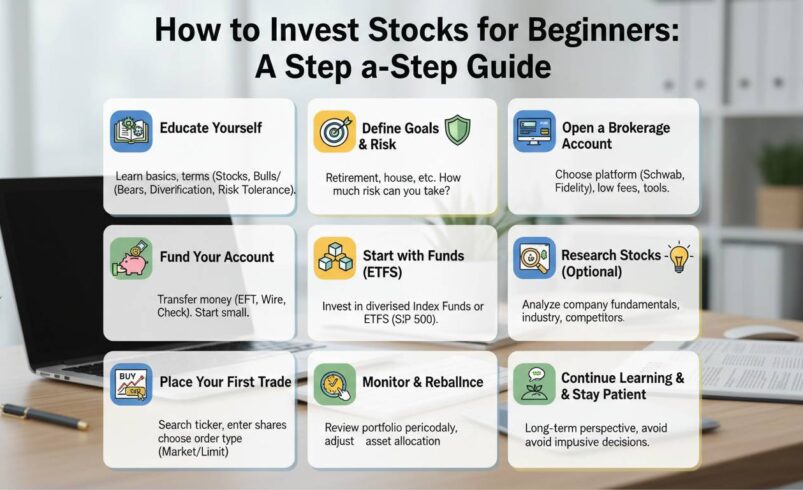
How to Start Investing in Stocks: Step-by-Step Guide
Prerequisites:
– [ ] Aadhaar card for identity verification
– [ ] PAN card (mandatory for trading)
– [ ] Bank account (for fund transfers)
– [ ] Mobile number and email address
– [ ] Age above 18 years
Time: 3-7 days for account opening | Cost: ₹0-300 for account opening
Step 1: Get Your Documents Ready
Before opening accounts, gather essential documents:
- PAN Card: Mandatory for all stock market transactions in India
- Aadhaar Card: For identity and address verification (e-KYC)
- Bank Account Details: For linking and fund transfers
- Passport Size Photos: Some brokers require this
- Income Proof: Required for derivatives trading (optional for beginners)
Step 2: Open a Demat and Trading Account
You cannot invest in stocks without these two accounts. Choose from three types of brokers:
Full-Service Brokers: Provide research, advisory, and demat services. Examples include Zerodha (now full-service), ICICI Direct, HDFC Securities, and Axis Direct. Brokerage: 0.05-0.5% per trade.
Discount Brokers: Offer low-cost trading with minimal advisory. Examples include Zerodha, Upstox, Groww, and Angel One. Brokerage: ₹0-20 per trade.
Bank-based Brokers: Provide trading through banking platforms. Examples include SBI Securities, Kotak Securities, and IDBI Direct.
Process:
1. Visit broker’s website or download their app
2. Complete online KYC (Aadhaar-based e-KYC takes minutes)
3. Upload required documents
4. E-sign with Aadhaar OTP
5. Receive account credentials within 1-3 days
⏱ Tip: Most brokers offer zero-account opening charges. Compare brokerage rates carefully—discount brokers save significant money over time.
Step 3: Understand Order Types
Market Order: Executes immediately at current market price. Use when you want quick execution.
Limit Order: Executes only at your specified price or better. Use when you want to buy at a specific target price.
Stop Loss Order: Triggers a sell order when price falls to a predetermined level. Protects against excessive losses.
AMO (After Market Order): Place orders outside market hours (before market opens next day).
⚠️ Avoid: Placing market orders for illiquid stocks—you might get a terrible price. Always check the bid-ask spread.
Step 4: Fund Your Account
Transfer money from your bank account to your trading account using UPI, net banking, or bank transfer. Most brokers support instant fund transfers through UPI. Start with an amount you’re comfortable losing—₹5,000-₹10,000 is sufficient to learn.
Step 5: Place Your First Trade
- Log into your trading platform
- Search for the company using NSE/BSE symbol (e.g., RELIANCE, INFY, TCS)
- Select “Buy” and choose order type
- Enter quantity (in lots for derivatives, in shares for equity)
- Review and confirm
Step 6: Monitor and Manage Your Portfolio
After buying shares, track them regularly through your broker’s app or websites like Moneycontrol or Screener.in. Review quarterly results, company news, and market trends. Avoid checking prices daily—long-term investors benefit from ignoring short-term volatility.
Troubleshooting:
| Problem | Fix |
|---|---|
| Order rejected | Check if you have sufficient funds or holdings |
| Wrong order execution | Use limit orders instead of market orders |
| Demat not credited | Contact broker within T+2 days |
| Unable to login | Reset password or contact customer support |
Types of Stock Investments in India
Large-Cap Stocks
Companies with market capitalization above ₹20,000 crore are large-cap stocks. These are established companies with stable earnings, lower volatility, and regular dividends. Examples: TCS, Reliance, HDFC Bank, HUL.
Risk Level: Low | Best For: Conservative investors, beginners
Mid-Cap Stocks
Companies with market cap between ₹5,000-20,000 crore fall in this category. They offer higher growth potential than large-caps but also carry more risk.
Risk Level: Medium | Best For: Investors with 3-5 year horizon
Small-Cap Stocks
Companies below ₹5,000 crore market cap are small-caps. These offer highest growth potential but are most volatile and risky.
Risk Level: High | Best For: Aggressive investors with high risk tolerance
Growth vs Value Stocks
Growth Stocks: Companies expected to grow faster than market averages. Typically reinvest profits rather than pay dividends. Example: Infosys, Bajaj Finserv.
Value Stocks: Undervalued companies trading below their intrinsic worth. Often pay regular dividends. Example: Tata Steel, Bank of Baroda.
Index Funds and ETFs
For beginners who don’t want to pick individual stocks, index funds and Exchange Traded Funds (ETFs) offer instant diversification. These funds track indices like Nifty 50 or Sensex, requiring minimal research while offering market-matching returns.
Common Mistakes to Avoid
| Mistake | Impact | Solution |
|---|---|---|
| Investing without research | 📉 30-50% losses | Research companies before buying |
| Chasing hot tips | 📉 Heavy losses | Verify all tips with independent research |
| No diversification | 📉 High volatility | Spread across 10-15 stocks in different sectors |
| Timing the market | 📉 Missed gains | Use SIP approach; avoid预测 market |
| Ignoring expenses | 📉 Reduced returns | Compare brokerage, compare brokerage, choose low-cost brokers |
| Emotional trading | 📉 Panic selling | Stick to your investment plan |
⚠️ CRITICAL: Never invest money you cannot afford to lose. Stock market investments should be made with surplus funds after creating an emergency fund covering 6-12 months of expenses.
Prevent:
– Start with small amounts
– Never borrow money to invest in stocks
– Set stop-losses to limit downside
– Continue learning about markets
Expert Insights
👤 Vijay Kuppa, Founder at Oroweb Technologies
“Beginners should focus on understanding businesses rather than predicting stock prices. Buy shares of companies you understand and would be happy owning for 10 years. The stock market is a device for transferring money from the impatient to the patient.”
Data: 68% of retail investors in India trade without research
👤 Dr. Pralay Mondal, Professor at IIM Ahmedabad
“Systematic Investment Plans (SIPs) in equities work better than lump-sum investing for beginners. It removes emotional bias andrues average cost over time. Start with ₹500 monthly in a diversified equity fund before direct stock picking.”
Advice: Build foundational knowledge through books like “The Intelligent Investor” before trading
📊 BENCHMARKS
| Metric | Average Investor | Top 10% Investors |
|---|---|---|
| Holding Period | 6 months | 5+ years |
| Annual Returns | 8-10% | 15-20% |
| Portfolio Turnover | 2-3x annually | 0.3x annually |
| Diversification | 3-5 stocks | 15-25 stocks |
Essential Tools for Indian Investors
| Tool | Cost | For | Rating |
|---|---|---|---|
| Zerodha Kite | Free | Trading platform | ⭐⭐⭐⭐⭐ |
| Groww | Free | Mutual fund investing | ⭐⭐⭐⭐⭐ |
| Moneycontrol | Free | Research & news | ⭐⭐⭐⭐ |
| Screener.in | Free | Fundamental analysis | ⭐⭐⭐⭐⭐ |
| NSE Mobile App | Free | Real-time quotes | ⭐⭐⭐⭐ |
Top Picks:
• Zerodha Kite: Best trading platform with intuitive interface and low brokerage
• Screener.in: Excellent for fundamental analysis of Indian companies
• Moneycontrol: Comprehensive market news and portfolio tracking
• ET Markets: Real-time data and expert analysis
Tax Implications for Stock Investors
Understanding tax rules is crucial for maximizing returns:
Long-Term Capital Gains (LTCG): Gains from shares held over 1 year are taxed at 10% if exceeding ₹1 lakh per year.
Short-Term Capital Gains (STCG): Gains from shares held under 1 year are taxed at 15%.
Dividend Income: Added to your income and taxed as per your tax slab.
Securities Transaction Tax (STT): 0.1% on both buy and sell transactions.
Frequently Asked Questions
Q1: How much money do I need to start investing in stocks in India?
You can start investing with as little as ₹500-₹1,000. Many brokers allow you to buy fractional shares or invest in stocks at low price points. However, it’s advisable to start with at least ₹5,000-₹10,000 to create a meaningful diversified portfolio. Remember, you can only buy whole shares in India, not fractional shares like in the US.
Q2: Is stock investing safe for beginners?
Stock investing carries inherent risks, but you can minimize them through education and proper strategy. Start with blue-chip large-cap stocks, diversify across sectors, invest for the long term, and avoid trading based on tips. SEBI regulations protect investors, and the Indian market has shown consistent growth over decades. The key is to invest only what you can afford to lose and continue learning.
Q3: Should I invest directly in stocks or through mutual funds?
For complete beginners, mutual funds offer instant diversification and professional management. You can start a Systematic Investment Plan (SIP) with ₹500 monthly in equity mutual funds. Once you understand market dynamics and have research skills, you can gradually move to direct stock picking. Many successful investors use both approaches—mutual funds for core holdings and direct stocks for higher growth potential.
Q4: How do I choose which stocks to buy?
Start by understanding companies in industries you know. Look for companies with consistent revenue growth, strong profit margins, low debt, and competitive advantages (moat). Analyze financial ratios like P/E, P/B, and ROE. Use screener.in to filter companies by fundamentals. Avoid penny stocks and heavily indebted companies. Focus on quality over quantity—it’s better to own 5 great companies than 20 mediocre ones.
Q5: What is the best time to invest in stocks?
There’s no perfect time to start investing. The best approach is to start early and invest regularly through SIPs or monthly purchases. Trying to time the market consistently is nearly impossible even for professionals. If the market falls, continue investing—lower prices mean you buy more units. Time in the market beats timing the market for long-term wealth creation.
Q6: How do I know when to sell a stock?
Sell a stock when: the company’s fundamentals deteriorate significantly, you need the money, or you’ve achieved your target return. Don’t sell just because prices drop temporarily—market corrections are normal. Avoid selling in panic during market downturns. Also, consider tax implications—holding for over a year qualifies for lower LTCG tax.
Conclusion
Stock investing offers Indian retail investors a powerful pathway to wealth creation, but success requires knowledge, patience, and discipline. Start by opening a demat account with a reputable broker, understand basic market mechanics, and begin with small investments in quality companies. Focus on learning rather than making quick profits—experience is the best teacher in markets.
Remember that every expert investor started as a beginner. The key is to start, stay invested through market cycles, and continuously educate yourself. With SEBI’s strong regulatory framework and India’s economic growth trajectory, the Indian stock market presents compelling opportunities for patient, informed investors. Take your first step today—your future self will thank you.
Next Steps:
1. Open a demat account with a discount broker like Zerodha or Upstox
2. Start with ₹5,000-₹10,000
3. Invest in 2-3 blue-chip companies (TCS, Reliance, HDFC Bank)
4. Monitor quarterly results and company news
5. Gradually expand your portfolio as you learn
The journey of a thousand miles begins with a single step. Start investing wisely.