
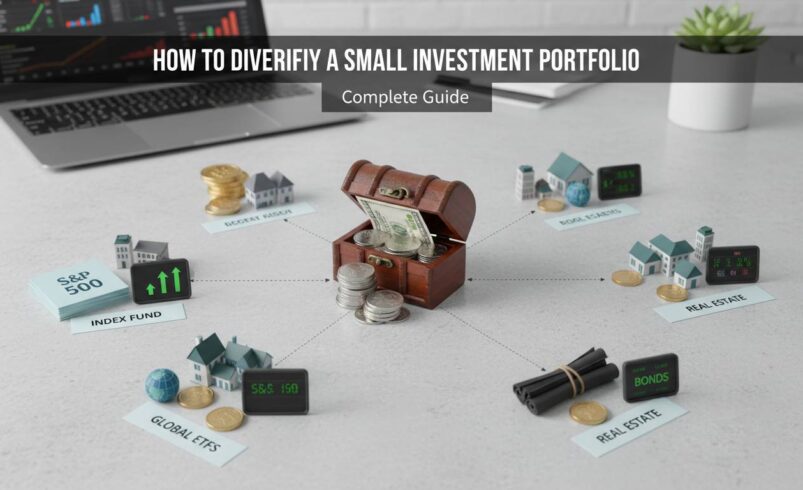

If you’re investing with less than $10,000, someone somewhere is probably telling you that diversification is pointless at your scale. They’re wrong. What they mean is that you can’t replicate a billionaire’s portfolio with pocket change—but that’s never been the point. The real goal for small investors is building a foundation that can grow without exposing you to unnecessary risk. The strategies below aren’t watered-down versions of what the wealthy do. They’re the exact same principles, adapted for real people with limited capital.
Dollar-Cost Averaging
The most powerful tool available to small investors isn’t a specific security—it’s a discipline. Dollar-cost averaging means investing a fixed amount at regular intervals, regardless of whether the market is up or down. You buy more shares when prices are low and fewer when prices are high, naturally smoothing out your average cost over time.
Here’s an example: if you invest $200 monthly in an S&P 500 index fund, you’d have purchased shares at prices ranging from market peaks to pandemic lows, all averaged together. During the 2008 financial crisis, this strategy meant you accumulated more shares while everyone else was panicking—and those extra shares fueled your recovery when markets bounced back.
The practical approach is to automate your investments. Set up a recurring transfer from your checking account to your brokerage. This removes emotion from the equation entirely. You’re not timing the market; you’re building wealth through consistency.
Index Funds and ETFs
Index funds and exchange-traded funds (ETFs) let you own hundreds or thousands of companies with a single purchase. This is the closest thing to instant diversification that exists, and it’s cheap. The average expense ratio for a large-cap index fund is around 0.03%—compared to 0.7% or more for actively managed mutual funds.
Vanguard’s Total Stock Market ETF (VTI) holds over 4,000 stocks. That’s more diversification than most hedge fund managers achieve, at a fraction of the cost. For small portfolios, this matters enormously. Every percentage point you save in fees stays in your account, compounding over decades.
The key is choosing the right index. A total market fund gives you exposure to the entire US economy. A simple three-fund portfolio—US stocks, international stocks, and bonds—can be constructed for less than 0.05% in annual fees.
Fractional Shares
Not long ago, you needed enough money to buy a full share of Amazon ($150+ per share), Apple ($180+), or Google ($140+) before you could invest in them at all. Fractional shares changed this entirely. Now you can buy $10 worth of any stock, and you’ll own that tiny slice proportionally.
This matters for diversification because it opens up expensive stocks that would otherwise be inaccessible. You can now build a meaningful position in dozens of different companies without saving up for months to afford a single share. Most major brokerages—Fidelity, Schwab, Robinhood, E*TRADE—offer fractional shares at no additional cost.
The benefit is straightforward: you’re no longer limited by share price. You can allocate $100 across ten different companies regardless of their individual prices. This makes building a diversified portfolio genuinely achievable on a modest budget.
Target-Date Funds
A target-date fund is a single investment that automatically adjusts its allocation over time. You pick the year you expect to retire, and the fund handles the rest. When you’re decades away from retirement, it leans heavily into stocks. As you approach retirement, it gradually shifts toward bonds and cash.
This is one of the simplest diversification solutions for beginners. There’s no need to manually rebalance or decide how much international exposure to include. The fund does it all based on a professionally designed glide path.
Fidelity and Vanguard both offer target-date funds with expense ratios under 0.15%. For context, managing your own three-fund portfolio requires occasional attention and rebalancing. A target-date fund requires nothing beyond the initial selection. If you’re overwhelmed by the idea of building your own allocation, this is your answer—just pick a fund with an appropriate date.
Bond Exposure
Stocks get all the attention, but bonds are the shock absorbers that keep your portfolio intact when markets tank. During the 2008 financial crisis, while the S&P 500 lost 37%, intermediate-term US Treasury bonds gained roughly 5%. The correlation between stocks and bonds isn’t perfect, which is exactly why holding both reduces your overall risk.
For small portfolios, bond allocation is often undersized simply because the dollar amounts feel too small to matter. But they don’t. Even $1,000 in bonds provides meaningful downside protection when your stocks are crashing.
A reasonable starting point for most young investors is 10-20% in bonds. As you get closer to retirement or find yourself uncomfortable with volatility, you can increase this allocation. The key is holding high-quality bonds—Treasury bonds, investment-grade corporate bonds, and bond ETFs like BND or AGG—rather than reaching for higher yields that come with increased risk.
International Stocks
US stocks have outperformed international stocks for over a decade. This has led many investors to abandon international exposure entirely, reasoning that why bother with underperformers? Here’s why: past performance doesn’t predict future results, and international diversification provides genuine protection when US markets stumble.
International stocks also give you exposure to different economies, currencies, and growth drivers. Emerging markets in Asia and Latin America offer higher growth potential than mature US companies. European markets include world-class companies in industries where the US isn’t dominant.
Vanguard’s Total International Stock ETF (VXUS) holds over 6,000 stocks across developed and emerging markets. A common allocation is 20-30% of your stock portfolio in international funds. This isn’t about chasing returns—it’s about ensuring your portfolio isn’t overly dependent on a single economy’s performance.
REITs for Real Estate Exposure
Real estate investment trusts (REITs) let you own commercial and residential properties without buying physical real estate. You buy shares in a company that owns apartments, office buildings, warehouses, data centers, or cell towers—and you collect a share of the rental income.
REITs offer two benefits for small investors. First, they’re required by law to distribute 90% of their taxable income as dividends, so you’ll receive regular income from your investment. Second, real estate often moves independently of stocks, providing additional diversification.
Vanguard Real Estate ETF (VNQ) is a popular choice, holding over 160 different REITs. A 5-10% allocation to real estate gives you meaningful exposure without overweighting a single sector. The dividends are taxed as ordinary income, which is a drawback in taxable accounts, so consider holding REITs in your retirement accounts.
Robo-Advisors for Automatic Diversification
Robo-advisors like Betterment, Wealthfront, and Fidelity Go build and manage diversified portfolios for you, using algorithms rather than human financial advisors. The fees are typically 0.25% to 0.35% annually, and the minimum investment is often just $1.
This is worth considering for a specific reason: behavioral coaching. Humans are terrible at sticking to their own investment plans. When markets crash, we panic-sell. When markets rally, we FOMO in at the worst possible time. A robo-advisor automatically rebalances your portfolio, maintains your target allocation, and stops you from making emotional mistakes.
The trade-off is paying a small fee for convenience. For someone who genuinely doesn’t want to think about their investments, this is a reasonable cost. For someone willing to spend thirty minutes a year managing their own three-fund portfolio, self-management saves money and offers the same underlying diversification.
Avoid Over-Diversification
Here’s an uncomfortable truth: you can actually have too much diversification. If you own fifty different index funds, you’re not improving your risk profile—you’re just diluting your returns. True diversification means holding assets that respond differently to market conditions, not owning more of the same thing under different labels.
The classic example is someone who buys five different S&P 500 index funds. They’re not diversified at all—they’ve simply bought the same exposure five times. Real diversification means holding different asset classes that behave differently: US stocks, international stocks, bonds, and possibly real estate or other alternatives.
For a small portfolio, three to seven different holdings is usually enough. More than that, and you’re just creating work without meaningful benefit. Focus on broad asset classes rather than trying to own every sector and sub-sector available.
Regularly Rebalance Your Portfolio
Rebalancing is the discipline of bringing your portfolio back to your target allocation over time. If you started with 80% stocks and 20% bonds, a strong stock market run might leave you at 85% stocks and 15% bonds. Rebalancing means selling some stocks and buying bonds to return to your original target.
This sounds counterintuitive—why sell your winners?—but it’s essential for risk management. Rebalancing forces you to sell high and buy low, which is the opposite of what most investors naturally do. It also ensures your portfolio’s risk level stays consistent with your comfort zone.
For most people, annual rebalancing is sufficient. Some prefer to rebalance only when allocations drift more than 5% from targets. Whatever method you choose, mark your calendar. Without a system, rebalancing won’t happen, and your portfolio will gradually drift toward whatever asset class is performing best—which is when you’re taking the most risk without realizing it.
Conclusion
Diversification at any scale follows the same principles: own different asset classes, minimize costs, and maintain discipline during market turbulence. The secret that financial professionals don’t always emphasize is that you don’t need much money to start. Fractional shares, low-cost index funds, and automated investing have democratized portfolio construction in ways that would have seemed impossible twenty years ago.
What remains difficult is the behavioral part. Building wealth requires consistent contributions, patient holding, and occasional courage when everyone else is panicking. The strategies above give you the framework. What you do with it—year after year—is what actually builds wealth.