
I’ve been building dividend portfolios for clients and myself for over fifteen years, and there’s one question I hear more than any other: “How do I get paid every month instead of waiting for those quarterly checks?” The answer isn’t complicated, but it does require knowing which investment types actually pay monthly—and most advice out there completely ignores this distinction. Most dividend articles tell you to buy Apple and hold forever, but Apple pays quarterly like almost every other S&P 500 company. That’s not going to solve your monthly income problem. What follows is the actual framework I use to build portfolios that generate predictable monthly cash flow—and yes, you can start with as little as a few thousand dollars.
Understanding Monthly Dividends
Dividends are periodic payments made by companies to their shareholders, typically from profits. Most S&P 500 companies pay quarterly—four payments per year—usually in March, June, September, and December. This creates a payment schedule that leaves investors guessing when their next check arrives, and for those of us who need consistent monthly income, it’s genuinely frustrating.
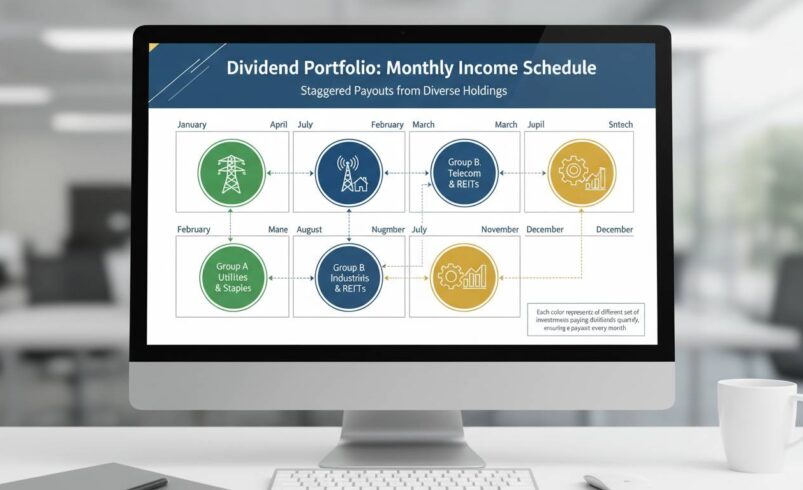
Monthly dividend payers solve this problem directly. These are investments that distribute dividends twelve times per year, creating a steady paycheck rather than lump sums you have to budget across three months. The difference in psychological terms is significant: knowing $400 hits your account on the first of every month changes how you think about your portfolio.
The three main categories of monthly dividend payers are real estate investment trusts (REITs), certain utility companies, and a small but growing number of traditional dividend stocks that have adopted monthly payment schedules. REITs are legally required to distribute at least 90% of their taxable income as dividends, and many choose monthly payments to attract income-focused investors. This is why REITs form the backbone of any monthly dividend strategy.
Here’s what most articles get wrong: they tell you to reinvest all dividends automatically. While compound growth is powerful, if your goal is monthly income, you’re actually better off taking the cash in your early years while you build positions. Let the portfolio grow through capital appreciation and new contributions instead. Reinvesting everything sounds wise until you realize you’ve created a machine that produces more dividends but you’re still waiting for your first check.
Step 1: Determine Your Income Goal
Before buying a single share, you need to answer a fundamental question: how much monthly income do you actually need? This isn’t about guessing—it’s about calculation.
Take your desired monthly income and divide it by an average sustainable yield. If you want $1,000 per month from a dividend portfolio yielding 4% on average, you need $300,000 invested. That’s a significant number, and I mention it because I see people constantly underestimating what it takes to generate meaningful income. A $10,000 portfolio at 4% yields $400 per year, or about $33 per month. That’s not a rent payment—that’s a nice dinner out.
The calculation works in reverse too. If you have $50,000 to invest today in a portfolio averaging 4.5% yield, you’re looking at $2,250 annual income, or roughly $187 per month. Still not replacement income, but it’s a meaningful supplement that grows over time. Many people find that a target of $200–$500 monthly as a supplemental income stream is more realistic than replacing their entire salary.
What matters enormously but gets ignored in most advice: your time horizon. If you’re thirty years from retirement, you can afford more risk and can let compound growth work. If you’re five years out, you need higher-yielding, lower-volatility positions even if that means accepting lower overall returns. There’s no universally correct answer—there’s only the answer that matches your specific situation.
One more thing most advisors won’t tell you: don’t set your target based on current yields alone. Yields fluctuate. A portfolio yielding 5% today might yield 4% in two years if the underlying stocks appreciate while dividends stay flat. Build in a buffer. Target a yield slightly above what you think you need.
Step 2: Choose the Right Accounts
Where you hold your dividend investments matters almost as much as what you buy. The difference between a taxable brokerage account and a tax-advantaged retirement account can mean thousands of dollars in net returns over a decade.
Taxable brokerage accounts are ideal for monthly dividend portfolios if your income is low enough that you qualify for qualified dividend tax rates (0% or 15%), or if you expect to be in a lower tax bracket in retirement. You get flexibility—you can withdraw whenever you want without penalties—and qualified dividends are taxed at favorable rates. The downside is that ordinary dividends (less common in quality dividend stocks but present in some REITs and BDCs) are taxed at your ordinary income rate.
Traditional IRAs and 401(k)s give you tax-deferred growth, meaning you don’t pay taxes on dividends until you withdraw. If you’re in a high tax bracket now, this is usually the better play. But there’s a major drawback: early withdrawals before age 59½ incur penalties, and required minimum distributions force you to take money out whether you need it or not. For a monthly income strategy you want accessing in your fifties, this creates problems.
Roth IRAs are the ideal container if you qualify. All withdrawals are tax-free, including dividends, and you can access contributions (not earnings) anytime without penalties. The contribution limits are relatively low ($7,000 per year if you’re under 50), so this works best as a complement to other accounts rather than your entire dividend strategy.
Here’s the counterintuitive part: if you’re building a monthly income portfolio specifically, don’t put everything in retirement accounts. Having at least some of it in a taxable brokerage gives you flexibility in retirement that RMDs would otherwise force away. You can draw down taxable accounts first in early retirement while letting tax-advantaged accounts continue growing.
Step 3: Select Your Dividend Investments
This is where most articles fail because they give generic advice like “buy quality companies with long track records.” That’s not wrong, but it’s not specific enough to actually build a monthly income portfolio. Let me be precise.
Individual Dividend Stocks
Some of the most reliable dividend payers in the market pay quarterly, but a handful pay monthly. Among traditional stocks, the most notable monthly payers include:
Realty Income (O) — The “Monthly Dividend Company” literally trademarked that phrase. It pays approximately $0.257 per share monthly, yielding around 5.3% as of early 2025. It’s a net-lease REIT, meaning it owns properties and rents them to creditworthy tenants on long-term leases. The rent escalates over time, which provides a natural dividend growth mechanism. This is the single most important holding in most monthly dividend portfolios.
STAG Industrial (STAG) — Another industrial REIT that pays monthly, currently yielding around 4.5%. It focuses on single-tenant industrial properties, a sector that’s benefited enormously from e-commerce growth. The portfolio is diversified across thirty-five states, reducing concentration risk.
Main Street Capital (MAIN) — A business development company that pays a monthly dividend of around $0.235 per share, yielding approximately 6%. BDCs are riskier than traditional REITs because they lend to smaller companies, but the yields reflect that additional risk.
For quarterly payers that are worth holding anyway because of their dividend reliability: Johnson & Johnson (JNJ), Procter & Gamble (PG), Coca-Cola (KO), and PepsiCo (PEP) have all increased dividends for more than fifty consecutive years. Even though you only get four checks per year, the reliability is unmatched. Many monthly dividend strategies include a mix of monthly and quarterly payers to maximize both consistency and growth.
Dividend ETFs
Exchange-traded funds provide instant diversification and are far less risky than holding individual stocks. For monthly income portfolios, I recommend a blend:
Schwab U.S. Dividend Equity ETF (SCHD) — This has become one of the most popular dividend ETFs for good reason. It tracks the Dow Jones U.S. Dividend 100 Index, holding 100 high-quality companies with consistent dividend payments. It pays quarterly, but the portfolio quality is exceptional. The yield hovers around 3.4%, and it’s had remarkable total returns, consistently beating many higher-yielding alternatives. This is your growth engine within an income portfolio.
Vanguard High Dividend Yield ETF (VYM) — Holds about 400 stocks with high dividend yields, providing broader exposure than SCHD. Yield is around 3.1%. The tradeoff is that it holds some lower-quality companies simply because they have high yields, so the dividend sustainability is slightly lower than SCHD’s more selective approach.
Vanguard Real Estate ETF (VNQ) — This is your REIT exposure in ETF form. It holds a broad mix of real estate investment trusts across multiple sectors. Yield is around 3.8%. The big advantage over individual REITs is instant diversification—you get exposure to hundreds of REITs in a single purchase.
Here’s what most articles get wrong about dividend ETFs: they treat all dividend ETFs as interchangeable. They’re not. SCHD’s methodology specifically selects for dividend quality and consistency, while VYM just picks the highest-yielding stocks regardless of dividend sustainability. That’s a meaningful distinction that matters over decades.
The Asset Allocation Framework
For a portfolio focused on monthly income, here’s a reasonable starting allocation:
40–50% in monthly-paying REITs (O, STAG, and similar) — This is your reliable monthly income foundation
20–30% in dividend growth ETFs (SCHD, VYM) — This provides growth and some income
10–20% in individual dividend stocks (JNJ, PG, KO) — This adds diversification and stability
10–20% in broader market exposure (VOO or VTI) — This ensures you don’t miss overall market gains
This allocation isn’t aggressive, but it’s not conservative either. It prioritizes income consistency while leaving room for growth. If you’re closer to retirement, shift more toward REITs and less toward growth-oriented holdings. If you have decades to go, the reverse makes sense.
Step 4: Build Your Monthly Dividend Portfolio
Let me give you three concrete examples of how this works at different investment levels.
The $10,000 Starter Portfolio
At this level, you’re not building a complex portfolio—you’re building a foundation. With $10,000, I’d recommend:
$4,000 in Realty Income (O) — 40% in the most reliable monthly payer
$3,000 in SCHD — 30% for dividend growth exposure
$2,000 in STAG Industrial (STAG) — 20% for additional monthly REIT exposure
$1,000 in VTI — 10% for broad market participation
At current yields, this generates approximately $50–$65 per month in dividends. That’s not life-changing, but it’s automatic. You add to these positions over time, and the income grows. In ten years, assuming modest dividend growth and reinvestment, you’re looking at $80–$100 monthly from this same principal.
One thing I want to be honest about: at $10,000, you’re not going to generate meaningful income. What you’re doing is building the habit and the positions. The real income comes when you’ve accumulated enough that the yield on your total portfolio produces meaningful cash flow. Don’t let anyone tell you that $10,000 will replace a paycheck.
The $50,000 Portfolio
At $50,000, things start getting interesting:
$18,000 in monthly REITs (O, STAG, and possibly MAIN)
$15,000 in SCHD
$10,000 in VYM
$7,000 in individual dividend stocks (a split between JNJ, PG, and KO)
At current yields, this portfolio generates approximately $225–$275 per month. That’s a car payment, or groceries for a small family, or a utility bill covered without touching your paycheck. It’s real money, even if it’s not retirement-level income yet.
The key at this stage: you’re starting to build real diversification. Multiple REITs, multiple ETFs, individual stocks across different sectors. The income becomes more predictable because you’re not dependent on any single company’s dividend policy.
The $100,000 Portfolio
At $100,000, you’re in meaningful income territory:
$35,000 in monthly REITs
$25,000 in SCHD
$20,000 in VYM
$12,000 in VNQ (additional real estate exposure)
$8,000 in individual dividend stocks
This generates approximately $450–$550 per month in dividends. Over a year, that’s $5,400–$6,600 in passive income. Combined with Social Security, a pension, or other income sources, this can meaningfully contribute to monthly expenses.
At this level, the conversation shifts from “building” to “managing.” You’re rebalancing annually, monitoring dividend sustainability, and potentially adding positions in BDCs or other higher-yielding vehicles if your risk tolerance allows.
Risk Considerations
I need to be direct with you: dividend investing carries real risks that get glossed over in most articles.
Dividend cut risk is the biggest one. When a company or REIT cuts its dividend, the stock typically drops significantly, and your income shrinks. This is especially true with REITs during economic downturns. During the 2008 financial crisis, many REITs cut dividends by 50% or more. During the 2020 pandemic, retail and hotel REITs slashed payouts while office REITs faced existential questions. The lesson: don’t overweight any single REIT or sector. Diversification is your insurance policy.
Interest rate risk affects all dividend investments. When rates rise, dividend stocks typically fall because investors can get safer returns elsewhere. This happened dramatically in 2022 and early 2023. The current yield environment is relatively attractive because rates are elevated, but that could change. If you’re building a long-term portfolio, understand that you’ll live through periods where your portfolio value drops even as your dividend income stays steady.
Concentration risk is what happens when you fall in love with one stock because it has the highest yield. I see people put half their portfolio in O because it yields 5.3% and they ignore everything else. That’s a mistake. If Realty Income hits a major problem—as happened briefly when its largest tenant (Coinstar) struggled—you’ve just lost half your income in a single position.
Reinvestment risk is subtle but real. When dividends are reinvested automatically during bull markets, you’re buying at higher prices and getting lower effective yields. During corrections, reinvestment works beautifully. There’s no perfect solution here, but being thoughtful about when you reinvest (or taking some dividends as cash during extended bull markets) can improve long-term results.
The honest truth: there’s no such thing as a “safe” dividend portfolio. There’s only portfolios where the risks are managed through diversification, and portfolios where risks are ignored in pursuit of higher yields.
Tools and Resources
Building and managing a monthly dividend portfolio doesn’t require expensive tools, but the right resources make a significant difference.
Dividend screening tools help you find candidates. Morningstar’s X-Ray tool lets you analyze your portfolio’s dividend quality. The Schiller divide calculator (available at multiples sources) helps you understand historical yield relationships. Simply Safe Dividends provides a dividend safety score that’s genuinely useful for evaluating individual company sustainability—I’ve found their analysis more useful than most Wall Street research.
Portfolio trackers keep you organized. Personal Capital (now Empower) provides excellent portfolio analysis including dividend income tracking. If you prefer simpler tools, a basic spreadsheet tracking your positions, yields, and income works fine. I know several wealthy dividend investors who just use Excel.
Brokerage selection matters more than people realize. Some brokers offer fractional shares, making it easier to build small positions in expensive stocks. Interactive Brokers and Fidelity offer the best combination of low costs and quality research. For monthly income specifically, look for brokers that let you easily set up dividend reinvestment or automatic cash transfers.
Frequently Asked Questions
How much money do I need to live off dividends?
This depends entirely on your target income and the yield you can sustainably achieve. A common rule of thumb: divide your desired annual income by 4% (the “4% rule”). To generate $40,000 per year in dividends, you’d need approximately $1,000,000 invested at a 4% yield. For $60,000 per year, you’d need $1.5 million. These are substantial numbers, which is why most people build toward this goal over decades rather than achieving it immediately.
Can I lose money in dividend stocks?
Absolutely. Dividend stocks are still stocks—they can and do lose value. The key difference is that dividend stocks tend to be more stable than growth stocks because they’re typically established companies in mature industries. But during market crashes, dividend stocks fall just like everything else. The advantage is that dividend income continues (assuming the dividend isn’t cut), providing a return even when capital values are depressed. This is called the “dividend put” effect, and historically it’s provided a cushion during downturns.
What’s the best dividend ETF for monthly income?
No major ETF pays true monthly dividends—most dividend ETFs pay quarterly. If monthly income is your priority, you’re better off building a portfolio of individual monthly-paying REITs rather than looking for an ETF solution. SCHD is the best overall dividend ETF for long-term total returns, but it won’t solve your monthly income timing problem on its own.
Should I reinvest all my dividends?
For long-term wealth building, reinvesting dividends is powerful because of compound growth. However, if your explicit goal is monthly income, taking dividends as cash in your early years while you build the portfolio often makes more sense. Once you’ve accumulated to a level where the portfolio generates your target income, you can shift to reinvesting. There’s no universally correct answer—it depends on whether you need the income now or can wait.
Conclusion
Building a dividend portfolio that pays you every single month is entirely achievable. It requires understanding that monthly income comes primarily from REITs and a handful of other monthly-paying securities, not from the standard S&P 500 stocks that dominate most “dividend” advice. The real work isn’t in picking the right stocks—it’s in accumulating enough capital that the yields generate meaningful cash flow.
The biggest mistake I see is people starting too small and expecting too much too soon. A $5,000 portfolio yielding 5% generates $250 per year, or about $21 per month. That’s not a failure—it’s a beginning. The magic happens over decades as contributions compound, dividends grow, and your positions appreciate. Someone who starts with $10,000 at age thirty and contributes $500 monthly will have built something remarkable by age sixty, even if they never add another dollar beyond their monthly contributions.
The second mistake is chasing yield at the expense of sustainability. A 7% yield might look attractive, but if it’s from a BDC that’s lending to shaky companies or a REIT in a troubled sector, that yield might not last. Patience and diversification beat aggressive yield-seeking every time.
Where you go from here depends on your situation. If you’re starting from zero, open a brokerage account and buy your first position this week—even if it’s small. If you already have dividend holdings, review them against the framework in this article. Are you actually getting monthly income, or are you just getting quarterly checks from companies with high yields? There’s a meaningful difference, and it matters for your goals.
The question I can’t answer for you: how patient are you willing to be? Building genuine monthly income takes time. But if you’re willing to stay the course, the payoff is real—checks in your account every month, regardless of what the broader market is doing. That’s not a promise of profits or protection from losses. It’s simply the mechanical result of owning the right securities in the right proportions. And that result is available to anyone willing to put in the work.