
The renewable energy sector has evolved from a niche investment theme into a cornerstone of modern portfolio construction. If you want to build wealth while supporting the global transition away from fossil fuels, you need a strategy that goes beyond simply buying into the clean energy trend. The difference between a renewable energy portfolio that delivers consistent returns and one that volatility destroys often comes down to one thing: how well you’ve balanced exposure across different technologies.
I’ve spent over a decade analyzing energy markets and advising investors on portfolio construction. Most retail investors get this completely wrong. They pile into solar stocks because those make the headlines, or they buy a single clean energy ETF and call it diversified. Neither approach serves them well. A genuinely balanced renewable energy portfolio requires understanding the distinct risk profiles, growth trajectories, and cyclical patterns of each technology — solar, wind, hydroelectric, battery storage, and emerging alternatives like green hydrogen. Once you understand how these technologies interact with each other and with broader market forces, building allocation becomes much more intuitive.
This guide walks you through the complete process: from understanding what makes each renewable technology distinct as an investment asset, through evaluating individual opportunities, to constructing and maintaining a portfolio that can weather market turbulence while capturing long-term growth. I’ll give you specific allocation frameworks you can implement immediately, name specific investment vehicles that actually work, and be honest about where conventional wisdom on this topic leads investors astray.
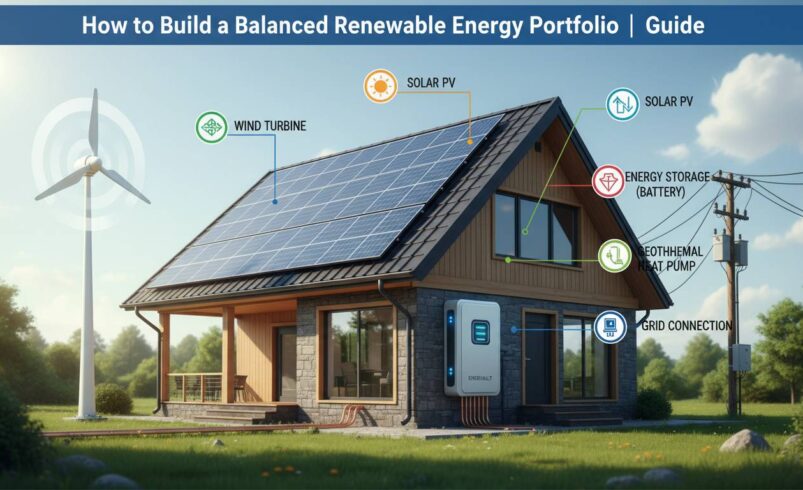
The Five Renewable Technologies You Need to Know
Before you can build a balanced portfolio, you need to understand what you’re actually investing in. The renewable energy sector isn’t a monolith. It’s a collection of distinct technologies with different maturity levels, cost structures, regulatory environments, and market dynamics. Treating them as interchangeable is one of the most common mistakes I see.
Solar energy has achieved grid parity in most regions and continues to experience dramatic cost declines. The technology benefits from distributed generation potential — you can put solar panels on residential rooftops or massive utility-scale installations. However, solar is weather-dependent and produces no power at night, creating intermittency challenges that affect its value in energy markets. Companies like First Solar (FSLR) and NextEra Energy (NEE) represent different points on the solar investment spectrum, from pure-play manufacturers to integrated utilities with massive renewable portfolios.
Wind energy, particularly offshore wind, represents the largest potential for scale in the renewable sector. Offshore wind farms generate more power per installation than their onshore counterparts and can operate in conditions that solar cannot. The downside is capital intensity — offshore projects require billions in infrastructure investment and long development timelines. Ørsted and NextEra Energy dominate this space, though Chinese manufacturers are increasingly competitive globally.
Hydroelectric power is the mature giant of renewable energy. It provides baseload generation — consistent power output regardless of weather — making it uniquely valuable in any energy portfolio. The limitations are geographic (not every region has suitable rivers) and environmental (dam construction carries significant ecological consequences). Brookfield Renewable Partners (BEP) operates as the primary publicly traded vehicle for hydro exposure, though its portfolio includes other technologies as well.
Battery storage has emerged as the critical enabling technology for a renewable-dominant grid. As solar and wind penetration increases, grid operators need storage to smooth out intermittency and provide grid stability. Tesla (TSLA) dominates the utility-scale storage market through its Megapack product, while residential storage through systems like Powerwall serves the distributed generation market. This sector will likely see the fastest growth over the next decade.
Emerging technologies — including green hydrogen, geothermal, and advanced nuclear — round out the technology landscape. Green hydrogen, produced using renewable electricity to electrolyze water, promises to decarbonize sectors that electrification cannot reach: heavy industry, long-haul shipping, and aviation. Companies like Plug Power (PLUG) have attracted significant investor attention, though the sector remains unproven at scale. Geothermal energy offers baseload potential with a smaller geographic footprint than hydro, and companies like Ormat Technologies (ORA) operate in this space.
Understanding these five technology categories is the foundation for everything that follows. Each serves a different function in the energy system, and each carries different risk and return characteristics. A balanced portfolio doesn’t just own renewables. It owns a collection of technologies that together provide reliable, diversified exposure to the energy transition.
Why Technology Balance Matters More Than You Think
The conventional advice on renewable energy investing usually goes something like: “Just buy a clean energy ETF and you’ll get exposure to everything.” This is lazy advice that often underperforms, and here’s why.
Clean energy ETFs typically weight their holdings based on market capitalization. This means the largest companies — often those that have already experienced their biggest growth curves — dominate the portfolio. If you look at the Invesco Solar ETF (TAN), the largest holding as of early 2025 represents a significant portion of total assets, meaning you’re heavily concentrated in whatever that company happens to be doing at the moment. That’s not diversification. It’s accidental concentration.
More importantly, different renewable technologies move through their growth cycles at different times. When interest rates rise, capital-intensive industries like offshore wind and utility-scale solar face headwinds because their projects become more expensive to finance. Battery storage, meanwhile, might benefit because grid stability becomes more valuable in a higher-rate environment. Solar panel manufacturers face constant pricing pressure from Chinese competitors, while integrated utilities with renewable portfolios can pass costs through to ratepayers. These dynamics mean that holding a single balanced fund often means you’re systematically overexposed to whatever cycle that fund’s largest holdings happen to be in.
The solution isn’t to avoid ETFs. Many of them provide excellent, low-cost exposure. But you should complement broad-market exposure with targeted positions in specific technologies where you have conviction. I tell clients to think about their renewable energy allocation in three layers: a broad base (the ETF or mutual fund), a technology layer (specific bets on solar, wind, storage, or hydro), and a selection layer (individual company positions where you’ve done deeper research).
This layered approach gives you the best of both worlds: broad diversification that reduces single-company risk, plus the ability to overweight technologies you believe have superior risk-adjusted return potential. It requires more thought than simply buying one fund, but the difference in portfolio outcomes over a full market cycle can be substantial.
Evaluating Renewable Energy Investments: What Actually Moves the Needle
When I’m analyzing a renewable energy company for potential inclusion in a client portfolio, I focus on a framework that goes well beyond the generic metrics you’d apply to any stock. Here’s what actually matters.
Contracted revenue visibility is my first check. Companies with long-term power purchase agreements (PPAs) provide contracted cash flows that reduce market risk. A wind farm with a 20-year PPA selling electricity at a fixed price has dramatically different risk characteristics than a solar panel manufacturer selling into the merchant market. Brookfield Renewable Partners derives a significant portion of its generation from contracted assets, which is why it trades at a premium to uncontracted peers. Always look for the percentage of revenue that’s locked in versus exposed to spot market volatility.
The cost of capital matters enormously in this sector. Renewable energy projects are capital-intensive, meaning the rate at which companies can borrow money directly affects their ability to grow. Companies with investment-grade balance sheets — strong credit ratings, manageable debt levels, access to capital markets — can fund growth at lower costs than leveraged competitors. This advantage compounds over time, particularly in rising rate environments. NextEra Energy’s investment-grade rating has allowed it to fund one of the largest renewable buildout programs in the industry while maintaining reasonable financing costs.
Technology differentiation separates winners from also-rans over the long term. In solar, this means companies with proprietary manufacturing processes or thin-film technology that competitors cannot easily replicate. In storage, it means battery chemistry that delivers superior energy density or cycle life. In wind, it means turbine technology that captures more energy from lower-wind-speed sites. Generic players — companies that simply assemble components without meaningful intellectual property — face constant margin pressure and are vulnerable to Chinese competition. Ask specifically: what does this company make that its competitors cannot copy?
Regulatory positioning varies dramatically by company and geography. Some companies derive most of their revenue from markets with stable, supportive regulatory frameworks — think the United States with its Investment Tax Credit and Production Tax Credit, or certain European markets with strong renewable mandates. Others operate in jurisdictions where policy support is uncertain or actively hostile to clean energy. Understanding where a company generates revenue and how dependent it is on specific policy mechanisms is essential to assessing long-term risk.
One counterintuitive point that many investors miss: sometimes the company with the best technology isn’t the best investment. A company might have revolutionary technology but be so capital-constrained or so poorly managed that it never translates that technological advantage into shareholder returns. The investment decision requires evaluating the entire business, not just the engineering.
Building Your Balanced Portfolio: A Framework
Now we get to the practical question: how do you actually allocate capital across these technologies? I’ll give you a framework, but I want to be direct about something first. There is no single correct allocation. Your right answer depends on your risk tolerance, your time horizon, your tax situation, and whether this renewable allocation sits inside a tax-advantaged account or a taxable brokerage. With those caveats acknowledged, here’s a framework that reflects how I think about this for a typical long-term investor with moderate risk tolerance.
For a core allocation that you’re planning to hold for five years or more, I’d suggest starting with this structure: 35% solar, 25% wind, 20% storage and enabling technologies, 15% hydro and other baseload renewables, and 5% emerging technologies for growth exposure.
This allocation reflects several convictions. Solar gets the largest weight because the technology is mature, cost-competitive, and has the most predictable growth trajectory over the coming decade. The IRA in the United States provides substantial policy support through at least 2032, reducing political risk for US-focused solar investments. Wind gets a slightly smaller allocation because offshore wind projects carry more execution risk and capital intensity, though the growth potential justifies significant exposure. Storage receives 20% because this is where the most dynamic growth is happening, and because storage provides optionality that other technologies lack. It benefits from the renewable buildout regardless of which specific technology wins in any given market.
The 15% allocation to hydro and other baseload renewables provides portfolio stability. These assets generate regardless of whether the sun is shining or the wind is blowing, making them valuable during market downturns when investors flee riskier growth assets. The 5% emerging technology allocation is deliberately small. These investments carry higher risk but potentially higher rewards, and you want enough exposure to benefit if one of these technologies breaks through without letting a speculative bet move your overall portfolio needle.
I want to be honest about a limitation here: this allocation is US-centric by default, reflecting the policy environment I know best. If you’re investing from Europe, you might reasonably weight European offshore wind more heavily. If you’re in a region with significant geothermal potential, that might warrant additional allocation. Customize based on your geography and the markets you understand best.
Investment Vehicles: How to Implement This Strategy
Knowing what allocation you want is only half the battle. You need to actually buy something. Let me walk through the primary vehicle categories and where I think each fits in a balanced renewable portfolio.
ETFs provide the easiest entry point and work well for the core base allocation. The iShares Global Clean Energy ETF (ICLN) holds a global mix of renewable companies weighted by market cap. The Invesco Solar ETF (TAN) gives concentrated solar exposure. The First Trust Global Wind Energy ETF (FANW) provides wind-specific exposure. For storage, the Global X Lithium & Battery Tech ETF (LIT) offers broad battery exposure, though it includes lithium miners alongside battery manufacturers. For clients wanting broad renewable exposure with minimal hassle, I often suggest a core holding of ICLN supplemented by targeted positions in specific technologies where they have stronger conviction.
Individual stocks let you express specific views but require more research and ongoing attention. The pure-play renewable developers — companies like NextEra Energy, Duke Energy (DUK), and Southern Company (SO) — provide integrated utility exposure with significant renewable portfolios. These tend to be slower-growing but more stable than pure-play developers. The technology leaders — First Solar for thin-film panels, Vestas for wind turbines, Tesla for storage — offer exposure to specific technology bets but trade at premiums that reflect their market positions. For most investors, I recommend limiting individual stock selection to positions you genuinely have time to monitor. Most people don’t follow energy markets closely enough to pick individual winners consistently.
Green bonds and infrastructure funds deserve a place in taxable accounts for their tax efficiency. Brookfield Renewable Partners (BEP) operates as a limited partnership that passes through most income to unitholders, creating a tax-inefficient structure in taxable accounts but excellent for qualified accounts. Green bonds — debt instruments specifically earmarked for renewable projects — provide income generation with lower volatility than equities. Several major issuers, including Apple (AAPL) and Bank of America (BAC), have issued green bonds as part of sustainability financing frameworks.
A practical implementation might look like this: 50% of your renewable allocation in a broad clean energy ETF for core diversification, 25% in technology-specific ETFs or individual stocks where you have conviction, 15% in yield-focused vehicles like Brookfield or green bonds for income, and 10% in emerging technology exposure through smaller, higher-risk positions.
Risk Factors You Cannot Ignore
Every investment article should include honest risk disclosure, and this topic has more than its share. I’ve already mentioned several risks in passing, but let me pull them together into a coherent framework so you understand what you’re actually facing.
Policy risk is the most obvious. Renewable energy subsidies — the Investment Tax Credit, Production Tax Credit, Renewable Portfolio Standards — have driven enormous investment in this sector. If these policies change, companies that depend on them will face headwinds. The current US policy environment is supportive through at least 2032, but elections have consequences, and a significant policy shift would affect valuations across the sector. This is why I emphasize companies with contracted revenues that provide some insulation from policy changes. They have cash flows locked in regardless of what Congress does next.
Interest rate risk affects the sector disproportionately. Renewable energy projects are capital-intensive, financed heavily through debt. When rates rise, the economics of new projects deteriorate, and companies with floating-rate debt see their financing costs increase. The rate increases of 2022 and 2023 hit renewable project developers hard, and while rates have stabilized, this remains a vulnerability. Companies with strong balance sheets and fixed-rate debt are better positioned to navigate this risk.
Technology obsolescence risk is real but often overstated. Solar panel efficiency improves constantly, and battery technology evolves rapidly. But the renewable energy market is so vast that companies with competitive positions today will likely have viable businesses for years even if they don’t remain technology leaders. The bigger risk is not technological obsolescence but competitive obsolescence. Being undercut by lower-cost Chinese manufacturers is why technology differentiation matters so much.
Market sentiment risk drives short-term volatility that can test your resolve. Renewable energy stocks surged in 2020 and 2021 on enthusiasm about climate policy, then fell dramatically in 2022 as interest rates rose and growth stocks broadly sold off. If you cannot stomach seeing your renewable allocation drop 30% in a year without selling, you need a smaller allocation or a longer time horizon. This isn’t a sector for investors with thin skin.
Maintaining Your Portfolio Over Time
Building the portfolio is the easy part. Holding it through market cycles requires discipline and a rebalancing framework. Here’s how I think about this.
Set calendar reminders to review your allocation quarterly, but only rebalance when your target weights drift by more than 5 percentage points. If you target 35% solar and it grows to 42% of your renewable allocation, trim back to target. If it drops to 28%, consider adding. This discipline forces you to sell what has performed well and buy what has underperformed. The exact opposite of what most investors do naturally, and exactly what produces superior long-term returns.
Stay informed about technology developments without overreacting to every headline. When a company announces a breakthrough battery technology, that’s worth evaluating. When a single study claims solar efficiency has improved by 0.1%, that’s noise. Distinguishing signal from noise is where your long-term returns get built.
One more honest admission: I don’t have a crystal ball about which specific technologies will dominate in 2035. The allocation framework I outlined reflects my current best judgment, but I’m genuinely uncertain about the relative performance of offshore wind versus distributed solar versus green hydrogen over a ten-year horizon. What I’m confident about is that renewable energy as a category will grow substantially. Global electricity demand is increasing, and policy and economics increasingly favor zero-carbon sources. Your job isn’t to predict the perfect allocation. It’s to build a reasonable one and stick with it.
Moving Forward
The renewable energy transition represents one of the most significant investment opportunities of our lifetime. But capturing that opportunity requires more thought than throwing money at a popular ETF and hoping for the best. By understanding the distinct characteristics of each renewable technology, building a deliberate allocation across those technologies, selecting appropriate investment vehicles, and maintaining discipline through market cycles, you can construct a portfolio that serves both your financial goals and your values.
The most important thing you can do right now is start. If you’ve been thinking about adding renewable exposure to your portfolio, this framework gives you a path forward. Begin with the core allocation, add targeted positions based on your conviction, and commit to reviewing and rebalancing on a schedule. The renewable energy sector will have its ups and downs. That’s inevitable for any growth sector. But investors who build thoughtfully and hold patiently have historically been rewarded.
If you’re uncertain about constructing this allocation on your own, working with a fee-only financial advisor who understands sustainable investing can help you customize this framework to your specific situation. The important thing is that you build something deliberate rather than accidental. Your future self will thank you.