
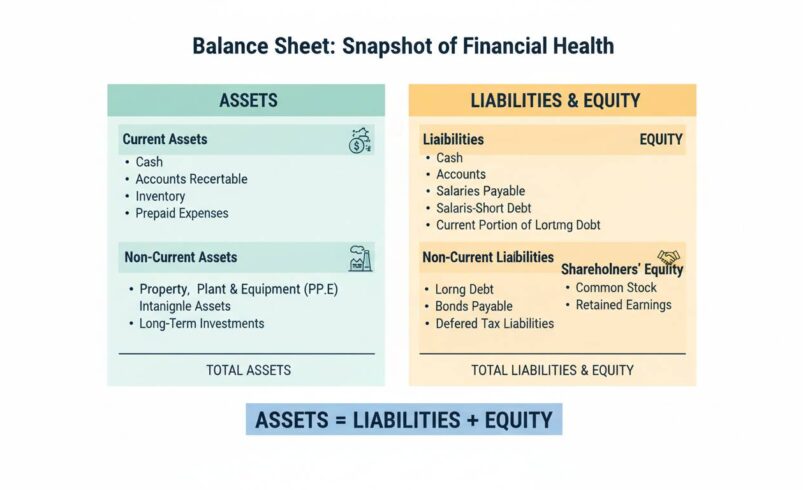

Most investors check revenue growth, earnings per share, and P/E ratios before buying a stock. Fewer than half bother to understand what the company owes and when it needs to pay it back. That’s where blowups happen. Enron had healthy-looking earnings right up until it didn’t. Hertz looked reasonable on traditional metrics before its 2020 bankruptcy. The companies that destroy shareholder value rarely announce it in advance — but the debt tells the story if you know how to read it.
This guide walks through how to analyze a company’s debt before committing capital. You’ll learn the ratios that matter, where to find the data, how to compare across industries, and the warning signs that should make you walk away. By the end, you’ll have a framework you can apply to any public company in about thirty minutes.
Why Debt Analysis Matters for Stock Investors
Debt is leverage — it amplifies returns in good times and accelerates losses in bad ones. A company with no debt can survive a revenue downturn. A company buried under obligations will cut dividends, issue dilutive shares, or go bankrupt when cash flow tightens. The 2008 financial crisis killed Bear Stearns and Lehman Brothers not because they had no assets, but because they had too much debt and not enough time.
For stock investors, debt matters for three reasons. First, debt claims sit ahead of equity in the liquidation queue. If a company goes bankrupt, bondholders get paid before shareholders — and there’s often nothing left. Second, interest and principal payments consume cash that could otherwise go to growth, dividends, or buybacks. Third, debt covenants often restrict what management can do. A company nearing its debt limits might be prohibited from pursuing attractive acquisitions or returning capital to shareholders.
Debt isn’t inherently bad. Apple carries over $100 billion in long-term debt — but it also holds $150 billion in cash and generates $100 billion in annual free cash flow. The debt is a financing tool, not a problem. The issue is when debt exceeds what the company can reasonably service, or when the terms expose the business to unnecessary risk.
Key Debt Ratios Every Investor Should Know
Debt-to-Equity Ratio
The debt-to-equity (D/E) ratio measures total liabilities relative to shareholders’ equity. Calculate it by dividing total liabilities by total shareholders’ equity. A ratio of 1.0 means the company has $1 of debt for every $1 of equity. Higher ratios indicate more leverage.
For context, as of early 2025, utilities and financial institutions routinely operate with D/E ratios above 2.0 because their stable cash flows support the borrowing. Technology companies like Microsoft and Google typically maintain ratios below 0.5. A D/E of 3.0 outside the financial sector should trigger scrutiny — but “high” depends entirely on the industry.
Interest Coverage Ratio
The interest coverage ratio tells you how easily a company can pay interest on its debt. Divide earnings before interest and taxes (EBIT) by interest expense. A ratio of 2.0 means the company earns twice what it owes in interest — generally considered the minimum safety threshold. Below 1.5 gets uncomfortable. Below 1.0 means the company isn’t covering interest with operating earnings and is eating into principal or refinancing to survive.
Current Ratio and Quick Ratio
The current ratio divides current assets by current liabilities. It answers: can the company pay its near-term bills? A ratio above 1.5 is comfortable; below 1.0 suggests the company may need to borrow or sell assets to meet obligations coming due in the next twelve months.
The quick ratio (or acid-test) excludes inventory from current assets, since inventory isn’t always easy to liquidate quickly. A quick ratio above 1.0 is solid. Retailers often have low quick ratios because most of their current assets are inventory — acceptable in that context but dangerous if sales slow.
Debt-to-EBITDA Ratio
This ratio measures how many years of EBITDA it would take to pay off all debt. A ratio below 3.0 is generally healthy. Above 5.0, the company is carrying significant debt relative to its earnings power. This ratio is particularly useful for comparing companies across different capital structures because it normalizes for interest rates and accounting decisions.
Long-Term Debt to Capitalization
This metric focuses specifically on long-term debt rather than all liabilities. Divide long-term debt by (long-term debt plus shareholders’ equity). It shows what percentage of the company’s permanent capital comes from debt versus equity. A high ratio here suggests the company has been funding growth through borrowing rather than retained earnings or equity raises.
Step-by-Step Debt Analysis Framework
Step 1: Get the Financial Statements
Start with the balance sheet and cash flow statement. The 10-K annual report and 10-Q quarterly reports are your primary sources. Pull at least three years of data to see trends. The financial statements are available through the SEC’s EDGAR database or any major financial data provider.
Step 2: Run the Numbers Yourself
Calculate the key ratios yourself rather than relying on pre-calculated figures. Sometimes data providers use different definitions — some include operating lease liabilities in debt, others don’t. Calculate each ratio using the same methodology across all companies you’re comparing.
Step 3: Compare to Industry Peers
A D/E ratio of 1.5 is concerning for a software company and completely normal for a railroad. Always compare to companies in the same industry with similar business models. If you’re looking at a retail company, compare it to Target and Walmart, not to Salesforce.
Step 4: Look at Trends Over Time
A company that doubled its debt in three years is telling you something — even if the current ratio looks fine. Look at the trend. Is debt growing faster than earnings? Is the company consistently issuing new debt to repay old debt (a refinancing treadmill)? The trajectory matters as much as the absolute number.
Step 5: Watch for Red Flags
Watch for deteriorating interest coverage, shrinking equity from net losses, and any mentions of debt covenant violations in the footnotes. The MD&A (Management’s Discussion and Analysis) section often includes forward-looking context about debt plans and risks. Read it carefully.
How to Interpret Debt Ratios by Industry
Sector norms are everything. The “good” debt ratio for a bank is completely different from the “good” ratio for a software company.
Technology companies typically carry minimal debt because their business model doesn’t require heavy infrastructure investment. Microsoft, Apple, and Google all maintain low D/E ratios by choice — they have the balance sheet strength to borrow cheaply but prefer equity and cash flow to fund operations. A tech company with a D/E above 1.0 is an outlier worth questioning.
Manufacturing and industrials need factories, equipment, and supply chains. They legitimately carry more debt. A D/E between 1.0 and 2.0 is common and often appropriate. The key is whether the debt is producing returns above its cost.
Financial institutions are different. Banks borrow to lend — their entire business is maturity transformation. D/E ratios of 10.0 or higher are normal for banks because their liabilities (deposits) are their primary product. Analyzing bank debt requires entirely different metrics focused on capital adequacy ratios and asset quality.
Retail companies use debt to fund inventory and real estate. They tend to have lower quick ratios because inventory makes up most current assets. Focus on same-store sales trends and inventory turnover — if those deteriorate, the debt load becomes dangerous quickly.
Utilities are capital-intensive and carry high debt as a matter of course. Regulated utilities can pass interest costs through to customers, so their debt capacity is essentially guaranteed by their revenue model. Look at debt to operating cash flow ratio rather than raw D/E.
Real Examples: Analyzing Debt in Popular Stocks
Let’s apply this framework to two well-known companies.
Apple carries over $100 billion in long-term debt but holds approximately $150 billion in cash and equivalents. Its net debt position (debt minus cash) is actually negative — the company is a net cash holder. Interest coverage exceeds 20x. The D/E ratio looks high on the surface, but the net debt perspective reveals a company using its investment-grade borrowing capacity efficiently. Apple can service this debt effortlessly and generates enough free cash flow to pay down the entire balance in under two years if management chose to do so.
Netflix presents a different picture. The company carried minimal debt through its early streaming transition but began issuing debt to fund content investment and international expansion. As of 2024, Netflix maintains a D/E ratio around 0.8 — moderate for a content company. More importantly, free cash flow turned positive in 2024 after years of negative FCF. Interest coverage is adequate but thinner than Apple’s. The debt is funding growth that appears to be working, but the risk profile is materially different from Apple’s fortress balance sheet.
The lesson: identical ratios can mean very different things depending on cash generation, growth trajectory, and industry context.
Red Flags That Should Concern Stock Investors
Rapid Debt Accumulation Without Clear Purpose
If a company is issuing debt but you can’t find a corresponding investment in growth, new assets, or acquisitions, something is wrong. Debt used to fund share repurchases at high valuations can destroy value. Debt used to cover operating losses is a death spiral.
Declining Interest Coverage
Watch for any deterioration in the ability to pay interest. A company that was covering interest 5x and is now covering 2x is signaling stress — even if the absolute numbers still look “okay.” This often precedes dividend cuts or equity raises that dilute existing shareholders.
Refinancing Risk
Check when debt comes due. A company with $5 billion in debt maturing in the next twelve months and only $2 billion in cash is vulnerable if credit markets tighten. This is what killed many companies in 2008 and 2020 — they could service their debt but couldn’t refinance approaching maturities.
Covenant Violations
Read the footnotes. Debt covenants often require minimum cash ratios, maximum leverage, or minimum interest coverage. Violations can trigger accelerated repayment — essentially a forced bankruptcy event. Companies in covenant distress often stop disclosing specific metrics or use increasingly aggressive accounting to hide the situation.
Off-Balance-Sheet Obligations
Operating leases, joint venture debt, and contingent liabilities from lawsuits or warranties aren’t always included in the headline debt figures. Calculate adjusted debt to account for these obligations. A company that looks debt-light might be hiding significant obligations.
Common Mistakes in Debt Analysis
Most retail investors get debt analysis wrong in one of three ways. First, they ignore it entirely, relying on earnings and revenue growth alone. Second, they look at a single ratio without context — a D/E of 2.0 means nothing without knowing the industry and cash flow coverage. Third, they treat all debt as equivalent when the terms, maturity, and purpose matter enormously.
Here’s something many investment guides get wrong: low debt isn’t always better. A company with zero debt might be underutilizing its balance sheet, failing to pursue growth opportunities, or — worse — generating so little cash that no lender would extend credit. The question isn’t “does this company have debt?” It’s “can this company service its debt comfortably while pursuing its strategy?”
Another mistake is using book values rather than market values for equity. Debt-to-equity calculated from balance sheet figures can be misleading if the market values the equity significantly higher or lower than book value. For a healthy company with appreciating stock, book equity understates true equity, making the D/E ratio look worse than it is. For a troubled company, the opposite applies.
Conclusion: Building Your Debt Analysis Practice
Debt analysis isn’t the most exciting part of stock research, but it’s among the most consequential. A company can grow earnings at 20% per year and still destroy shareholder value if it’s borrowing faster than it earns. Conversely, a company with “high” leverage can be conservatively financed if it generates predictable cash flow well in excess of its obligations.
The framework here will serve you well across industries and market conditions. Start with the five key ratios. Compare to industry peers. Look at trends over time. Identify red flags. Then make your investment decision with your eyes open about what the company owes and whether it can realistically pay it back.
The best investors treat debt analysis as a filter — not a final verdict, but a way to eliminate the companies where downside risk is unacceptable. Most stocks don’t deserve your capital. Debt analysis helps you figure out which ones definitely don’t.