

The frustration hits when you try to send a simple transaction and the network demands $50 in fees. This isn’t a bug—it’s the fundamental mechanism that keeps Ethereum running. Understanding how these fees actually work will save you money and help you make smarter decisions about when and how you use the network.
This guide covers everything you need to know about Ethereum gas fees, from the basic mechanics to the EIP-1559 upgrade that changed everything in 2021.
What Are Ethereum Gas Fees?
Gas is the metering unit for computational work on the Ethereum network. Every operation—sending ETH, swapping tokens, minting an NFT, or deploying a smart contract—consumes a specific amount of gas. Without this system, anyone could spam the network with infinite computations, bringing it to a halt.
The fee isn’t arbitrary. It directly correlates to the computational resources required to process your transaction. A simple ETH transfer costs 21,000 gas units. A complex DeFi swap might consume 150,000 gas or more, depending on what the smart contract needs to do.
Here’s the key distinction: gas and ETH are not the same thing. Gas is the unit of work. ETH is the currency you pay with. The fee you pay equals the gas used multiplied by the gas price at the moment your transaction executes.
This dual-layer system exists because it separates the cost of computation (which is relatively stable) from the price of ETH (which fluctuates wildly). The network doesn’t need to recalibrate gas costs when ETH swings from $1,000 to $4,000—only the gas price adjusts.
Understanding Gas Limits
The gas limit is the maximum amount of gas you’re willing to pay for a single transaction. Setting this too low means your transaction fails and you lose your fee. Setting it too high means you might overpay, though the excess usually returns to your wallet.
For a standard ETH transfer, the gas limit is 21,000 units. This covers the fixed cost of processing any basic transaction. Smart contract interactions require higher limits because they involve more complex operations—storage writes, multiple calculations, internal contract calls.
When you submit a transaction, you specify both the gas limit and your maximum priority fee. The network executes your transaction up to that limit. If the operation completes with gas to spare, the difference refunds automatically. If it runs out, the transaction reverts, but you still pay for all the gas consumed up to that point.
The wallet you use typically suggests a gas limit based on the operation type. For simple transfers, the default is usually correct. For smart contract interactions, especially with new or complex protocols, check whether the protocol documentation specifies a recommended gas limit.
Gas Price and Gwei Explained
The gas price is what you’re willing to pay per unit of gas. This is denominated in gwei, which is one-billionth of an ETH (0.000000001 ETH). Using gwei makes the math manageable—when gas is 50 gwei, you’re paying 0.00005 ETH per unit, not a decimal with eight zeros.
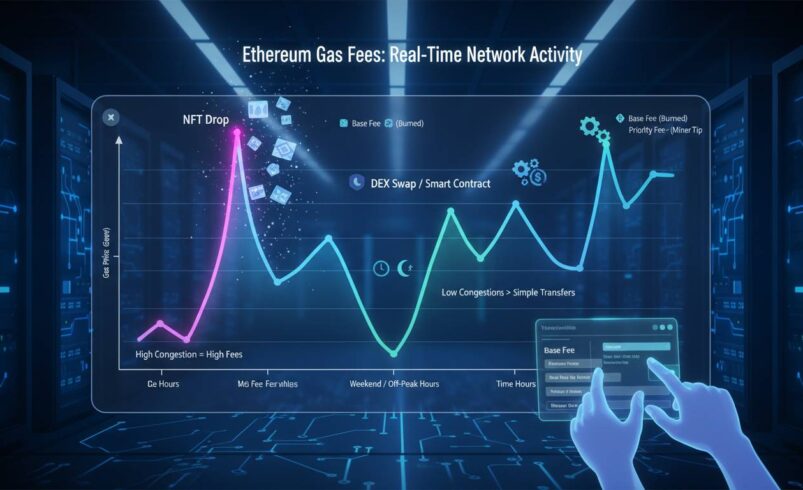
Gas prices fluctuate constantly based on demand. When the network is quiet, you might pay 10 gwei or less. During a surge—popular NFT drop, major DeFi launch, market volatility—gas prices can spike to 200 gwei, 500 gwei, or higher. On extremely congested days, I’ve seen prices exceed 1,000 gwei.
The gas price isn’t fixed by you alone. It’s a market: you propose what you’re willing to pay, and validators (formerly miners) choose which transactions to include. Higher fees get processed faster. If you set your gas price too low, your transaction sits in the mempool waiting for space to clear—sometimes for hours, sometimes indefinitely.
How EIP-1559 Changed Everything
Before August 2021, Ethereum used a pure auction system. You bid a gas price, and transactions with the highest bids got included first. This was simple but chaotic—users had to guess what others would pay, often overpaying significantly.
EIP-1559 introduced a two-part fee structure that fundamentally changed how users interact with the network. Every transaction now includes a base fee and a priority fee.
The base fee is set by the network itself, determined by block congestion. Each block targets 15 million gas worth of transactions. If the previous block exceeded this target, the base fee increases. If it fell short, the base fee decreases. This creates a responsive mechanism that automatically adjusts to demand.
The math is explicit: the base fee can change by at most 12.5% from one block to the next. This prevents the wild price swings of the old system while still allowing the market to find equilibrium.
The priority fee (often called a tip) goes directly to the validator who includes your transaction. This replaces the old gas price bidding war. You set a maximum priority fee, and the validator receives whatever you specify (assuming the base fee doesn’t exceed your total max fee).
The practical impact: you now set a max fee that covers both the base fee and priority fee. If the base fee is lower than your max, the difference refunds to you after the transaction. This means you can set your max fee once and forget it, rather than constantly adjusting bids.
EIP-1559 also introduced ETH burning. The base fee gets destroyed rather than going to anyone. As of early 2025, over $10 billion worth of ETH has been burned through this mechanism. This creates deflationary pressure on ETH supply—a profound economic change that connects the value of the network directly to its usage.
Why Ethereum Gas Fees Remain High
The biggest misconception is that EIP-1559 was supposed to lower fees. It wasn’t. The upgrade improved fee predictability and created a sustainable economic model, but it didn’t reduce the cost of computation.
Ethereum has a throughput limit of roughly 15-30 million gas per block, depending on network conditions. That’s a hard cap that creates natural competition for space. Every person wanting to transact at the same time bids up the price.
Several factors drive sustained high fees:
- Network usage: Ethereum processes over 1 million transactions daily, with peaks during major events. Every transaction competes for the same limited block space.
- Smart contract complexity: A simple transfer costs 21,000 gas. A Uniswap swap might cost 150,000 gas because it involves price calculations, liquidity checks, token transfers, and state updates. More complex operations can consume millions of gas units.
- NFT activity: Mints and trading consume enormous gas, especially when thousands of people try to mint simultaneously. A popular drop can congest the entire network for hours.
- Speculation and trading: DeFi arbitrage, liquidations, and trading bots constantly compete for block space. These operations are often automated and willing to pay premium fees for faster execution.
The reality is that Ethereum’s architecture prioritizes decentralization and security over transaction throughput. This is an explicit design choice, not a failure. Alternative networks sacrifice varying degrees of these properties to offer cheaper transactions. Whether that’s worth the trade-off depends entirely on your use case.
Calculating Your Actual Fee
The fee formula is straightforward, but the numbers can confuse people.
Total fee = Gas used × (Base fee + Priority fee)
With EIP-1559, you specify a max fee and max priority fee. The actual fee depends on what the base fee is when your transaction gets included.
Let’s walk through a real example. Suppose you want to send ETH and your wallet shows these settings:
- Max fee: 100 gwei
- Max priority fee: 2 gwei
When the transaction executes, the base fee is 50 gwei. Your total fee is 50 + 2 = 52 gwei per unit. With a gas limit of 21,000, you pay 21,000 × 52 = 1,092,000 gwei, or 0.001092 ETH.
The max fee you set (100 gwei) becomes the ceiling. If the base fee had spiked to 150 gwei, your transaction would fail because that’s above your max fee. You’d need to increase your max fee or wait for congestion to ease.
Most wallets now display the estimated cost in both gwei and your local currency. This helps, but the currency estimate is only valid at the moment of display—fees can change within seconds.
Best Times to Reduce Gas Fees
Timing isn’t everything, but it’s significant. Gas prices follow patterns that are predictable enough to exploit if you understand them.
- Off-peak hours: Network activity drops substantially during certain windows. Late nights and early mornings in North America tend to have lower fees. Weekend activity varies but often sees reduced congestion compared to weekdays.
- Avoid major events: NFT drops, token launches, and significant market moves will spike fees regardless of timing. If you can wait, do so.
- Use gas trackers: Tools like Etherscan’s gas tracker show current base fees and expected wait times. Watching these for a few hours helps you understand the rhythm.
- Layer 2 solutions: For non-urgent transactions, moving to Layer 2 networks like Arbitrum, Optimism, or Base can reduce fees by 90% or more. These networks bundle transactions and settle them on Ethereum, inheriting Ethereum’s security while dramatically lowering costs.
The key is planning. If you’re executing a DeFi strategy where timing matters, you might need to pay premium fees. But if you’re just moving funds or making a trade that can wait, patience saves money.
Layer 2 Networks and Fee Reduction
Ethereum’s Layer 2 solutions have matured significantly since 2022. Arbitrum, Optimism, Base, and zkSync all offer substantially lower fees while still settling to Ethereum’s mainnet.
The trade-off is added complexity. You need to bridge funds to the Layer 2, which itself requires a mainnet transaction. For small transactions, the bridging cost might exceed the savings. For larger transactions or frequent users, Layer 2 economics make sense.
Here’s the practical breakdown: a simple ETH transfer on mainnet might cost $5-20 depending on congestion. The same transfer on Arbitrum costs a few cents. A DeFi swap that costs $30-100 on mainnet typically costs under $1 on Layer 2.
For anyone using Ethereum regularly—traders, DeFi users, NFT collectors—understanding Layer 2s is essential. The savings compound quickly.
Common Questions About Ethereum Gas
Can gas fees be zero?
No. Even if you set a zero priority fee, you still pay the base fee (which can approach zero during extremely low congestion). The base fee can theoretically drop to near-zero, but it never goes fully negative.
Do failed transactions cost gas?
Yes. The network still processed your transaction attempt, consuming computational resources. You pay for all gas used up to the point of failure.
Can I get a refund on unused gas?
Yes. If your transaction completes before reaching your gas limit, the unused portion refunds automatically. The total fee only accounts for gas actually consumed.
Why does my wallet show a higher fee than the transaction ultimately cost?
Wallets display the maximum possible fee (gas limit × max fee). Since the base fee is often lower than the max, and unused gas refunds, you typically pay less than the estimate.
What happens if I set my max fee too low?
Your transaction sits in the mempool until fees drop below your threshold or until the transaction expires (typically after a few hours or days, depending on wallet settings).
The Future of Ethereum Fees
Ethereum’s roadmap includes several upgrades that could affect fees. Dencun, implemented in March 2024, introduced proto-danksharding, which significantly reduced data availability costs for Layer 2s. The long-term goal is “blobs” that make Layer 2 transactions even cheaper.
Further upgrades will continue improving throughput, but Ethereum’s core philosophy prioritizes security and decentralization over raw capacity. Fees will likely remain volatile and sometimes expensive during high-demand periods.
The practical advice hasn’t changed: use Layer 2s for regular transactions, monitor gas prices before transacting, and plan around major network events. The fee mechanism isn’t going away—it’s the price of operating a decentralized world computer.
Understanding this system doesn’t eliminate the frustration of paying $50 to swap tokens during a market surge. But it does help you time your transactions better, choose the right network layer, and make informed decisions about when the cost is worth it.