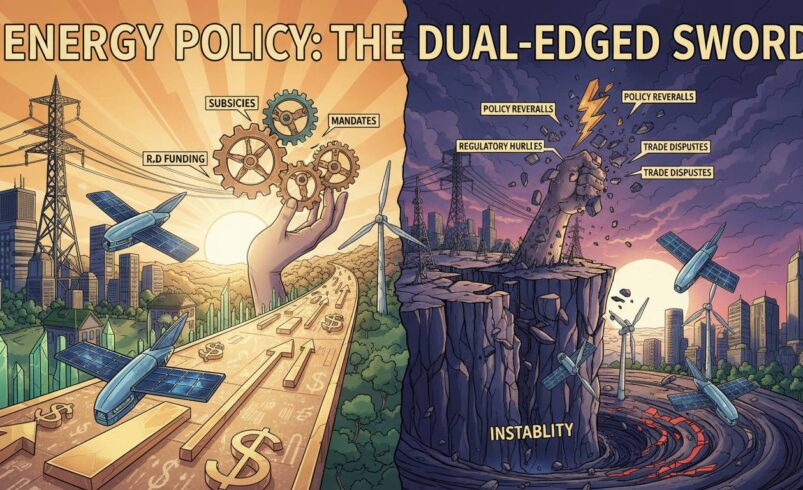

The relationship between government energy policy and renewable stock returns isn’t subtle — it’s the dominant variable in this sector. I’ve spent fifteen years analyzing clean energy markets, and the pattern is unmistakable: policy certainty drives returns with remarkable consistency, while policy volatility destroys them just as reliably. The reason most retail investors underperform in renewable stocks isn’t that they pick the wrong companies. It’s that they underestimate how completely government policy determines the financial fundamentals these companies can project.
This isn’t a sector where company fundamentals matter most in isolation. A solar panel manufacturer can have the best technology in the world, but if the Investment Tax Credit disappears overnight, their projected revenue collapse wipes out any fundamental advantage. Understanding which policies matter, how they create or destroy value, and how to assess policy risk is the single most important skill for anyone investing in this space.
The Mechanism: Policy as a Demand Multiplier
Government policy affects renewable stock returns through three primary channels: direct financial incentives, regulatory mandates, and market certainty. Each channel operates differently, and the interaction between them creates the price movements that define this sector.
Direct incentives like tax credits change the economics of renewable projects in immediate, quantifiable ways. When the Investment Tax Credit covers 30% of a solar installation’s cost, project developers can offer power purchase agreements at prices that compete with fossil fuels. That directly increases demand for solar panels, inverters, and mounting equipment — which flows through to manufacturer revenues and, eventually, stock prices.
Regulatory mandates like Renewable Portfolio Standards create guaranteed demand floors. When a state requires 50% renewable electricity by 2030, utilities must procure renewable energy regardless of current prices. That guaranteed offtake reduces investment risk, lowers capital costs, and drives construction activity — all of which flow through the supply chain.
Market certainty might be the most powerful channel, precisely because it’s invisible. When investors believe a policy will persist, they price it into valuations. The Inflation Reduction Act of 2022 didn’t just provide incentives — it provided a decade of visibility into what those incentives would be. That visibility reduced risk premiums and drove multiple expansion across the sector. Uncertainty does the reverse.
Investment Tax Credit: The 800-Pound Gorilla
The Investment Tax Credit is the most impactful single policy affecting renewable stocks, particularly for solar and storage. Understanding its history and current structure is essential for any serious investor.
The ITC was originally enacted in 2006 as part of the Energy Policy Act, initially offering a 30% credit for solar property. Its trajectory since then illustrates exactly how policy volatility destroys returns. In 2008, the credit was increased to 30% as part of the economic stimulus. In 2015, it began a scheduled decline to 10% for utility-scale solar. Each phase of decline triggered selloffs as investors recalculated project economics.
Then came the Inflation Reduction Act in 2022, which extended the 30% credit through 2032 and added bonus credits for domestic manufacturing and projects in energy communities. The market reaction was immediate and substantial. The Invesco Solar ETF (TAN) rose over 80% in the twelve months following the IRA’s passage.
Here’s what most investors miss: the ITC’s value isn’t linear. A project planned for 2026 needs to assume the credit will still exist at its expected rate. When policy visibility extends to 2032, developers can lock in financing at lower rates because the revenue projection is more certain. That certainty cascades through the entire supply chain.
For stock analysis, the ITC creates a simple framework: companies with exposure to residential and commercial solar benefit most from ITC stability because those segments have the highest credit utilization. First Solar (FSLR) and Sunrun (RUN) derive significant value from ITC certainty. First Solar also manufactures domestically, so it can capture additional bonus credits — a structural advantage that doesn’t depend on policy duration alone.
The practical takeaway: whenever Congress debates tax code changes, the ITC is your primary monitor. Track not just whether the credit exists, but whether its duration extends far enough to matter for long-term project financing.
Production Tax Credit: Wind’s Economic Foundation
The Production Tax Credit operates on a different model than the ITC — it rewards actual electricity generation rather than capital investment. For wind companies, the PTC has been the difference between viable project economics and economic impossibility.
The PTC currently provides 0.3 cents per kilowatt-hour for wind generation, adjusted annually for inflation. Like the ITC, its history demonstrates how policy volatility destroys value. The credit expired four times between 1999 and 2013, creating what the industry called the “flicker” effect — projects would be rushed online before expirations, then construction would freeze afterward. That boom-bust pattern made wind project development inherently risky and suppressed stock valuations.
The IRA addressed the PTC’s primary weakness by establishing a ten-year extension with clear phase-down schedules. For the first time in decades, wind developers can plan projects with policy visibility extending beyond 2030.
This matters enormously for stock analysis. NextEra Energy (NEE), the world’s largest utility by market cap and a dominant wind developer, benefits from PTC certainty because it allows long-term power purchase agreement negotiations. The company’s contracted revenue profile — roughly 80% of its earnings come from long-term agreements — depends on policy stability to maintain its value.
The practical takeaway: for wind stocks, the PTC’s duration matters more than its current rate. A 15-year PTC at 1.5 cents creates more value than a 5-year PTC at 3 cents because long-term contracts lock in revenue. When evaluating wind companies, always check their contracted backlog against the policy horizon.
EPA Regulations: The Indirect Accelerator
Environmental Protection Agency regulations don’t provide direct subsidies, but they create the regulatory framework within which renewable energy competes. And in recent years, the EPA has become a de facto renewable energy accelerator.
The Clean Air Act’s mercury and air toxics standards, updated under the Biden administration, effectively require utilities to reduce coal generation. The Clean Water Act’s Section 316(b) rules increase cooling water intake restrictions, making once-through cooling economically unviable for many coal plants. Each regulatory tightening reduces fossil fuel competitiveness and indirectly increases renewable demand.
The most significant recent development is the EPA’s carbon pollution standards for power plants, finalized in April 2024. These standards effectively require new natural gas plants to implement carbon capture technology and existing coal plants to meet emissions limits that most cannot achieve economically. The regulatory consensus now assumes coal’s decline is inevitable — which means renewable capacity must fill the gap.
This matters for stock analysis in ways that aren’t immediately obvious. Regulated utilities like Duke Energy (DUK) and Southern Company (SO) must build renewable capacity to replace retiring fossil generation. That regulatory requirement creates demand regardless of whether federal subsidies persist. When you see a utility’s integrated resource plan projecting significant renewable build-out, that’s a policy-driven revenue floor you can model.
The practical takeaway: EPA regulations create tailwinds that survive individual administrations. Even if Congress eliminates all renewable tax credits, existing EPA rules would continue driving the energy transition. Factor regulatory momentum into your long-term thesis, not just current subsidy levels.
State-Level Renewable Portfolio Standards: The Guarantee Behind the Market
While federal policy gets most attention, state-level Renewable Portfolio Standards often matter more for specific companies and regional markets. These mandates require utilities to source specified percentages of electricity from renewable sources, creating guaranteed demand that operates independently of federal policy.
California’s RPS requires 60% renewable electricity by 2030 and 100% by 2045. Texas, despite having no formal RPS, has added more renewable capacity than any state through market forces — but Texas also has aggressive carbon reduction goals that function similarly. New York’s Climate Act mandates 70% renewable electricity by 2030, creating enormous procurement requirements for the state’s utilities.
These state mandates matter for stock analysis because they create geographically concentrated demand. Companies with significant operations in high-RPS states — like NextEra Energy in Florida and California, or AES Corporation (AES) in several Northeast markets — benefit from demand floors that don’t depend on federal policy.
The Inflation Reduction Act actually supercharged state RPS programs by extending the timeline for domestic content bonuses and energy community credits that align with state-level priorities. A project in California that meets both domestic content and energy community requirements can capture credits significantly above the base 30%.
The practical takeaway: when analyzing renewable stocks, map their operational geography against state RPS requirements. Companies with exposure to states with aggressive targets have policy tailwinds that extend well beyond any single federal administration’s priorities.
The Destructive Power of Policy Uncertainty
Now for the uncomfortable truth that most articles on this topic skip: policy certainty drives returns, but so does the absence of policy certainty. And the destruction from policy uncertainty is asymmetric — it happens faster and more completely than the gradual build from policy support.
The most recent example is instructive. In early 2024, the Treasury Department’s implementation of the IRA’s domestic content bonus created enormous confusion. The original statute required that steel, iron, and manufactured products be produced in the United States to qualify for bonus credits. But “produced in the United States” was undefined for solar panels assembled from foreign components — which describes essentially all solar panels in the US market.
The resulting regulatory uncertainty lasted months. Developers froze procurement decisions. Manufacturers couldn’t price projects. Stock prices for First Solar and other domestic manufacturers swung dramatically on each rumor about how the Treasury would rule.
That’s the key insight most investors miss: uncertainty itself is the problem. It doesn’t matter whether the final rule is favorable or unfavorable — what matters is that until the rule exists, rational actors delay decisions. Delayed decisions mean delayed revenues, which means lower valuations.
This creates a practical framework for evaluating policy risk: whenever a significant policy is under deliberation, the affected stocks will experience elevated volatility regardless of the eventual outcome. The market prices in uncertainty, which is inherently a tax on returns. Your job as an investor is to assess not just whether a policy will pass, but whether the process of passing it will create extended uncertainty periods that depress valuations even before the outcome is known.
Case Study: The 2009-2010 Stimulus Boom
The American Recovery and Reinvestment Act of 2009 provides a useful historical case study for how policy-driven returns can be — and how they can evaporate.
The stimulus package included an eight-year extension of the ITC and a three-year extension of the PTC, along with cash grants in lieu of tax credits for projects that couldn’t utilize the credits directly. The effect on renewable stocks was immediate and dramatic. Between early 2009 and early 2011, the solar sector — measured by the Guggenheim Solar ETF (TAN) — more than tripled.
But here’s what happened next: the policy visibility that drove the boom also drove overcapacity. Manufacturers, responding to the guaranteed demand, expanded production aggressively. When the ITC began its scheduled decline in 2016, the market had absorbed more panel capacity than demand could sustain. Prices collapsed. Manufacturer margins disappeared. Stock prices cratered.
The lesson isn’t that policy-driven booms are bad — it’s that the boom itself contains the seeds of the subsequent bust. When evaluating renewable stocks after a policy-driven rally, always assess whether current valuations incorporate expectations that the policy will remain stable indefinitely. They usually don’t.
Case Study: The Trump Administration and the Wind Sector
The 2016 election created a natural experiment in policy-driven destruction. The Trump administration opposed wind energy aggressively, with the President himself criticizing wind farms as harmful to property values and promising to eliminate the PTC.
The PTC had already begun phasing down under the 2015 PATH Act, so the direct policy impact was limited. But the rhetorical attack on wind energy created something more dangerous than a specific policy change: it created uncertainty about the future. Would the administration attempt to eliminate the PTC retroactively? Would it impose barriers to wind project permitting?
The market’s response was instructive. While the broader renewable sector sold off, the most significant impact was on project development timelines. Developers delayed final investment decisions, uncertain whether the regulatory environment would remain favorable. That delay translated into reduced near-term revenue expectations, which compressed valuations.
What happened next was equally instructive: the PTC had been structured to phase down gradually, so the actual policy impact was minimal. By 2020, the sector had recovered substantially. Investors who panic-sold during the policy uncertainty period missed significant subsequent gains.
The takeaway: policy-driven fear often exceeds policy-driven reality. But the timing of fear and reality don’t align perfectly, which is where opportunity exists for investors who understand the actual policy mechanics.
The Inflation Reduction Act: A New Paradigm?
The Inflation Reduction Act of 2022 deserves specific analysis because it represents a qualitative change in how the federal government supports renewable energy — and because it’s the dominant factor in current sector valuations.
Previous renewable energy policies shared a common characteristic: they were temporary. The ITC had been extended multiple times, always with expiration dates. The PTC had expired and been renewed repeatedly. That pattern created inherent uncertainty and prevented the long-term planning necessary for massive infrastructure investments.
The IRA changed this by extending major incentives through at least 2032, with gradual phase-downs beginning in 2030 and 2033 depending on the credit. For the first time, developers can sign power purchase agreements with 10-year visibility into project economics. That changes the risk profile fundamentally.
But here’s where honest analysis requires acknowledgment of uncertainty: the IRA’s incentives phase down based on congressional appropriations and emissions targets. If a future Congress changes those targets, the phase-down could accelerate. The credits are also subject to “clawback” provisions if projects don’t meet wage and apprenticeship requirements, creating execution risk.
The practical takeaway: the IRA represents the most significant policy support in renewable energy history, and current sector valuations depend heavily on its provisions remaining in place. But prudent investors should model scenarios where some IRA provisions are modified, not eliminated, and assess company exposure to those modifications.
Framework for Analyzing Policy Risk in Renewable Investments
After fifteen years of analyzing this sector, I’ve developed a practical framework for assessing policy risk that goes beyond simply tracking legislative developments.
First, distinguish between direct incentives and regulatory mandates. Tax credits can be modified or eliminated by future Congresses. EPA regulations, once finalized, persist regardless of administration. Companies with revenue exposed primarily to regulatory mandates have more durable policy tailwinds than those dependent on tax credits.
Second, assess geographic concentration. Companies with exposure to multiple state RPS markets are less vulnerable to any single jurisdiction’s policy changes. Companies dependent on one state’s incentives carry concentrated policy risk.
Third, examine contract structures. Companies with long-term, fixed-price power purchase agreements have revenue visibility that insulates them from spot market volatility. Companies reliant on merchant power sales are more exposed to policy-driven cost changes.
Fourth, evaluate supply chain positioning. Companies that can capture domestic content bonuses or energy community credits have structural advantages that don’t depend on policy duration. Vertical integration provides similar insulation.
Fifth, track policy implementation, not just enactment. The IRA’s bonus credit provisions are still being implemented, and Treasury decisions on domestic content definitions will determine whether manufacturers actually capture those bonuses. Policy risk exists in implementation, not just legislation.
Conclusion: The Only Thing That Matters
If there’s one insight worth carrying away from this analysis, it’s that government energy policy isn’t one factor among many in renewable stock returns — it is the dominant factor. Company execution matters, technology advantages matter, management quality matters. But policy determines the ceiling on what any of those factors can achieve.
The energy transition isn’t happening because renewable technology became cheaper than fossil fuels. It’s happening because governments created the policy frameworks that made the transition economically rational. The stocks that have delivered returns — and the stocks that have destroyed them — have done so primarily through policy channels.
This creates both risk and opportunity. The risk is that policy changes can wipe out fundamental advantages overnight. The opportunity is that policy uncertainty creates mispricings that informed investors can exploit. Understanding how policy drives returns — and how it destroys them — is the necessary foundation for any serious investment in this sector.
What remains genuinely unresolved is whether the current policy framework will persist through the 2030s, when the IRA’s major provisions begin phasing down. The political consensus supporting renewable energy incentives is narrower than it appears. Investors should build their models on the assumption that current policy continues, but hold reserves for scenarios where it doesn’t — and recognize that the next significant policy change will create as much opportunity as destruction for those prepared to act.