
Most investors know compound interest is powerful. What they underestimate is how much faster dividend reinvestment builds wealth compared to simply collecting cash dividends. When you reinvest dividends back into the stocks that paid them, you create a compounding engine that historically outperforms over decades. This isn’t theoretical—it’s been documented across market cycles, and the mechanics are simple enough for anyone to use.
This guide covers how dividend reinvestment works, why it compounds so effectively, what historical returns actually look like, and how to set it up. I’ll also explain why DRIP isn’t the right move in every situation, because conventional wisdom isn’t always right.
What is Dividend Reinvestment (DRIP)?
DRIP is exactly what it sounds like: instead of taking dividend payments as cash, you use them to buy more shares of the same company or fund. When a company pays a dividend, shareholders receive a set amount per share. With DRIP, those dollars automatically buy fractional shares, which then generate their own dividends.
Most major brokerages offer automatic dividend reinvestment. At Fidelity, Vanguard, and Charles Schwab, you can enable DRIP with a single account setting. The process is seamless—dividends execute as purchases on the payment date, often at a slight discount since there’s no commission.
One thing that trips people up: DRIP doesn’t mean you have to reinvest every dividend. Most programs let you choose which securities to reinvest and which to take as cash. You can also manually reinvest by setting up recurring purchases aligned with dividend payment dates. The key point is that enabling it makes the process automatic, removing the behavioral barrier of remembering to reinvest manually.
How DRIP Compounds Your Wealth
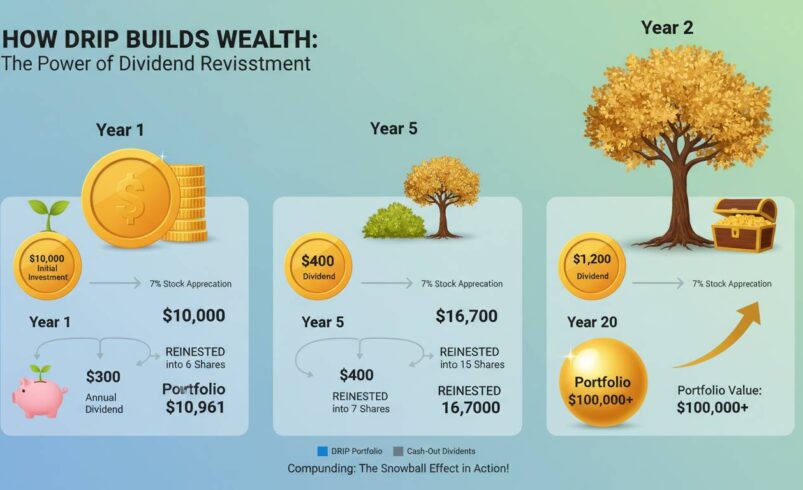
The compounding power of DRIP comes from two effects working together. First, you’re increasing your share count with every dividend payment, which means your next dividend will be larger because you own more shares. Second, those additional shares generate their own dividends, which buy even more shares. This recursive growth is exponential—in practice, it creates a snowball effect that becomes harder to ignore over time.
Let’s use concrete numbers. Suppose you invest $10,000 in a dividend-paying stock yielding 3% with 5% annual dividend growth—conservative by historical standards for quality dividend stocks. In year one, you receive $300 in dividends. If you reinvest that $300 at the current share price, you buy more shares. By year ten, your annual dividend income has grown to approximately $470, even without adding a single dollar of new capital. By year twenty, it approaches $1,100. Your original $10,000 investment is now generating over 11% annually in dividend income alone, before considering share price appreciation.
Here’s what most calculators get wrong: they assume a flat dividend yield. Real dividend growth matters enormously. When companies increase their dividends—a behavior tracked by the S&P 500 Dividend Aristocrats, which have raised dividends for at least 25 consecutive years—the compounding accelerates dramatically. A stock yielding 2.5% today but growing its dividend 7% annually will eventually outpace a static 4% yielder, often within a decade.
The formula isn’t complicated, but it requires patience. Your wealth equation with DRIP becomes: more shares → larger dividend → more shares → larger dividend. There is no step in this chain where the math works against you, assuming you hold quality dividend-paying investments.
Real-World Examples of DRIP Performance
Historical data from the S&P 500 provides a reliable benchmark for understanding DRIP performance over long periods. From 1973 through 2023, the total return of the S&P 500 averaged approximately 10% annually when dividends were reinvested, compared to roughly 7% annually when dividends were taken as cash. That 3% gap might not sound enormous on a year-by-year basis, but over thirty years, it transforms an initial investment dramatically.
Consider some well-known dividend payers. Johnson & Johnson, a Dividend Aristocrat, has increased its dividend for over 60 consecutive years. An investor who bought $10,000 worth of J&J shares in 1990 and enrolled in DRIP would have seen their annual dividend income grow from approximately $300 in 1990 to over $1,800 by 2023—six times the original income, with share price appreciation on top of that. The dividend yield on cost exceeded 18% by 2023.
Procter & Gamble tells a similar story. Since 1990, Procter & Gamble has raised its dividend every year. Maintaining DRIP enrollment would have turned a $10,000 initial investment into a position generating roughly $1,400 in annual dividend income by 2023, plus substantial capital appreciation.
Here’s where I want to push back on conventional DRIP advice: the comparison between DRIP and taking dividends as cash isn’t as straightforward as most articles suggest. If you take dividends as cash during bull markets and reinvest them during corrections, you can actually outperform automatic DRIP in some scenarios. Reinvesting during bear markets—when share prices are lower—produces better long-term returns than mechanically reinvesting at any price. Automatic DRIP is psychologically easier, but it’s not mathematically optimal in every market environment. The difference isn’t massive, but it’s real, and honest analysis should acknowledge this.
Benefits of Dividend Reinvestment
The most underrated benefit of DRIP is psychological simplicity. When you don’t have to decide whether to reinvest each quarter, you remove the opportunity for hesitation or market timing that costs most investors dearly. Research consistently shows that investors who automate their investing outperform those who manage actively, and DRIP is one of the purest forms of automation available.
DRIP also provides automatic dollar-cost averaging. Since dividend payments arrive on predictable schedules—quarterly for most American companies—you’re systematically buying shares at various price points throughout the market cycle. During high-priced periods, your dividend buys fewer shares. During downturns, the same dividend buys more shares. Over time, this smooths out your cost basis and reduces the risk of investing a large lump sum at the wrong moment.
The tax deferral advantage is often overlooked. In tax-advantaged accounts like IRAs and 401(k)s, dividend reinvestment occurs without immediate tax consequences. Even in taxable accounts, qualified dividends receive preferential capital gains treatment, and holding DRIP shares long-term means you’re only taxed when you eventually sell, not on each reinvestment.
Finally, DRIP creates a forced savings mechanism. For investors who struggle to contribute regularly to their portfolios, the knowledge that dividends will automatically purchase more shares—even without additional contributions—provides steady growth that compounds quietly in the background.
Potential Drawbacks to Consider
The tax inefficiency of DRIP in taxable accounts deserves more attention than it typically receives. When you reinvest dividends, you’re creating a new tax basis for each purchase. This means more lots to track come tax time, more opportunities for capital gains calculations, and potentially more tax complexity when you eventually sell. For high earners in high tax brackets, this can become a meaningful administrative burden.
There’s also concentration risk to think through. If you own a single stock with DRIP enabled and that stock declines significantly, you’re continuing to buy more of a falling asset. The standard advice to “buy the dip” sounds good in theory, but when it’s happening automatically through DRIP, you might be doubling down on a deteriorating business. This is why DRIP works best with diversified funds rather than individual stocks—specifically broad index funds that give you automatic exposure to the entire market.
One more consideration that gets insufficient attention: DRIP can reduce your portfolio’s dividend yield over time if you’re not careful. When share prices rise dramatically, the dividend yield percentage naturally falls. A stock that yielded 4% when you bought it might yield only 2% after several years of price appreciation, even though your absolute dividend income has grown. This is normal and expected, but it can be confusing for investors who monitor their portfolio’s yield percentage rather than their total dividend income.
How to Start a DRIP
Starting dividend reinvestment is simpler than most people realize. Here’s exactly how to do it at the three largest brokerage platforms:
Fidelity: Log into your account, navigate to “Positions” or “Account Settings,” find “Dividend Reinvestment,” and select “Reinvest All” for each position. You can also set up partial reinvestment if you want to take some dividends as cash.
Vanguard: Go to “My Holdings,” select the position, click “Dividend and Capital Gains,” and choose your reinvestment election. Vanguard allows you to enroll specific holdings or set a default for all new positions.
Charles Schwab: Access “Account Settings,” find “Dividend Reinvestment,” and enable it for individual securities or your entire account.
For those who want more control, you can achieve DRIP-like results manually by setting up recurring investments. Most brokers let you schedule automatic purchases on a monthly or quarterly basis. The key difference is that manual recurring investments use a fixed dollar amount rather than the variable dividend amount, but the practical effect—consistent exposure accumulation—is similar.
If you’re building a portfolio specifically for DRIP, focus on Dividend Aristocrats and Dividend Kings (50+ years of increases), broad dividend ETFs like SCHD, VYM, or VIG, and individual quality companies with strong balance sheets and consistent payout growth. Avoid the temptation to chase high yields alone—a 7% yield might signal a troubled company that’s cutting dividends soon rather than a sustainable income stream.
Frequently Asked Questions
Does DRIP work with ETFs? Yes. Most dividend-focused ETFs like the Schwab U.S. Dividend Equity ETF (SCHD) or Vanguard High Dividend Yield ETF (VYM) support DRIP. When the ETF pays a dividend, it gets reinvested into additional ETF shares automatically.
Can I enroll in DRIP with any brokerage? Most major brokerages offer it. If your brokerage doesn’t support DRIP directly, you can achieve the same result by setting up automatic purchases that coincide with dividend payment dates.
What happens to DRIP during a recession? Reinvested dividends continue purchasing shares during downturns, often at lower prices. This accelerates recovery when markets bounce back, since you own more shares purchased at discounted prices. However, if dividends are cut—which happened broadly during 2008-2009—your reinvestment amount decreases alongside the dividend reduction.
Is DRIP better than reinvesting capital gains? They serve different purposes. DRIP focuses on income-producing securities, while capital gains reinvestment applies to any profitable investment. Both compound wealth, but DRIP provides more regular purchase intervals and automatic dollar-cost averaging.
How long does it take to see meaningful results from DRIP? Meaningful dividend income growth typically becomes noticeable after five to seven years. The compounding effect accelerates significantly after year ten, with most investors seeing their original dividend income double or triple within fifteen to twenty years.
The Bottom Line
Dividend reinvestment remains one of the most powerful wealth-building tools available to individual investors. The historical data is clear: reinvesting dividends consistently outperforms taking dividends as cash, because the mechanism forces systematic compounding that most investors fail to achieve through manual effort alone.
But here’s the honest tension that every investor must navigate: automatic DRIP is psychologically easier but mathematically imperfect. The investors who do best often combine DRIP’s automatic convenience with deliberate manual intervention during significant market corrections. That’s not a contradiction—it’s recognizing that the best investment strategy is one you’ll actually stick with, while leaving room for optimization when opportunities become clear.
The real question isn’t whether DRIP works. It does. The question is whether you’re willing to stay invested long enough for the compounding to work its magic. Most people aren’t. They check their accounts too often, panic during downturns, and tinker with strategies at precisely the wrong moments. DRIP’s greatest advantage might not be the mathematical compound at all—it might be the behavioral guardrail that keeps you from sabotaging your own wealth.