
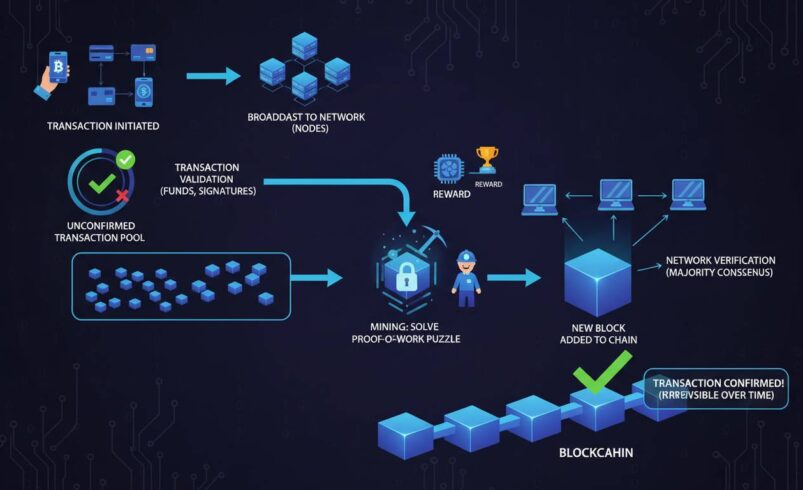

Every second, thousands of cryptocurrency transactions travel through a digital labyrinth most users never see. You tap “send,” your wallet broadcasts the transaction, and somewhere in the ether, a complex choreography of nodes, miners, and cryptographic puzzles determines whether that transaction actually lands in the recipient’s wallet. Understanding this process isn’t just for developers or traders—it’s essential knowledge for anyone who holds or uses cryptocurrency. The confirmation mechanism is what makes blockchain trustworthy, yet it’s routinely misunderstood or oversimplified.
This guide walks through the entire transaction confirmation process, from the moment you submit a transfer to when it’s irreversibly recorded on the blockchain. You’ll find specific numbers, real examples, and enough technical depth to understand what’s happening under the hood without needing a computer science degree.
The Transaction Lifecycle: From Your Wallet to the Blockchain
When you initiate a cryptocurrency transfer, your wallet doesn’t immediately send money anywhere. Instead, it constructs a digital package containing the amount, the recipient’s address, your digital signature, and metadata about the transaction. This package gets broadcast to the nearest node—a computer running the cryptocurrency’s software that’s connected to the peer-to-peer network.
The node receiving your transaction immediately performs validation checks. It verifies that your digital signature is authentic (proving you actually control the sending address), that you haven’t already spent those coins, and that the transaction follows the protocol’s rules. If anything is wrong, the node rejects it outright. If everything checks out, the node propagates the transaction to its peers, who each perform their own validation. Within seconds, your transaction has reached thousands of nodes across the network.
This is where most users assume the transaction is “done.” It’s not. Your transaction has simply entered the pool of unconfirmed transactions waiting to be included in the next block. The time between broadcast and final confirmation is where most of the confusion—and frustration—occurs.
What Is the Mempool?
The mempool (short for “memory pool”) is essentially the waiting room for unconfirmed transactions. Think of it as a public queue where every valid transaction sits until a miner picks it up and includes it in a new block. Each node maintains its own mempool, and these aren’t perfectly synchronized—your transaction might appear in one node’s mempool seconds before another node sees it.
The mempool operates on a fee-based priority system. When block space is limited, miners naturally gravitate toward transactions that pay the highest fees per byte. This creates a competitive market: during periods of high demand, users who pay lower fees find their transactions stuck in the mempool while higher-fee transactions get confirmed first. On Bitcoin’s network, this dynamic plays out constantly—the mempool regularly contains tens of thousands of unconfirmed transactions during busy periods.
Every node sets its own mempool size limits. When the queue gets too long, nodes drop the lowest-fee transactions to make room for newer ones with higher fees. This is why transactions sometimes “disappear” from block explorers—if the fee was too low and the mempool flushed out older transactions, your transfer effectively returns to your wallet as if it never happened. This isn’t common, but it happens.
You can actually watch the mempool in real-time through block explorers like blockchain.com or mempool.space. These sites display the current queue of unconfirmed transactions, sorted by fee rate, so you can gauge how much you need to pay for timely confirmation.
How Miners Confirm Transactions
Cryptocurrency networks don’t have a central authority confirming transactions. Instead, they rely on miners—specialized computers that compete to solve complex mathematical puzzles in exchange for block rewards. This process, called proof of work, is what secures the network and determines which transactions get confirmed next.
Here’s how it works in practice. When miners assemble a new block, they select transactions from the mempool, typically prioritizing those with the highest fees. They bundle these transactions together and attempt to find a number (called a nonce) that, when hashed with the block’s data, produces a result starting with a specific number of zeros. This is pure brute force—miners iterate through billions of nonces per second until someone finds one that works.
The first miner to find a valid hash broadcasts their block to the network. Other miners verify the block is valid, then abandon their own attempts and start working on the next block. This is the moment of confirmation for every transaction in that block. Your transaction is now officially part of the blockchain.
The mining process creates what makes cryptocurrency revolutionary: an impartial, decentralized arbiter that no single entity controls. Miners have economic incentive to follow the rules because accepting invalid transactions would waste their computational resources and forfeit potential rewards. The network is self-policing in a way traditional financial systems can’t match.
What Are Block Confirmations?
When someone says a transaction is “confirmed,” they mean it’s been included in a block that’s part of the blockchain. But here’s the nuance: a single confirmation doesn’t mean the transaction is irreversibly settled. Blockchain reorganizations—where the network briefly disagrees about which chain is valid—can occasionally reverse recently confirmed transactions.
This is why most services require multiple confirmations before considering a transaction final. Each new block added on top of your transaction’s block makes reversal increasingly difficult. The deeper a transaction sits in the blockchain, the more computational work would be required to undo it.
For Bitcoin, the commonly recommended threshold is six confirmations for large transactions. This isn’t arbitrary—it represents the point at which the mathematical probability of reversal becomes negligible. Each confirmation exponentially increases the energy required to rewrite history. A would-be attacker would need to control more than 50% of the network’s mining power to have any chance of reversing a transaction, and even with majority hash power, success becomes exponentially harder with each new block.
Ethereum operates differently. The network moved to proof of stake in September 2022 (the Merge), replacing energy-intensive mining with validators who stake ETH as collateral. Confirmations on Ethereum are faster—a new block appears approximately every 12 seconds compared to Bitcoin’s roughly 10 minutes. Many services consider Ethereum transactions final after 12-15 confirmations, though for most practical purposes, a single confirmation is sufficient for smaller amounts.
Confirmation Times by Cryptocurrency
Different cryptocurrencies have dramatically different confirmation characteristics. Understanding these differences matters when you’re deciding which chain to use or how long to wait before considering a transaction final.
Bitcoin averages around 10 minutes per block, though this varies. The network targets block times of exactly 10 minutes by adjusting difficulty every 2016 blocks (approximately every two weeks). Sometimes blocks arrive in 2 minutes; occasionally they take 20. This randomness is built into the protocol.
Ethereum’s block time averages 12 seconds post-Merge, though the network can occasionally produce blocks faster during high-activity periods. This speed makes Ethereum feel significantly more responsive than Bitcoin for everyday transactions.
Other cryptocurrencies vary widely. Litecoin, which uses a different hashing algorithm, produces blocks every 2.5 minutes. Solana claims sub-second finality under normal network conditions, though its proof-of-history mechanism differs fundamentally from both Bitcoin and Ethereum. Bitcoin Cash, a Bitcoin fork, maintains 10-minute blocks like its predecessor.
These numbers represent averages and targets, not guarantees. Network congestion, fee markets, and random variance all influence actual confirmation times. A Bitcoin transaction might confirm in 5 minutes, or you might wait an hour. The protocol doesn’t promise specific times—it only promises that valid transactions with sufficient fees will eventually confirm.
Factors Affecting Confirmation Speed
The most significant factor determining confirmation speed is the fee you attach to your transaction. This is simple economics: miners fill blocks with the highest-paying transactions first. During congested periods, users who underpay can wait hours or days.
Block space demand drives these dynamics. When cryptocurrency markets surge, when popular NFT drops occur on Ethereum, or when a new DeFi protocol launches, thousands of users compete for limited block space simultaneously. Fees spike. Low-fee transactions get stuck.
Network latency also matters. Your transaction propagates across the globe through peer-to-peer connections. In most cases, this takes seconds, but if your wallet connects to only a few peers or those peers are slow, your transaction might enter the mempool later than expected. Some wallets let you choose which node or peer to connect to, though most users stick with defaults.
The time of day matters indirectly. Cryptocurrency trading is more active during certain hours, particularly U.S. market hours and Asian evening hours. Higher trading volume correlates with more transaction submissions, which drives up fees and congestion during these windows.
One counterintuitive reality: sometimes paying a lower fee actually gets your transaction confirmed faster. This happens when network activity suddenly drops—a weekend afternoon or holiday period can clear the mempool completely, and miners will confirm low-fee transactions just to collect the block reward. Patience can be its own strategy.
Troubleshooting Slow Transactions
If your transaction has been pending for hours or days, several things might be happening, and the solutions differ depending on the cause.
First, check the fee. If you paid below the going rate for block space, your transaction is simply waiting in line. Block explorers show the current fee landscape—compare what you paid to what others are paying. If you’re significantly below average, low fee is likely your problem.
For unconfirmed transactions, some wallets offer “replace-by-fee” (RBF) functionality. This lets you resend the same transaction with a higher fee, telling the network to prioritize the new version. Not all transactions support this—it must be enabled when you create the original transaction—so check your wallet’s settings before sending.
Bitcoin users have another option: child pays for parent (CPFP). If you’re the recipient of a stuck transaction, you can spend the unconfirmed funds in a new transaction that pays an extremely high fee, incentivizing miners to confirm both transactions together to collect that fee.
Sometimes transactions simply fail to propagate correctly. Your wallet might have trouble connecting to the network, or the initial fee might have been so low that nodes dropped it before it reached the mempool. In these cases, simply resending with a higher fee usually resolves the issue.
Frequently Asked Questions
How long does it take for a crypto transaction to confirm?
Bitcoin transactions typically confirm within 10-60 minutes, though this varies based on network congestion and the fee paid. During busy periods, confirmation can take hours. Ethereum transactions usually confirm within 15-30 seconds under normal conditions. Smaller or newer blockchains often have faster or slower times depending on their specific protocols.
How many confirmations does a transaction need?
Bitcoin most commonly requires 6 confirmations for large transactions, though 1 confirmation is generally sufficient for small purchases. Ethereum typically needs 12-15 confirmations for large amounts, though many services accept 1 confirmation for routine transactions. The specific requirement depends on the service receiving the funds and the amount involved.
Why do crypto transactions sometimes fail?
Transactions fail for several reasons: insufficient fees during congestion, network propagation issues, invalid signatures, or attempting to spend funds that were already spent in another transaction. Some failures result from wallet bugs or user error, like entering incorrect recipient addresses. Unlike bank reversals, failed transactions don’t automatically return funds—you may need to wait for the transaction to timeout or manually troubleshoot.
Moving Forward
The blockchain confirmation system represents a genuine innovation in how humans coordinate around shared records. It removes the need for trusted intermediaries, replaces hierarchical approval with cryptographic proof, and creates a settlement system that no single entity controls. Understanding how this works isn’t academic—it’s practical knowledge that helps you set appropriate expectations, troubleshoot problems, and make better decisions about which cryptocurrencies to use and when.
What remains genuinely unresolved is how these systems will scale. Layer-2 solutions like Bitcoin’s Lightning Network and Ethereum’s various rollup technologies aim to make transactions faster and cheaper while maintaining security, but they’re still maturing. The tension between decentralization, security, and scalability continues driving innovation across the space. How these tradeoffs evolve over the next decade will shape whether cryptocurrency achieves mainstream utility or remains a niche technology.
The next time you send crypto and watch that “pending” status, you’ll know exactly what’s happening in that digital waiting room. The system isn’t magic—it’s code, economics, and thousands of computers doing exactly what they were designed to do.