
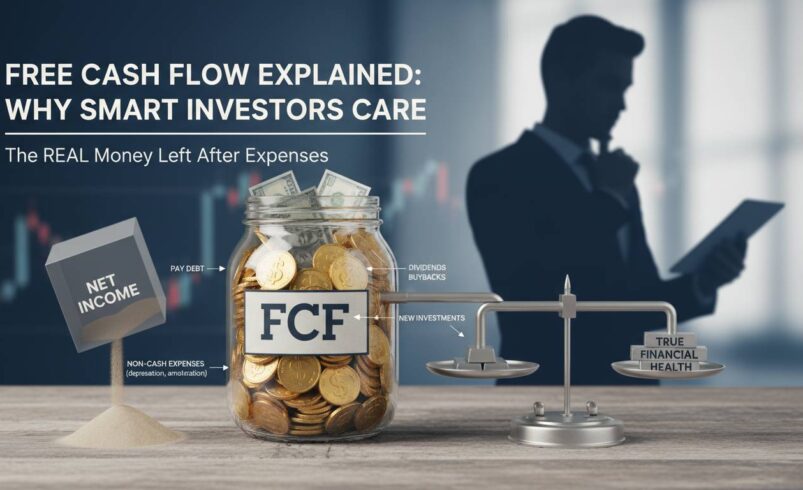

Most investors fixate on earnings per share, net income, or revenue growth when evaluating a stock. They’re looking in the wrong place. Free cash flow — the cold, hard cash actually generated by a business after covering its capital expenditures — tells you whether a company can sustain itself, reward shareholders, pay down debt, or invest in growth without begging for external financing. It’s the metric that separates companies with genuine financial strength from those simply painting pretty pictures with accounting adjustments.
I’ve spent years analyzing balance sheets, and I can tell you that free cash flow is the single most important number on any financial statement — more reliable than net income, more informative than operating cash flow in isolation, and far more telling about a company’s actual ability to create value for shareholders. Here’s everything you need to understand it, calculate it, and use it to make better investment decisions.
What Is Free Cash Flow (FCF)?
Free cash flow represents the cash remaining after a company has paid for all capital expenditures necessary to maintain or expand its asset base. Capital expenditures include purchases of property, plant, and equipment, as well as investments in technology and other long-term assets that keep the business running and growing.
The reason free cash flow matters so much is that it’s nearly impossible to manipulate through accounting tricks. Earnings can be massaged through depreciation assumptions, revenue recognition policies, or one-time adjustments. Cash in the bank is real. When a company generates substantial free cash flow, it has genuine flexibility — it can issue dividends, repurchase shares, reduce debt, acquire competitors, or simply accumulate a war chest for a rainy day. When free cash flow turns negative, the company is consuming cash to stay afloat, which is rarely sustainable without external financing.
Think of free cash flow as the “take-home pay” for the business. Revenue is like gross salary before deductions. Operating cash flow is like your paycheck after taxes but before your personal expenses. Capital expenditures are like your mortgage, car payment, and other mandatory costs. What’s left — what you can actually spend or save — is your free cash flow.
Free Cash Flow Formula
The basic formula for free cash flow is straightforward:
Free Cash Flow = Operating Cash Flow − Capital Expenditures
That’s the simplest version. You can find both components on the cash flow statement, which is one of the three main financial statements (alongside the balance sheet and income statement).
Operating cash flow, also called cash from operations, shows the cash generated by the company’s core business activities — selling products, delivering services, paying employees, and managing working capital. It starts with net income and adds back non-cash items like depreciation and amortization, then adjusts for changes in working capital.
Capital expenditures (often abbreviated as CapEx) represent the cash spent on acquiring, upgrading, or maintaining physical assets. Companies that own factories, retail locations, or data centers consistently spend billions annually on CapEx just to maintain their current operations, let alone grow.
A more detailed version of the formula incorporates changes in working capital, especially for more sophisticated analysis:
Free Cash Flow = Net Operating Profit After Tax (NOPAT) + Depreciation & Amortization − Change in Working Capital − Capital Expenditures
This detailed version is useful when you want to isolate cash flow generation from pure operations, but the simplified formula works perfectly well for most investment analysis purposes.
How to Calculate Free Cash Flow (Step-by-Step)
Let me walk through a practical calculation using a hypothetical company to make this concrete. Assume you’re analyzing a manufacturing company with the following figures from its cash flow statement:
- Operating Cash Flow: $500 million
- Capital Expenditures: $200 million
Step 1: Identify Operating Cash Flow
Look at the cash flow from operations section. This company generated $500 million in cash from its day-to-day business activities.
Step 2: Identify Capital Expenditures
Find the CapEx line item, typically listed under cash flow from investing activities. This company spent $200 million on equipment upgrades, facility maintenance, and expansion.
Step 3: Subtract CapEx from Operating Cash Flow
$500 million − $200 million = $300 million
This company’s free cash flow is $300 million. That’s real cash available for dividends, debt repayment, acquisitions, or reinvestment.
Now let’s compare this to another company in the same industry with identical revenue and similar net income:
- Company A: Operating Cash Flow = $500M, CapEx = $200M, FCF = $300M
- Company B: Operating Cash Flow = $500M, CapEx = $450M, FCF = $50M
Both companies look similar on an earnings basis. But Company A generates six times more free cash flow than Company B. That tells you Company A has far more financial flexibility — it can return more capital to shareholders, grow faster without issuing new debt, or survive an economic downturn much more easily.
One important caveat: capital expenditures can be lumpy. A company might spend heavily on a new factory in one year and spend very little the next. That’s why I always look at free cash flow over multiple years rather than a single year to understand the true cash generation capability.
Why Investors Care About Free Cash Flow
If you’re evaluating a stock, free cash flow answers several critical questions that other metrics simply cannot.
Can the company pay dividends sustainably?
Companies that pay dividends out of free cash flow rather than borrowed money are on much sounder footing. When free cash flow covers the dividend comfortably, the payout is sustainable through economic cycles. When companies pay dividends despite negative free cash flow, they’re either depleting their cash reserves or taking on debt — both warning signs.
Consider the difference between a company with a 30% free cash flow dividend payout ratio versus one at 120%. The first is building shareholder wealth. The second is playing a dangerous game that will end poorly.
What is the company’s true debt capacity?
Free cash flow determines how much additional debt a company can realistically service. A company generating $1 billion in annual free cash flow can comfortably carry billions in debt obligations. A company burning through cash cannot take on more debt without increasing its risk of default exponentially.
This is why credit analysts obsess over free cash flow. It tells you whether a company can actually pay its bills — not on paper, but in real cash.
Can the company fund its own growth?
Companies with strong free cash flow don’t need to issue new shares or raise debt to invest in growth opportunities. They can fund research and development, open new locations, acquire competitors, or expand into adjacent markets using internally generated cash. This is called “organic growth,” and it’s generally valued more highly by investors than growth funded through constant capital raises that dilute existing shareholders.
Is the earnings quality high?
This is perhaps the most important point for sophisticated investors. When free cash flow consistently diverges from net income, something is wrong with the earnings quality. Perhaps the company is recognizing revenue that hasn’t been collected in cash. Perhaps it’s capitalizing expenses that should reduce earnings. Perhaps depreciation assumptions are unrealistic.
I’ve seen countless companies report healthy earnings while their free cash flow deteriorates year after year. That’s a massive red flag that the accounting is masking underlying weakness. Conversely, companies where free cash flow exceeds net income often have hidden assets or conservative accounting that understates true profitability.
Free Cash Flow vs Other Metrics
Understanding what free cash flow tells you requires knowing what it doesn’t tell you and how it differs from related metrics.
Free Cash Flow vs Net Income
Net income is an accounting measure that follows generally accepted accounting principles (GAAP). It includes non-cash items like depreciation, accounts for interest and taxes, and recognizes revenue when earned rather than when collected. Two companies with identical operations can report vastly different net incomes depending on their accounting methods, depreciation schedules, and capital structure.
Free cash flow ignores accounting decisions and focuses purely on cash. A company might show $100 million in net income while generating only $40 million in free cash flow — or significantly more. The gap often reveals important information about asset intensity, working capital requirements, and capital expenditure needs.
I generally trust free cash flow more than net income for companies in capital-intensive industries like manufacturing, telecommunications, or airlines. For asset-light companies like software firms, the gap between the two metrics tends to be smaller, but free cash flow still provides valuable confirmation.
Free Cash Flow vs Operating Cash Flow
Operating cash flow includes all cash generated by operations but before capital expenditures. It tells you whether the core business is generating cash — but it ignores how much the company must reinvest just to maintain its current position.
A company with $500 million in operating cash flow but $450 million in capital expenditures generates only $50 million in free cash flow. That looks much less impressive, and rightly so. The high CapEx requirement means the company is essentially treading water, spending almost everything it earns just to stay competitive.
Free Cash Flow vs EBITDA
EBITDA (earnings before interest, taxes, depreciation, and amortization) is popular because it approximates cash flow before capital investments. However, EBITDA ignores changes in working capital, which can be enormous, and it completely omits capital expenditures, making it a poor proxy for actual cash available to shareholders.
I find EBITDA useful for comparing companies in the same industry with different capital structures, but it should never be used alone. A company can have stellar EBITDA while generating minimal or negative free cash flow if it’s spending heavily on CapEx or burning working capital.
What Is a Good Free Cash Flow?
This is where investors need context. A $100 million free cash flow figure means nothing without understanding the company’s size, debt obligations, and capital requirements.
Free Cash Flow Yield
The most useful way to evaluate free cash flow in relation to the company’s market value is the free cash flow yield, calculated as:
Free Cash Flow Yield = Free Cash Flow ÷ Market Capitalization
A free cash flow yield of 5% means the company generates cash returns equal to 5% of its market value. As a general benchmark, a yield above 4-5% suggests the company is reasonably valued and generates substantial cash relative to its price. Yields above 8-10% might indicate an undervalued company — or it might signal that the free cash flow is declining.
Very high free cash flow yields sometimes indicate companies in decline, where the stock price has fallen faster than cash generation. Context matters enormously.
Comparing Within Industries
Capital-intensive industries like utilities, railroads, and energy infrastructure naturally have lower free cash flow margins than software or media companies. A railroad company with a 10% free cash flow margin might be excellent; the same margin at a software company would be disappointing.
Always compare free cash flow metrics to direct competitors with similar business models and capital requirements.
The Negative FCF Trap
Negative free cash flow isn’t always a problem — but it almost always requires explanation. Young companies in growth phases often burn cash to build infrastructure, acquire customers, or develop products. The question is whether the negative free cash flow is intentional and temporary (investing for future growth) or structural and concerning (the business model doesn’t work).
For mature companies, sustained negative free cash flow is almost always a warning sign. It means the company is consuming cash faster than it produces it, which cannot continue indefinitely without external funding.
Real-World Example: Apple Inc
Apple provides an excellent case study in free cash flow. Despite reporting net income that sometimes fluctuates due to product cycles, Apple has consistently generated enormous free cash flow — often exceeding $100 billion annually in recent years.
Here’s how it works for Apple:
- Operating cash flow: approximately $120-130 billion annually
- Capital expenditures: approximately $10-15 billion annually
- Free cash flow: approximately $110 billion annually
This massive free cash flow generation has funded Apple’s dividend program (over $15 billion annually), massive share repurchases (tens of billions per year), and acquisitions — all without issuing new debt for these purposes. Apple’s free cash flow yield has historically been in the 3-5% range, making it reasonably valued despite its massive market cap.
The lesson: companies that generate consistent free cash flow have enormous strategic flexibility. They can return capital to shareholders, weather downturns, or make transformative acquisitions. That’s the real power of strong free cash flow.
Frequently Asked Questions
Is free cash flow the same as profit?
No. Profit (net income) is an accounting measure that includes non-cash items and follows specific accounting rules. Free cash flow represents actual cash available after all business requirements are met. A company can be profitable on paper while generating negative free cash flow if it’s spending heavily on CapEx or accumulating working capital.
What is a healthy free cash flow margin?
For most industries, a free cash flow margin above 10% is considered strong. However, this varies significantly by sector. Software companies often achieve 20-30% margins, while manufacturers might consider 5-10% excellent. Always compare to industry peers.
Can free cash flow be negative and still be a good investment?
Sometimes. Rapidly growing companies often have negative free cash flow as they invest in expansion. The key question is whether the investments are generating returns. If negative free cash flow is funding growth that will eventually convert to positive cash flow, it can create enormous shareholder value. But sustained negative free cash flow without clear path to profitability is usually a red flag.
Why do investors prefer free cash flow over net income?
Free cash flow is harder to manipulate than accounting profit. It represents actual cash generation rather than theoretical earnings. While both metrics have value, free cash flow provides a more conservative and reliable measure of a company’s financial health, particularly for capital-intensive businesses.
Conclusion
Free cash flow isn’t just another financial metric — it’s the metric that reveals whether a company can actually do what it claims. It tells you whether dividends are safe, whether growth is sustainable, and whether the earnings you’re seeing on paper will eventually convert to cash in the bank.
Smart investors don’t just look at what a company reports. They look at what it actually generates after covering the costs of doing business. Free cash flow is that honest assessment. It exposes companies that are genuinely creating value from those that are merely papering over fundamental weaknesses with accounting creativity.
The investors who master free cash flow analysis gain a significant edge. They can spot financial strength that others miss, identify sustainable dividends, and avoid the traps that catch investors focused solely on earnings. That’s why the most sophisticated investors — the ones managing the largest portfolios — return to free cash flow again and again.
If you’re serious about investing, make free cash flow your first stop when evaluating any stock. The numbers will tell you things that earnings never could.