
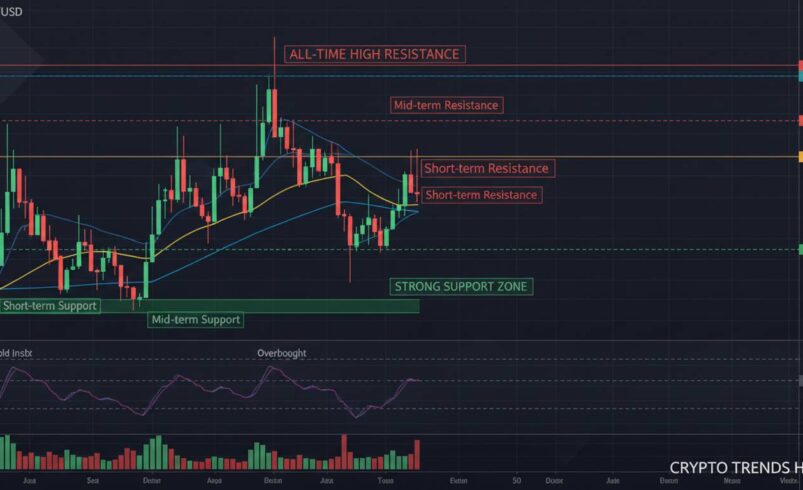

Ethereum (ETH) remains one of the most closely watched cryptocurrencies globally, with its price movements influencing broader digital asset markets. As of early 2025, Ethereum continues to evolve through major network upgrades and shifting market dynamics, making technical and fundamental analysis critical for understanding potential price trajectories. This comprehensive guide examines key price levels, trend indicators, and factors driving Ethereum’s valuation in the Indian market and worldwide.
Key Insights
– Ethereum’s institutional adoption has grown significantly, with major financial institutions offering ETH exposure through regulated products
– Network upgrades including EIP-1559 and the transition to proof-of-stake have fundamentally altered ETH’s supply dynamics
– Technical analysis reveals critical support and resistance levels that traders monitor for entry and exit decisions
– The Indian cryptocurrency market has emerged as a significant player, with Ethereum trading volumes on domestic exchanges showing consistent growth
Understanding Ethereum’s Market Position
Ethereum holds the second-largest market capitalization among cryptocurrencies, consistently ranking behind Bitcoin. As of early 2025, Ethereum’s market cap exceeds $200 billion, representing approximately 15-18% of the total cryptocurrency market capitalization. This substantial market position means that Ethereum price movements often correlate with broader crypto market sentiment, creating both opportunities and risks for investors.
The Ethereum network processes millions of transactions daily, supporting thousands of decentralized applications (dApps), decentralized finance (DeFi) protocols, and non-fungible token (NFT) marketplaces. This utility-based demand creates organic price drivers that differentiate Ethereum from purely speculative assets. In India, platforms like CoinDCX, WazirX, and ZebPay facilitate Ethereum trading against the Indian Rupee (INR), allowing Indian investors to participate in ETH price movements with relative ease.
Ethereum’s transition from proof-of-work (PoW) to proof-of-stake (PoS) consensus, completed in September 2022 through “The Merge” upgrade, marked one of the most significant protocol changes in cryptocurrency history. This shift reduced Ethereum’s energy consumption by approximately 99.95% while fundamentally changing the asset’s economic model. Stakers now earn passive income through staking rewards, creating additional demand for ETH holdings.
Technical Analysis: Key Price Levels and Indicators
Technical analysis provides traders and investors with frameworks for understanding potential price movements based on historical patterns and market psychology. Several key indicators and price levels merit attention when analyzing Ethereum’s market position.
Moving Averages
The 50-day and 200-day moving averages (MA) serve as critical trend indicators. When Ethereum’s price trades above these moving averages, it generally signals bullish momentum. Conversely, prices below these levels suggest bearish conditions. The 200-day MA particularly acts as a long-term trend filter, with sustained breaks above or below this level often triggering significant price movements.
| Indicator | Current Position | Significance |
|---|---|---|
| 50-day MA | Variable | Short-term trend direction |
| 200-day MA | Variable | Long-term trend filter |
| RSI (14) | 40-70 range | Overbought/oversold conditions |
| MACD | Histogram analysis | Momentum shifts |
Relative Strength Index (RSI)
The RSI momentum oscillator measures the speed and magnitude of price changes on a scale of 0 to 100. RSI values above 70 typically indicate overbought conditions, potentially signaling pullbacks. Values below 30 suggest oversold conditions, which could precede rebounds. As of early 2025, Ethereum’s RSI frequently oscillates between 40 and 70, reflecting continued volatility without extreme overbought or oversold conditions.
Support and Resistance Levels
Technical analysis identifies specific price levels where buying or selling pressure historically concentrates. Support levels represent price floors where demand historically exceeds supply, while resistance levels function as ceilings where selling pressure typically intensifies. Key Ethereum support levels often cluster around previous cycle highs and significant Fibonacci retracement levels. Resistance levels typically form at round numbers and previous all-time highs.
Indian traders should note that domestic exchange prices may slightly differ from international averages due to premium/discount dynamics, with INR-ETH pairs sometimes showing 1-3% variation from USD-ETH prices.
Fundamental Factors Driving Ethereum Valuation
Beyond technical indicators, fundamental factors significantly influence Ethereum’s long-term value proposition. Understanding these drivers helps contextualize price movements within broader market narratives.
Network Activity and Usage
Ethereum’s real-world utility directly impacts its valuation. Daily active addresses, transaction counts, and gas fees serve as proxies for network health. When DeFi protocols experience high activity or NFT markets surge, increased network usage typically elevates ETH demand. The implementation of EIP-1559 in August 2021 introduced base fee burning, making ETH deflationary during high-usage periods—a structural change that fundamentally alters its supply economics.
Institutional Adoption
Institutional interest in Ethereum has grown substantially since 2021. Major asset managers including BlackRock, Fidelity, and Franklin Templeton have explored or launched Ethereum-based products. The approval of Ethereum futures ETFs in the United States marked a significant milestone for institutional access. This institutional participation brings legitimacy and capital depth that previously characterized traditional financial markets.
Competitive Landscape
Ethereum faces competition from layer-1 blockchains including Solana, Avalanche, and Polygon, as well as emerging protocols. These competitors offer varying tradeoffs regarding transaction speed, costs, and decentralization. Ethereum’s network effects, developer ecosystem, and first-mover advantage remain significant moats, but competitive pressures can influence market sentiment and price discovery.
Regulatory Environment
Regulatory developments significantly impact cryptocurrency valuations globally. India’s regulatory approach has evolved, with the government implementing taxation rules for crypto transactions while neither fully banning nor explicitly legalizing cryptocurrencies. Clarity on regulatory frameworks—whether supportive or restrictive—typically creates significant price movements as markets price in regulatory risk or opportunity.
Ethereum Price Forecast Considerations
Forecasting cryptocurrency prices involves substantial uncertainty, and no projection should be treated as financial advice. Several frameworks help analysts develop scenarios while acknowledging inherent limitations.
Bull Case Scenarios
In optimistic scenarios, Ethereum could benefit from increased institutional adoption, expanded DeFi utility, and growing corporate treasury adoption similar to Bitcoin strategies. Widespread integration of blockchain technology across industries could drive sustained demand growth. Major network upgrades improving scalability and reducing costs could unlock new use cases, potentially supporting higher valuations.
Bear Case Considerations
Negative scenarios could emerge from adverse regulatory actions, security vulnerabilities, or sustained competition from alternative blockchains. Market corrections following speculative bubbles have historically impacted cryptocurrency prices significantly. Economic downturns typically reduce risk appetite, affecting demand for speculative assets including cryptocurrencies.
Realistic Range Expectations
Based on historical volatility patterns and market maturity, analysts typically consider wide price ranges for Ethereum forecasts. Rather than specific price targets, most analyses focus on scenarios incorporating various market conditions, timeframes, and catalyst expectations.
Risk Management for Ethereum Investment
Regardless of price forecasts, risk management remains essential for anyone considering Ethereum exposure. The cryptocurrency market exhibits high volatility, with daily price swings of 5-10% occurring regularly during volatile periods.
Position Sizing
Investors should only allocate capital they can afford to lose entirely. Many financial advisors recommend limiting cryptocurrency exposure to 1-5% of a diversified portfolio, though individual circumstances vary significantly.
Diversification Benefits
Holding multiple assets reduces concentration risk. While Ethereum represents a significant cryptocurrency position, diversification across asset classes including stocks, bonds, and other cryptocurrencies provides portfolio protection.
Understanding Tax Implications
India’s cryptocurrency tax framework requires reporting of virtual digital asset transactions. Gains from cryptocurrency trading may attract capital gains tax, and TDS (Tax Deducted at Source) applies to certain transactions. Indian investors should maintain comprehensive transaction records and consult tax professionals for personalized guidance.
Using Secure Storage
Security remains paramount in cryptocurrency investment. Hardware wallets provide offline storage for ETH holdings, protecting against exchange hacks and online threats. Indian investors should use reputable exchanges with strong security track records and enable two-factor authentication on all accounts.
The Indian Ethereum Market
India has emerged as one of the world’s largest cryptocurrency markets, with millions of Indian investors participating in digital asset markets. Domestic exchanges facilitate ETH trading against the Indian Rupee, creating direct market access without currency conversion requirements.
Market Dynamics
Indian cryptocurrency trading often exhibits distinct patterns compared to global markets. Trading volumes typically increase during evening hours when Indian markets align with both Asian and European trading sessions. Premium or discount relative to international prices can create arbitrage opportunities, though execution risks exist.
Regulatory Considerations
Indian regulatory uncertainty remains a factor for cryptocurrency investors. The Reserve Bank of India (RBI) has expressed concerns about cryptocurrency risks while the government has implemented tax provisions. Industry advocates continue engaging with regulators to develop clear frameworks that protect investors while enabling innovation.
Local Exchange Ecosystem
Indian cryptocurrency exchanges have invested significantly in infrastructure, user education, and compliance. Platforms like CoinDCX, WazirX (acquired by Binance), ZebPay, and others offer varying fee structures, security features, and user experiences. New users should compare platforms based on security, fees, customer support, and regulatory compliance.
Frequently Asked Questions
What factors most influence Ethereum’s price movements?
Ethereum’s price is influenced by multiple factors including network activity and transaction volumes, broader cryptocurrency market sentiment, institutional adoption announcements, regulatory developments, technological upgrades to the Ethereum network, and macroeconomic conditions. Supply dynamics following the transition to proof-of-stake and EIP-1559 implementation also significantly impact price discovery.
Is Ethereum a good investment for Indian investors?
Whether Ethereum suits an individual investor depends on their risk tolerance, investment timeline, and understanding of cryptocurrency markets. Ethereum offers potential for high returns but carries substantial volatility and risk. Indian investors should only invest money they can afford to lose entirely, understand the tax implications, use reputable exchanges, and consider consulting financial advisors familiar with cryptocurrency investments.
How is Ethereum price in INR calculated?
Ethereum price in INR derives from USD-ETH prices multiplied by the USD-INR exchange rate, plus any exchange-specific premiums or fees. Major Indian exchanges like CoinDCX and WazirX provide direct INR-ETH trading pairs, offering real-time prices based on international rates adjusted for local market dynamics.
What is Ethereum’s long-term price outlook?
Cryptocurrency price forecasting involves substantial uncertainty, and no reliable prediction exists for future Ethereum prices. Long-term outlooks depend on factors including technology adoption, regulatory clarity, competitive developments, and broader economic conditions. Investors should approach any price predictions with skepticism and conduct independent research.
How do I safely buy Ethereum in India?
To safely purchase Ethereum in India, create an account on a reputable cryptocurrency exchange that supports INR deposits. Complete the required KYC (Know Your Customer) verification. Deposit INR through supported payment methods. Purchase ETH at current market rates. Consider transferring holdings to a personal hardware wallet for long-term storage, keeping only trading amounts on exchanges.
What is the minimum amount needed to invest in Ethereum?
Unlike traditional investments with minimum thresholds, Ethereum is divisible to 18 decimal places, meaning investors can purchase fractions of a single ETH. Most Indian exchanges allow starting with small amounts, sometimes as low as ₹100. However, transaction fees relative to small positions can make tiny investments impractical.
Conclusion
Ethereum remains a foundational asset in the cryptocurrency ecosystem, with its price reflecting complex interactions between technological developments, market dynamics, regulatory environments, and broader economic conditions. While price forecasts provide frameworks for understanding potential scenarios, the inherent volatility and uncertainty in cryptocurrency markets demand careful risk management and realistic expectations.
For Indian investors considering Ethereum exposure, understanding both the opportunities and risks proves essential. The growing domestic cryptocurrency ecosystem offers increasingly sophisticated infrastructure for participation, while regulatory developments continue shaping the investment landscape. Whether Ethereum represents an appropriate investment depends entirely on individual circumstances, risk tolerance, and investment objectives.
Successful navigation of Ethereum’s price movements requires ongoing education, disciplined risk management, and recognition that no forecast guarantees future performance. As with any investment, individuals should conduct thorough research, understand tax implications, and consider professional advice before committing capital to cryptocurrency markets.