
Decentralized Finance, or DeFi, represents one of the most significant shifts in how people interact with money globally—and India is emerging as a key player in this transformation. Unlike traditional banking systems where institutions act as intermediaries, DeFi platforms enable peer-to-peer financial transactions using blockchain technology, potentially offering higher returns, greater transparency, and broader accessibility. For Indian users specifically, DeFi opens doors to financial services that have traditionally been difficult to access, from earning interest on savings to accessing credit without extensive documentation. This guide walks you through everything you need to understand about DeFi platforms, how they work, and how you can safely participate in this growing ecosystem.
What is DeFi and Why It Matters in India
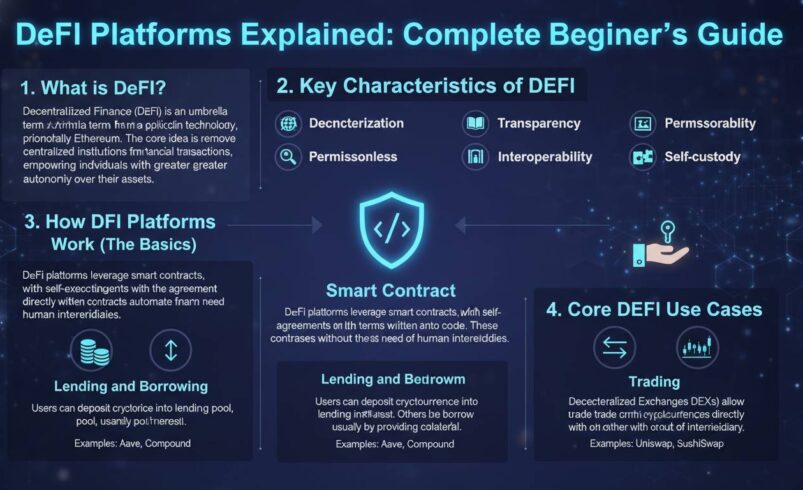
DeFi refers to a collection of financial applications built on blockchain networks—primarily Ethereum—that operate without traditional intermediaries like banks, brokerages, or insurance companies. Instead of trusting a single institution to hold your money and process transactions, DeFi uses smart contracts: self-executing programs that automatically enforce the terms of an agreement when predetermined conditions are met. This fundamental shift removes the need for “trusted middlemen” and replaces them with transparent, publicly verifiable code.
For India specifically, DeFi addresses several persistent financial inclusion challenges. According to World Bank data, approximately 190 million adults in India remain unbanked, lacking access to basic financial services. DeFi platforms can potentially serve these underserved populations by requiring only an internet connection and a cryptocurrency wallet—no bank account, credit history, or extensive documentation necessary. The Reserve Bank of India has shown growing interest in digital currencies and blockchain technology, signaling that regulatory clarity may emerge in coming years.
The Indian cryptocurrency market has experienced remarkable growth, with estimates suggesting over 15 million Indians actively trade or hold digital assets as of recent years. This growing adoption creates fertile ground for DeFi expansion, particularly among young, tech-savvy Indians seeking alternatives to traditional investment vehicles. The country also boasts a strong software development community, positioning India to potentially become a hub for DeFi innovation and talent.
How DeFi Platforms Actually Work
Understanding DeFi requires grasping three core concepts: blockchain technology, smart contracts, and decentralized applications (dApps). Blockchain serves as the underlying infrastructure—a distributed ledger that records all transactions across thousands of computers simultaneously, making the system nearly impossible to alter retroactively. When you interact with a DeFi platform, your transaction gets recorded on this public ledger, ensuring transparency and immutability.
Smart contracts are the engines driving DeFi functionality. These are precisely coded programs deployed on blockchain networks that automatically execute when specific conditions are fulfilled. For example, if you want to lend your cryptocurrency and earn interest, a smart contract can automatically distribute interest payments to your wallet based on predefined parameters—no human intervention required, no paperwork, and no waiting periods. The code is visible to everyone, meaning anyone can audit how the contract functions before trusting it with their funds.
Decentralized applications, or dApps, are the user-facing interfaces that make DeFi accessible. Rather than visiting a bank’s website, you connect your cryptocurrency wallet to a dApp and interact with various financial services through a simple interface. Popular DeFi activities include lending platforms where you can earn interest by supplying liquidity, decentralized exchanges (DEXs) that facilitate cryptocurrency trading without intermediaries, yield farming strategies that optimize returns across multiple platforms, and stablecoins designed to maintain a fixed value pegged to traditional currencies.
The entire ecosystem operates through “gas fees”—small payments required to execute transactions on blockchain networks. These fees compensate the network participants who validate and record transactions. Understanding gas costs is crucial for Indian users, as fees can fluctuate significantly during periods of high network activity, potentially affecting the economics of smaller transactions.
Key Benefits of Decentralized Finance
DeFi offers several compelling advantages that distinguish it from traditional financial systems, particularly for Indian users navigating an economy with limited banking penetration and restrictive credit access.
Financial Inclusion: DeFi operates 24 hours a day, 365 days a year, accessible to anyone with an internet connection. This accessibility proves transformative in a country where rural banking infrastructure remains limited and millions lack formal identification documents required for traditional bank accounts.
Higher Yield Potential: Traditional savings accounts in India offer interest rates typically between 3-7% annually. DeFi lending protocols frequently offer significantly higher returns on cryptocurrency deposits, sometimes exceeding 10-15% for certain assets, though these returns come with corresponding risks that require careful evaluation.
Transparency: Every transaction, interest rate, and smart contract function is publicly verifiable on the blockchain. Users can examine exactly how funds are managed, what fees are charged, and how returns are calculated—contrast this with traditional banks where fee structures often remain opaque.
Speed and Efficiency: Cross-border transactions that typically take 3-5 business days through traditional banking can complete in minutes through DeFi platforms. This speed particularly benefits Indian workers sending remittances to family members abroad or businesses engaged in international trade.
Censorship Resistance: Because DeFi operates on decentralized blockchain networks, no single entity or government can easily block transactions or freeze accounts. This feature provides financial sovereignty that some users value particularly highly.
| Feature | Traditional Finance | DeFi Platforms |
|---|---|---|
| Account Requirements | ID verification, bank account | Crypto wallet only |
| Operating Hours | Business hours, weekdays | 24/7/365 |
| Average Interest (Savings) | 3-7% | 5-20%+ variable |
| Transaction Speed | 1-5 business days | Minutes |
| Transparency | Limited disclosure | Full on-chain visibility |
| Accessibility | Branch-dependent | Internet-only |
Popular DeFi Platforms You Should Know
The DeFi ecosystem has exploded with hundreds of platforms offering various financial services. For beginners entering this space, understanding which platforms have established track records and strong security histories is essential.
Uniswap stands as the largest decentralized exchange by trading volume, facilitating billions of dollars in daily cryptocurrency swaps. Unlike centralized exchanges that match buyers and sellers through order books, Uniswap uses automated market makers (AMMs)—mathematical formulas that determine asset prices based on supply and demand in liquidity pools. Indian users can trade dozens of tokens directly from their wallets without creating accounts or submitting personal information.
Aave pioneered the concept of flash loans and has grown into one of the most trusted lending protocols in DeFi. Users can deposit cryptocurrencies as collateral and borrow other assets, or they can supply assets to liquidity pools and earn interest. The platform has processed over $30 billion in cumulative loan volume and maintains robust security measures including insurance funds protecting against potential losses.
Compound operates similarly to Aave, offering algorithmic interest rates that adjust based on asset utilization within the protocol. Its governance token COMP created significant buzz when distribution began, sparking the yield farming craze that characterized 2020-2021 DeFi growth. Compound’s clean interface and strong security audits make it popular among more conservative DeFi participants.
Curve Finance specializes in stablecoin trading, offering extremely low slippage when exchanging tokens designed to maintain fixed values like USDC, USDT, or DAI. For Indian users interested in DeFi yield strategies without exposure to volatile cryptocurrency price movements, Curve provides essential infrastructure for efficient stablecoin swaps.
Yearn Finance automates yield optimization, automatically moving funds between different DeFi lending protocols to capture the highest available interest rates. This “set and forget” approach appeals to users who want DeFi returns without constantly monitoring multiple platforms manually.
| Platform | Primary Function | Key Feature | Risk Level |
|---|---|---|---|
| Uniswap | Decentralized Exchange | Largest DEX by volume | Medium |
| Aave | Lending/Borrowing | Flash loans available | Lower |
| Compound | Lending/Borrowing | Governance token rewards | Lower |
| Curve | Stablecoin Exchange | Low slippage swaps | Lower |
| Yearn | Yield Optimization | Automated strategies | Medium |
Getting Started with DeFi in India
Entering the DeFi space requires careful preparation and understanding of the technical and regulatory landscape in India. Here’s how Indian users can safely begin their DeFi journey.
Step 1: Set Up a Cryptocurrency Wallet: The foundation of DeFi participation is a non-custodial wallet that gives you complete control over your funds. MetaMask remains the most popular choice for Ethereum-based DeFi, available as a browser extension and mobile app. WalletConnect offers compatibility with numerous dApps for mobile users preferring smartphone interactions. Remember to securely store your seed phrase—12 or 24 words that grant access to your wallet—and never share this with anyone.
Step 2: Acquire Cryptocurrency: You’ll need Ethereum (ETH) to interact with most DeFi platforms, as ETH pays for network transaction fees. Indian users can purchase ETH through registered cryptocurrency exchanges like CoinDCX, WazirX, or ZebPay using Indian Rupees through UPI or bank transfers. Only use exchanges that comply with Indian regulatory requirements and maintain strong security practices.
Step 3: Connect Wallet to DeFi Platforms: Once you have ETH in your wallet, navigate to your chosen DeFi platform’s website and click “Connect Wallet.” Your wallet will prompt you to authorize the connection—always verify you’re on the legitimate platform URL before connecting, as scammers frequently create convincing fake sites.
Step 4: Start Small: Never invest more than you can afford to lose, especially when learning. Begin with modest amounts to understand how transactions work, how gas fees affect your returns, and how different platforms function. Many experts recommend starting with less than 5% of any capital you’re willing to allocate to crypto.
Step 5: Research Before Committing: Investigate any platform before providing funds. Look for security audits from reputable firms like Certik or OpenZeppelin, examine whether the team is publicly identified, review community discussions on platforms like Twitter and Reddit, and understand exactly how the protocol generates returns.
Risks and How to Mitigate Them
DeFi’s promise comes with significant risks that every Indian user must understand and actively manage. The most common pitfalls include smart contract vulnerabilities, impermanent loss, scams, and regulatory uncertainty.
Smart Contract Risks: While blockchain code is transparent, bugs in smart contracts can lead to catastrophic losses. The DeFi ecosystem has experienced numerous exploits where hackers stole millions by finding vulnerabilities in code. Mitigation strategies include using established platforms with multiple security audits, only providing funds you can afford to lose, and researching whether protocols maintain insurance funds.
Impermanent Loss: When you provide liquidity to automated market makers like Uniswap, the value of your deposited assets can change relative to each other. This “impermanent loss” occurs when token prices diverge significantly from their values when you deposited them. While sometimes temporary, this loss can become permanent if you withdraw during unfavorable price conditions. Understanding this risk is crucial before providing liquidity.
Scams and Fraud: The DeFi space attracts scammers creating fake platforms, Ponzi schemes disguised as yield programs, and phishing attacks targeting wallet credentials. Never share your seed phrase, verify all website URLs carefully, and approach any platform promising guaranteed returns with extreme skepticism.
Regulatory Considerations: India’s regulatory environment for cryptocurrency and DeFi remains evolving. The government has proposed taxation rules for virtual digital assets and continues developing framework guidance. Indian users should stay informed about regulatory developments and consult qualified professionals regarding compliance obligations.
Mitigation Best Practices: Diversify across multiple platforms rather than concentrating funds in one protocol. Use hardware wallets for significant holdings. Keep software updated. Maintain separate wallets for different DeFi activities. Never click links in unsolicited messages. Document your investments for tax purposes.
Frequently Asked Questions
Is DeFi legal in India?
DeFi platforms operate in a regulatory gray area in India. While cryptocurrency trading is legal, the Reserve Bank of India has expressed concerns about virtual assets. DeFi itself is not explicitly illegal, but users should stay updated on regulatory developments and consult legal professionals regarding compliance.
How much money do I need to start with DeFi?
You can begin with very small amounts—some platforms allow interactions with just a few dollars worth of cryptocurrency. However, remember that network fees (gas) can make small transactions economically inefficient on Ethereum. Many experts recommend starting with at least $100-200 to make the economics worthwhile.
Can I lose money in DeFi?
Yes, DeFi investments carry significant risks including total loss from smart contract hacks, impermanent loss from liquidity provision, rug pulls where developers abandon projects, and scams. Never invest money you cannot afford to lose, and thoroughly research any platform before committing funds.
Do I need technical skills to use DeFi platforms?
Basic technical literacy helps, but modern DeFi platforms have increasingly user-friendly interfaces. You’ll need to understand how to use a crypto wallet, navigate web3 websites, and understand basic concepts like gas fees. Many resources exist to help beginners learn these skills safely.
How are DeFi returns calculated?
Returns in DeFi vary based on the protocol and your chosen strategy. Lending protocols pay interest from borrower fees. Liquidity pools distribute trading fees to providers. Yield farming strategies move funds between protocols to optimize returns. All returns are denominated in cryptocurrency and fluctuate based on token prices and protocol usage.
What is the best DeFi platform for beginners?
For absolute beginners, starting with established lending platforms like Aave or Compound offers relatively straightforward earning opportunities with lower complexity than advanced strategies like yield farming or flash loans. Uniswap provides an accessible introduction to decentralized trading. Always start with small amounts while learning.
Conclusion
DeFi platforms represent a fundamental transformation in financial services, offering Indian users unprecedented access to global financial markets, higher yield opportunities, and greater control over their money. The technology enables peer-to-peer transactions, automated smart contracts, and financial services operating without traditional intermediaries—potentially particularly valuable in a country where banking access remains uneven and credit availability restricted.
However, entering this space requires careful preparation, ongoing education, and disciplined risk management. Start by understanding the fundamentals, begin with small amounts you can afford to lose, and gradually expand your participation as your knowledge grows. The DeFi ecosystem evolves rapidly, with new opportunities and risks emerging regularly. Stay curious, remain cautious, and approach every investment opportunity with appropriate skepticism.
India’s position in the global DeFi landscape continues developing, influenced by regulatory decisions, technological advancement, and market adoption. Whether you’re seeking higher returns on savings, exploring new investment strategies, or simply curious about financial technology’s future, DeFi offers compelling possibilities worth exploring thoughtfully and carefully.