
Most investors thinking about defense sector exposure face a deceptively simple question: should I buy a fund that holds multiple defense companies, or pick the individual stocks myself? The answer isn’t as straightforward as the finance media makes it seem. Both approaches have legitimate use cases, and the “right” choice depends on what you’re actually trying to accomplish with your money—not some abstract ranking of superiority.
I’ve spent over a decade analyzing defense sector investments, and what I’ve learned is that the ETF-versus-stock debate usually misses the point. The question isn’t which option is objectively better. It’s which structure aligns with your actual goals, your time horizon, and your willingness to stay engaged with specific companies through their ups and downs. This article breaks down the real differences—not the surface-level ones everyone repeats—but the structural, practical, and sometimes uncomfortable distinctions that actually matter when money is on the line.
What Defense ETFs Actually Hold
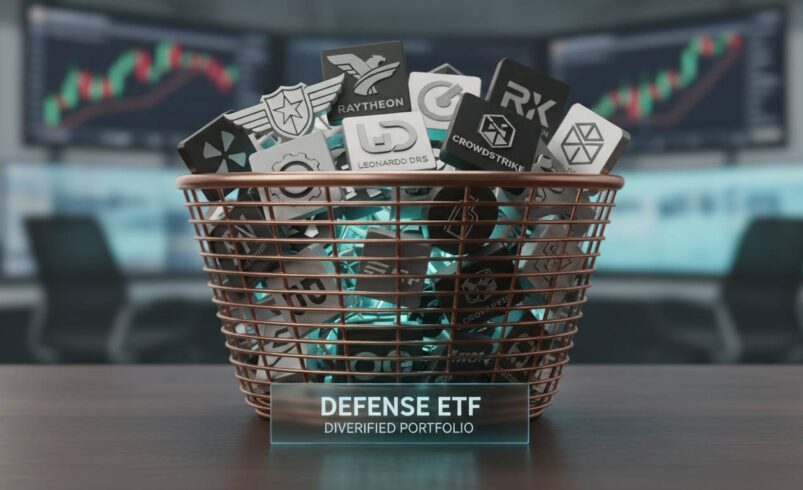
Defense ETFs are exchange-traded funds that invest in companies within the aerospace, defense, and military technology sectors. The largest and most widely traded funds in this space have specific methodologies that investors frequently misunderstand.
The iShares U.S. Aerospace & Defense ETF (ITA) holds approximately 35-40 stocks and weights them by market capitalization. Its top holdings as of early 2025 include Lockheed Martin, RTX (Raytheon), Northrop Grumman, General Dynamics, and L3Harris Technologies. The fund is reconstituted quarterly, meaning holdings shift as market values change.
The Invesco Aerospace & Defense ETF (PPA) takes a different approach, weighting by equal exposure across its holdings rather than market cap. This means small companies have equal influence to giants like Lockheed Martin, which fundamentally changes the risk and return profile compared to cap-weighted funds.
The SPDR S&P Aerospace & Defense ETF (XAR) focuses specifically on companies in the S&P Total Market Index that are classified as aerospace and defense components, with weightings determined by market cap but with additional screening for liquidity.
What investors often don’t realize is that these funds have significant overlap. If you own both ITA and XAR, you’re essentially doubling down on the same large-cap defense primes without intending to. The defense ETF landscape looks diverse on the surface but converges heavily toward the same five or six major contractors.
Individual Defense Stocks: What You’re Actually Buying
When you buy individual defense stocks, you’re purchasing shares of specific companies that manufacture military hardware, provide defense services, or supply components to the broader defense ecosystem. The universe extends far beyond the household names.
The major prime contractors—Lockheed Martin, Raytheon Technologies (RTX), Northrop Grumman, General Dynamics, and Boeing’s defense division—dominate government contracts and represent the backbone of U.S. defense capability. These companies have long product cycles, established relationships with the Pentagon, and predictable revenue streams tied to multi-year contracts.
Beyond the primes, there’s an entire ecosystem of suppliers. L3Harris Technologies focuses on communications and electronic warfare. Axon Enterprise makes body cameras and tasers—increasingly vital for both law enforcement and military applications. Leidos provides IT services and systems integration. AeroVironment makes drones. The list extends to dozens of companies with varying degrees of pure-play defense exposure.
Here’s what the ETF comparisons never mention: individual stock selection lets you lean into specific theses. If you believe drone warfare is transforming conflict, you can overweight that exposure. If you think the F-35 program is permanently underfunded and want to avoid Lockheed Martin exposure, you can do that. You’re not forced to accept whatever the index committee decided.
The Structural Differences That Actually Matter
The distinction between ETFs and individual stocks isn’t just about diversification—it’s about how you gain exposure and what you’re actually owning.
Ownership structure differs fundamentally. When you buy an ETF share, you own a slice of a basket of securities. The ETF itself owns the underlying stocks. You’re one step removed from the actual companies. When you buy a single stock, you own a direct claim on that company’s assets and cash flows.
Corporate actions flow differently. When Lockheed Martin pays a dividend or announces a stock buyback, that value passes through the ETF to you (minus the fund’s expense ratio). When a stock splits, your ETF share count adjusts automatically. But you never make decisions about whether to participate in a stock buyback or reinvest dividends—you’re along for the ride.
Voting rights disappear entirely with ETFs. If you care about how defense companies govern themselves, what ESG policies they adopt, or how they handle controversial contracts, ETF ownership means you have no voice. Direct stock ownership gives you voting power on shareholder proposals.
Tax treatment can diverge significantly. ETFs generally generate more capital gains distributions, especially in years with high turnover within the fund. Individual stocks let you control the timing of taxable events through strategic selling. This matters significantly in taxable accounts.
Performance Comparison: The Numbers Reality Check
Performance comparison is where the ETF-versus-stock debate gets messy, because the answer depends entirely on which time period you examine and which specific funds or stocks you’re comparing.
From 2020 through early 2025, the defense sector experienced significant volatility. The post-COVID defense budget increases, the Ukraine war’s impact on NATO spending, and the F-35 program ramp-up all drove sector performance. During this period, the iShares U.S. Aerospace & Defense ETF (ITA) returned approximately 85-90% total return, roughly matching the sector’s performance.
Individual stocks told a different story. Lockheed Martin significantly outperformed the ETF average during this period, driven by strong F-35 deliveries and space programs. Northrop Grumman had a more muted run. RTX (Raytheon) struggled with commercial aerospace headwinds that depressed its overall returns despite strong defense performance. The dispersion between the best and worst defense stocks was far wider than the ETF’s return.
But here’s the honest assessment: selecting the best-performing defense stocks requires picking winners, which means you’re competing against professional defense analysts who do this for a living. The average investor holding three to five defense stocks likely underperformed the ETF over most rolling five-year periods. This isn’t speculation—it’s what the data shows about individual stock selection across virtually every sector.
The counterargument—that you could have simply bought the best performers—suffers from hindsight bias. Nobody knew in 2020 that Lockheed Martin would outperform Northrop by 40 percentage points over five years. The ETF provides that return without requiring you to make that prediction.
Costs and Fees: What You’re Actually Paying
The expense ratio argument gets made constantly in ETF articles, and it’s mostly irrelevant for the decision you’re making.
Defense ETF expense ratios range from approximately 0.35% to 0.70% annually. ITA charges around 0.40%. PPA charges approximately 0.55%. These percentages sound small, and they are—but they compound over time.
Individual stock trading costs depend entirely on your brokerage. Most major brokers now offer commission-free stock trading. The real cost isn’t the commission—it’s the bid-ask spread, which for heavily traded defense stocks like Lockheed Martin amounts to a few cents per share. For large positions, this is negligible.
What nobody talks about is the hidden cost of rebalancing. If you build a portfolio of five defense stocks and one doubles while another halves, your allocation is now way off target. You either accept the drift or pay transaction costs to rebalance. Defense ETFs rebalance automatically, but you still bear the cost through the expense ratio.
Tax efficiency tilts toward individual stocks in taxable accounts. You control when to realize gains or losses. ETFs, especially those with higher turnover like some equal-weighted funds, can force taxable distributions whether you want them or not. In a tax-advantaged account like an IRA, this difference disappears entirely.
Risk Factors: Diversification Is Not Protection
The conventional wisdom says ETFs are less risky because they’re diversified, while individual stocks are riskier because you’re concentrated. This is true but incomplete, and the nuance matters significantly.
ETF concentration risk is real but often overlooked. If you own one defense ETF, you’re overweight the largest defense primes regardless of what the ETF is technically “diversified” into. During periods when large-cap defense stocks underperform—say, when Boeing’s commercial problems drag down the entire sector—your ETF falls with them. The diversification protects you from company-specific disasters but not from sector-wide movements.
Individual stock risk is asymmetric. If you pick one defense stock and it goes bankrupt—a real if unlikely possibility for any contractor—you lose your entire investment. The probability is low for major primes with long government contracts, but it’s not zero. Ask shareholders of companies that went bust during defense downturns in the 1980s and 1990s.
Sector risk affects both approaches identically. Defense spending is politically driven. When administrations change, budget priorities shift. The defense sector underperformed significantly during the immediate post-Cold War drawdown. If you’re buying defense exposure, you’re making a bet on continued geopolitical tension—which may or may not be correct.
The honest answer is that neither approach eliminates risk. They just distribute it differently.
Liquidity and Trading Flexibility
Liquidity matters more than most investors realize until they need to sell.
Defense ETFs trade with excellent liquidity, especially the large-cap funds. You can buy or sell thousands of shares at tight spreads throughout the trading day. Market orders execute near the quoted price. This matters if you might need to exit quickly.
Individual defense stocks vary significantly by company. Lockheed Martin and RTX trade millions of shares daily with tight spreads. But smaller defense suppliers like AeroVironment trade far less volume. You might face wider bid-ask spreads, and larger orders can move the price against you. If you hold a material position in a smaller defense company, exiting quickly can be costly.
Stop-loss orders work differently in ETFs versus stocks. In ETFs, they’re reliable. In individual stocks, especially smaller ones, stop-losses can gap down significantly in fast-moving markets. I’ve seen investors get crushed by stop-losses triggering at 15% below the previous close in thinly traded defense stocks.
Pros and Cons at a Glance
| Factor | Defense ETFs | Individual Defense Stocks |
|---|---|---|
| Diversification | Immediate, automatic | Requires capital and effort |
| Minimum investment | One share (often under $200) | Requires buying multiple positions for diversification |
| Control | No company-specific decisions | Full control over holdings |
| Time commitment | Low | High |
| Tax efficiency (taxable accounts) | Moderate | High |
| Voting rights | None | Full shareholder rights |
| Upside potential | Limited to index performance | Can exceed index with right picks |
| Downside risk | Sector risk only | Company + sector risk |
| Performance consistency | More predictable | Higher variance |
Which Is Better for Your Situation?
The answer depends on honest self-assessment of your circumstances.
If you’re a passive investor with a long time horizon who wants defense sector exposure without thinking about it, the ETF is the obvious choice. You’re not going to research quarterly defense contract announcements. You don’t want to rebalance manually. You just want exposure and can accept market-average returns. That’s what ETFs deliver.
If you’re an active investor with the time and skill to follow defense companies closely, individual stocks offer genuine advantages. You can weight your convictions, avoid companies you dislike, and potentially outperform the index. But this requires honest assessment of whether you actually have an information advantage. Most retail investors don’t—they just think they do.
If you have a small account under $10,000, ETFs are almost certainly the better choice. Building a diversified portfolio of five to ten defense stocks at small position sizes eats up too much portfolio value in transaction costs and makes rebalancing impractical. The ETF gives you instant diversification at reasonable cost.
If you have a large account over $100,000, individual stock selection becomes more viable. You can build meaningful positions in five to eight defense companies, rebalance occasionally, and tolerate the idiosyncratic risk. The question is whether you have the expertise to actually add value through stock selection—which most people overestimate.
If this is for a tax-advantaged account like an IRA or 401(k), the tax efficiency argument for individual stocks vanishes. The decision should rest purely on whether you want to manage it actively or not.
Common Questions About Defense Investments
Are defense ETFs a good investment in 2025?
Defense ETFs offer reasonable exposure to a sector that benefits from continued global tensions and defense spending increases. The 2025 budget environment shows continued support for military procurement. However, valuations in the sector are not cheap, and significant outperformance from 2020-2024 may not repeat. Whether they’re “good” depends on what else you’re holding and what returns you expect.
What are the best defense ETFs?
The three most liquid defense ETFs are ITA (iShares), XAR (SPDR), and PPA (Invesco). Each has different weighting methodologies. For most investors, the choice comes down to whether you want market-cap weighting (ITA, XAR) or equal weighting (PPA). There’s no objective “best”—they do different things.
Do defense stocks pay better dividends than ETFs?
Individual defense stocks typically have higher dividend yields than the ETFs that hold them. Lockheed Martin and Northrop Grumman yield around 2.5-3%, while defense ETFs yield roughly 1.5-2% because the index includes lower-yielding growth companies. If income is your primary goal, individual stocks have an advantage—provided you’re willing to hold them through downturns.
Is it easier to sell ETFs or individual stocks?
ETFs are generally easier to sell in large quantities without affecting price. Individual stocks, especially smaller defense suppliers, can have liquidity issues in turbulent markets. If you might need to exit quickly, ETFs provide more reliable execution.
The Honest Takeaway
The defense sector presents a genuine choice between convenience and control. ETFs give you exposure without effort. Individual stocks give you potential outperformance but require genuine expertise and ongoing attention.
What I find most investors get wrong is assuming the ETF is the “safe” choice and stocks are the “risky” one. The reality is that both carry significant sector risk. Both depend on government spending decisions you can’t control. The difference is whether you want to manage that exposure actively or let a fund do it for you.
If you’re unsure whether you have the time or expertise to pick individual defense stocks successfully, that’s your answer—the ETF is the right choice. Confidence in your ability to pick winners is the prerequisite for going individual, and most people who feel that confidence are overestimating their actual edge.
The defense sector will continue growing as geopolitical tensions persist. How you capture that growth—through a fund or through stocks—is a personal decision, not a correctness test. Make it honestly, based on what you’re actually willing to do with your portfolio over the next decade.