
If you’ve ever searched for a safe way to grow your savings, you’ve probably encountered certificates of deposit. They’re everywhere in financial advertising, often promising higher returns than a regular savings account with zero risk. But here’s what most people don’t realize: a CD isn’t automatically better than a savings account, and in certain rate environments, it can actually cost you money. Understanding how CDs work—and when they actually make financial sense—is the difference between earning decent interest and leaving hundreds of dollars on the table.
This guide covers everything you need to know about certificates of deposit, from the basic mechanics to advanced strategies like CD laddering. I’ll walk you through the pros and cons, compare them directly to high-yield savings accounts, and help you determine whether a CD belongs in your financial plan right now.
How Does a CD Work?
A certificate of deposit is a savings product offered by banks and credit unions that pays a fixed interest rate on your deposited funds for a specified period of time. When you open a CD, you agree to leave your money untouched for the entire term—anywhere from three months to five years or longer. In exchange, the bank guarantees you that fixed rate, regardless of what happens to interest rates elsewhere.
The mechanics are straightforward. Suppose you deposit $10,000 into a 12-month CD offering 4.50% APY. At the end of the year, your balance would grow to $10,450—no surprises, no fluctuations. That predictability is the core value proposition. Unlike a savings account where your rate can change monthly or even daily, a CD locks in your return.
But there’s a catch that trips up many first-time CD buyers: early withdrawal penalties. If you need your money before the term ends, most banks charge a penalty equal to several months of interest. Some penalize you the entire term’s interest. This liquidity sacrifice is the price of the guaranteed rate.
FDIC insurance adds another layer of security. CDs at FDIC-insured banks are covered up to $250,000 per depositor, per ownership category. If the bank fails, the FDIC steps in. This makes CDs one of the safest financial products available—on par with traditional savings accounts.
When your CD matures, you typically have a grace period, usually 10 days, to decide whether to renew the CD for another term, withdraw your money, or roll it into a different product. Don’t sleep on this decision: if rates have fallen, your bank might automatically renew your CD at a lower rate.
Types of CDs
Not all certificates of deposit are created equal. The type you choose matters as much as the rate you’re offered.
Traditional CDs are the standard product. You deposit money for a fixed term at a fixed rate. These make sense when you expect rates to fall and want to lock in today’s higher rates.
No-penalty CDs, sometimes called liquid CDs, allow you to withdraw your money before the term ends without paying a penalty. The tradeoff is a lower interest rate—typically 0.25% to 0.75% less than a traditional CD of the same term. These are worth considering if there’s any chance you might need access to your cash.
Bump-up CDs let you request a rate increase once or multiple times during the term, usually to match higher rates the bank is offering to new customers. These are useful in rising rate environments, though banks often limit how many times you can bump and may not match the full current rate.
Step-up CDs automatically increase your rate at predetermined intervals, say every six months. These offer some protection against rate changes without requiring you to remember to request a bump.
Jumbo CDs simply require larger minimum deposits, usually $100,000 or more, but often pay slightly higher rates. Unless you have substantial savings, these aren’t relevant for most people.
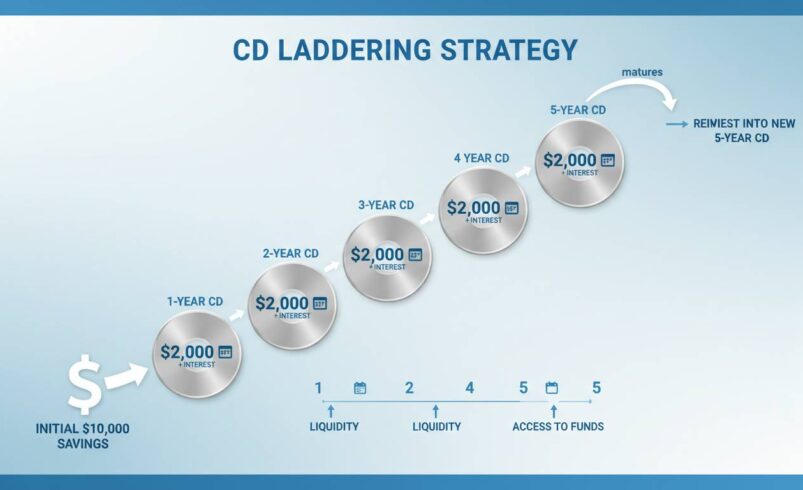
CD ladders are a strategy rather than a product. You divide your savings among multiple CDs with different maturity dates. When the shortest CD matures, you roll it into a new long-term CD. This gives you regular access to some of your money while still capturing higher long-term rates. A typical ladder might have CDs maturing in 6 months, 12 months, 18 months, 24 months, and 30 months, with the cycle repeating as each matures.
Pros and Cons of CDs
Before committing your money, weigh these factors honestly. CDs aren’t universally superior—they’re a specific tool for specific situations.
Advantages
Predictable returns. Your interest rate won’t change for the entire term. If rates plummet, you’re still earning today’s rate. This certainty appeals to risk-averse savers planning for known future expenses.
FDIC protection. Your principal is insured up to $250,000, making CDs essentially risk-free regarding loss of principal, barring bank failure, which is exceptionally rare.
Higher rates than regular savings. Traditional CDs consistently pay more than standard savings accounts, though high-yield savings accounts have narrowed this gap significantly since 2022.
No market exposure. Unlike investments in stocks or bonds, CDs don’t fluctuate in value. You won’t open your statement to find your balance has dropped.
Disadvantages
Limited liquidity. Your money is locked away. Early withdrawal penalties can erase your interest gains and even eat into principal.
Inflation risk. If inflation exceeds your CD rate, your purchasing power actually declines. A 3% CD in a 4% inflation environment means you’re losing ground in real terms.
Rate risk. If rates rise after you open your CD, you’re stuck with your lower fixed rate. This happened dramatically in 2022-2023, when savers who locked in 2021 rates watched as new CD rates climbed past 5%.
Minimum deposit requirements. Some CDs require $1,000 or more to open. This isn’t problematic for most, but it excludes those building emergency funds from scratch.
When a CD Makes Sense
Here’s where most generic financial articles fail. They list features without explaining when those features actually matter. Let me be specific.
You’re saving for a known expense with a set timeline. If you’re accumulating a down payment for a house in exactly 18 months, a 12- or 18-month CD makes perfect sense. You know when you need the money, you don’t want to risk market volatility, and the fixed rate removes uncertainty from your planning. A 2024 study from the Federal Reserve found that homeowners who used CDs for down payment savings had fewer last-minute surprises than those keeping money in volatile accounts.
You want to lock in current rates when they’re favorable. In early 2025, CD rates above 4.5% are available at many online banks and credit unions. If you believe rates will fall over the next year, which many economists predict as the Federal Reserve cuts interest rates, locking in today’s 4.75% for 12 months protects you from future rate drops.
You’re a conservative investor with money you can’t afford to lose. If you’re retired or near retirement and need guaranteed income from your savings, CDs provide that certainty. The predictability matters more than maximizing returns when your priority is capital preservation.
You’re building a CD ladder as part of a structured savings plan. Advanced savers use ladders to balance liquidity with yield. By staggering maturities, you get regular access to portions of your cash while maintaining higher average rates on the money committed to longer terms.
The counterintuitive reality: CDs make less sense when rates are falling dramatically or when you need flexibility. If you might need your money unexpectedly, the early withdrawal penalty can destroy your returns. In a declining rate environment, you’re often better off with a high-yield savings account where you can at least capture rate cuts as they happen.
CD vs. Savings Account
The comparison seems simple but gets complicated in practice. Here’s the honest breakdown.
| Factor | CD | High-Yield Savings Account |
|---|---|---|
| Interest rate | Fixed for term | Variable, changes with market |
| Access to funds | Locked (penalty for early withdrawal) | Unlimited withdrawals |
| Current rates (early 2025) | 4.25% – 5.00% APY | 4.00% – 4.50% APY |
| Minimum deposit | Often $500-$1,000 | Usually $0-$25 |
| FDIC insured | Yes | Yes |
| Best for | Known future expenses, rate locking | Emergency funds, uncertain timelines |
The rate difference has narrowed considerably. In 2021, you might have earned 0.05% in a regular savings account and 1.5% in a CD—a massive gap. Today, high-yield savings accounts offer 4.25% APY, while the best 12-month CDs might pay 4.85% APY. The difference is meaningful but not dramatic, and it comes with a major tradeoff: liquidity.
Here’s what many articles won’t tell you: for most people’s actual needs, a high-yield savings account is probably the better choice. If you’re saving for something vague—retirement, a car “someday,” financial independence—a savings account’s flexibility matters more than a 0.5% rate difference. The moment you face an unexpected expense or opportunity, that locked CD becomes expensive.
The exception is when you have a specific, time-bound goal with a firm deadline. Then the CD’s higher rate and guaranteed return are worth the liquidity sacrifice.
How to Open a CD
Opening a CD isn’t complicated, but the institution you choose matters enormously for your returns.
Where to look. Online banks and credit unions consistently offer the highest CD rates. Big brick-and-mortar banks typically pay far less, sometimes less than 1% APY. A $10,000 CD at 5% APY earns about $500 more over one year than the same CD at 0.5% APY. That’s free money for doing five minutes of research.
What to compare. Don’t just look at the advertised rate. Check whether it’s APY, which accounts for compounding, or a simple interest rate. Also examine early withdrawal penalties, as they vary significantly. One bank might charge three months of interest; another might charge six. Over a 12-month term, that difference can be substantial.
The practical steps. Once you’ve selected a bank, you’ll need to provide identification, your Social Security number, and an initial deposit. The entire process often takes 10-15 minutes online. Most banks fund the CD by transferring money from an existing account.
What to watch for. Some banks offer introductory rates that apply for only part of the term, then drop significantly. Read the fine print. Also, automatically renewing CDs can work against you if rates fall, so set calendar reminders for your maturity dates.
Current CD Rates
CD rates peaked in late 2023 and early 2024, with some one-year CDs briefly touching 5.50% APY. As of early 2025, rates have moderated slightly but remain historically favorable.
Typical rates you’ll find at competitive online banks:
- 3-month CD: 4.50% – 5.00% APY
- 6-month CD: 4.75% – 5.10% APY
- 12-month CD: 4.50% – 4.90% APY
- 18-month CD: 4.25% – 4.75% APY
- 24-month CD: 4.00% – 4.50% APY
- 36-month CD: 3.75% – 4.25% APY
- 60-month CD: 3.50% – 4.00% APY
Credit unions sometimes offer slightly better rates than banks, especially on longer terms. Membership may be required.
The Federal Reserve’s interest rate decisions directly impact CD rates. Most analysts expect the Fed to cut rates in 2025, which means CD rates will likely follow downward. This creates a strategic decision: lock in current rates for longer terms now, or accept lower rates in exchange for maintaining flexibility.
Frequently Asked Questions
What happens if I withdraw early?
You’ll typically pay an early withdrawal penalty equal to three to twelve months of interest, depending on the bank and term length. In severe cases, penalties can exceed your earned interest, meaning you’d lose principal. Some CDs don’t allow early withdrawal at all.
Are CDs worth it in 2025?
They can be. If you have a specific savings goal with a known timeline, CDs offer guaranteed returns that high-yield savings accounts can’t match. However, the rate premium over savings accounts has shrunk, so the liquidity sacrifice may not be worth it for flexible savings needs.
Do CDs have monthly fees?
Most CDs have no monthly maintenance fees. Some promotional CDs might charge fees, but these are clearly disclosed. Unlike checking accounts, CDs are straightforward products.
Can I add money to a CD after opening it?
Generally, no. Once funded, a traditional CD doesn’t accept additional deposits. You can open a new CD or use an add-on CD if your bank offers one, though these are rare.
What happens when a CD matures?
You enter a grace period, typically 10 days, where you can withdraw all or part of your money or roll it into a new CD. If you take no action, many banks automatically renew the CD for the same term at whatever rate they’re offering at that time, often lower than your original rate.
The Honest Truth About CDs
After reading this far, you might expect me to tell you exactly whether to open a CD. I won’t, because the decision genuinely depends on your specific situation—and that’s what most articles gloss over.
What I will tell you is this: the question isn’t whether CDs are “good” or “bad.” It’s whether the guaranteed rate and locked term serve your actual financial goals. If you’re saving for a house closing in eight months, a CD is probably your best option. If you’re building an emergency fund, a high-yield savings account’s flexibility almost certainly wins. If you’re retired and need predictable income from savings, a CD ladder might be exactly right.
The trap is treating CDs as automatically superior because the rate is higher. That higher rate comes with real costs: loss of flexibility, exposure to inflation, and the risk of locking in while rates rise. Evaluate your timeline, your need for access, and your tolerance for rate changes. Then decide.
One last thing: rates will keep changing. The best financial strategy isn’t finding the perfect product once—it’s understanding your needs well enough to adjust as conditions shift. That applies whether you’re opening a CD today or waiting for the right moment.