

Indian investors can now access Bitcoin through U.S. spot ETFs after the SEC approved them in January 2024. This guide covers the main options, their fees, and what to know before investing.
Understanding Bitcoin ETFs and Their Significance
A Bitcoin ETF holds actual Bitcoin and trades on stock exchanges, letting investors get cryptocurrency exposure without buying and managing digital tokens themselves. The difference between spot and futures ETFs matters: spot funds hold real Bitcoin tracking the current price, while futures funds derive value from contracts that can drift from Bitcoin’s actual price.
Spot Bitcoin ETFs hitting the market in early 2024 were a big deal for cryptocurrency adoption in traditional finance. These funds trade on major exchanges, can sit in IRAs and 401(k)s, and skip the hassle of cryptocurrency wallets and security concerns. Indian investors with U.S. brokerage accounts—or those just watching the global market—should understand what’s available since rules in India still limit domestic Bitcoin ETFs.
Top Bitcoin ETF Picks at a Glance
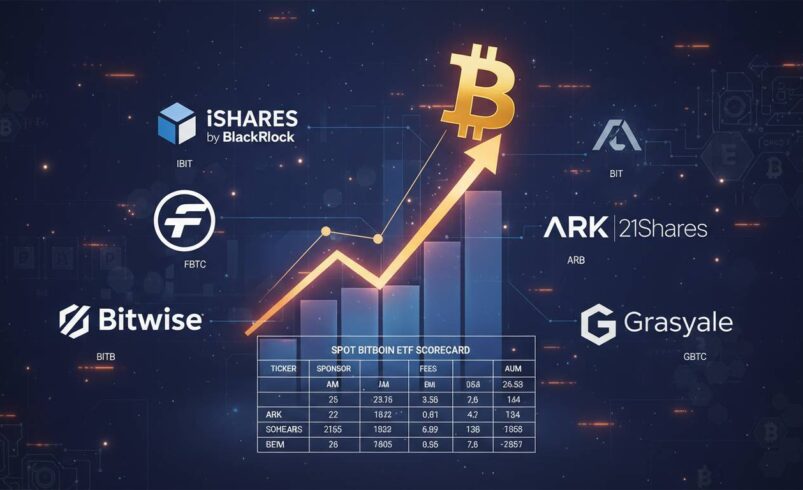
Multiple issuers launched spot Bitcoin ETFs after approval. Here’s how the main ones stack up:
| ETF Name | Ticker | Expense Ratio | AUM (Billions) | Issuer |
|---|---|---|---|---|
| iShares Bitcoin Trust | IBIT | 0.25% | $50+ | BlackRock |
| Fidelity Wise Origin Bitcoin Fund | FBTC | 0.25% | $20+ | Fidelity |
| ARK 21Shares Bitcoin ETF | ARKB | 0.21% | $3+ | ARK Invest/21Shares |
| Bitwise Bitcoin ETF | BITB | 0.20% | $4+ | Bitwise |
| Invesco Galaxy Bitcoin ETF | BTCO | 0.25% | $2+ | Invesco/Galaxy |
BlackRock’s IBIT dominates the space, pulling in over $50 billion in assets within its first year. That’s remarkable for any ETF, let alone one tracking something as volatile as Bitcoin. Fidelity’s FBTC also saw strong inflows, partly because the company already handles so many retirement accounts.
If you’re watching costs, Bitwise’s BITB has the lowest fee at 0.20%. ARKB comes in at 0.21%. The difference sounds small, but it adds up over years.
How We Ranked These ETFs
We looked at expense ratios, assets under management, issuer credibility, and trading liquidity. Expense ratios matter because even tiny fee differences compound—on a $10,000 holding over ten years, the gap between 0.25% and 0.20% runs around $50.
AUM indicates investor confidence. Bigger funds tend to have better liquidity and tighter spreads, which helps when you’re buying or selling. BlackRock and Fidelity clearly lead here.
Issuer track record counts too. These companies have decades of ETF experience and face significant regulatory scrutiny—that’s reassuring when your money is involved.
Detailed Comparison of Leading Bitcoin ETFs
iShares Bitcoin Trust (IBIT)
BlackRock doesn’t launch products half-measure, and IBIT proved that. It hit $50 billion in assets faster than any ETF in history. The 0.25% fee matches the market standard. For Indian investors with U.S. account access, IBIT trades on the NYSE and fits easily into any brokerage portfolio.
Fidelity Wise Origin Bitcoin Fund (FBTC)
Fidelity already manages trillions in retirement assets, so FBTC benefits from that existing trust. The 0.25% fee is standard, and over $20 billion in assets shows investors are comfortable with the product. If you already use Fidelity for other accounts, holding FBTC keeps everything in one place.
ARK 21Shares Bitcoin ETF (ARKB)
Cathie Wood’s ARK partnered with 21Shares for ARKB. At 0.21%, the fee is slightly lower than the big players. The fund has around $3 billion in assets—solid but far behind BlackRock and Fidelity. Liquidity is good for most trade sizes.
Bitwise Bitcoin ETF (BITB)
Bitwise made low cost its pitch. At 0.20%, BITB is the cheapest major spot Bitcoin ETF. The $4 billion in assets shows people are using it, and Bitwise’s background in crypto index products means they understand the space well.
Pros and Cons of Bitcoin ETFs
Advantages include convenience—you buy through your regular brokerage without setting up crypto exchanges or worrying about wallet security. Holding in tax-advantaged accounts like IRAs adds real planning value. Daily holdings disclosures let you see exactly what the fund owns.
The drawbacks are worth knowing too. ETF prices can drift from the actual Bitcoin price, creating premiums or discounts. Expense ratios, while lower than crypto funds, still eat into returns. And you don’t actually own Bitcoin—you can’t withdraw it or spend it anywhere.
How Indian Investors Can Access Bitcoin ETFs
Indian residents can access U.S. Bitcoin ETFs through international brokerage accounts. Several Indian brokers offer global trading platforms with Nasdaq and NYSE access. You’ll need to comply with FEMA regulations and understand how overseas investments get taxed.
The process involves opening an international trading account, verifying your identity, and funding the account in foreign currency. Tax treatment depends on your situation, so consulting a tax professional makes sense.
Some Indian investors stick with domestic crypto products operating within India’s current rules. These aren’t spot Bitcoin ETFs—they work differently—but they exist if you prefer keeping everything domestic.
Performance Considerations and Historical Context
Since launching in January 2024, Bitcoin ETFs have closely tracked Bitcoin’s price, which has been, let’s say, eventful. BlackRock’s IBIT recorded tens of billions in inflows during the first year. That reflects both Bitcoin’s gains and growing institutional acceptance.
Bitcoin remains extremely volatile. These ETFs will swing dramatically—sometimes within single trading sessions. Past performance tells you nothing about what comes next. The long-term case for Bitcoin as an inflation hedge or digital gold is one argument; plenty of professionals disagree.
Frequently Asked Questions
What is the best Bitcoin ETF for Indian investors?
It depends on your access and goals. IBIT has the most assets and liquidity. BITB has the lowest fee at 0.20%.
How much do Bitcoin ETFs charge in fees?
Expense ratios run from 0.20% to 0.25% annually. These fees come out of the fund’s assets automatically.
Are Bitcoin ETFs safe to invest in?
They provide regulated exposure to Bitcoin, but Bitcoin itself is highly volatile. Only invest what you can afford to lose, and be honest about your risk tolerance.
Can Indian residents legally buy Bitcoin ETFs?
You can buy through international brokerage accounts if you follow FEMA rules. Domestic Bitcoin ETFs remain restricted in India.
What is the minimum investment required?
ETFs trade like stocks—one share if your broker allows it. The minimum depends on the share price and your broker’s rules.
Do Bitcoin ETFs hold actual Bitcoin?
Yes. Spot ETFs like IBIT, FBTC, ARKB, BITB, and BTCO hold real Bitcoin, not futures or derivatives.
Conclusion
Spot Bitcoin ETFs mark a real shift in how mainstream finance handles cryptocurrency. Indian investors exploring international opportunities should understand the product landscape, compare fees, and think carefully about their risk tolerance before jumping in.
Access requires jumping through some regulatory hoops—international brokerage accounts, currency considerations, tax implications—but the products themselves work like any other ETF. Do your research, know what you’re getting, and don’t invest more than you can afford to lose. Markets change fast, especially in crypto.