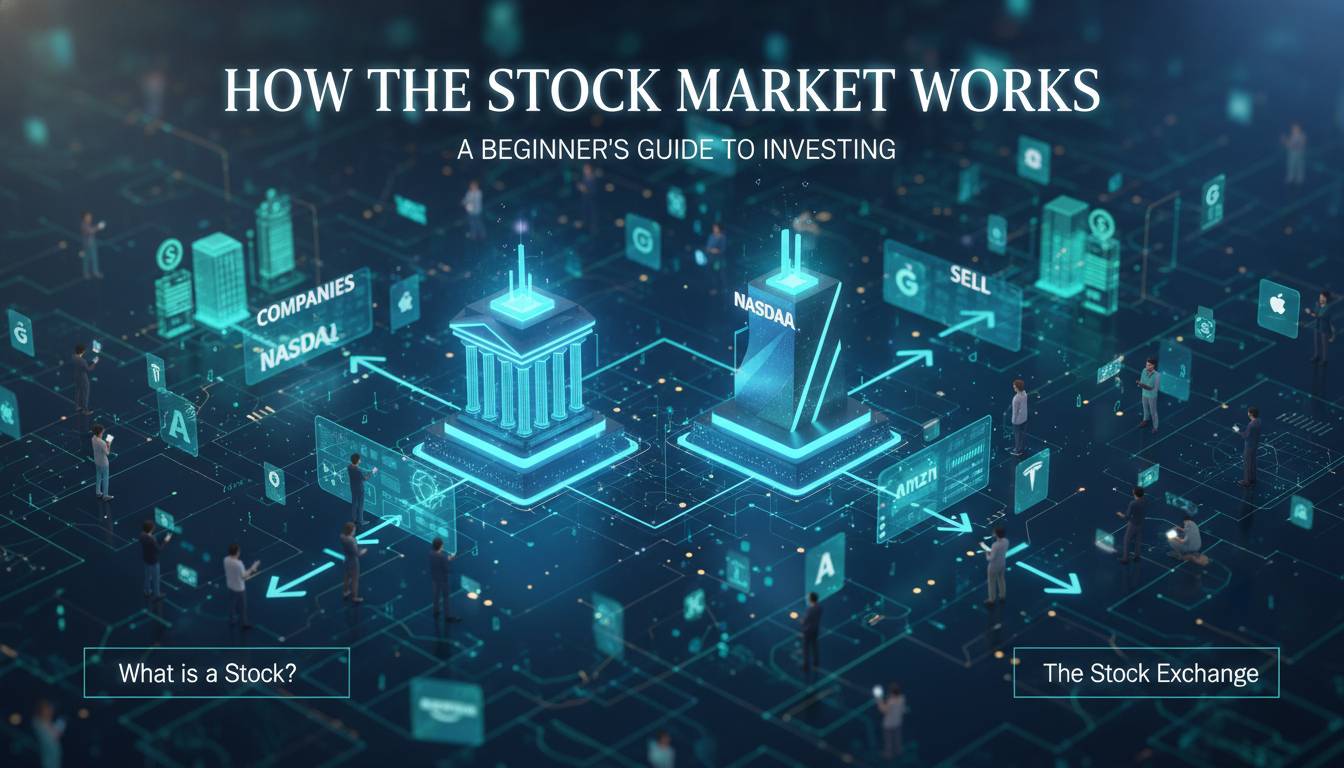


A stock exchange is a marketplace where buyers and sellers trade shares of publicly listed companies. In India, the two primary stock exchanges are the National Stock Exchange (NSE) and the Bombay Stock Exchange (BSE). Understanding how these markets function is essential for anyone looking to build wealth through equity investments. This guide provides a comprehensive overview of stock exchanges, the trading process, and strategies for making informed investment decisions.
What Is a Stock Exchange and How Does It Work?
A stock exchange serves as a regulated marketplace that facilitates the buying and selling of securities. It provides the infrastructure, rules, and systems necessary for price discovery, trading, and settlement of transactions. Without stock exchanges, individual investors would have no organized way to purchase ownership stakes in companies.
The Indian stock market operates through two major exchanges: the Bombay Stock Exchange (BSE), established in 1875 as the oldest Asian stock exchange, and the National Stock Exchange (NSE), which began operations in 1994 and introduced electronic trading to India. Both exchanges operate under the regulatory oversight of the Securities and Exchange Board of India (SEBI), which was established in 1992 to protect investor interests and promote fair market practices.
When a company wishes to raise capital from the public, it undergoes an Initial Public Offering (IPO) to list its shares on a stock exchange. Once listed, these shares trade in the secondary market where investors can buy or sell them based on prevailing market prices. The exchange maintains a continuous auction system that matches buy and sell orders, determining the closing price for each trading day.
Understanding the Indian Stock Market Structure
The Indian stock market operates through a multi-layered structure involving various participants. At the core are the two stock exchanges—NSE and BSE—which provide the trading platform. Above them sits SEBI, which regulates all market participants including stock brokers, depositories, and listed companies.
Key Market Participants:
| Participant | Role |
|---|---|
| Stock Brokers | Facilitate buy and sell orders for investors |
| Depositories (CDSL, NSDL) | Hold securities in electronic form |
| Registrars and Transfer Agents | Maintain investor records |
| Custodians | Safekeep securities for institutional investors |
| Asset Management Companies | Manage mutual fund and portfolio investments |
The trading session in India follows a specific schedule. Pre-market trading occurs from 9:00 AM to 9:15 AM, while normal trading runs from 9:15 AM to 3:30 PM. The closing session from 3:30 PM to 4:00 AM allows for market-on-close orders. Equity delivery settlements happen on a T+1 basis, meaning transactions are settled one business day after the trade date.
How to Open a Trading and Demat Account
Before you can begin investing in the stock market, you need to open two essential accounts: a trading account and a Demat account. The trading account enables you to place buy and sell orders, while the Demat account holds your securities in electronic form.
To open these accounts, you must first select a registered stock broker or depository participant. India has numerous brokerage firms ranging from full-service brokers offering research and advisory services to discount brokers providing low-cost trading platforms. Some prominent brokers include Zerodha, Upstox, ICICI Direct, HDFC Securities, and Axis Direct.
The account opening process typically requires completing the Know Your Customer (KYC) procedure, which involves submitting identity proof (Aadhaar, PAN card, or passport), address proof, bank account details, and passport-sized photographs. Most brokers now offer fully digital account opening through video verification, allowing investors to start trading within 24 hours.
Once your accounts are operational, you can fund your trading account through net banking, UPI, or bank transfers. The minimum amount required to start investing varies—you can begin with as little as ₹500, though most experts recommend starting with at least ₹5,000 to ₹10,000 to meaningfully diversify your portfolio.
Types of Orders and Trading Mechanisms
Understanding different order types is crucial for executing trades effectively. Market orders execute immediately at the best available price, while limit orders allow you to specify the maximum price you are willing to pay (for buys) or minimum price for sells. Stop-loss orders automatically trigger a sell when the price falls to a predetermined level, helping you limit losses.
Common Order Types:
| Order Type | Description | Best Used For |
|---|---|---|
| Market Order | Executes immediately at current price | When speed is priority |
| Limit Order | Executes only at specified price or better | Buying at lower prices |
| Stop-Loss | Triggers sale when price reaches threshold | Limiting downside risk |
| Stop-Loss Limit | Combines stop-loss with limit price | Precise exit points |
| AMO (After Market Order) | Placed after market hours | Extended time flexibility |
The National Stock Exchange offers trading in three segments: cash market (equity delivery), futures market, and options market. The cash market involves actual delivery of shares, while derivatives allow you to trade based on underlying asset prices without holding the physical securities.
Investment Strategies for Long-Term Wealth Creation
Successful investors typically follow either fundamental analysis or technical analysis approaches. Fundamental analysis involves evaluating a company’s financial health by examining metrics such as revenue growth, profit margins, debt levels, and cash flow. Investors using this approach seek undervalued stocks with strong fundamentals that have the potential to appreciate over time.
Technical analysis, on the other hand, focuses on price patterns and trading volume to predict future price movements. This approach uses various indicators including moving averages, Relative Strength Index (RSI), and MACD to identify entry and exit points.
For long-term wealth creation, systematic investment works particularly well. This approach involves investing a fixed amount regularly, regardless of market conditions, which naturally averages out purchase costs over time. Many Indian platforms now offer Systematic Investment Plan (SIP) options for direct equity investing alongside mutual fund SIPs.
Core Investment Principles:
- Diversification: Spread investments across sectors and market caps to reduce risk
- Time Horizon: Equity investments should ideally have a 5-7 year minimum holding period
- Research: Never invest in companies you don’t understand
- Avoid Herd Mentality: Make decisions based on analysis, not market rumors
- Regular Review: Monitor portfolio quarterly but avoid frequent trading
Risk Management and Portfolio Protection
Every investment carries inherent risks, but proper risk management can significantly protect your capital. The most fundamental principle is to never invest money you cannot afford to lose, particularly in equity markets where returns are not guaranteed.
Position sizing involves limiting the amount of capital allocated to any single stock or sector. Many experienced investors follow the rule of not allocating more than 2-5% of their total portfolio to a single stock. Similarly, sector diversification prevents excessive exposure to industry-specific risks.
Stop-loss mechanisms provide automated protection against significant losses. Setting a stop-loss at 7-10% below your purchase price ensures that no single investment decimates your portfolio. For long-term investments, trailing stop-losses can protect gains as stock prices appreciate.
Understanding market volatility is essential for Indian investors. The BSE Sensex and Nifty 50 can experience significant daily movements, particularly during political events, policy announcements, or global economic developments. Maintaining an emergency fund equivalent to 6-12 months of expenses outside the market provides financial security during downturns.
Common Mistakes to Avoid as a Beginner
Novice investors often fall into predictable traps that diminish their returns. One of the most common mistakes is investing without adequate knowledge or research. Following stock tips from unverified sources or making decisions based on social media recommendations frequently leads to losses.
Another frequent error is timing the market. Attempting to buy at the absolute bottom and sell at the absolute top is nearly impossible, even for professional investors. Missing just a few of the market’s best days can dramatically reduce overall returns. Remaining invested through market cycles generally produces better outcomes than trying to predict short-term movements.
Emotional trading represents another significant pitfall. Fear during market crashes causes many investors to sell at lows, while greed during bull markets leads to buying at peaks. Maintaining discipline through a well-defined investment plan helps overcome these emotional impulses.
Beginners also often neglect the costs associated with trading. Brokerage charges, securities transaction tax, GST, and demat account fees all impact net returns. Understanding the complete cost structure and choosing appropriate brokerage plans based on your trading frequency helps maximize actual returns.
Tax Implications for Stock Market Investments
Understanding the tax treatment of your investments is crucial for accurate returns calculation. In India, profits from equity delivery transactions held for more than one year qualify as Long-Term Capital Gains (LTCG) and are taxed at 10% without indexation benefit, though the first ₹1 lakh per year is exempt.
Short-Term Capital Gains (STCG) from equity sold within one year are taxed at 15%. Additionally, the Securities Transaction Tax (STT) applies to all equity trades at 0.1% for delivery-based transactions. Dividends received from stocks are added to your income and taxed according to your applicable income tax slab.
For investors in the highest tax brackets, tax-efficient strategies such as holding investments for more than a year to qualify for LTCG treatment, or utilizing tax-saving instruments alongside equity investments, can significantly improve after-tax returns.
Frequently Asked Questions
What is the minimum amount needed to start investing in the Indian stock market?
You can start investing with as little as ₹500 to ₹1,000 through fractional shares or systematic investment plans. However, most financial advisors recommend beginning with at least ₹5,000 to ₹10,000 to build a meaningfully diversified portfolio. The actual minimum depends on your chosen broker and investment strategy.
How do I choose between the NSE and BSE for trading?
The choice between NSE and BSE matters less for regular retail investors since both offer similar liquidity for most stocks. NSE generally has slightly lower brokerage rates and faster trade execution, while BSE offers more listing options for smaller companies. Most brokers provide access to both exchanges through a single trading account.
Is it safe to invest in stocks through online platforms?
Yes, investing through SEBI-registered brokers using authorized trading platforms is safe. Ensure your broker is registered with SEBI and uses two-factor authentication for accounts. The depositories (CDSL and NSDL) hold your securities in electronic form, providing secure record-keeping protected by regulatory oversight.
How long does it take to see returns from stock investments?
Stock market investments are designed for long-term wealth creation. While short-term fluctuations occur daily, meaningful returns typically require holding periods of 3-5 years minimum. Historical data from the Indian market shows that equity investments have delivered approximately 12-15% annualized returns over extended periods.
Can I lose all my money in the stock market?
Yes, it is possible to lose your entire investment in stocks, particularly if you invest in penny stocks, follow unreliable tips, or fail to diversify. However, investing in fundamentally strong companies across diversified sectors significantly reduces this risk. Using stop-loss orders and maintaining proper position sizing provides additional protection.
What documents do I need to open a Demat account?
You need proof of identity (PAN card is mandatory), proof of address (Aadhaar, passport, voter ID, or utility bills), bank account details, and passport-sized photographs. The entire process can now be completed digitally through video verification with most brokerage platforms.
Conclusion
Investing in the stock market represents one of the most accessible paths to building long-term wealth in India. By understanding how stock exchanges function, opening the appropriate accounts, and following proven investment strategies, anyone can participate in the country’s economic growth. Remember to begin with thorough research, maintain realistic expectations, and prioritize long-term wealth creation over short-term gains. The key to successful investing lies in discipline, continuous learning, and emotional resilience through market cycles. Start small, stay invested, and gradually expand your knowledge and portfolio as you gain experience in the markets.