
Decentralized Finance, commonly known as DeFi, has transformed the global financial landscape by eliminating intermediaries and enabling peer-to-peer financial transactions. For Indian investors and crypto enthusiasts, DeFi platforms offer opportunities for lending, borrowing, trading, and earning yields that traditional banking systems often cannot match. This comprehensive guide explores the best DeFi projects available, their unique features, and what Indian users need to know before participating in this rapidly evolving ecosystem.
Understanding DeFi and Its Significance in India
DeFi refers to financial services built on blockchain technology that operate without traditional intermediaries like banks, brokerages, or insurance companies. These platforms use smart contracts—self-executing code deployed on blockchains—to automate financial agreements, ensuring transparency, security, and accessibility.
India has emerged as one of the largest crypto markets globally, with millions of users actively trading and investing in digital assets. The country’s young, tech-savvy population has shown particular enthusiasm for DeFi platforms, attracted by the potential for higher returns compared to traditional savings accounts. With the Reserve Bank of India (RBI) now permitting crypto transactions following the Supreme Court’s 2020 ruling, Indian users have clearer pathways to participate in DeFi ecosystems.
The DeFi market has grown exponentially, with total value locked (TVL) in DeFi protocols reaching approximately $80-100 billion globally in recent years. This growth reflects increasing institutional and retail adoption, making it essential for Indian investors to understand which platforms offer the best opportunities and security.
Key DeFi Metrics and How to Evaluate Platforms
Before exploring specific projects, understanding the metrics that define a robust DeFi platform is crucial for Indian investors.
Total Value Locked (TVL) represents the total cryptocurrency deposited into a platform’s smart contracts. Higher TVL typically indicates greater user trust and platform stability. As of early 2025, the DeFi ecosystem has seen TVL fluctuate significantly based on market conditions and regulatory developments.
Yield Rates vary across platforms and depend on supply and demand for particular assets. Indian users should compare rates across multiple platforms while factoring in volatility and impermanent loss risks associated with liquidity provision.
Transaction Costs matter significantly for Indian users, as gas fees on networks like Ethereum can eat into profits for smaller investments. Layer-2 solutions and alternative blockchains like Solana, Polygon, and Binance Smart Chain offer more affordable options for frequent DeFi interactions.
Security Audits conducted by reputable firms like Certik, Hacken, and OpenZeppelin provide assurance about smart contract integrity. Platforms without third-party audits carry higher risk for user funds.
Top Decentralized Lending Platforms
Decentralized lending platforms allow users to lend their crypto assets and earn interest or borrow against their holdings without traditional credit checks.
Aave
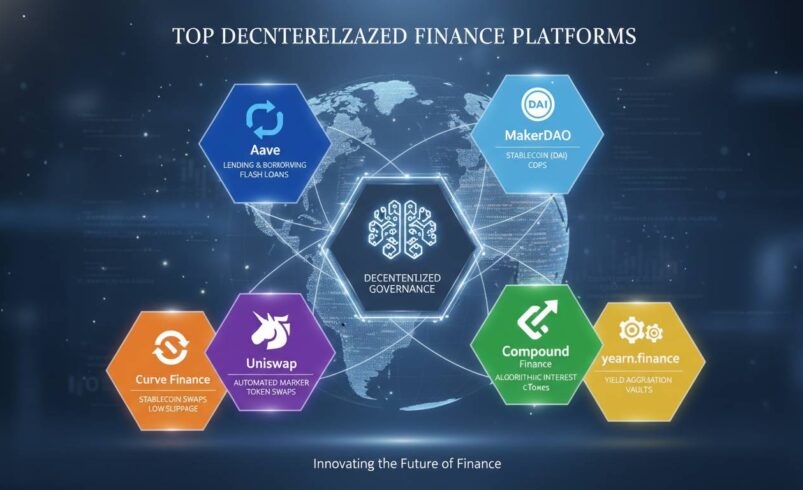
Aave stands as one of the largest and most established decentralized lending protocols in the world. Launched in 2017, the platform allows users to supply assets to liquidity pools and earn variable or stable interest rates. Borrowers can access over 20 different cryptocurrencies as collateral.
The platform’s innovative feature includes flash loans—uncollateralized loans that must be repaid within a single blockchain transaction. Aave has processed billions in total volume and maintains strong security fundamentals with multiple audits and a reserve fund to protect users against smart contract failures.
For Indian users, Aave’s multi-chain presence (Ethereum, Polygon, Avalanche, Arbitrum) provides flexibility in managing gas costs while accessing the platform’s full features.
Compound
Compound is a pioneer in algorithmic, autonomous interest rate protocols. The platform automatically adjusts interest rates based on supply and demand dynamics, creating efficient markets for crypto lending.
Users supply assets to liquidity pools and receive cTokens representing their deposits and accrued interest. Compound’s governance token, COMP, allows holders to propose and vote on protocol changes, making it a community-driven platform.
The platform has suffered exploits in the past, including a 2021 incident where a governance attack resulted in approximately $80 million in losses. However, the team has implemented enhanced security measures since then.
Leading Decentralized Exchanges
Decentralized exchanges (DEXs) enable cryptocurrency trading without centralized order books or intermediaries.
Uniswap
Uniswap is the largest decentralized exchange by volume, operating on an automated liquidity protocol. Unlike traditional exchanges, Uniswap uses liquidity pools where traders swap tokens directly with the pool, eliminating order books and market makers.
The platform introduced the UNI governance token in September 2020, distributing tokens to early users and creating one of the most active DeFi communities. Uniswap operates across Ethereum and scaling solutions like Arbitrum and Optimism.
For Indian traders, Uniswap’s gas costs on Ethereum mainnet can be prohibitive for smaller trades, but the expansion to Layer-2 networks has improved accessibility.
Raydium
Raydium is a decentralized exchange built on Solana, offering significantly lower transaction fees compared to Ethereum-based alternatives. The platform provides fast transaction finality and integrates with Serum’s central order book, combining the benefits of AMMs with centralized exchange features.
Raydium’s ACCELERATE program offers reduced trading fees and rewards for liquidity providers, making it attractive for active traders. The platform has gained substantial popularity among Indian users seeking affordable DeFi trading options.
Yield Farming and Staking Platforms
Yield farming involves leveraging multiple DeFi protocols to maximize returns on crypto assets.
Yearn Finance
Yearn Finance automates yield generation by constantly moving user funds across different lending protocols to capture the highest yields. The platform’s vault strategies are developed by professional strategists and regularly optimized.
Yearn’s native token, YCRV, provides governance rights and fee discounts. The platform has processed billions in total value and remains one of the most sophisticated yield optimization protocols.
Indian investors should note that Yearn’s complexity makes it more suitable for experienced DeFi users rather than beginners.
Lido Finance
Lido Finance enables users to stake their Ethereum (and other proof-of-stake tokens) while receiving liquid stETH tokens. This allows users to maintain liquidity while earning staking rewards, which currently range from 3-5% annually.
With Ethereum’s transition to proof-of-stake, liquid staking has become essential for users wanting to participate in network validation while retaining capital flexibility. Lido has become the dominant liquid staking solution, holding billions in total value locked.
For Indian users concerned about tax implications, staking rewards’ treatment remains ambiguous under current Indian crypto tax laws, requiring careful record-keeping.
DeFi Aggregators and Portfolio Management
These platforms help users optimize their DeFi strategies across multiple protocols.
1inch Network
1inch aggregates liquidity from various DEXs to provide users with the best possible trading rates. The Pathfinder algorithm finds optimal swap paths across multiple exchanges, saving users significant money on large trades.
The platform’s Chi Gastoken helps reduce gas costs by optimizing transaction structures. 1inch operates across multiple chains including Ethereum, Binance Smart Chain, Polygon, and Avalanche.
For cost-conscious Indian traders, using aggregators like 1inch can significantly reduce slippage and gas expenses on larger transactions.
Zerion
Zerion provides a unified interface for managing DeFi investments across multiple protocols. Users can trade, swap, lend, borrow, and track their entire DeFi portfolio from a single dashboard.
The platform supports over 15 blockchains and integrates with hundreds of DeFi protocols. Zerion’s widget-based approach makes it accessible for users who find navigating multiple protocols complex.
Risks and Considerations for Indian Users
Before participating in DeFi, Indian users must understand the significant risks involved.
Smart Contract Risk remains the primary concern in DeFi. Despite audits, vulnerabilities can lead to complete loss of funds. The DeFi ecosystem has experienced billions in exploits, including major incidents like the Ronin Bridge hack ($625 million) and Wormhole bridge attack ($320 million).
Regulatory Uncertainty persists in India. While the Supreme Court overturned RBI’s banking ban in 2020, the government has proposed taxation rules that have created confusion. DeFi platforms operate without clear regulatory frameworks, potentially exposing users to legal complications.
Impermanent Loss affects liquidity providers when the price ratio of deposited tokens changes unfavorably. This can result in lower returns compared to simply holding tokens.
Gas Fee Volatility particularly impacts Ethereum-based DeFi, where network congestion can make transactions prohibitively expensive. Indian users should consider Layer-2 solutions or alternative blockchains to manage costs.
Tax Implications remain unclear for DeFi activities in India. Income from DeFi is currently taxed at 30% with no cost basis adjustment, creating challenges for calculating accurate tax liabilities, especially for yield farming and staking rewards.
Getting Started with DeFi in India
Indian users looking to enter DeFi should follow a structured approach.
Education First: Understanding blockchain fundamentals, wallet management, and smart contract interactions is essential before committing funds. Resources like DeFi Pulse, Bankless, and The Defiant provide educational content.
Start Small: Begin with minimal amounts to understand transaction flows, gas costs, and platform interfaces before committing significant capital.
Use Hardware Wallets: For substantial DeFi investments, hardware wallets like Ledger or Trezor provide superior security compared to browser extensions or mobile wallets.
Diversify Across Platforms: Avoid concentrating all funds in a single protocol. Spreading investments across multiple audited platforms reduces single-point failure risks.
Maintain Records: Document all transactions for tax purposes, as Indian crypto tax laws require reporting of all digital asset transactions.
Frequently Asked Questions
What is the best DeFi project for beginners in India?
Uniswap and Aave are considered beginner-friendly options due to their established track records, extensive documentation, and large user bases. Starting with these platforms allows new users to understand DeFi mechanics before exploring more complex protocols.
Is DeFi legal in India?
Following the Supreme Court’s March 2020 ruling that overturned RBI’s banking ban, DeFi participation is legal in India. However, the regulatory framework remains evolving, and users should stay updated on potential regulatory changes.
How much money do I need to start with DeFi?
The minimum amount depends on the platform and blockchain chosen. Ethereum-based DeFi requires sufficient capital to cover gas fees, making smaller investments impractical. Polygon, Binance Smart Chain, or Solana offer lower costs, with some platforms accepting investments as low as ₹1,000 ($12).
Can I lose money in DeFi?
Yes, DeFi investments carry significant risks including smart contract failures, hacks, rug pulls, impermanent loss, and cryptocurrency volatility. Users should only invest what they can afford to lose entirely.
How are DeFi gains taxed in India?
DeFi gains are currently treated as income and taxed at 30% under India’s crypto taxation rules introduced in 2022. This applies to yield farming rewards, staking income, and capital gains from DeFi token sales. Users must maintain detailed transaction records for compliance.
Should I use a VPN for DeFi in India?
While not specifically required for DeFi access in India, using reputable VPN services adds privacy and can help access services that may have geographic restrictions. However, ensure compliance with all applicable laws when using such tools.
Conclusion
DeFi represents a fundamental shift in how individuals can access financial services, offering Indian users opportunities for earning yields, borrowing assets, and trading cryptocurrencies without traditional intermediaries. The platforms outlined in this guide—Aave, Uniswap, Compound, Raydium, Yearn Finance, and others—represent the most established and audited options in the ecosystem.
However, the DeFi space demands careful risk management, continuous learning, and disciplined investment approaches. Indian users should prioritize security, understand tax implications, and start with small amounts while gaining experience. As the regulatory landscape continues developing, staying informed about legal developments will be crucial for safe and compliant DeFi participation.
The decentralized finance revolution offers unprecedented financial autonomy, but with that freedom comes the responsibility of self-custody and personal security. Approach DeFi with caution, education, and realistic expectations about both potential returns and risks.