
Blockchain technology has evolved from a niche concept behind Bitcoin to a transformative force reshaping industries across India and globally. At its core, blockchain is a decentralized, distributed digital ledger that records transactions across multiple computers in a way that makes the records extremely difficult to alter retroactively. This fundamental characteristic—often called “immutability”—is why governments, financial institutions, and tech companies are investing billions in understanding and implementing this technology.
Key Insights
– The global blockchain market is projected to reach $1.4 trillion by 2030, with India’s contribution growing at 47% annually
– Over 100 million Indians own cryptocurrency, making India one of the largest crypto markets in the world
– The Indian government has launched multiple blockchain initiatives across states including Karnataka, Telangana, and Andhra Pradesh
– Major Indian enterprises including Reliance Industries, ICICI Bank, and Yes Bank have deployed blockchain solutions
This guide breaks down blockchain technology into clear, understandable components, explores its practical applications for Indian users and businesses, and examines why it matters for India’s digital economy.
What Exactly is Blockchain?
Blockchain is a distributed database or ledger that is shared among the nodes of a computer network. Unlike traditional databases that store information in centralized locations, blockchain distributes identical copies of the data across entire networks. This decentralization is what makes the technology fundamentally different from conventional data management systems.
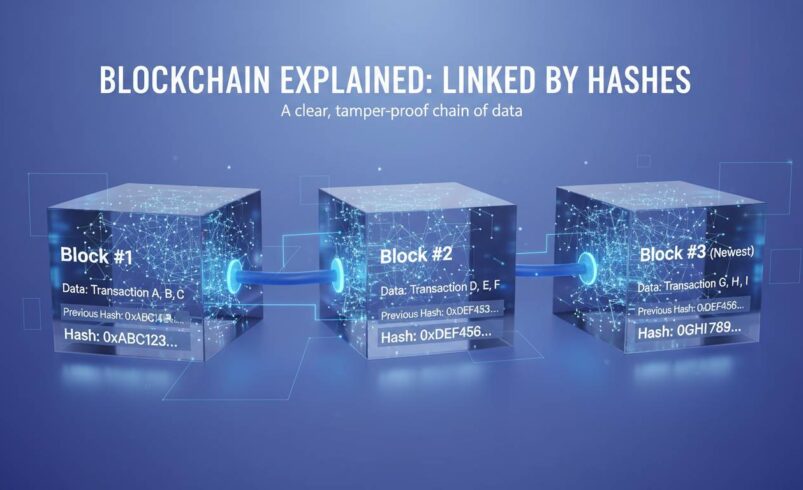
Each “block” in the chain contains three elements: data, a hash (a unique digital fingerprint), and the hash of the previous block. The data stored depends on the blockchain’s purpose—financial blockchains typically record transaction details like sender, receiver, and amount, while supply chain blockchains might record product information, location data, and ownership changes.
When a new transaction occurs, it is broadcast to all nodes in the network. These nodes validate the transaction using consensus mechanisms—essentially agree that the transaction is legitimate. Once consensus is reached, the transaction is grouped with other transactions into a new block. This new block is then added to the existing chain, creating a permanent and unchangeable record.
The revolutionary aspect is that to alter any single block, an attacker would need to change every block that came after it—across thousands of computers simultaneously. This mathematical impossibility is what gives blockchain its security properties.
How Blockchain Works: A Technical Deep Dive
Understanding blockchain requires examining its four foundational components: distributed ledger technology, consensus mechanisms, cryptographic hashing, and smart contracts.
The Distributed Ledger
A distributed ledger is a database that is synchronized across multiple sites, countries, or institutions. In blockchain, every participant (node) maintains a complete copy of the entire transaction history. When a new transaction occurs, it propagates across the network within seconds. This means no single entity controls the data, eliminating single points of failure that plague traditional centralized systems.
For Indian businesses, this distributed nature addresses a critical concern: data sovereignty. With data stored across multiple nodes (potentially within India’s borders), companies can maintain compliance with data localization requirements while still leveraging decentralized technology.
Consensus Mechanisms
Consensus mechanisms are the protocols that ensure all nodes in a blockchain network agree on a single version of truth. The most common mechanisms include:
Proof of Work (PoW): Used by Bitcoin, this requires miners to solve complex mathematical puzzles to validate transactions. While extremely secure, PoW consumes significant energy—Bitcoin’s annual electricity consumption exceeds that of entire countries like Argentina or Norway.
Proof of Stake (PoS): Ethereum, the second-largest blockchain, transitioned to PoS in 2022, reducing energy consumption by approximately 99.95%. Validators stake their cryptocurrency as collateral to propose new blocks, with penalties for dishonest behavior.
Proof of Authority (PoA): Used in private blockchains, this relies on identity verification. Validators stake their reputation rather than cryptocurrency, making it suitable for enterprise applications.
India’s regulatory environment has shown preference for energy-efficient consensus mechanisms, with the Ministry of Electronics and IT (MeitY) indicating support for sustainable blockchain solutions.
Cryptographic Hashing
Hashing converts input data of any size into a fixed-size string of characters. Each block’s hash depends on its data and the previous block’s hash—creating a cryptographic chain. This is analogous to a wax seal on an envelope: any attempt to alter the contents would break the seal.
SHA-256, the hashing algorithm used by Bitcoin, produces a 64-character hexadecimal string. The probability of two different inputs producing the same hash is approximately 1 in 4.3 billion—making tampering mathematically infeasible.
Smart Contracts
Smart contracts are self-executing programs stored on the blockchain that automatically enforce agreement terms when predetermined conditions are met. They eliminate intermediaries—removing the need for lawyers, notaries, or banks to oversee traditional contracts.
When a farmer in Maharashtra sells produce to a retailer, a smart contract can automatically release payment once a logistics API confirms delivery. This eliminates payment delays that often plague agricultural supply chains, where farmers historically wait 30-90 days for payment.
Key Features and Benefits
Immutability
Once data is recorded on a blockchain, it cannot be changed without detection. This creates permanent audit trails essential for industries requiring accountability—healthcare, legal, supply chain, and financial services.
The Indian pharmaceutical industry, one of the world’s largest, stands to benefit significantly. Counterfeit drugs are a $4.5 billion problem in India annually. Blockchain can track each drug’s journey from manufacturer to patient, ensuring authenticity.
Transparency
All transactions on public blockchains are visible to anyone. This transparency reduces fraud and corruption—critical issues for India’s economic development. Government welfare programs, which lose an estimated 30-40% to corruption and leakage, could theoretically distribute funds directly to beneficiaries with full traceability.
Security
Blockchain’s distributed architecture eliminates single points of failure. Even if several nodes are compromised, the network continues functioning. Data is encrypted using advanced cryptographic standards, providing protection against unauthorized access.
Efficiency and Cost Reduction
Cross-border payments that traditionally take 3-5 business days and cost 6-10% in fees can settle in seconds on blockchain networks at a fraction of the cost. For India, which received $100 billion in remittances in 2022, even modest fee reductions would save billions annually.
Types of Blockchains
Blockchains are not one-size-fits-all. Understanding the different types helps determine appropriate applications.
| Type | Accessibility | Speed | Examples | Best Use Cases |
|---|---|---|---|---|
| Public | Anyone | Slow | Bitcoin, Ethereum | Decentralized finance, global payments |
| Private | Invitation-only | Fast | Hyperledger Fabric | Enterprise applications, internal operations |
| Consortium | Selected participants | Medium | R3 Corda | Banking consortia, supply chain networks |
| Hybrid | Combined features | Variable | Kadena, Polygon PoS | Scalable dApps, enterprise-grade applications |
Public Blockchains
Public blockchains like Bitcoin and Ethereum are fully decentralized. Anyone can participate by running node software. While offering maximum security and transparency, they face scalability challenges. Ethereum processes approximately 15-30 transactions per second (TPS), while Visa handles 65,000 TPS.
Private Blockchains
Private blockchains restrict participation to approved entities. Organizations like IBM and Oracle offer enterprise blockchain solutions preferred by Indian corporations seeking efficiency without public visibility.
Consortium Blockches
Consortium blockchains are governed by a group of organizations rather than single entities. The Indian government has explored consortium models for land record management and educational credential verification—enabling inter-agency collaboration while maintaining data control.
Real-World Applications in India
Financial Services
ICICI Bank became India’s first bank to use blockchain for international payments, enabling real-time cross-border transactions. Yes Bank and Axis Bank have similarly deployed blockchain solutions for trade finance and documentation.
The Reserve Bank of India (RBI) has been exploring a central bank digital currency (CBDC), with pilot programs launching in 2022. The digital rupee could reduce currency management costs and increase financial inclusion for India’s 190 million unbanked adults.
Supply Chain and Agriculture
The Maharashtra government partnered with IBM to develop a blockchain-based supply chain solution for agricultural produce. The system tracks produce from farms to markets, ensuring farmers receive fair prices while consumers verify product origin.
Titan, Tata Group’s jewellery brand, uses blockchain to certify diamond authenticity—addressing concerns about conflict stones and ensuring ethical sourcing.
Land Registry
Andhra Pradesh became the first Indian state to implement blockchain for land records. The system prevents title fraud, which accounts for over 70% of civil litigation in India. Telangana and Karnataka have launched similar initiatives.
Healthcare
Apollo Hospitals, India’s largest healthcare chain, has piloted blockchain for patient record management. The system enables patients to control who accesses their medical history while ensuring data integrity—addressing both privacy concerns and the fragmentation of health records across providers.
Common Misconceptions
“Blockchain is Just Cryptocurrency”
This is perhaps the most pervasive myth. While Bitcoin popularized blockchain, the technology has applications far beyond digital currency. Supply chain tracking, voting systems, digital identity, and intellectual property management all leverage blockchain without any cryptocurrency component.
“Blockchain is Completely Anonymous”
Public blockchains are pseudonymous—not anonymous. Transactions are linked to wallet addresses, which can potentially be traced to real identities. Chainalysis, a blockchain analytics company, has assisted law enforcement in tracking illegal transactions. For truly private transactions, privacy-focused cryptocurrencies exist, but they face regulatory scrutiny globally.
“Blockchain is Unhackable”
While blockchain itself is secure, the systems built around it are not. Cryptocurrency exchanges, wallet providers, and smart contracts have all suffered hacks. Over $3.8 billion was stolen from crypto platforms in 2022. The infamous Ronin Bridge hack resulted in $615 million in losses—the vulnerability was in the bridge, not the underlying blockchain.
“Blockchain is Too Slow for Real Applications”
This outdated criticism applies primarily to public blockchains using Proof of Work. Modern blockchain solutions using Proof of Stake or layer-2 technologies process thousands of transactions per second. Polygon, an Indian-founded blockchain, handles over 7,000 TPS—exceeding Visa’s capacity.
Getting Started with Blockchain
For Individuals
Indian residents interested in exploring blockchain can begin with educational resources. Platforms like Coursera, Udemy, and edX offer blockchain courses ranging from beginner to advanced. Understanding cryptocurrency wallets, private keys, and seed phrases is essential before holding digital assets.
For those wishing to invest, Indian cryptocurrency exchanges including CoinDCX, WazirX, and CoinStats allow trading. However, investors should understand the regulatory uncertainty—the Supreme Court overturned RBI’s banking ban in 2020, but regulatory frameworks continue evolving.
For Businesses
Indian companies exploring blockchain should start with problem identification. Blockchain excels at solving trust, transparency, and traceability challenges—but is unnecessary for problems solvable with traditional databases.
Consulting with blockchain development firms including Credbee, Turing, and tech giants’ Indian arms can help assess feasibility. Many offer proof-of-concept development before full implementation.
Government initiatives including the Blockchain District in Telangana and the Karnataka Blockchain Valley provide incubation support for blockchain startups.
The Future of Blockchain in India
India’s unique position—with a large tech workforce, significant cryptocurrency adoption, and government interest in digital infrastructure—creates substantial blockchain potential.
The Indian government announced a $1.2 billion blockchain investment plan in the 2024 budget, focusing on:
- Digital identity verification
- Agricultural supply chain optimization
- Financial inclusion programs
- Cross-border trade facilitation
The Digital India Act and proposed data protection legislation will likely include provisions for blockchain-based identity and data management.
Industry experts predict India could become a global blockchain hub by 2030, with blockchain contributing an estimated $5 billion to GDP annually through efficiency gains and new business models.
Frequently Asked Questions
What is blockchain in simple terms?
Blockchain is a digital ledger system where information is stored across many computers simultaneously. Once information is recorded, it cannot be changed without changing all subsequent records across the entire network—making it extremely secure and transparent.
Is blockchain the same as cryptocurrency?
No. Cryptocurrency is one application of blockchain technology. Blockchain is the underlying infrastructure; cryptocurrencies like Bitcoin and Ethereum are digital assets that run on that infrastructure. Blockchain also powers many applications unrelated to money, including supply chain tracking and digital identity systems.
Is blockchain legal in India?
Yes, cryptocurrency trading is legal in India following the Supreme Court’s 2020 ruling that overturned RBI’s banking ban. The government has proposed taxation on crypto assets and continues developing regulatory frameworks. Blockchain technology itself is legal and actively promoted by various state governments for enterprise applications.
How can I learn blockchain development?
Start with online courses on platforms like Coursera, edX, or freeCodeCamp. Learn programming languages commonly used in blockchain development: Solidity (for Ethereum), Rust, or Go. Practice by building small projects on test networks. Certifications from institutions like IIT Bangalore and various blockchain bootcamps are also available.
Which Indian companies use blockchain?
Major Indian companies using blockchain include ICICI Bank (banking), Reliance Industries (supply chain), Tata Group (diamonds and jewellery), Apollo Hospitals (healthcare), and multiple state governments (land records and governance). Several Indian-founded blockchain companies including Polygon and CoinDCX have gained international recognition.
What is the future of blockchain technology in India?
The future appears promising, with government investment of over $1 billion planned for blockchain infrastructure. Expected growth areas include financial services (digital rupee, cross-border payments), supply chain (pharmaceuticals, agriculture), governance (land records, identity verification), and skills development. India aims to become a global blockchain hub by 2030.
Conclusion
Blockchain technology represents a fundamental shift in how we think about trust, transparency, and data management. For India—a country grappling with challenges ranging from financial inclusion to supply chain inefficiency to bureaucratic corruption—blockchain offers tangible solutions.
The technology is not a magic bullet. Its implementation requires careful consideration of use cases, regulatory compliance, and technical infrastructure. But across banking, healthcare, agriculture, and governance, early adopters are demonstrating measurable benefits.
As India continues its digital transformation journey, understanding blockchain becomes increasingly valuable—whether you’re a student exploring career options, a business owner evaluating efficiency solutions, or simply a curious citizen. The blockchain revolution is underway, and India’s participation will shape its trajectory for decades to come.