

India has witnessed a remarkable surge in cryptocurrency adoption over the past few years, with millions of investors actively trading digital assets on various platforms. Among the most discussed events in the crypto ecosystem is Bitcoin halving—a phenomenon that occurs approximately every four years and fundamentally alters the supply dynamics of the world’s largest cryptocurrency. Understanding Bitcoin halving is essential for any investor looking to navigate the crypto markets intelligently, particularly in India where regulatory clarity continues to evolve and investor interest peaks during major market events.
What Is Bitcoin Halving and Why It Matters
Bitcoin halving is a pre-programmed event in the Bitcoin protocol that reduces the block reward given to miners by half. This occurs approximately every 210,000 blocks, which translates to roughly every four years. The mechanism was designed by Bitcoin’s anonymous creator, Satoshi Nakamoto, to control inflation and ensure that the total supply of Bitcoin never exceeds 21 million coins.
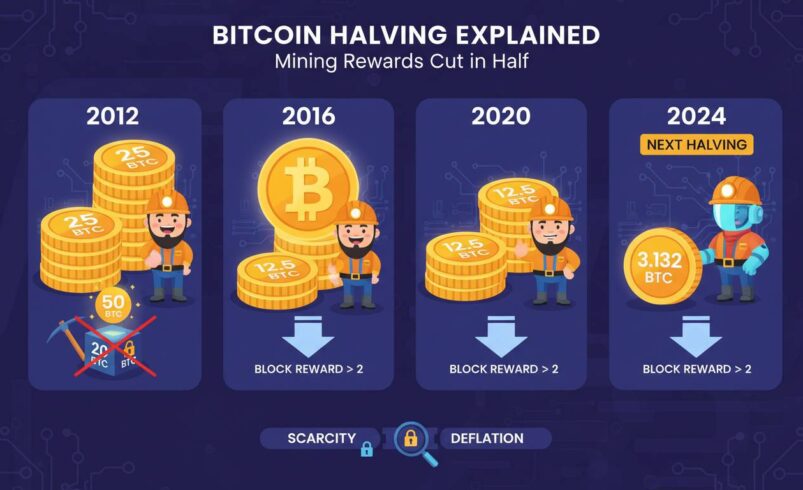
When Bitcoin launched in 2009, miners received 50 BTC for each block they added to the blockchain. The first halving occurred in November 2012, reducing the reward to 25 BTC. The second halving in July 2016 brought it down to 12.5 BTC, and the most recent halving in May 2020 reduced the block reward to 6.25 BTC. The next halving is expected around April 2024, when the reward will drop to 3.125 BTC.
For Indian investors, understanding this mechanism is crucial because it directly impacts the supply side of Bitcoin’s economics. With fewer new bitcoins entering the market, the reduced supply pressure often creates upward price momentum when demand remains stable or increases. Historical data shows that each halving has been followed by significant price appreciation, though past performance does not guarantee future results.
The halving also serves as a reminder that Bitcoin’s monetary policy is transparent and predictable—unlike central bank currencies that can be printed at will. This scarcity mechanism is one of the core value propositions that attract investors seeking alternatives to traditional inflation-prone assets.
The Technical Mechanism Behind Bitcoin Halving
Bitcoin operates on a decentralized blockchain network where transactions are validated and added to the public ledger by miners. These miners compete to solve complex mathematical puzzles, and the first to succeed gets to add the next block and receive the block reward. This process is known as Proof of Work.
The halving mechanism is hard-coded into Bitcoin’s source code and requires no human intervention. The code specifically contains a halving schedule that automatically adjusts the subsidy based on block height. Here is how it works:
When a miner successfully adds a block to the blockchain, they receive newly minted bitcoins along with transaction fees. The subsidy portion—the newly created coins—gets cut in half at each halving. This continues until the block reward reaches near zero, at which point miners will rely primarily on transaction fees for their revenue.
The mathematical certainty of this process means that by the year 2140, all 21 million bitcoins will have been mined, and no new coins will enter circulation. This deflationary design is intentional and represents Bitcoin’s primary differentiation from fiat currencies.
For technically inclined investors in India, understanding this mechanism provides confidence in Bitcoin’s scarcity model. Unlike the Reserve Bank of India which can increase money supply, Bitcoin’s protocol ensures that supply growth slows predictably over time.
Historical Performance: What Past Halvings Tell Us
Examining Bitcoin’s price behavior around previous halvings provides valuable insights, though investors should approach such analysis with appropriate caution.
First Halving : Bitcoin’s price was approximately $12 when the reward dropped from 50 to 25 BTC. Within a year, prices surged to over $1,100—a gain of approximately 9,000%. However, this was still early in Bitcoin’s adoption curve.
Second Halving : The price hovered around $650 before the halving reduced rewards from 25 to 12.5 BTC. By December 2017, Bitcoin reached nearly $20,000, representing roughly 3,000% appreciation from pre-halving levels.
Third Halving : Bitcoin traded around $9,000 before the event. The subsequent bull run carried prices to an all-time high of nearly $69,000 in November 2021—a gain exceeding 660% from pre-halving prices.
These historical patterns have created what many call the “halving cycle”—the expectation that prices will rise substantially in the 12-18 months following each halving. However, Indian investors should note that multiple factors influence price beyond just the halving event, including regulatory developments, macroeconomic conditions, and investor sentiment.
The Indian context matters significantly. When Bitcoin prices surged in 2021, India saw unprecedented trading volumes on exchanges like CoinDCX, WazirX, and ZebPay. The subsequent market correction also impacted Indian investors heavily, serving as a reminder of the volatility involved.
How Bitcoin Halving Affects Price and Market Dynamics
The relationship between halving and price involves several economic principles that investors should understand.
Supply Shock Theory: When the block reward halves, the rate at which new bitcoins enter the market decreases by 50%. If demand remains constant or grows, the reduced supply flow creates upward pressure on prices. This is basic economics—decreasing supply while demand stays stable leads to higher prices.
Miner Economics: Halving directly impacts miner profitability. Those with inefficient operations may be forced to shut down when their revenue drops by half while operational costs remain constant. This can temporarily reduce network hash rate and mining difficulty, though the network automatically adjusts. In India, where electricity costs vary significantly between states, mining economics are particularly sensitive.
Psychological Factors: The halving is widely publicized and creates anticipatory buying. Many investors expect prices to rise, leading to pre-halving accumulation. This self-fulfilling prophecy can drive prices higher even before the actual supply reduction occurs.
Historical Precedent: The consistent pattern of post-halving rallies creates expectations, attracting more investors and capital into the market. However, these expectations also mean that prices may already be elevated before the halving occurs—priced in by informed traders.
For Indian investors, it is important to recognize that while historical patterns are suggestive, they are not guarantees. The 2022 market downturn demonstrated that even well-established cycles can be disrupted by broader economic factors like interest rate hikes and regulatory uncertainty.
Investment Strategies for Indian Investors
Indian investors considering Bitcoin exposure around halving events should approach with a well-defined strategy.
Dollar-Cost Averaging: Rather than timing the market, consistently investing a fixed amount at regular intervals helps mitigate volatility. This strategy works particularly well for Indian investors who can set up recurring buys on local exchanges, converting rupees to Bitcoin systematically regardless of price movements.
Allocation Framework: Financial experts typically recommend allocating only a small portion of a diversified portfolio to volatile assets like Bitcoin. Many suggest 1-5% maximum, depending on individual risk tolerance. For Indian investors, this means ensuring that emergency funds, insurance, and traditional investments are in place before considering crypto exposure.
Long-Term Holding: Bitcoin’s volatility makes it unsuitable for short-term trading for most individual investors. The halving cycle suggests that meaningful price appreciation occurs over years, not days or weeks. Holding for at least 3-5 years has historically yielded positive returns.
Regulatory Compliance: Indian investors must ensure they are trading on compliant exchanges and report cryptocurrency gains in their income tax returns. The Goods and Services Tax (GST) provisions and Income Tax rules around crypto have evolved, and investors should stay updated with current requirements.
Security Practices: Using hardware wallets for significant holdings, enabling two-factor authentication, and avoiding keeping large amounts on exchanges represents basic security hygiene that Indian investors should follow.
Common Misconceptions About Bitcoin Halving
Several myths surround Bitcoin halving that deserve clarification.
Myth 1: Prices Always Rise After Halving. While historical data shows price appreciation, the relationship is not deterministic. Multiple factors including global economic conditions, regulatory changes, and market sentiment influence prices. The 2022 bear market demonstrated that significant drawdowns can occur even after halving events.
Myth 2: Halving Causes Immediate Price Increases. The price impact typically manifests over months or years following the event, not immediately. Markets are efficient at pricing in known events, meaning much of the anticipated price increase may already be reflected before the halving occurs.
Myth 3: Miners Will Stop Mining When Rewards Become Too Low. While some less efficient miners may exit, others will continue as long as Bitcoin has value. Additionally, transaction fees provide increasing revenue for miners as the block subsidy diminishes.
Myth 4: Halving Solves Bitcoin’s Energy Problems. Halving reduces new coin creation but does not directly change mining energy consumption. The network’s security requires computational work regardless of block reward size.
Myth 5: Bitcoin Will Become Deflationary After All Halvings. While new supply eventually stops, Bitcoin will not become deflationary in the traditional sense. Instead, it will have a fixed supply cap, creating what supporters call “hard money” characteristics.
Risks and Considerations for Investors
Investing in Bitcoin, particularly around volatile events like halving, carries substantial risks that Indian investors must carefully evaluate.
Extreme Volatility: Bitcoin prices can swing 20-30% or more within days. The 2022 market saw Bitcoin fall from $69,000 to under $16,000—a decline of more than 75%. Indian investors should only invest capital they can afford to lose entirely.
Regulatory Uncertainty: India’s regulatory stance on cryptocurrency has evolved and may continue to change. While the government has clarified that crypto is not illegal, future regulatory developments could impact trading, holding, or transferring Bitcoin.
Market Manipulation: The relatively small market capitalization of Bitcoin compared to traditional assets makes it susceptible to manipulation by large holders (often called “whales”). Indian investors should be aware that price movements may not always reflect fundamental value.
Technical Risks: Wallet failures, exchange hacks, or loss of private keys can result in permanent loss of Bitcoin holdings. Following proper security practices is essential.
Emotional Decision-Making: The hype surrounding halving events can lead to FOMO-driven (fear of missing out) decisions. Rational, predetermined investment strategies help avoid emotional trading.
For Indian investors specifically, rupee depreciation against the dollar adds another layer of consideration. While Bitcoin may appreciate in dollar terms, rupee-denominated returns depend on BTCINR exchange rate movements as well.
Conclusion
Bitcoin halving represents one of the most significant events in the cryptocurrency calendar, with direct implications for supply dynamics and market psychology. For Indian investors, understanding the mechanics—why it happens, how it works, and what historical patterns suggest—provides a foundation for informed decision-making.
The evidence from three previous halvings shows a pattern of subsequent price appreciation, though the magnitude varies and past performance does not guarantee future results. What remains consistent is Bitcoin’s predictable supply schedule, which distinguishes it from any traditional asset.
Indian investors should approach Bitcoin investments with clear strategies: appropriate portfolio allocation, dollar-cost averaging, long-term holding perspective, and strict adherence to security and regulatory compliance. The halving event, while notable, should be viewed as one factor among many that influence Bitcoin’s value—not a guaranteed profit catalyst.
As with any investment, thorough research, personal risk assessment, and perhaps consultation with financial advisors familiar with cryptocurrency should precede any allocation of capital to Bitcoin or other digital assets.
Frequently Asked Questions
When is the next Bitcoin halving?
The next Bitcoin halving is expected to occur in April 2024, when the block reward will decrease from 6.25 BTC to 3.125 BTC. This event will take place automatically based on Bitcoin’s protocol, approximately four years after the previous halving in May 2020.
Does Bitcoin halving guarantee price increases?
No, Bitcoin halving does not guarantee price increases. While historical data shows significant price appreciation following previous halvings, multiple factors including regulatory developments, macroeconomic conditions, and market sentiment influence prices. Past performance does not guarantee future results.
How does Bitcoin halving affect Indian investors?
Indian investors are impacted by Bitcoin halving primarily through price movements on Indian exchanges. The INR-BTC exchange rate means that returns also depend on rupee-dollar dynamics. Additionally, Indian tax provisions regarding cryptocurrency gains apply to profits realized from trading.
Should I buy Bitcoin before or after the halving?
There is no definitive answer to timing the market around halving events. Some investors choose to accumulate before the halving to benefit from anticipated supply constraints, while others prefer to dollar-cost average consistently. Research and personal risk tolerance should guide investment decisions rather than speculation on timing.
How much Bitcoin can still be mined?
Approximately 19.5 million Bitcoin have been mined out of the maximum supply of 21 million. The remaining 1.5 million BTC will be created over the next approximately 120 years through the halving process, with the final fraction of a Bitcoin expected to be mined around the year 2140.
Is Bitcoin a good investment for beginners in India?
Bitcoin’s extreme volatility makes it unsuitable for risk-averse investors or beginners with limited investment experience. Those interested should start with very small amounts, thoroughly research the technology and risks, ensure they have adequate emergency funds and traditional investments first, and only invest capital they can afford to lose entirely.