
The intersection of blockchain technology and gaming has created one of the most dynamic sectors in the cryptocurrency market. NFT gaming coins represent digital assets that power in-game economies, enable true ownership of virtual items, and reward players for their time and skill. For Indian gamers and investors, understanding this space has become increasingly relevant as mobile gaming continues its explosive growth across the subcontinent.
Understanding NFT Gaming Coins
NFT gaming coins are cryptocurrencies specifically designed to function within blockchain-based gaming ecosystems. Unlike traditional in-game currencies that remain controlled by game developers, these tokens exist on decentralized networks, giving players genuine ownership of their digital assets. When you purchase a weapon, character, or piece of virtual land in an NFT game, that item becomes yours to sell, trade, or transfer regardless of whether the game continues operating.
The market for NFT gaming has experienced significant evolution. According to data from various industry trackers, the play-to-earn model gained substantial traction between 2021 and 2023, with games like Axie Infinity demonstrating how players could earn real value through gameplay. While the sector has undergone correction and consolidation, the underlying technology continues to mature, with major gaming studios exploring blockchain integration.
For Indian users, several factors make this sector particularly interesting. The country’s massive mobile gaming audience—estimated at over 500 million gamers—provides a substantial potential user base. Additionally, the growing acceptance of cryptocurrency trading on Indian exchanges has made it easier to access these digital assets. However, Indian investors should also note the regulatory landscape, including taxation rules for virtual digital assets that came into effect in 2022.
Top NFT Gaming Tokens with Market Presence
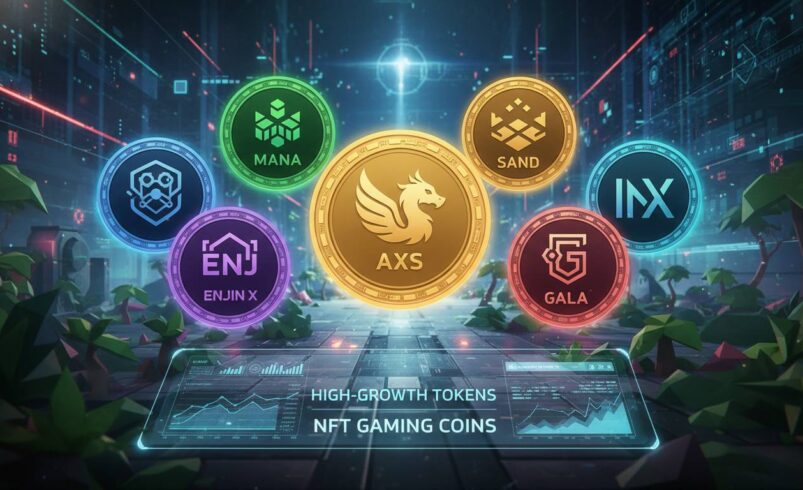
Several NFT gaming tokens have established themselves through consistent development activity, user adoption, and real-world utility within their respective gaming ecosystems. Here’s a look at some notable options:
| Token | Primary Game/Ecosystem | Key Feature |
|---|---|---|
| AXS | Axie Infinity | Original play-to-earn pioneer with scholarship model |
| SAND | The Sandbox | User-generated virtual world with LAND ownership |
| MANA | Decentraland | Virtual reality platform with NFT land parcels |
| ENJ | Enjin Platform | Gaming item tokenization with Jumpnet ecosystem |
| ILV | Illuvium | Open-world RPG with NFT creatures |
| GALA | Gala Games | Player-owned gaming ecosystem |
Axie Infinity (AXS) remains one of the most recognizable names in NFT gaming. The game introduced the scholarship model, allowing players without sufficient resources to borrow characters and earn rewards. AXS token holders can participate in governance decisions and earn through staking. The game has processed billions in transaction volume, though user numbers have fluctuated significantly from peak periods.
The Sandbox (SAND) represents a different approach, focusing on user-generated content and virtual experiences. Players can create, monetize, and experience games and assets within the platform. The SAND token serves as the primary currency for transactions, land purchases, and creator rewards. Partnerships with major brands including Adidas, Samsung, and various entertainment companies have provided mainstream visibility.
Decentraland (MANA) operates similarly as a virtual world where users can explore, socialize, and build. Land ownership through MANA tokens has attracted significant investment, with some parcels selling for substantial sums. The platform hosts events, concerts, and virtual experiences, demonstrating the potential for metaverse applications.
Enjin (ENJ) takes a different approach by focusing on item tokenization. Rather than building a single game, Enjin provides tools for developers to integrate NFTs into existing and new games. The ENJ token backs the value of minted items, with the platform’s ecosystem including multiple partner games and applications.
How to Purchase NFT Gaming Coins in India
Indian investors interested in NFT gaming tokens have several pathways to acquire these digital assets. The process typically involves selecting a cryptocurrency exchange, completing verification requirements, and executing trades.
Popular Indian Exchanges: Platforms like WazirX, CoinDCX, and Coinswitch Kuber list various cryptocurrencies and provide Indian Rupee (INR) trading pairs. These exchanges have adapted to Indian regulations, implementing know-your-customer (KYC) procedures and tax reporting features. WazirX, acquired by Binance, offers a wide selection of tokens including many gaming cryptocurrencies.
Purchase Process: After creating an account and completing identity verification, users can deposit INR through bank transfers, UPI, or other payment methods supported by the exchange. Once funds are available, users can search for their desired token—such as AXS, SAND, or MANA—and place buy orders. Most Indian exchanges support both market orders for immediate execution and limit orders for price targeting.
Storage Considerations: For security, cryptocurrency tokens should typically be stored in personal wallets rather than keeping them on exchanges. Hardware wallets like Ledger or software wallets like MetaMask provide better security for significant holdings. When purchasing NFT gaming tokens, ensure your chosen wallet supports the relevant blockchain network—for instance, Ethereum for AXS and SAND, or the specific network used by other tokens.
Transaction Costs: Indian users should account for multiple fee structures including deposit fees (varies by payment method), trading fees (typically 0.1-0.5% per trade), withdrawal fees (network fees plus platform charges), and gas fees for blockchain transactions. These costs can be significant, particularly for smaller trades or during periods of network congestion.
Risks and Important Considerations
Investing in NFT gaming tokens carries substantial risks that Indian investors must carefully evaluate before committing capital. The cryptocurrency market remains highly volatile, with prices capable of significant swings within short periods.
Market Volatility: NFT gaming tokens have experienced dramatic price movements. Many tokens that reached all-time highs during the 2021 bull market subsequently lost significant value. The sector saw particular correction as interest rates rose and speculative capital retreated from risk assets. Past performance provides no guarantee of future results, and investors should be prepared for the possibility of total loss.
Regulatory Uncertainty: India’s regulatory environment for cryptocurrency continues to evolve. While the government has implemented taxation rules, the precise framework for digital assets remains subject to change. Investors should stay informed about regulatory developments and understand that future rules could impact holding, trading, or transferring these assets.
Project Viability: The NFT gaming sector has seen numerous projects fail, with some revealing themselves as unsustainable business models or, in worse cases, outright scams. Due diligence is essential—research the development team, examine tokenomics (supply, distribution, utility), assess community engagement, and evaluate the actual product rather than marketing claims.
Technical Risks: Smart contract vulnerabilities, blockchain forks, and network issues can result in loss of funds. The emerging nature of many gaming platforms means technical challenges remain common. Additionally,游戏的可持续性取决于活跃用户群的数量。
Financial Readiness: Only invest what you can afford to lose entirely. The speculative nature of cryptocurrency investing means these assets should not represent money needed for essential expenses, emergency funds, or other financial obligations. Diversification across different asset classes remains prudent financial practice.
The Future of NFT Gaming in India
Looking ahead, several trends may shape the NFT gaming landscape for Indian participants. The continued growth of mobile gaming in India provides a substantial potential audience for blockchain-based gaming applications. As internet penetration improves and smartphone capabilities expand, more Indians may gain access to these platforms.
Major gaming companies have begun exploring blockchain integration, though many are taking cautious approaches. Unlike the early play-to-earn experiments that often prioritized token economics over gameplay quality, emerging projects increasingly emphasize entertainment value while incorporating blockchain elements. This shift may attract more traditional gamers who were previously skeptical of crypto gaming.
The development of layer-2 scaling solutions and blockchain networks designed for gaming could address current limitations around transaction speed and costs. These technical improvements may make blockchain gaming more accessible and practical for everyday users.
However, the sector faces continuing challenges. Sustainable economic models remain elusive for many projects, and the industry continues to search for the right balance between rewarding players and maintaining viable business operations. Regulatory clarity in India and globally will significantly influence adoption trajectories.
For Indian gamers and investors interested in this space, approaching with education and caution seems advisable. Understanding the technology, evaluating individual projects thoroughly, and maintaining appropriate position sizing can help manage risks while allowing participation in what some view as the future evolution of gaming.
Frequently Asked Questions
What are the best NFT gaming coins for beginners in India?
For beginners, starting with established tokens like AXS (Axie Infinity), SAND (The Sandbox), or MANA (Decentraland) may be appropriate due to their larger market caps, established communities, and available information. These tokens are available on major Indian exchanges and have track records, though all cryptocurrency investments carry substantial risk.
Are NFT gaming coins legal in India?
As of current regulations, cryptocurrency trading is legal in India, though it exists in a regulatory gray area. The government has implemented a 30% tax on cryptocurrency gains and requires reporting of transactions. However, the Reserve Bank of India has cautioned about risks, and future regulatory changes remain possible. Investors should consult current regulations and consider consulting financial advisors.
How much money do I need to start investing in NFT gaming tokens?
There is no minimum investment requirement, but Indian investors should consider transaction fees, which can be significant for small trades. Many exchanges allow purchasing fractional tokens, so you can start with small amounts. However, given the volatility, only invest what you can afford to lose entirely.
Can I earn NFT gaming tokens through gameplay without investing?
Yes, some games offer opportunities to earn tokens through gameplay. Axie Infinity popularized this model, where players can earn AXS tokens through gameplay. However, getting started typically requires purchasing or borrowing game characters, which involves initial investment. Additionally, token values can fluctuate significantly, and earnings are not guaranteed.
What is the difference between NFT gaming coins and regular cryptocurrency?
NFT gaming coins are designed to function within specific gaming ecosystems, often providing utility such as governance rights, staking rewards, or in-game purchases. While they trade like other cryptocurrencies on exchanges, their value proposition ties closely to the success and adoption of their associated gaming platforms. Regular cryptocurrencies like Bitcoin function more as stores of value or payment systems.
Should I store my NFT gaming tokens on exchanges or in wallets?
For security, larger holdings are generally better stored in personal wallets—either hardware wallets for maximum security or software wallets for convenience. Keeping significant assets on exchanges exposes you to counterparty risk if the exchange faces issues. However, smaller amounts for active trading may remain on exchanges for convenience.