
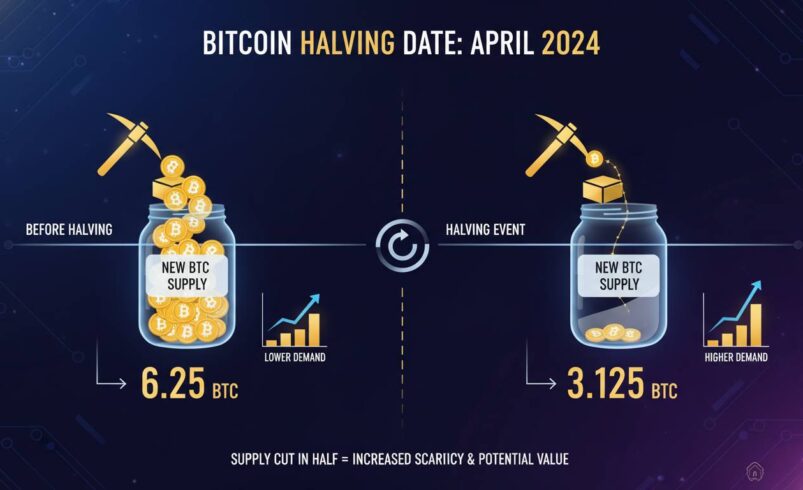

The next Bitcoin halving is approaching, and Indian crypto investors are closely monitoring the countdown. This scheduled event, hardcoded into Bitcoin’s protocol since its creation, reduces the new BTC entering circulation by 50%—a mechanism designed to create scarcity and ultimately drive value. Understanding when the next halving occurs and what it means for your investment requires knowing both the technical mechanics and the historical patterns that have emerged across Bitcoin’s four complete halving cycles.
What Is Bitcoin Halving?
Bitcoin halving is a pre-programmed event that occurs approximately every four years, or more precisely, after every 210,000 blocks are mined. The Bitcoin protocol automatically reduces the block reward given to miners by 50%, meaning the speed at which new Bitcoin enters circulation drops dramatically. This is not a decision made by any individual, company, or government—it is embedded in Bitcoin’s founding code by its anonymous creator, Satoshi Nakamoto.
The rationale behind halving stems from Bitcoin’s capped supply. Only 21 million Bitcoin will ever exist, and halving ensures this maximum supply is reached gradually rather than all at once. Currently, approximately 19.6 million Bitcoin are already in circulation, meaning only about 1.4 million remain to be mined over the next century. Each halving slows this process, creating increasing scarcity as the maximum supply approaches.
For Indian investors, understanding this mechanism matters because scarcity traditionally influences price dynamics. The reduced emission rate means Bitcoin becomes harder to obtain as time progresses, which has historically corresponded with price appreciation in the months and years following each halving event.
When Is the Next Bitcoin Halving?
The next Bitcoin halving is expected to occur in April 2028, when the blockchain reaches block height 1,050,000. Based on current block times of approximately 10 minutes per block, analysts project the specific date will fall around April 20-21, 2028. However, this date can shift slightly depending on network hashrate fluctuations, which affect how quickly blocks are produced.
| Halving Number | Block Height | Date | Block Reward (BTC) |
|---|---|---|---|
| 1st | 210,000 | November 28, 2012 | 25 → 12.5 |
| 2nd | 420,000 | July 9, 2016 | 12.5 → 6.25 |
| 3rd | 630,000 | May 11, 2020 | 6.25 → 3.125 |
| 4th | 840,000 | April 20, 2024 | 3.125 → 1.5625 |
| 5th | 1,050,000 | April 2028 (est.) | 1.5625 → 0.78125 |
Indian crypto exchanges typically run countdown trackers in the months leading up to each halving, making it easy to monitor the exact timing. The reduction will cut miner rewards from 3.125 BTC per block to just 1.5625 BTC, meaning only about 0.78 BTC enters the market every minute compared to 1.56 BTC today.
Historical Halving Dates and Price Impact
Examining past halving events reveals patterns that Indian investors find compelling, though past performance never guarantees future results. The first halving in November 2012 reduced the block reward from 50 to 25 BTC, and Bitcoin’s price—which was around $12 at the time—began a remarkable ascent that would see it reach nearly $1,100 by late 2013.
The second halving in July 2016 reduced rewards from 25 to 12.5 BTC. Bitcoin traded approximately $650 at the halving and embarked on what became its most famous bull run, peaking at nearly $20,000 in December 2017. The approximately 30x gain from pre-halving prices demonstrated the market’s response to reduced supply inflows.
The third halving occurred in May 2020 during pandemic uncertainty, with Bitcoin around $9,000. Despite global economic turmoil, the reduced block reward coincided with unprecedented institutional adoption, driving prices to an all-time high of approximately $69,000 in November 2021.
Most recently, the fourth halving in April 2024 reduced rewards from 6.25 to 3.125 BTC. Bitcoin responded with significant gains, crossing $100,000 for the first time in late 2024 and reaching new all-time highs in early 2025, demonstrating that the halving narrative continues to influence market sentiment in India and globally.
Why the Halving Matters for Indian Investors
The significance of halving extends beyond technical mechanics into investment strategy. When block rewards decrease, the daily supply of newly mined Bitcoin entering the market drops substantially. On a net basis, this creates what economists describe as a supply shock—a situation where demand remains constant or grows while available supply diminishes.
India’s crypto market has matured significantly, with millions of active traders on platforms like CoinDCX, WazirX, and ZebPay. These investors have increasingly incorporated halving cycles into their strategic planning, understanding that reduced emission rates typically coincide with bullish sentiment in global markets.
The halving also affects mining economics directly. With rewards cut in half, miners must either achieve greater efficiency or pass costs along to the market. Many smaller mining operations struggle to remain profitable when rewards decrease, leading to hash rate consolidation among larger, more efficient operations. This dynamic has historically preceded periods of price appreciation as network security concerns and supply constraints intersect.
Bitcoin Halving and Mining Economics in India
Indian cryptocurrency miners face unique challenges compared to their global counterparts. Electricity costs in India vary significantly by state, with industrial rates ranging from ₹5 to ₹12 per kilowatt-hour depending on location and usage category. This variability directly impacts mining profitability, as energy costs typically represent 60-80% of operational expenses.
When halving occurs, miners receiving the same block reward in BTC suddenly see their revenue drop by 50% when measured in fiat terms—assuming constant Bitcoin prices. However, if historical patterns hold and Bitcoin prices rise in response to reduced supply, miners may maintain or even improve their fiat-denominated profits despite earning fewer coins.
Many Indian mining operations have invested in energy-efficient hardware, particularly application-specific integrated circuit (ASIC) miners, to maximize profitability through each halving cycle. Some operations have also located facilities in regions with lower electricity costs, such as parts of Gujarat, Maharashtra, and the northeastern states, where power availability and pricing support more sustainable mining economics.
Regulatory Context for Indian Crypto Investors
India’s regulatory approach to cryptocurrency has evolved significantly, providing clearer guidelines than in earlier years. The government classified virtual digital assets as goods and services in 2022, bringing clarity to taxation treatment. Indian investors now face a 30% tax on cryptocurrency gains and a 1% tax deducted at source on transactions above certain thresholds.
The Reserve Bank of India initially expressed concerns about cryptocurrency’s potential risks to financial stability but has since allowed regulated banking services to flow to cryptocurrency businesses, removing an earlier prohibition. This regulatory framework provides Indian investors confidence to participate in Bitcoin markets with clearer understanding of their obligations.
The halving itself occurs regardless of regulatory developments—it is protocol-level and cannot be changed without broad network consensus. Indian investors can therefore plan their investment strategies around known halving dates without worrying about policy shifts affecting the fundamental mechanics of Bitcoin’s emission schedule.
Market Sentiment and Trading Strategies Around Halving
Indian cryptocurrency traders employ various strategies around halving events. Many practice what is known as “buy the rumor, sell the news,” purchasing Bitcoin in anticipation of the halving and selling after the event captures media attention and prices potentially peak. However, this strategy has proven increasingly unreliable as markets have grown more sophisticated.
Other investors prefer a long-term accumulation strategy, using halving periods to Dollar Cost Average (DCA) into Bitcoin positions. This approach reduces timing risk by spreading purchases across regular intervals regardless of short-term price movements. Indian investment advisors often recommend this strategy for investors who believe in Bitcoin’s long-term value proposition but want to avoid the stress of market timing.
Institutional investors globally have also recognized halving dynamics, with several launching structured products and investment vehicles timed around these events. Indian retail investors can access similar exposure through domestic exchanges offering structured investment products, though direct Bitcoin ownership remains the most popular approach.
What to Expect After the 2028 Halving
Looking beyond the immediate halving event, Bitcoin’s long-term trajectory involves progressively smaller block rewards approaching zero around 2140. The 2028 halving will reduce annual new supply to approximately 0.82% of total Bitcoin in circulation, down from 1.6% currently and 3.6% in 2020.
This declining emission rate means Bitcoin becomes increasingly deflationary over time—a unique characteristic among monetary assets. Critics argue this creates challenges for monetary policy, while proponents celebrate the predictable, decreasing supply that eliminates inflationary manipulation.
For Indian investors, the key takeaway is that Bitcoin’s fundamental design ensures scarcity increases systematically. Whether prices rise, fall, or remain stable around any given halving depends on complex interactions between supply dynamics, regulatory developments, technological adoption, and broader economic conditions—factors that no algorithm can perfectly predict.
Frequently Asked Questions
When exactly will the next Bitcoin halving happen in 2028?
The next Bitcoin halving is expected around April 20-21, 2028, when the blockchain reaches block height 1,050,000. The precise date depends on actual block times, which can vary slightly based on network hashrate. You can track the block height countdown on major Indian crypto exchanges or blockchain explorers.
How does Bitcoin halving affect the price?
Historically, Bitcoin prices have increased in the 12-18 months following each halving due to reduced new supply entering the market. However, past performance does not guarantee future results. The price impact depends on broader market conditions, adoption rates, and macroeconomic factors at the time of each halving.
Should I buy Bitcoin before or after the halving?
There is no definitive answer that works for all investors. Some prefer buying before the halving to capture potential pre-event price increases, while others wait to see how the market reacts. A Dollar Cost Averaging (DCA) strategy—investing fixed amounts regularly regardless of timing—remains popular among Indian investors for reducing timing risk.
How much will miner rewards decrease after the 2028 halving?
Miner rewards will decrease from 3.125 BTC per block to 1.5625 BTC per block, representing a 50% reduction. This means approximately 1.64 million BTC will be mined annually compared to 3.28 million BTC in the current period.
Is Bitcoin halving the same as Bitcoin being cut in half?
No, Bitcoin halving refers specifically to the reduction in block rewards paid to miners, not the value or quantity of Bitcoin that existing holders own. Your Bitcoin holdings remain unchanged during halving—the reduction applies only to newly created Bitcoin entering circulation.
Will Bitcoin halving make mining unprofitable in India?
Some less efficient mining operations may struggle after halving, particularly those with high electricity costs. However, Indian miners with access to affordable power and modern, energy-efficient hardware can remain profitable. The historical pattern shows network difficulty adjusts to maintain miner sustainability over time.