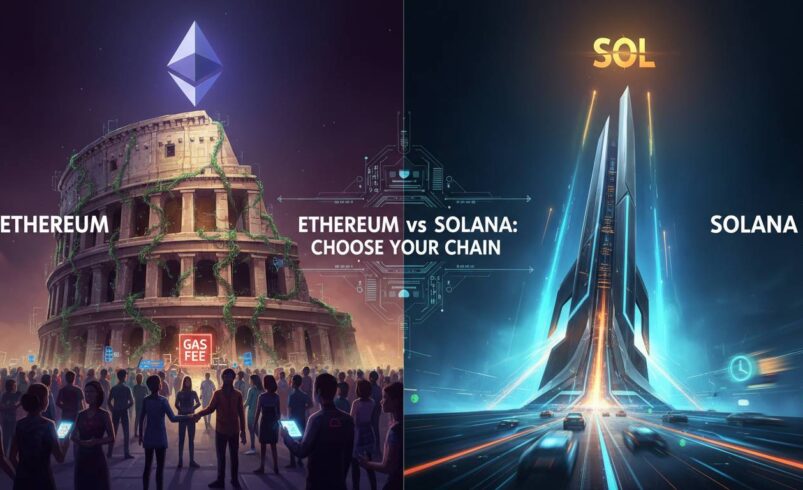

The blockchain wars have entered a new phase, and Indian developers, investors, and entrepreneurs are paying close attention. As cryptocurrency adoption accelerates across India—with reports indicating over 100 million Indians own some form of digital assets—the choice between Ethereum and Solana has become less theoretical and more practical. Whether you’re building the next unicorn dApp, investing your hard-earned rupees, or simply exploring Web3 career opportunities, understanding the fundamental differences between these two platforms can shape your entire trajectory in this space.
This isn’t just a technical comparison. It’s a strategic decision that impacts development costs, user experience, career opportunities, and potential returns. Let’s break down everything you need to make an informed choice.
Understanding the Fundamentals
What Ethereum Brings to the Table
Ethereum isn’t just a blockchain—it’s the ecosystem that virtually invented smart contracts and decentralized applications. Launched in 2015 by a team led by Vitalik Buterin, Ethereum introduced the world to the concept of a programmable blockchain where developers could build anything from lending protocols to NFT marketplaces.
The platform underwent a massive transformation in September 2022 with “The Merge,” shifting from energy-intensive Proof of Work to Proof of Stake. This upgrade reduced Ethereum’s energy consumption by approximately 99.95%, addressing long-standing environmental concerns while maintaining network security.
Ethereum processes approximately 15-30 transactions per second (TPS) under normal conditions, though this number can fluctuate significantly during periods of high network activity. The average transaction fee—commonly called “gas”—varies widely: during quiet periods, you might pay less than ₹50 ($0.60) per transaction, but during peak demand, fees can spike to ₹1,500 ($18) or higher.
What Solana Offers
Solana entered the scene in 2020, founded by Anatoly Yakovenko, a former engineer at Qualcomm. What sets Solana apart is its revolutionary approach to transaction processing. The network utilizes a unique consensus mechanism called Proof of History (PoH), which creates a historical record proving that an event has occurred at a specific moment in time.
This architectural innovation allows Solana to theoretically process up to 65,000 transactions per second, though real-world performance typically sits around 3,000-4,000 TPS. More importantly for everyday users, Solana’s transaction fees consistently remain below ₹2 ($0.0025), making it remarkably affordable even during high-activity periods.
However, Solana’s journey hasn’t been without turbulence. The network experienced multiple outages in 2021 and 2022, drawing scrutiny about its reliability. The team has since made significant improvements, but this history remains relevant to the comparison.
Technical Architecture: The Deep Dive
Consensus Mechanisms
Ethereum’s transition to Proof of Stake was one of the most significant events in blockchain history. Validators stake 32 ETH (approximately ₹4.5 lakh or $5,400) to participate in block production, earning rewards while securing the network. This system makes Ethereum extraordinarily secure but computationally intensive in a different way—requiring significant capital to become a validator.
Solana combines Proof of History with Proof of Stake, creating what it calls a “historical proof of stake” system. This hybrid approach enables the remarkable speed advantages but introduces complexity that has occasionally led to stability issues.
Smart Contract Capabilities
Both platforms support Turing-complete smart contracts, meaning they can theoretically execute any computational task. However, the development experience differs substantially.
Ethereum uses Solidity as its programming language, which has become the most widely adopted smart contract language in the industry. The developer tooling, documentation, and community support are unmatched. Indian developers can access free courses, bootcamps, and extensive documentation in multiple languages.
Solana uses Rust as its primary language, with Anchor framework simplifying development. Rust offers memory safety and performance advantages, but the learning curve is steeper. That said, once mastered, Solana development can be more efficient for certain high-throughput applications.
Ecosystem and Real-World Adoption
DeFi Dominance
When measuring Total Value Locked (TVL)—the total cryptocurrency deposited in DeFi protocols—Ethereum maintains its dominance. As of late 2024, Ethereum hosts over 60% of all DeFi TVL, with protocols like Uniswap, Aave, and MakerDAO processing billions of dollars daily.
Solana’s DeFi ecosystem, while smaller, has grown exponentially. Jupiter, Raydium, and Marinade Finance have built substantial user bases. The fees advantage makes Solana particularly attractive for smaller investors who would be priced out of Ethereum’s higher transaction costs.
NFTs and Gaming
The NFT landscape reveals interesting patterns among Indian users. Ethereum hosts the majority of high-profile NFT collections and marketplaces—OpenSea, Blur, and Foundation remain the venues for premium digital art and collectibles. However, Solana’s low minting costs have made it the preferred choice for gaming NFTs and mass-market collections where transaction costs directly impact profitability.
Indian gaming studios have shown increasing interest in Solana, citing the ability to build free-to-play models without players bearing blockchain transaction fees.
Enterprise and Institutional Adoption
Ethereum’s first-mover advantage translates to significant enterprise adoption. Major financial institutions including JPMorgan, Goldman Sachs, and numerous Indian banks have explored or implemented Ethereum-based solutions. The network’s predictability and established regulatory framework make it the safer choice for institutional players.
Solana has attracted attention from companies focused on high-frequency use cases—payment processing, gaming, and real-time data applications. Walmart India reportedly explored Solana for supply chain tracking, demonstrating enterprise interest in the platform’s speed advantages.
Investment Considerations for the Indian Market
Price Volatility and Market Position
Both ETH and SOL have experienced substantial volatility, typical of the cryptocurrency market. Ethereum’s market capitalization consistently ranks second only to Bitcoin, providing relative stability compared to smaller tokens. Solana, while more volatile, has demonstrated remarkable resilience, recovering from 2022’s market downturn to reclaim significant market share.
Indian investors should note that both assets are available on major Indian exchanges including CoinDCX, WazirX, and CoinSwitch, making entry points accessible. However, the tax implications for cryptocurrency transactions in India remain complex—gains from digital asset sales are taxed at 30% with no offsetting losses, making long-term holding potentially more attractive than active trading.
Staking Rewards
Ethereum staking currently offers approximately 3-5% annual returns, paid in ETH. The minimum requirement of 32 ETH puts full validator participation out of reach for most individual investors, but liquid staking tokens like Lido’s stETH allow smaller holders to participate.
Solana staking yields are typically higher—ranging from 5-8% annually—with a minimum requirement significantly lower than Ethereum. Indian staking providers have emerged, offering simplified interfaces for those interested in earning passive income on their SOL holdings.
Development Perspective: Building on Each Platform
Developer Tools and Resources
The developer ecosystem around Ethereum is mature and extensive. Hardhat and Foundry provide robust testing environments. The EVM (Ethereum Virtual Machine) compatibility means code written for Ethereum works across numerous Layer 2 solutions and alternative chains, providing flexibility.
Solana’s development tools, while improving rapidly, remain less developed. Anchor has simplified the developer experience significantly, but debugging and testing tools aren’t as mature as Ethereum’s. Indian developers should consider that more Stack Overflow answers, tutorials, and documentation exist for Ethereum than for Solana.
Cost Implications for dApps
For Indian developers building applications, cost structure matters significantly. On Ethereum, every interaction—whether minting an NFT, swapping tokens, or updating data—incurs gas fees. For a dApp with significant user activity, these costs can become prohibitive.
Solana’s fee model makes building consumer-facing applications more viable. A social media dApp where users post content, like posts, or follow others would face astronomical costs on Ethereum but remains economically feasible on Solana.
Making Your Decision: A Framework
Choose Ethereum If…
You prioritize security and decentralization above all else. Ethereum’s network is significantly more decentralized, with thousands of validators distributed globally. This provides stronger censorship resistance and long-term resilience.
You’re building financial applications. The DeFi ecosystem on Ethereum is unparalleled. If you’re creating lending protocols, trading platforms, or financial instruments, the existing infrastructure and liquidity make Ethereum the natural choice.
You need regulatory predictability. As the most widely scrutinized blockchain, Ethereum offers clearer regulatory guidance—a consideration for Indian projects seeking compliance.
You’re starting your Web3 journey. The learning resources, community support, and job market favor Ethereum developers. Indian companies actively seek Solidity developers, and the opportunities are abundant.
Choose Solana If…
Transaction volume is your priority. Building a gaming platform, micropayment system, or high-frequency trading application? Solana’s speed and cost advantages are decisive.
You have a consumer-focused product. When your end users bear transaction costs, Solana’s near-zero fees create dramatically better user experiences.
You’re budget-conscious as a developer. Lower costs to deploy, test, and iterate mean faster time to market with less capital expenditure.
You’re building in gaming or consumer tech. The ecosystem of gaming studios, consumer apps, and payment solutions on Solana is vibrant and growing.
The Hybrid Approach
Many sophisticated Indian developers and projects don’t view this as an either-or decision. Building on Ethereum while deploying to Solana—or utilizing Layer 2 solutions like Polygon, Arbitrum, or Optimism—provides flexibility.
Polygon, in particular, has emerged as an Ethereum Layer 2 with strong Indian roots, offering near-zero fees while maintaining Ethereum’s security. This hybrid approach lets developers capture the best of both worlds.
The Road Ahead
Both Ethereum and Solana continue evolving rapidly. Ethereum’s roadmap includes future upgrades aimed at improving scalability through sharding. Solana’s teams are actively working on stability improvements and feature enhancements.
For Indian developers and investors, the timing is remarkable. The country represents one of the world’s largest pools of blockchain talent and retail interest. Whether you ultimately choose Ethereum’s established dominance or Solana’s speed advantages, the skills and knowledge you develop transfer across the broader ecosystem.
The best choice ultimately depends on your specific use case, risk tolerance, and long-term objectives. Ethereum offers proven stability and ecosystem depth. Solana delivers performance and cost advantages for specific applications. Neither choice is wrong—the key is matching your decision to your actual needs.
Frequently Asked Questions
Which blockchain is better for beginners in India?
For beginners, Ethereum is generally recommended due to its extensive documentation, larger community, and more tutorials available in Hindi and English. The job market for Solidity developers in India is also more established, making it a safer career investment.
Can I hold both ETH and SOL in Indian exchanges?
Yes, both Ethereum and SOL are available on major Indian cryptocurrency exchanges including CoinDCX, CoinSwitch, WazirX, and ZebPay. You can hold both in your portfolio as part of a diversified strategy.
Do Indian banks support transactions involving ETH and SOL?
While Indian regulations have evolved, several banks have become more receptive to cryptocurrency transactions. However, policies vary between banks and can change. It’s advisable to use dedicated cryptocurrency exchanges rather than peer-to-peer transfers for more reliable processing.
Which blockchain has lower environmental impact?
Both Ethereum (after The Merge) and Solana are significantly more environmentally friendly than older Proof of Work blockchains. Ethereum’s energy consumption dropped by approximately 99.95% after transitioning to Proof of Stake. Solana’s energy efficiency is also notably high due to its efficient consensus mechanism.
Which blockchain is faster for transactions?
Solana is significantly faster, with theoretical throughput of 65,000 TPS compared to Ethereum’s 15-30 TPS. In practice, Solana handles 3,000-4,000 TPS comfortably, while Ethereum processes fewer but more complex transactions.
Is it profitable to stake Ethereum or Solana in India?
Both networks offer staking rewards. Ethereum staking yields approximately 3-5% annually, while Solana staking typically offers 5-8%. Indian staking providers exist, but ensure you use reputable platforms and understand the lock-up periods and any associated risks.