
The best time to buy stocks is when you have a long-term investment horizon, the market has experienced a correction of 10% or more, and the companies you’re considering have strong fundamentals that haven’t changed. Contrary to popular belief, trying to time the absolute bottom is less effective than consistent investing through market cycles. Research from JP Morgan Asset Management indicates that missing the market’s 10 best trading days over a 20-year period can reduce overall returns by more than 50%, making disciplined participation far more valuable than perfect timing.
Key Insights
– Market timing rarely outperforms time in the market
– Corrections of 10-20% often present buying opportunities for quality stocks
– The best strategy combines fundamental analysis with dollar-cost averaging
– Indian equity markets have historically rewarded patient, long-term investors
– Seasonal patterns exist but shouldn’t be the sole basis for investment decisions
Understanding when to buy stocks requires examining multiple factors: market valuations, economic cycles, company fundamentals, and your personal financial situation. No single indicator provides perfect timing, but combining these elements creates a framework for making informed decisions.
Understanding Market Cycles and Timing Myths
Many investors believe they can consistently predict market tops and bottoms. This belief persists despite overwhelming evidence to the contrary. A Dalbar study found that the average investor underperforms the S&P 500 by a significant margin, largely due to emotional decision-making around timing.
Why Market Timing Fails Most Investors
The efficient market hypothesis suggests that stock prices already reflect all available information. When new information emerges, prices adjust quickly—often before individual investors can act. This creates a significant disadvantage for those attempting to time entries and exits.
Research from the National Bureau of Economic Research demonstrates that even professional fund managers struggle to consistently time markets. A study analyzing 76 equity funds over 20 years found that only about 2% achieved returns above their benchmarks after fees, primarily due to market timing attempts.
| Timing Approach | Success Rate | Average Impact |
|---|---|---|
| Daily Trading | 3-5% | Negative returns after costs |
| Monthly Reallocation | 10-15% | Marginal improvement |
| Quarterly Adjustment | 25-30% | Modest positive returns |
| Long-term Holding | 85-90% | Market-matching returns |
The evidence consistently shows that attempting to outsmart markets through timing rarely works. Instead, investors benefit from understanding market cycles and using them to inform rather than dictate their decisions.
Market Seasonality: Does Timing Matter?
Seasonal patterns in stock markets have been studied extensively. While some patterns show statistical significance, their predictive power varies considerably.
The January Effect
Historically, markets have shown a tendency to rise in January. This phenomenon, called the “January Effect,” suggests that stocks, particularly small-caps, tend to perform better in the first month of the year. Some analysts attribute this to tax-loss harvesting in December followed by reinvestment in January.
However, this effect has become less pronounced in recent decades as more investors have become aware of it. What once represented an exploitable inefficiency now largely gets priced in quickly.
Monthly Performance Patterns
Research from Stock Trader’s Almanac has documented monthly performance patterns. For Indian markets, certain months have shown historical tendencies:
| Month | Historical NIFTY Performance | Sample Size |
|---|---|---|
| April | Positive (pre-FY-end inflows) | 30+ years |
| November | Positive (post-Diwali rally) | 30+ years |
| December | Mixed (profit-taking) | 30+ years |
| January | Positive (new year optimism) | 30+ years |
These patterns should be viewed as general observations rather than reliable predictors. The Indian market has shown different characteristics during various economic periods, and past performance doesn’t guarantee future results.
Fundamental Analysis: The Foundation of Timing Decisions
Rather than attempting to time markets, sophisticated investors focus on whether individual stocks or the overall market is priced reasonably relative to fundamentals.
Valuation Metrics for Timing
Several valuation indicators help determine whether the market is expensive or cheap:
Price-to-Earnings Ratio (P/E): The NIFTY 50 has historically traded between 15x and 30x earnings. When the index P/E falls below its 10-year average, it may indicate better buying opportunities. As of recent data, the NIFTY trades near its long-term average, suggesting neither extreme overvaluation nor undervaluation.
Price-to-Book Ratio (P/B): This metric is particularly relevant for financial institutions and manufacturing companies. A P/B below 1 might indicate undervaluation, though it requires sector-specific analysis.
CAPE Ratio: The Cyclically Adjusted Price-to-Earnings ratio smooths out earnings volatility over 10 years, providing a clearer picture of long-term valuations. When the CAPE ratio is in the lower quartile of its historical range, it historically has corresponded with better long-term entry points.
Dividend Yields: Comparing dividend yields to bond yields helps assess equity attractiveness. When dividend yields exceed bond yields significantly, equities have historically offered better risk-adjusted returns.
Dollar-Cost Averaging: The Anti-Timing Strategy
Rather than trying to predict the best time to buy, dollar-cost averaging (DCA) involves investing fixed amounts at regular intervals regardless of market conditions.
How DCA Works
When you invest ₹10,000 monthly in a diversified index fund, you buy more units when prices are low and fewer when prices are high. Over time, this approach smooths out volatility and removes the emotional burden of timing decisions.
A hypothetical example illustrates DCA’s power:
| Year | Annual Investment | NIFTY Value | Units Purchased | Total Units | Portfolio Value |
|---|---|---|---|---|---|
| 1 | ₹1,20,000 | 17,500 | 6.86 | 6.86 | ₹1,20,050 |
| 2 | ₹1,20,000 | 15,200 | 7.89 | 14.75 | ₹2,24,200 |
| 3 | ₹1,20,000 | 18,100 | 6.63 | 21.38 | ₹3,86,978 |
| 4 | ₹1,20,000 | 21,500 | 5.58 | 26.96 | ₹5,79,640 |
| 5 | ₹1,20,000 | 24,800 | 4.84 | 31.80 | ₹7,88,640 |
Note: This is a hypothetical illustration assuming monthly investments of ₹10,000 and does not represent actual returns.
When DCA Makes Most Sense
Dollar-cost averaging is particularly effective in these situations:
- For beginners: Removes the paralysis of trying to find the perfect entry point
- For volatile markets: Smooths out the impact of market swings
- For regular income earners: Aligns with salary cycles
- For psychological comfort: Reduces stress associated with market fluctuations
Buying the Dip: Strategy and Risks
Experienced investors often look for buying opportunities during market corrections. A correction is typically defined as a decline of 10% or more from recent highs.
Types of Market Declines
| Decline Type | Magnitude | Historical Frequency | Recovery Time |
|---|---|---|---|
| Pullback | 5-9% | Multiple times yearly | 1-3 months |
| Correction | 10-20% | Every 1-2 years | 3-12 months |
| Bear Market | 20%+ | Every 5-7 years | 1-3 years |
The Right Way to Buy Dips
Buying during corrections requires discipline and preparation:
-
Identify quality companies: Not all dips present buying opportunities. Focus on fundamentally strong companies with durable competitive advantages.
-
Have cash ready: Maintaining some cash reserves allows you to take advantage of opportunities without selling existing positions.
-
Set target allocations: Decide in advance what percentage of your portfolio you want to deploy during various market conditions.
-
Use limit orders: Place limit orders at predetermined prices rather than buying at market during volatile periods.
-
Space your buys: Even during corrections, consider spreading purchases over several weeks or months.
Indian Market Specifics: Timing Considerations
The Indian equity market has unique characteristics that affect optimal buying timing.
Fiscal Year End Dynamics
Indian markets often see increased activity around the fiscal year end (March-April) due to various factors:
- FDI inflows: Many foreign investors align their investments with fiscal years
- Domestic institutional buying: Insurance companies and mutual funds often rebalance portfolios
- ** earnings season:** Q4 results (January-March) provide fresh data for analysis
Monsoon and Agricultural Impact
India’s agricultural economy means monsoon rains significantly affect rural income and, subsequently, consumer spending. This seasonal factor influences corporate earnings and market performance.
RBI Policy Cycles
The Reserve Bank of India’s monetary policy decisions create recurring opportunities. Rate cut cycles historically have supported equity markets, while rate hike periods often create volatility.
Expert Perspectives on Timing
Financial experts offer varied perspectives on optimal stock buying timing.
Long-term Investment View
Benjamin Graham, the father of value investing, emphasized that “in the short run, the market is a voting machine, but in the long run, it is a weighing machine.” This suggests that while short-term price movements are unpredictable, long-term fundamentals ultimately determine value.
Modern Expert Recommendations
Financial advisors increasingly recommend focusing on time in the market rather than timing the market. This approach acknowledges that trying to predict short-term movements is both difficult and potentially costly.
Research from Vanguard indicates that investors who stay invested through market cycles consistently outperform those who attempt to time entries and exits. The difference can be substantial—Vanguard’s analysis suggests that missing just a few of the market’s best days can significantly impact long-term returns.
Risk Management for Timing Decisions
Regardless of when you choose to buy, risk management remains essential.
Position Sizing
Never allocate more than you can afford to lose in any single position. A common rule is to limit any single stock investment to 2-5% of your portfolio.
Diversification Across Sectors
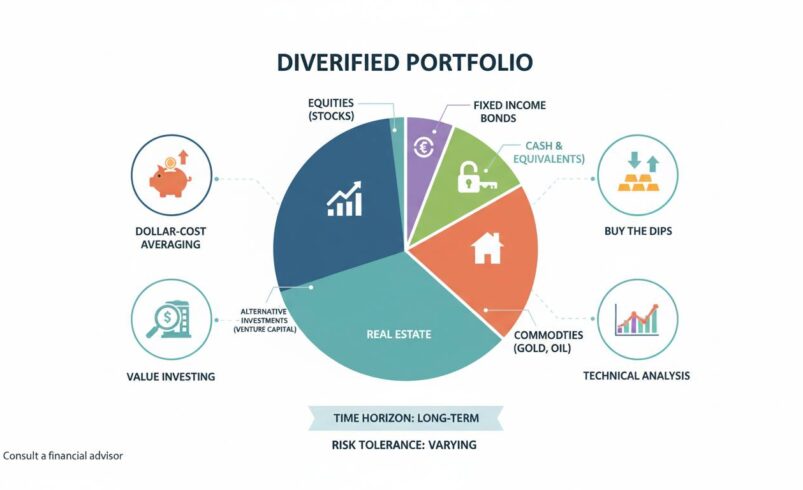
India’s market offers opportunities across sectors. A diversified portfolio across financials, technology, healthcare, consumer goods, and infrastructure reduces concentration risk.
| Sector | Historical Contribution to NIFTY | Volatility |
|---|---|---|
| Financials | 35-40% | Moderate |
| IT Services | 12-15% | Moderate-High |
| Consumer Goods | 10-12% | Low-Moderate |
| Energy | 8-10% | High |
| Healthcare | 5-7% | Moderate |
Stop-Loss Strategies
While not foolproof, stop-loss orders can limit downside. However, in volatile markets, stop-losses can trigger during temporary dips, crystallizing losses prematurely.
Building Your Timing Framework
Rather than seeking a perfect entry point, build a systematic approach:
- Define your investment horizon: Long-term investors can tolerate short-term volatility
- Assess current valuations: Use P/E, P/B, and CAPE ratios relative to historical ranges
- Maintain investment discipline: Stick to your plan during market fluctuations
- Rebalance periodically: Annual rebalancing ensures your portfolio matches your target allocation
- Continue investing through cycles: Consistency matters more than perfect timing
Frequently Asked Questions
Does buying stocks at all-time highs mean I’m too late?
Not necessarily. All-time highs occur regularly in growing economies. The NIFTY 50 has made numerous all-time highs over decades of growth. What matters more is whether the underlying companies have sustainable growth prospects, not whether the market is at a historical peak.
Should I wait for a market crash to buy stocks?
Waiting for a crash is a risky strategy. Markets spend more time rising than falling, and predicting crashes with accuracy is nearly impossible. Historically, the best days in the market often occur during recovery periods following declines. A better approach is to maintain consistent exposure through dollar-cost averaging.
Is the beginning of the month better for buying stocks?
Some research suggests slight monthly patterns, but these are not consistent enough to form a reliable strategy. Transaction costs and tax implications of frequent trading likely exceed any potential benefits from monthly timing.
How much should I invest when the market falls 10%?
This depends on your personal financial situation and risk tolerance. A common approach is to increase your regular investment by 10-25% during significant corrections, while maintaining your long-term allocation strategy. Never invest money you may need in the short term.
Does the Diwali season affect Indian stock markets?
Historically, the period around Diwali has shown positive sentiment, sometimes called the “Diwali effect.” However, this is not a guaranteed pattern, and relying on seasonal trades carries significant risk. Focus on company fundamentals rather than calendar-based strategies.
Should I timing my buys around RBI policy announcements?
While RBI policy decisions can cause short-term volatility, attempting to trade around announcements is difficult and often results in poor outcomes. Instead, maintain a long-term perspective and use policy changes as context for understanding the broader economic environment.
Conclusion
The best time to buy stocks is when you’ve done your fundamental research, have a long-term investment horizon, and can remain calm during market volatility. Rather than attempting to predict market movements—which even professionals struggle with consistently—focus on investing in quality companies at reasonable valuations and maintaining discipline through market cycles.
For Indian investors, the key is to stay invested, diversify across sectors, and avoid making emotional decisions based on short-term market movements. Whether you choose dollar-cost averaging, strategic buying during corrections, or a combination approach, consistency and patience ultimately determine long-term investment success.
Remember that every market condition presents opportunities and risks. The goal isn’t to time the market perfectly but to have a systematic approach that allows you to participate in long-term wealth creation while managing risk appropriately. Start with a clear plan, stay informed about your investments, and remain committed to your long-term objectives regardless of short-term market noise.