

Cryptocurrency trading in India has transformed from a niche activity into a mainstream investment avenue following the Supreme Court’s landmark 2020 ruling that lifted the banking ban imposed by the Reserve Bank of India. With over 15 million active crypto investors in India as of 2024, according to various industry estimates, the demand for effective trading strategies has never been higher. However, the 2022-2023 market downturn, which saw Bitcoin lose over 65% of its value from its all-time high, also demonstrated the critical importance of strategy over speculation.
The Indian crypto market operates differently from Western markets. You face unique considerations including 30% taxation on crypto gains (introduced in the Union Budget 2022-23), the absence of capital gains indexation benefits, and the need to use exchanges that support Indian Rupee (INR) deposits through UPI or bank transfers. This guide covers proven trading strategies specifically contextualized for Indian traders, helping you navigate these nuances while maximizing profit potential.
Understanding Market Fundamentals Before Trading
Before implementing any trading strategy, you must understand how cryptocurrency markets function differently from traditional stock markets. The crypto market operates 24 hours a day, 365 days a year, with trading volume distributed across global exchanges. This continuous operation means price movements can happen at any time, unlike the NSE or BSE which have fixed trading hours.
Cryptocurrencies exhibit significantly higher volatility than traditional assets. While the Nifty 50 might move 1-2% in a typical day, Bitcoin and altcoins routinely move 3-5% daily, and during market extremes, double-digit percentage swings occur within hours. This volatility creates both opportunities and risks—your strategy must account for this reality.
The Indian market also exhibits unique patterns. Trading volume typically peaks during Indian market hours (9:15 AM – 3:30 PM IST) when WazirX, CoinDCX, and ZebPay see heightened activity. Understanding these patterns helps you time entries and exits more effectively. Additionally, the premium or discount on Bitcoin prices in INR compared to USD prices can create arbitrage opportunities, though this has narrowed significantly as Indian exchanges have become more efficient.
Technical analysis works differently in crypto versus traditional markets. Volume indicators, moving averages, and RSI (Relative Strength Index) remain relevant, but the market’s lower liquidity means larger orders can move prices more dramatically. This necessitates using smaller position sizes than you might employ in stock trading.
Strategy 1: Dollar-Cost Averaging (DCA) for Long-Term Growth
Dollar-Cost Averaging represents the most beginner-friendly strategy with proven long-term results. Rather than attempting to time market bottoms, you invest a fixed amount at regular intervals regardless of price. This approach eliminates emotional decision-making and averages out purchase costs over time.
How to Implement DCA in India:
- Choose your exchange: Select a reliable Indian exchange like CoinDCX, WazirX, or ZebPay that offers automated recurring buy features
- Set your amount: Determine a fixed INR amount you can invest consistently—₹1,000-₹5,000 monthly works well for most beginners
- Select your assets: Bitcoin and Ethereum form the foundation of any DCA portfolio due to their established track records
- Automate the process: Use the Systematic Investment Plan (SIP) features available on major Indian exchanges to remove manual intervention
Why DCA Works in Volatile Markets:
During the 2022 bear market, Bitcoin fell from approximately ₹45 lakh to around ₹16 lakh. Investors who panicked sold at losses, while DCA practitioners continued accumulating at lower prices. When Bitcoin recovered in 2023-2024, those who maintained their DCA discipline saw their portfolios recover faster than lump-sum buyers who waited for the bottom.
The mathematical advantage is compelling. If you invested ₹10,000 monthly in Bitcoin over the past three years, your average purchase price would have been significantly lower than the annual average, positioning you well for future gains. This strategy also aligns with the Indian tax treatment—holding assets for more than three years qualifies for long-term capital gains treatment (though crypto currently faces a flat 30% tax regardless of holding period).
Strategy 2: Swing Trading Using Technical Analysis
Swing trading aims to capture price swings over days to weeks, holding positions longer than day trades but shorter than long-term investments. This strategy works well for Indian traders who cannot monitor screens continuously but can check prices daily.
Key Technical Indicators for Crypto Swing Trading:
| Indicator | Purpose | Application |
|---|---|---|
| Moving Averages (50, 200) | Identify trends | Buy when price crosses above, sell when below |
| RSI (14-period) | Find overbought/oversold | Buy below 30, sell above 70 |
| MACD | Momentum confirmation | Buy when MACD crosses above signal line |
| Volume | Validate price moves | Confirm breakouts with high volume |
Practical Swing Trading Setup:
- Identify the trend: Use the 200-day moving average on the daily chart. Prices above this line indicate an uptrend; below suggests a downtrend.
- Find entry points: Wait for price to pull back to the 50-day moving average or a previous support level in an uptrend. This provides better risk-reward than buying at all-time highs.
- Set stop-losses: Place stop-losses below recent swing lows—typically 5-8% below your entry for major cryptocurrencies.
- Take profits: Exit when price reaches the next resistance level or when your target return (typically 10-20% for swing trades) is achieved.
Indian exchanges provide charting tools, though many traders use TradingView for more advanced technical analysis before executing trades on their preferred exchange. The combination of WazirX’s interface with TradingView’s charts represents a popular setup among Indian swing traders.
Strategy 3: Range Trading for Sideways Markets
Cryptocurrency markets spend considerable time in consolidation phases where prices trade within defined boundaries. Range trading exploits these periods by buying at the support level and selling at resistance.
Identifying and Trading Ranges:
A range forms when price repeatedly bounces between a consistent floor (support) and ceiling (resistance). For example, if Ethereum trades between ₹1.5 lakh and ₹1.8 lakh over several weeks, these become your buy and sell zones respectively.
Execution framework:
- Define your range: Draw horizontal lines at the price levels where price has reversed multiple times
- Buy near support: Accumulate your target cryptocurrency when price approaches the lower boundary
- Sell near resistance: Take profits or reduce positions as price approaches the upper boundary
- Confirm with volume: Range boundaries strengthen when accompanied by high volume reversals
Risk Management in Range Trading:
The primary risk in range trading is range breaks—a sudden price movement that invalidates your established boundaries. Always use stop-losses just outside the range (above resistance in a short setup, below support in a long setup). If price breaks decisively through your range with volume, the breakout typically signals the beginning of a new trend.
For Indian traders, range trading proves particularly useful during periods of regulatory uncertainty or global market caution when cryptocurrency prices tend to consolidate.
Strategy 4: Momentum Trading with Volume Confirmation
Momentum trading focuses on assets showing strong directional movement, aiming to ride the trend until signs of exhaustion appear. This strategy requires quick execution and strict discipline but offers significant profit potential during trending markets.
Momentum Entry Criteria:
- Price breaks above recent resistance with volume exceeding the 20-day average by at least 50%
- RSI confirms strength without being overbought (RSI below 70 in an uptrend still shows room for continued movement)
- Moving averages (9, 21, 50) show clear bullish alignment
- Price closes above the breakout level on increased volume
Position Sizing for Momentum Trades:
Due to crypto’s volatility, position sizes should remain smaller than traditional markets. A general rule is to risk no more than 1-2% of your capital on any single trade. If you have ₹1 lakh in your trading account, your maximum risk per trade should be ₹1,000-₦2,000. This means if your stop-loss is 5% below entry, your position size would be ₹20,000-₹40,000.
Exit Strategy:
Momentum trades require predefined exit points. Trail your stop-loss as price moves in your favor—maintaining distance equal to your initial risk. Take partial profits (50% of position) when price reaches 2:1 reward-to-risk ratio, then let the remaining position ride with a trailing stop.
Strategy 5: Arbitrage Across Indian Exchanges
Price differences between Indian cryptocurrency exchanges occasionally create arbitrage opportunities. While these gaps have narrowed as the market matures, they still appear during periods of high volatility or liquidity stress.
How Crypto Arbitrage Works in India:
Different exchanges sometimes quote different prices for the same cryptocurrency. For instance, while WazirX might list Bitcoin at ₹42 lakh, CoinDCX might show ₹42.3 lakh. Buying on the lower exchange and selling on the higher exchange generates risk-free profit (before accounting for transaction fees and transfer times).
Requirements for Successful Arbitrage:
- Multiple exchange accounts: You need verified accounts on several Indian exchanges
- Quick execution: Prices normalize within minutes to hours
- Capital efficiency: You need sufficient balance on both exchanges to act immediately
- Fee consideration: Account for trading fees, withdrawal fees, and deposit fees—these can eliminate small price differences
Important Considerations:
The 30% tax on crypto gains applies to arbitrage profits as well. Additionally, transferring crypto between exchanges takes time (Bitcoin transfers typically require 10-60 minutes for confirmations), during which price changes could eliminate your margin. Most professional arbitrageurs use automated bots to execute these trades, making manual arbitrage increasingly difficult for retail traders.
Risk Management Principles for Indian Traders
No strategy succeeds without robust risk management. The cryptocurrency market’s volatility has wiped out countless accounts that lacked proper risk controls.
Core Risk Management Rules:
- Never invest more than you can afford to lose: Crypto should represent risk capital only. Your emergency fund, insurance, and essential expenses should never enter crypto markets.
- Use position sizing: Calculate your position size before every trade based on your risk tolerance.
- Set stop-losses always: Never hold positions without predefined exit points.
- Diversify across assets: Don’t put all capital into single cryptocurrencies. Even within crypto, spread across different sectors (Layer-1, DeFi, metaverse, etc.)
- Take profits regularly: In a market as volatile as crypto, “holding forever” often means giving back gains. Take partial profits at predetermined levels.
Tax Implications for Indian Crypto Traders:
Since the 2022-23 Union Budget, cryptocurrency gains are taxed at 30% plus applicable cess. This applies to all transactions including trading, selling, and even converting one cryptocurrency to another. Additionally, a 1% Tax Deducted at Source (TDS) applies to crypto transactions exceeding certain thresholds. These tax obligations significantly impact your net returns and must factor into your strategy. Maintaining detailed transaction records for every trade becomes essential for accurate tax filing.
Building Your Personal Trading Plan
Successful trading requires more than knowing strategies—you need a systematic approach that matches your risk tolerance, time availability, and financial goals.
Self-Assessment Questions:
- Time commitment: Can you monitor markets daily (swing trading), or only weekly (position trading)?
- Risk tolerance: Are you comfortable with 20%+ portfolio swings, or do you prefer more stable assets?
- Capital source: Is this long-term capital you won’t need for 3-5 years, or shorter-term funds?
- Knowledge level: Are you new to trading, or do you have experience from stock or forex markets?
Plan Documentation:
Write your trading plan including specific entry criteria, exit rules, position sizing guidelines, and maximum drawdown limits. Review and refine this plan monthly. The discipline of following your written plan prevents emotional decisions that destroy accounts.
Recommended Learning Path for Indian Traders:
Start with paper trading (simulated trading without real money) on your chosen exchange. Most Indian platforms offer testnet features. Once consistently profitable on paper for 2-3 months, begin with minimal capital. Only increase position sizes after demonstrating consistent profitability over multiple quarters.
Frequently Asked Questions
Which cryptocurrency exchange is best for beginners in India?
CoinDCX and WazirX are considered the most beginner-friendly exchanges in India due to their intuitive interfaces, extensive educational content, and robust customer support. Both support INR deposits through UPI and bank transfers, making them accessible for new investors. CoinDCX offers the “DCX Learn” platform for education, while WazirX provides the “WazirX Warriors” community for new traders.
Is cryptocurrency legal in India?
Yes, cryptocurrency trading is legal in India following the Supreme Court’s March 2020 ruling that overturned the RBI’s banking ban. While the government has proposed regulatory frameworks, no comprehensive law banning crypto exists as of 2024. However, crypto transactions are subject to 30% taxation and 1% TDS, making compliance essential.
What is the best crypto trading strategy for beginners?
Dollar-Cost Averaging (DCA) is the recommended starting strategy for beginners. It requires no technical analysis skills, removes emotional decision-making, and has historically produced strong returns. Begin with a small fixed amount invested monthly in Bitcoin and Ethereum, then gradually expand to other cryptocurrencies as you gain experience.
How much capital do I need to start crypto trading in India?
You can start with as little as ₹500-₹1,000 on most Indian exchanges. However, successful trading requires sufficient capital to implement proper risk management. A minimum of ₹10,000-₹50,000 allows for adequate position sizing and diversification while remaining manageable for most beginners.
Can I trade crypto part-time while working a full-time job?
Yes, swing trading and position trading suit part-time traders well. These strategies require checking markets daily (for swing trading) or weekly (for position trading), making them compatible with full-time employment. Avoid day trading unless you can dedicate significant time to monitoring positions during market hours.
What are the tax implications for crypto trading in India?
All cryptocurrency gains are taxed at a flat 30% rate regardless of holding period. Additionally, a 1% TDS applies to crypto transactions. There is no deduction for losses from other crypto gains—you can only offset losses against other crypto profits. Maintaining detailed transaction records throughout the year is mandatory for accurate tax filing.
Conclusion
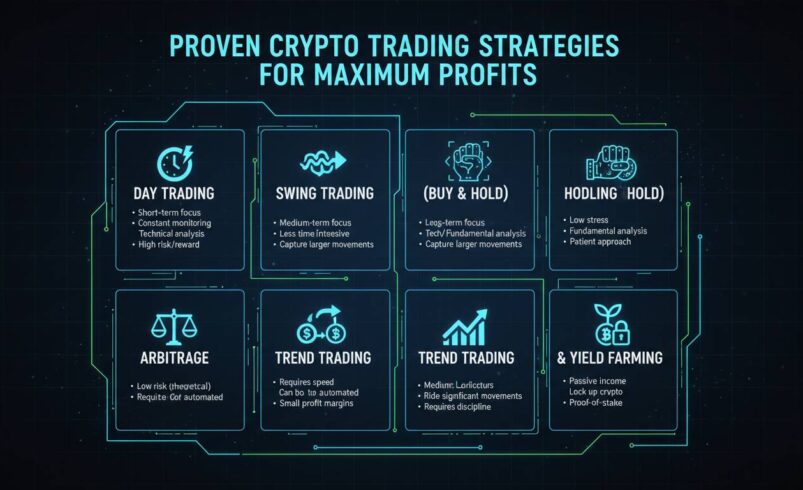
Profitable crypto trading in India requires combining effective strategies with disciplined execution and proper risk management. The strategies outlined—Dollar-Cost Averaging for long-term wealth building, swing trading for active profit capture, range trading for sideways markets, momentum trading for trending conditions, and arbitrage for niche opportunities—provide a comprehensive toolkit for Indian traders.
Remember that no strategy guarantees profits. The cryptocurrency market’s inherent volatility means losses are inevitable—your goal is ensuring profits exceed losses over time. Start with DCA if you’re new, then gradually add other strategies as you gain experience. Always factor in India’s tax treatment when calculating potential returns, and never invest more than you can afford to lose.
The Indian crypto market continues evolving with regulatory developments expected in coming years. Stay informed about legal changes, maintain proper tax compliance, and treat crypto trading as a serious skill requiring continuous learning rather than a get-rich-quick scheme. Success in this market rewards patience, discipline, and systematic approach over speculation and emotion.