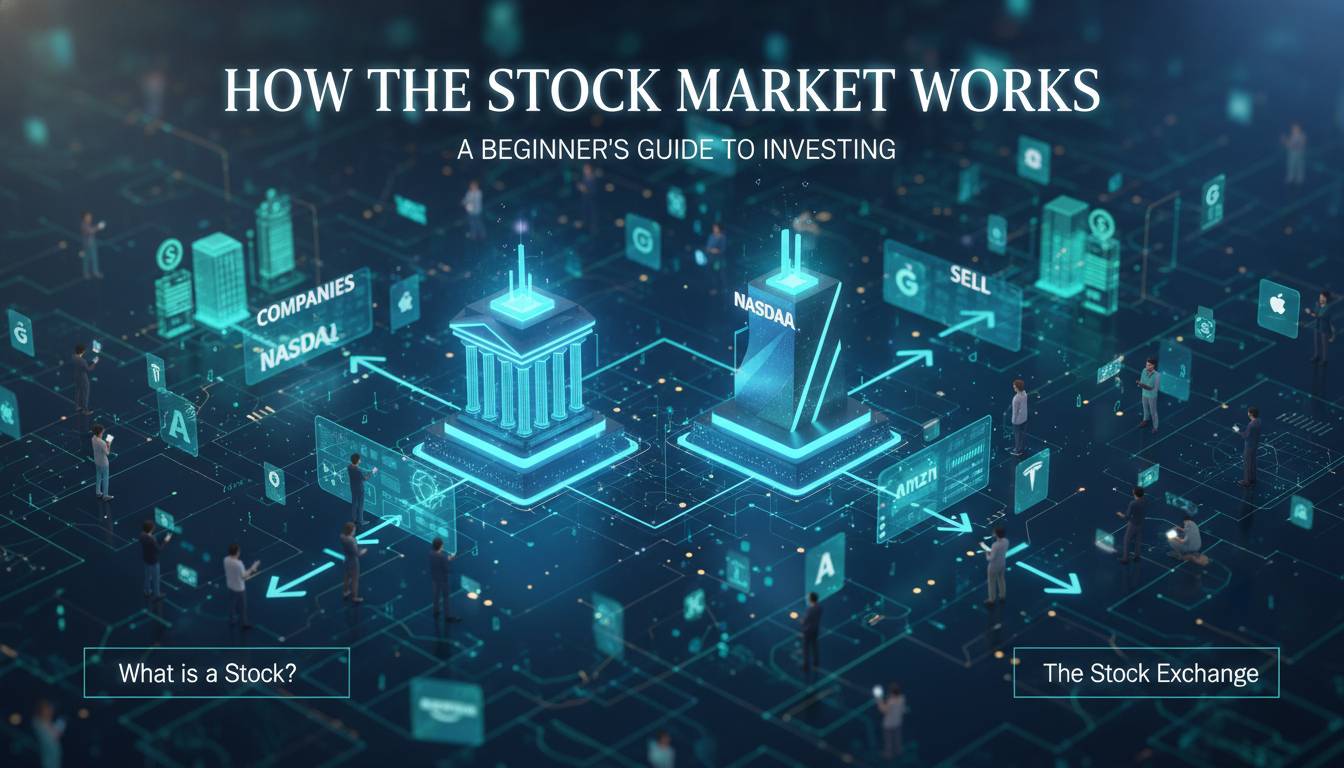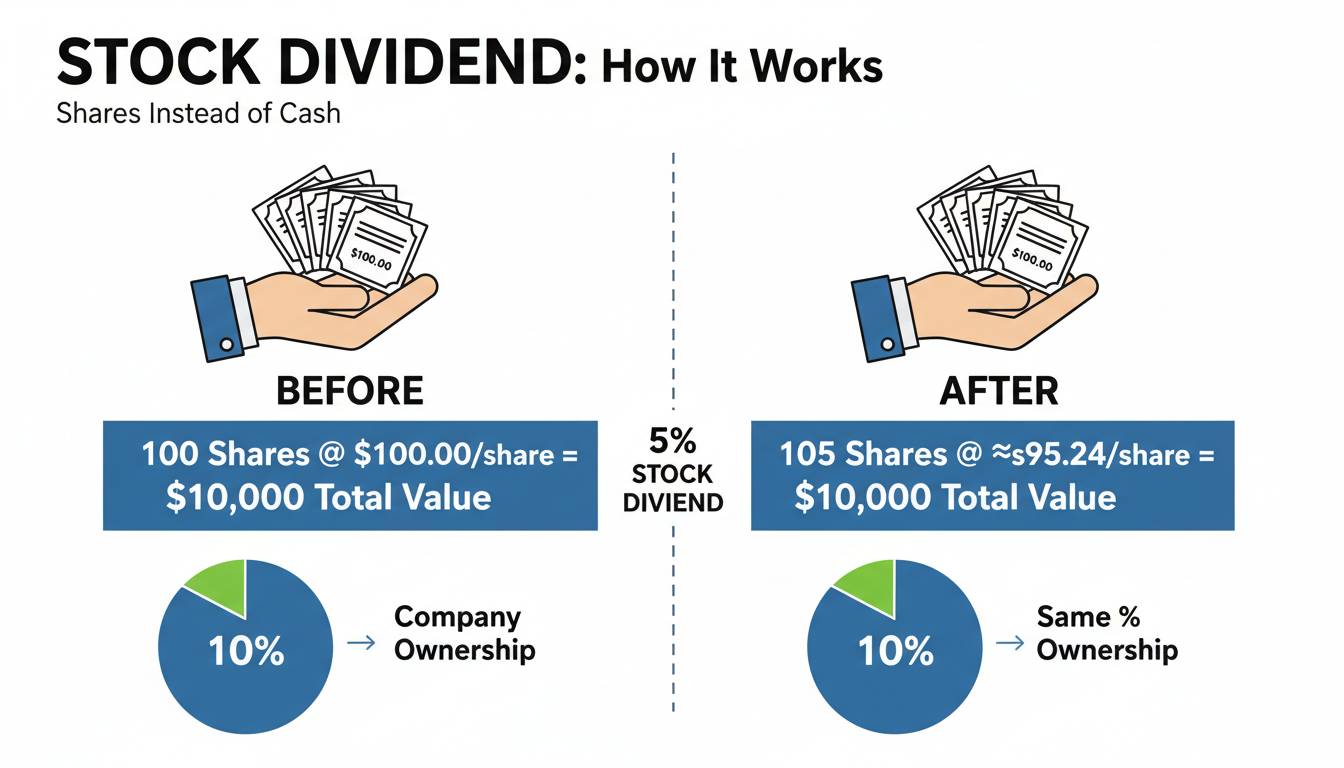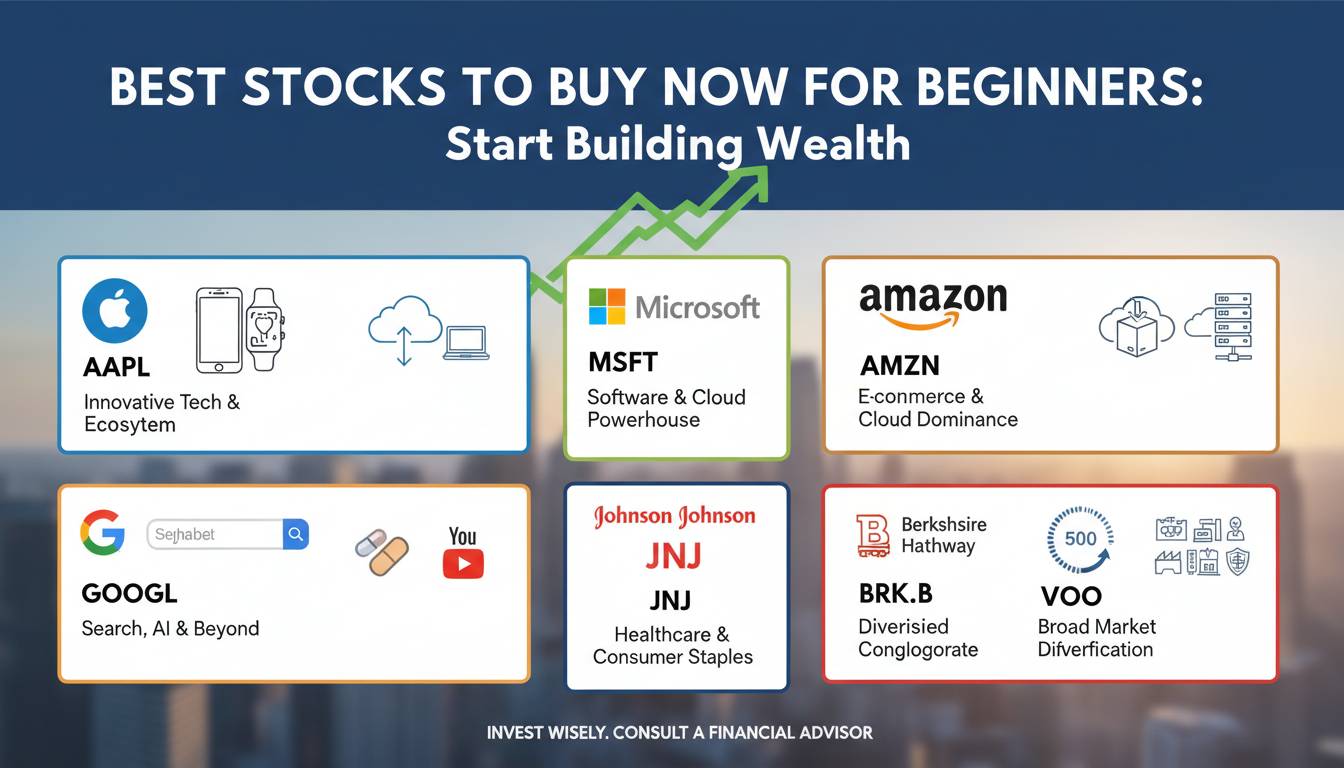


The stock market is a complex financial ecosystem where shares of companies are bought and sold. For beginners in India, understanding how it works is essential for building long-term wealth. This guide breaks down every aspect of stock market functioning—from basic concepts to practical investment strategies—empowering you to make informed financial decisions.
📊 STATS
• India’s stock market capitalization reached $3.9 trillion (BSE + NSE combined, 2024)
• 17 million active demat accounts registered with CDSL and NSDL (2024)
• 89% of Indian households with investments prefer equities for long-term growth
• The Nifty 50 has delivered 12.4% average annual returns over the last 20 years
Key Takeaways
• Stock exchanges (NSE, BSE) facilitate trading between buyers and sellers
• Shares represent ownership in a company; price fluctuates based on demand-supply
• Demat accounts are mandatory for holding electronic shares in India
• SEBI regulates all market activities to protect investor interests
• Long-term investing outperforms short-term trading for most retail investors
Understanding the stock market is crucial for anyone looking to grow their wealth beyond traditional savings accounts. Whether you’re planning for retirement, building an emergency fund, or seeking higher returns than fixed deposits, the stock market offers opportunities—but requires knowledge to navigate safely.
What Is the Stock Market?
The stock market is a collection of markets where stocks (pieces of ownership in companies) are traded between investors. It serves as a platform connecting companies seeking capital with investors looking for returns. In India, the two primary stock exchanges are the National Stock Exchange (NSE) and the Bombay Stock Exchange (BSE).
How Stock Exchanges Work
Stock exchanges like NSE and BSE operate as organized marketplaces where buyers and sellers come together. They provide:
– Trading infrastructure: Electronic platforms for order matching
– Price discovery: Continuous price determination based on buy-sell orders
– Liquidity: Ability to buy or sell shares quickly
– Transparency: Real-time price quotes and trading data
– Investor protection: Regulatory oversight and settlement guarantees
Elements:
• Listing: Companies must meet SEBI and exchange requirements to list shares publicly
• Trading hours: Monday to Friday, 9:15 AM to 3:30 PM IST (NSE/BSE)
• Settlement: T+1 day for equity delivery (as of 2024)
• Market segments: Equity, derivatives, currency, commodities
💡 STAT: The BSE is Asia’s oldest stock exchange, founded in 1875, while NSE began operations in 1992 and became the first dematerialized electronic exchange in India.
Why Companies Issue Shares
Companies issue shares to raise capital for:
– Business expansion and new projects
– Debt repayment
– Acquisitions and mergers
– Working capital requirements
– Brand building and marketing
When you buy a company’s stock, you become a partial owner. As the company grows and becomes more profitable, the value of your shares typically increases—along with potential dividends.
How Prices Are Determined
Stock prices fluctuate based on demand and supply dynamics. When more investors want to buy a stock than sell it, the price rises. Conversely, when selling pressure exceeds buying interest, prices fall.
Key factors affecting stock prices:
– Company earnings and financial performance
– Industry trends and economic conditions
– Government policies and regulations
– Global market sentiments
– News and investor perception
Benefits of Investing in the Stock Market
Investing in the stock market offers several advantages over traditional savings instruments, particularly in India’s economic growth trajectory.
| Benefit | Impact | Source |
|---|---|---|
| Higher Returns | 10-15% average annual returns vs 6-7% in FDs | SEBI, 2024 |
| Inflation Protection | Beats inflation (6-7%) consistently | RBI Data, 2024 |
| Ownership Stake | Partial ownership in growing companies | – |
| Liquidity | Easy buying/selling during market hours | NSE, 2024 |
| Dividends | Regular income from profitable companies | Annual Reports |
| Tax Benefits | Long-term capital gains tax exemptions | Income Tax Act |
Top Advantages for Indian Investors
• Wealth creation: Historical data shows equities outperform other asset classes over 10+ years
• Diversification: Access to 5,000+ listed companies across sectors
• Transparency: SEBI-mandated disclosures ensure information availability
• Accessibility: Start investing with as little as ₹100 through SIPs
• Economic growth participation: Benefit from India’s GDP growth story
📈 CASE: An investor who put ₹1 lakh in Nifty 50 in 2009 would have approximately ₹8.5 lakh by 2024—a 750% return over 15 years.
Key Participants in the Stock Market
Understanding who operates in the market helps you recognize different investment approaches.
| Participant | Role | Example |
|---|---|---|
| Retail Investors | Individual investors like you | 9.5 crore demat accounts |
| Foreign Institutional Investors (FIIs) | Overseas fund managers | Morgan Stanley, Goldman Sachs |
| Domestic Institutional Investors | Indian funds, insurance companies | LIC, HDFC AMC, UTI AMC |
| Market Makers | Provide liquidity | Registered stock brokers |
| Clearing Corporations | Ensure settlement | NSCCL, ICCL |
Stock Market Intermediaries
To trade in Indian markets, you’ll interact with several regulated entities:
- Depository Participants (DPs): Maintain your demat account (CDSL, NSDL)
- Stock Brokers: Execute your buy/sell orders (Zerodha, Upstox, Angel One)
- Registrar and Transfer Agents: Handle corporate actions
- SEBI: The regulatory body protecting investor interests
How to Start Investing in the Stock Market
Investing in the stock market requires following specific steps mandated by SEBI and Indian exchanges.
Prerequisites:
– [ ] Valid PAN card (mandatory)
– [ ] Aadhaar-linked bank account
– [ ] Proof of address
– [ ] Nominee details
– [ ] Bank account details for linking
Time: 2-5 days for account setup | Cost: ₹0-₹500 for account opening
Steps to Start Investing
1. Open a Demat Account
Your demat account holds shares in electronic form. Choose a SEBI-registered broker considering:
– Brokerage fees (flat vs percentage)
– Platform reliability
– Customer service quality
– Research tools offered
⏱ Time: 1-2 days | 💡 Tip: Most brokers offer free account opening with zero brokerage for delivery-based investing.
2. Complete KYC Verification
Complete the mandatory know-your-customer process online or offline:
– Submit identity and address proofs
– Upload photographs
– Complete in-person verification if required
⚠️ Avoid: Sharing OTP or login credentials with anyone—brokers never ask for these.
3. Link Bank Account
Your linked bank account enables:
– Money transfers for purchases
– Sale proceeds credit
– Dividend collection
4. Start with Understanding
Before investing:
– Learn basic financial terms (P/E ratio, market cap, EPS)
– Read company annual reports
– Follow market news
– Start with index funds or blue-chip stocks
5. Place Your First Order
– Log into your trading app
– Search for the company/stock
– Choose “Buy”
– Select quantity and order type (market/limit)
– Confirm the order
Troubleshooting:
| Problem | Fix |
|———|—–|
| Order rejected | Check if you have sufficient funds or holding |
| Shares not credited | Contact your DP within 24 hours |
| Wrong order placed | Use “Cancel” option before execution |
| App not working | Check internet or try alternate platform |
Common Mistakes to Avoid
Beginning investors often make predictable errors that cost them money. Avoiding these can significantly improve your investment outcomes.
| Mistake | Impact | Solution |
|---|---|---|
| Investing without research | 📉 30-50% potential loss | Research companies before buying |
| Following tips blindly | 📉 Losses when tips prove wrong | Verify information independently |
| Timing the market | 📉 Missed recovery gains | Stay invested long-term |
| Overtrading | 📉 High brokerage costs | Limit transactions |
| Ignoring diversification | 📉 High portfolio risk | Spread across sectors |
⚠️ CRITICAL: Never invest money you cannot afford to lose. The stock market carries inherent risks—past returns don’t guarantee future performance.
Prevent:
– Only invest surplus funds after creating an emergency fund (3-6 months expenses)
– Never borrow money to invest in stocks
– Avoid putting all money in one stock or sector
– Keep realistic expectations (15-20% annual returns are excellent)
Essential Stock Market Terms Every Beginner Should Know
Understanding key terminology helps you navigate the market confidently.
Basic Terms
- Share/Stock: Unit of ownership in a company
- BSE/NSE: Major Indian stock exchanges
- Nifty 50/Sensex: Index of top 50/30 stocks
- Demat Account: Electronic share holding account
- IPO: Initial Public Offering (first time a company lists)
- Bull Market: Rising market trend
- Bear Market: Falling market trend
- Market Capitalization: Total value of company shares
- P/E Ratio: Price-to-earnings ratio (valuation metric)
- Dividend: Profit distribution to shareholders
- FII/DII: Foreign/Domestic Institutional Investors
- SIP: Systematic Investment Plan
Order Types
- Market Order: Buy/sell at current market price
- Limit Order: Buy/sell at specified price or better
- Stop Loss: Automatic sell trigger at loss limit
Expert Insights
👤 Dr. B. Ravi Kumar, Chief Investment Officer at Sanctum Wealth Management
“Beginners should focus on large-cap blue-chip stocks and index funds initially. The key is consistency—regular monthly investments through SIPs help rupee-cost average and build wealth over time.”
👤 Sanjay Shah, Founder at Solaris Capital
“Indian market offers tremendous growth potential. Focus on companies with strong management, healthy balance sheets, and sustainable business models. Avoid speculative trading—this is for wealth creation, not gambling.”
📊 BENCHMARKS
| Metric | Average Investor | Top 10% Investors |
|——–|——————-|——————-|
| Returns (10 yr) | 9.2% | 18.5% |
| Portfolio Turnover | 2.4x annually | 0.8x annually |
| Holding Period | 8 months | 3+ years |
Best Investment Platforms in India
Choosing the right broker is crucial for a smooth investing experience.
| Platform | Brokerage | Features | Rating |
|---|---|---|---|
| Zerodha | Free delivery | Excellent tools, low costs | ⭐⭐⭐⭐⭐ |
| Upstox | Free delivery | Good mobile app, low fees | ⭐⭐⭐⭐ |
| Angel One | Free delivery | Research, advisory | ⭐⭐⭐⭐ |
| ICICI Direct | 0.55% | Full-service, branch support | ⭐⭐⭐⭐ |
| HDFC Securities | 0.50% | Banking integration | ⭐⭐⭐⭐ |
Top Picks:
• Zerodha: Best for cost-conscious beginners with excellent educational resources
• Angel One: Great for those wanting research support and advisory services
• Groww: Simplest interface for absolute beginners
How Does the Stock Market Work: A Summary
The stock market operates as a marketplace where buyers and sellers trade shares of companies. Stock exchanges like NSE and BSE facilitate these transactions, while SEBI regulates the entire ecosystem to protect investors.
Key takeaways:
1. Invest through regulated intermediaries — Always use SEBI-registered brokers and depository participants
2. Start with research — Understand companies before investing your hard-earned money
3. Think long-term — Time in the market beats timing the market
4. Diversify your portfolio — Don’t put all eggs in one basket
5. Stay informed — Keep learning about markets, economy, and investment strategies
Frequently Asked Questions
Q1: What is the minimum amount needed to start investing in the Indian stock market?
You can start investing with as little as ₹100 through Systematic Investment Plans (SIPs) in mutual funds or by buying shares of companies that trade at lower prices. Many brokers allow fractional investing, making it accessible for beginners.
Q2: Is the stock market safe for beginners?
The stock market carries risks, but with proper knowledge and risk management, it can be safe. Start with blue-chip stocks, index funds, and mutual funds. Avoid speculative trading and never invest money you cannot afford to lose.
Q3: How do I choose which stocks to buy?
Research companies based on fundamentals: financial performance, P/E ratio, debt levels, management quality, and growth prospects. Use screener tools, read annual reports, and follow reputable research. For beginners, starting with Nifty 50 or Sensex stocks is recommended.
Q4: What is the difference between BSE and NSE?
Both are Indian stock exchanges with similar functionality. BSE (Bombay Stock Exchange) is older with 6,000+ listed companies; NSE (National Stock Exchange) is newer with electronic trading and the popular Nifty 50 index. Both are equally regulated by SEBI.
Q5: How are stock market returns taxed in India?
Short-term capital gains (holding less than 1 year) are taxed at 15%. Long-term capital gains (holding over 1 year) above ₹1.25 lakh are taxed at 12.5%. Dividends are taxed as per your income tax slab.
Q6: Can I lose all my money in the stock market?
While you cannot lose more than your invested amount, stocks can become worthless if a company goes bankrupt. This is why diversification and research are crucial. Historically, the Indian market has recovered from downturns and delivered positive returns over long periods.