
A Bitcoin Exchange Traded Fund (ETF) is a investment vehicle that tracks the price of Bitcoin and trades on traditional stock exchanges, allowing investors to gain exposure to Bitcoin without directly owning the cryptocurrency. For Indian investors seeking to diversify their portfolio with digital assets, understanding Bitcoin ETFs has become increasingly important following the landmark approvals in global markets.
📊 STATS
• The first spot Bitcoin ETFs launched in the United States in January 2024
• Trading volumes for spot Bitcoin ETFs exceeded $10 billion in their first week
• India’s cryptocurrency market is estimated to have over 100 million investors
• Global Bitcoin ETF AUM crossed $50 billion by mid-2024
Key Takeaways
• Definition: A Bitcoin ETF tracks Bitcoin’s price and trades like a regular stock
• Access: Investors can buy through existing demat accounts without crypto wallets
• Regulation: US-approved ETFs operate under SEC oversight, adding investor protection
• India Context: Indian investors can access some Bitcoin ETFs through international trading accounts
• Taxation: Bitcoin investments in India are subject to capital gains tax
The emergence of Bitcoin ETFs represents a significant development for traditional investors who want cryptocurrency exposure without the complexities of managing digital wallets, understanding blockchain technology, or worrying about secure storage solutions.
What is a Bitcoin ETF?
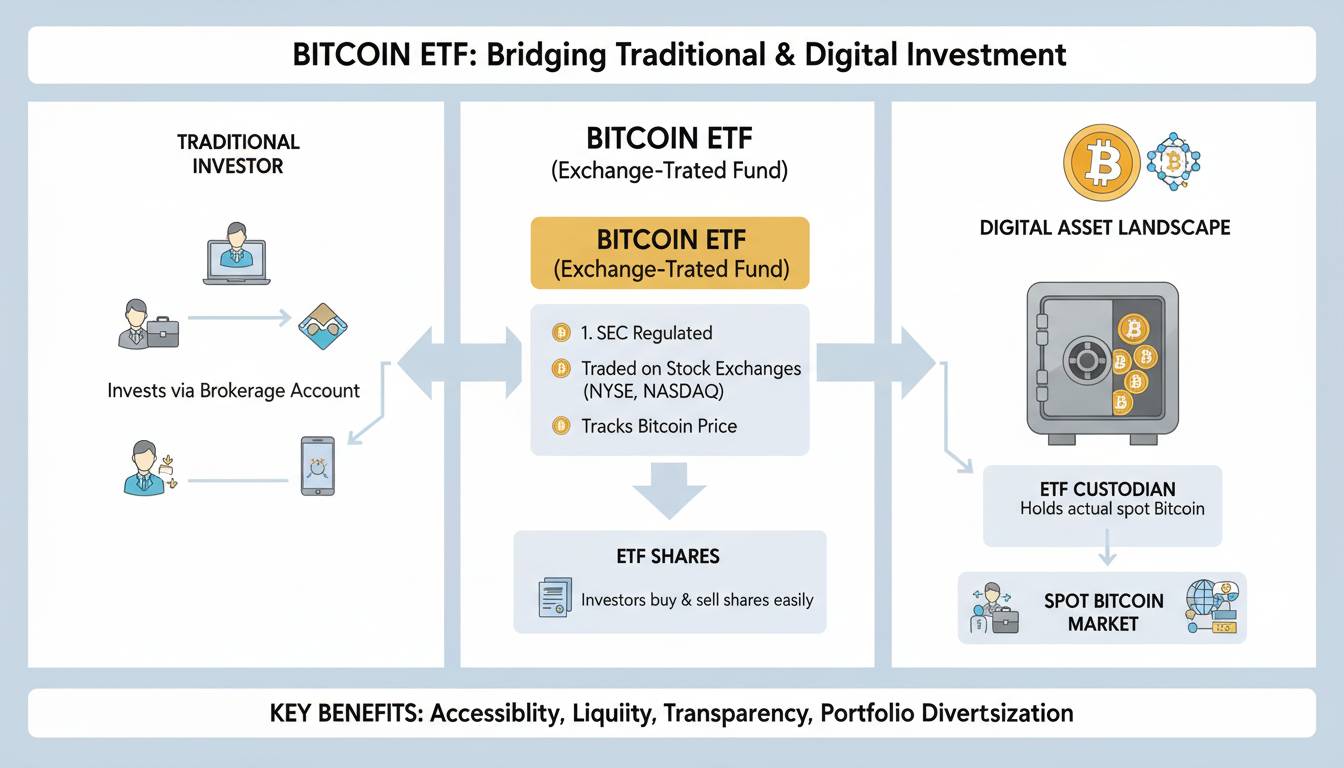
A Bitcoin ETF is an exchange-traded fund that invests primarily in Bitcoin or Bitcoin-related derivatives. The fund holds actual Bitcoin or uses derivatives to track its price, while the ETF shares trade on traditional stock exchanges like the NYSE or NASDAQ.
Types of Bitcoin ETFs
Spot Bitcoin ETFs: These funds directly hold Bitcoin and aim to match its price exactly. The approval of spot Bitcoin ETFs in the US marked a watershed moment for cryptocurrency adoption among mainstream investors.
Futures-Based Bitcoin ETFs: These funds trade Bitcoin futures contracts rather than holding actual Bitcoin. They were the first Bitcoin ETFs approved in the US, launching in 2021.
Grayscale Bitcoin Trust (GBTC): While technically a trust rather than an ETF, GBTC converts to an ETF structure and has historically been a popular way for institutional investors to gain Bitcoin exposure.
How It Works
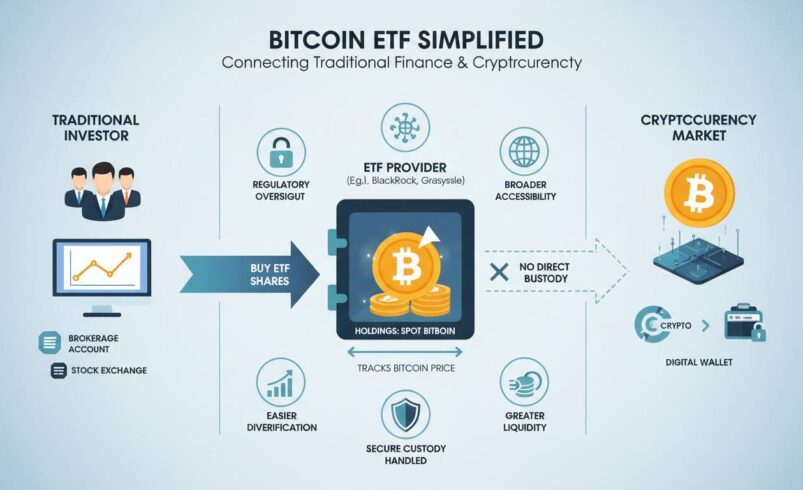
Bitcoin ETFs operate by creating a fund that purchases and holds Bitcoin in secure custody. The fund then issues shares that represent ownership in the underlying Bitcoin holdings. These shares can be bought and sold throughout the trading day on stock exchanges just like shares of Apple or Reliance Industries.
The fund manager ensures the ETF price closely mirrors Bitcoin’s market price through a mechanism called creation and redemption. When demand increases, the manager creates new shares by adding Bitcoin to the trust. When demand decreases, shares are redeemed for Bitcoin, which is then sold on the open market.
💡 FACT: The SEC approved the first spot Bitcoin ETFs in the United States on January 10, 2024, after more than a decade of rejection.
Benefits of Bitcoin ETFs
Bitcoin ETFs offer several advantages over direct cryptocurrency ownership, particularly for traditional investors and those new to the digital asset space.
| Benefit | Impact | Consideration |
|---|---|---|
| Traditional Trading | Trade through existing brokerages | No crypto exchange account needed |
| Simplified Taxation | Clearer reporting via Form 1099 | Professional custodians handle records |
| Professional Custody | Bank-grade security for assets | Removes self-custody risks |
| Regulatory Oversight | SEC-regulated investment product | Added investor protection |
| Fractional Investing | Buy small portions easily | Lower barrier to entry |
Key Advantages
Ease of Access: Indian investors with existing trading and demat accounts through brokers like Zerodha, Upstox, or Angel One can potentially access Bitcoin ETFs through international trading facilities, eliminating the need to navigate unfamiliar cryptocurrency exchanges.
Professional Security: Self-custody of Bitcoin carries significant risks from hacks, lost keys, or forgotten passwords. Bitcoin ETFs delegate custody to professional institutions with institutional-grade security infrastructure.
Regulatory Clarity: Unlike direct cryptocurrency purchases which exist in a regulatory gray area in India, ETFs traded on regulated exchanges offer clearer investor protection frameworks.
Transparency: ETF prices update throughout the trading day, and holdings are regularly disclosed, offering more transparency than many cryptocurrency investment options.
Institutional Adoption
The approval of spot Bitcoin ETFs has accelerated institutional adoption. Major asset managers including BlackRock and Fidelity have launched Bitcoin ETFs, bringing billions of dollars in institutional capital into the cryptocurrency market. This institutional involvement typically adds market stability and legitimacy to the asset class.
Comparison: Bitcoin ETF vs Direct Bitcoin vs Bitcoin Mutual Funds
Understanding the differences between various Bitcoin investment options helps Indian investors choose the right approach for their financial situation.
| Factor | Bitcoin ETF | Direct Bitcoin Purchase | Bitcoin Mutual Fund |
|---|---|---|---|
| Access | Stock exchange | Crypto exchanges | Limited in India |
| Custody | Professional third-party | Self-custody required | Fund manager |
| Trading Hours | Market hours | 24/7 | End-of-day pricing |
| Minimum Investment | 1 share price | Small fractions | NAV-based |
| Regulation | SEC/SEBI registered | Limited regulation | Fund regulations |
| Complexity | Low | High | Medium |
Bitcoin ETFs
✅ Pros: Easy access through traditional brokers, professional custody, regulatory oversight, familiar trading experience
❌ Cons: Management fees apply, may have tracking error, limited availability in India, currency conversion costs for international trades
💰 Price: Management fees typically range from 0.25% to 1.5% annually
🎯 For: Traditional investors seeking exposure without crypto exchange complexity
Direct Bitcoin Purchase
✅ Pros: Full ownership, can transfer to personal wallet, 24/7 trading, no management fees
❌ Cons: Requires secure storage, complicated tax reporting in India, must manage private keys, security risks
💰 Price: Variable based on market price plus exchange fees (typically 0.1-0.5%)
🎯 For: Tech-savvy investors comfortable with self-custody and blockchain technology
Bitcoin Mutual Funds (when available)
✅ Pros: Professional management, automatic rebalancing, familiar investment process
❌ Cons: Limited availability in India, higher fees, less transparency in some cases
💰 Price: Varies by fund structure and management fees
🎯 For: Investors preferring managed investment products
How to Invest in Bitcoin ETFs
Prerequisites:
– [ ] Demat and trading account (Indian broker)
– [ ] International trading access or overseas brokerage account
– [ ] Valid PAN card and KYC compliance
– [ ] Understanding of currency conversion costs
– [ ] Risk assessment suitable for volatile assets
Time: 1-2 hours for account setup | Ongoing: Minutes for trades
Steps
1. Verify International Trading Access
Contact your Indian broker to check if they offer access to international exchanges like the NYSE or NASDAQ where Bitcoin ETFs trade. Some brokers likeINDmoney, Vested Finance, or Interactive Brokers provide this capability.
⏱ Time: 1-3 days | 💡 Tip: Compare currency conversion rates between brokers
2. Complete Required Documentation
You may need additional documentation for international trading, including Global Intermediary Identification Number (GIIN) for FATCA compliance and understanding of repatriation rules.
3. Fund Your International Trading Account
Transfer INR to your trading account and convert to USD. Be aware of RBI’s Liberalised Remittance Scheme (LRS) limits.
⚠️ Avoid: Exceeding LRS limits ($250,000 annually) → Fix: Plan investments within regulatory limits
4. Research Available Bitcoin ETFs
Popular options include:
– iShares Bitcoin Trust (IBIT)
– Fidelity Wise Origin Bitcoin Fund (FBTC)
– ARK 21Shares Bitcoin ETF (ARKB)
– Grayscale Bitcoin Trust (GBTC)
5. Place Your Order
Once your account is funded, you can place orders just like buying domestic stocks. Consider using limit orders to control purchase price.
Troubleshooting:
| Problem | Fix |
|———|—–|
| Broker doesn’t offer international access | Consider specialized platforms like Vested orINDmoney |
| Currency conversion delays | Allow 3-5 business days for fund transfers |
| LRS limit exceeded | Wait for next financial year or explore alternative structures |
| Tax implications unclear | Consult a tax professional familiar with international investments |
Bitcoin ETFs in India: Current Scenario
Indian investors face unique considerations when seeking Bitcoin exposure through ETFs. SEBI has not yet approved domestic Bitcoin ETFs, creating both challenges and opportunities.
Regulatory Environment
The Securities and Exchange Board of India (SEBI) has expressed caution about cryptocurrency investments. While India has not banned Bitcoin outright, regulatory clarity remains evolving. The Income Tax Department requires disclosure of cryptocurrency gains, and the RBI has issued periodic warnings about the risks of virtual digital assets.
Investment Options for Indians
International Brokerage Accounts: Indian investors can access US-listed Bitcoin ETFs through platforms offering international trading. This approach involves currency conversion, understanding US tax implications, and navigating LRS limits.
Bitcoin Mutual Funds: Some Indian mutual funds have exposure to cryptocurrency-related companies but not direct Bitcoin holdings. These provide indirect exposure through stocks of companies involved in blockchain technology.
Direct Purchase: Indian cryptocurrency exchanges like CoinDCX, WazirX, and ZebPay allow direct Bitcoin purchases, though regulatory uncertainty persists.
Tax Implications in India
India treats Bitcoin as a virtual digital asset subject to capital gains tax. Key considerations include:
- Short-term capital gains (holding period under 36 months) taxed at applicable income tax slab rates
- Long-term capital gains (holding period over 36 months) taxed at 20% with indexation benefits
- TDS (Tax Deducted at Source) of 1% applicable on cryptocurrency transactions above specified thresholds
- Mandatory reporting of Bitcoin holdings in tax returns
⚠️ CRITICAL: Indian investors must disclose foreign asset holdings including overseas-traded ETFs in their tax returns. Non-disclosure can lead to penalties and scrutiny.
Prevent: Maintain detailed records of all transactions, conversion rates at time of purchase and sale, and consult a tax professional familiar with international investments.
Risks and Considerations
Understanding risks helps Indian investors make informed decisions about Bitcoin ETF investments.
Market Risks
Volatility: Bitcoin prices can fluctuate dramatically within hours. While Bitcoin ETFs provide easy access, they do not reduce underlying asset volatility.
Tracking Error: Some ETFs may not perfectly track Bitcoin prices due to management fees, cash holdings, or operational inefficiencies.
Liquidity Risk: While major Bitcoin ETFs trade actively, some may have lower liquidity, potentially causing bid-ask spread issues.
Regulatory Risks
US Regulation Changes: Future SEC decisions could impact Bitcoin ETF operations, fees, or availability.
Indian Regulatory Environment: Changes in India’s cryptocurrency regulations could affect how Indian investors access or report Bitcoin ETF holdings.
Tax Policy Changes: India’s tax treatment of cryptocurrency could change, affecting investment returns.
Currency and Operational Risks
USD/INR Fluctuation: For Indian investors, currency movements significantly impact returns. A 10% Bitcoin gain could become 5% or 15% after currency conversion.
Documentation Burden: Holding international assets requires more complex tax reporting and record-keeping.
👤 Expert Guidance: Indian investors should consult financial advisors familiar with both cryptocurrency and international investment regulations before allocating to Bitcoin ETFs.
Common Mistakes to Avoid
| Mistake | Impact | Solution |
|---|---|---|
| Ignoring currency costs | 3-5% reduction in returns | Compare conversion rates |
| Overlooking tax implications | Unexpected tax bills | Pre-plan for tax payments |
| Investing without research | Poor timing or wrong products | Understand the specific ETF |
| Ignoring LRS limits | Legal complications | Track annual usage carefully |
| Expecting guaranteed returns | Financial losses | Accept high volatility |
⚠️ CRITICAL: Never invest money you cannot afford to lose, especially in volatile assets like Bitcoin. The cryptocurrency market operates 24/7, and prices can drop significantly without warning.
Prevent: Start with a small allocation (1-3% of portfolio), gradually increase based on comfort level, and maintain emergency funds in traditional investments.
Conclusion
Bitcoin ETFs represent a significant advancement in cryptocurrency accessibility for traditional investors. By offering exposure through familiar brokerage accounts with professional custody and regulatory oversight, they reduce many barriers that previously prevented mainstream investors from adding Bitcoin to their portfolios.
For Indian investors, the path to Bitcoin ETFs involves navigating international trading access, understanding currency conversion costs, and maintaining awareness of both Indian and US regulatory frameworks. While direct Bitcoin purchase through Indian exchanges remains more accessible for now, Bitcoin ETFs offer a compelling alternative for those seeking institutional-grade exposure with traditional investment processes.
The key to successful Bitcoin ETF investing lies in understanding both the opportunities and risks, maintaining realistic expectations about volatility, and ensuring compliance with Indian tax and regulatory requirements. As the global cryptocurrency market continues maturing, Bitcoin ETFs will likely play an increasingly important role in diversified investment portfolios.
Frequently Asked Questions
Q1: Can Indian investors legally buy Bitcoin ETFs?
Yes, Indian investors can access international Bitcoin ETFs through brokers offering overseas trading facilities. This requires compliance with RBI’s Liberalised Remittance Scheme (LRS), which permits annual transfers of up to $250,000 for investment purposes. However, investors should maintain proper documentation and report foreign assets in tax returns.
Q2: What is the difference between spot and futures Bitcoin ETFs?
Spot Bitcoin ETFs directly hold the underlying Bitcoin and aim to track its price exactly. Futures-based ETFs trade Bitcoin futures contracts rather than holding actual Bitcoin, which can lead to tracking differences, especially during periods of market contango or backwardation.
Q3: Are Bitcoin ETFs safe compared to buying Bitcoin directly?
Bitcoin ETFs offer professional custody and regulatory oversight, reducing risks associated with self-custody like hacks or lost keys. However, they do not eliminate Bitcoin’s inherent price volatility. Both options carry market risk, and investors should carefully consider their risk tolerance.
Q4: What are the tax implications for Indian investors holding Bitcoin ETFs?
Indian investors must report Bitcoin ETF gains as capital gains in their tax returns. Short-term gains (under 36 months) are taxed at income slab rates, while long-term gains qualify for 20% taxation with indexation. Additionally, Bitcoin transactions in India may attract 1% TDS above certain thresholds.
Q5: How much should I invest in Bitcoin ETFs?
Financial experts generally recommend limiting cryptocurrency exposure to 1-5% of a diversified portfolio, depending on risk tolerance and investment horizon. Given Bitcoin’s volatility, investors should only allocate amounts they can afford to lose entirely.
Q6: Do Bitcoin ETFs pay dividends?
Most Bitcoin ETFs do not pay dividends because Bitcoin itself does not generate income like stocks or bonds. The returns come solely from Bitcoin price appreciation. Some ETFs may distribute small amounts from interest earned on cash holdings, but this is not typical.