
Most people overcomplicate investing. They chase hot tips, check stock prices daily, and feel the need to act on every market fluctuation. Passive stocks offer a fundamentally different approach—one that has consistently outperformed the frantic trading most investors default to. If you’ve ever felt exhausted by the mental burden of trying to beat the market, this guide explains why that exhaustion might be entirely unnecessary.
What Exactly Are Passive Stocks?
The term “passive stocks” is slightly misleading on its own, because you can’t simply buy a “passive stock.” What you can buy are passive investments—vehicles designed to track a market index rather than beat it. The most common forms are index funds and exchange-traded funds (ETFs) that hold every stock in a given index, like the S&P 500 or the total stock market.
When you buy into a passive fund, you’re purchasing a tiny slice of every company in that index simultaneously. If the S&P 500 contains 500 of the largest U.S. companies, your investment automatically includes all of them. You don’t need to pick winners because you’re owning everything. The fund’s value rises or falls with the broader market rather than with any single company’s fortune.
This is fundamentally different from actively managed funds, where portfolio managers handpick stocks they believe will outperform. Those managers charge significantly higher fees for the privilege of their selection—and historically, most fail to beat the market consistently after those fees are factored in.
The key characteristic of passive stocks isn’t the stocks themselves but how they’re held: through funds designed to match market returns with minimal trading and rock-bottom costs.
How Passive Investments Actually Work
Understanding the mechanics matters more than most beginner guides suggest. When you invest in an S&P 500 index fund, your money doesn’t just sit there—it gets distributed across hundreds of companies, with the exact weighting typically based on market capitalization. Apple, Microsoft, and Amazon hold larger positions than smaller companies in the index because they’re worth more.
The fund issuer—Vanguard, BlackRock, Fidelity, or others—doesn’t try to time the market or react to news. They simply maintain holdings that mirror the index. When a company gets added to the S&P 500, the fund buys it. When one gets removed, the fund sells it. This mechanical approach is precisely what keeps costs so low.
ETFs trade like individual stocks throughout the day, while mutual funds only execute at the end of trading. Both can be passive vehicles. The distinction matters for tax efficiency and trading flexibility, but for long-term investors holding in tax-advantaged accounts, the difference is largely academic.
Here’s what makes this powerful: the U.S. stock market has returned roughly 10% annually on average over very long periods. By owning the entire market, you capture that return without needing to predict which specific companies will lead.
Why Low Fees Matter More Than You Think
The math of fees is brutal in ways that aren’t intuitive. A 1% annual fee sounds negligible—pocket change compared to what you hope to earn. But over 30 years, that 1% can cost you roughly 25% of your final portfolio value. The higher the fees, the more you sacrifice.
Passive index funds typically charge between 0.03% and 0.15% annually. That tiny fraction means more of your actual returns stay in your pocket rather than flowing to fund managers. Over a decades-long investing horizon, the difference is transformative.
Consider this concrete example: invest $10,000 annually for 30 years with a 7% average return. At a 0.05% expense ratio (typical for a passive index fund), you’d end up with approximately $1.02 million. At a 1% expense ratio (typical for an actively managed fund), that drops to around $850,000. The $170,000 difference went to fees—not to superior performance, because actively managed funds rarely deliver returns that justify the extra cost.
This is why financial educators emphasize fees so heavily. You’re not just comparing returns; you’re comparing what actually reaches your retirement.
The Case Against Active Management
I’ve been investing for over fifteen years, and I’ve watched the data confirm something that makes many financial advisors uncomfortable: active management, as a whole, fails to deliver value for most investors. The SPIVA U.S. Persistence Scorecard—which tracks how actively managed funds perform against their benchmarks—consistently shows that the majority of actively managed funds underperform the S&P 500 over 5-year, 10-year, and 15-year periods.
This isn’t a fluke or a temporary phenomenon. It’s structural. Active managers must cover their higher costs, trading expenses, and research teams. To match a passive index after fees, they must beat it before fees by those same fees plus more. That’s a heavy burden that most fail to carry consistently.
The few active managers who do outperform often have brief windows of success followed by periods of mediocrity. Predicting which ones will be the exceptions—not the rule—is essentially impossible. Meanwhile, passive funds deliver market returns with near-certainty.
There’s also a psychological dimension worth acknowledging. Active investing tempts you to check performance, stress over holdings, and make emotionally driven decisions. Passive investing removes that temptation. You invest consistently, ignore the noise, and let compounding work.
Building Your Passive Portfolio: Where to Start
Starting is simpler than most advice suggests. You don’t need to become a finance expert or analyze dozens of funds. For most people, a three-fund portfolio provides everything they need.
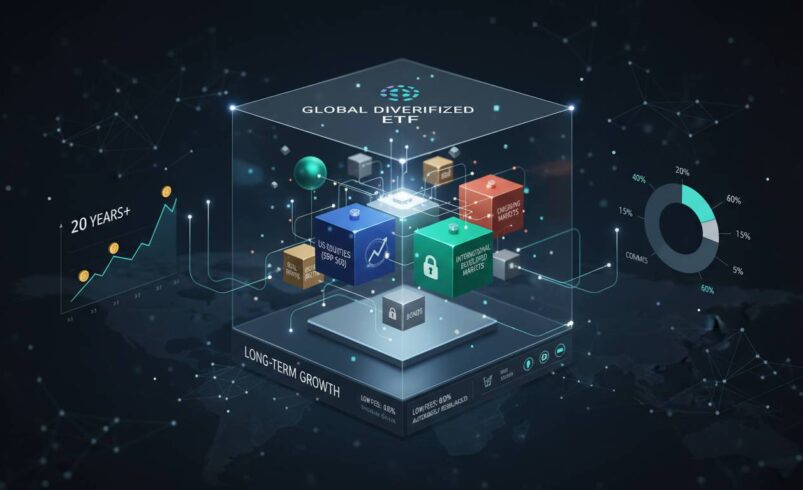
The classic three-fund approach combines a U.S. total stock market index fund, an international stock index fund, and a U.S. bond index fund. This gives you broad diversification across thousands of companies in dozens of countries, plus stability from bonds. The exact percentages depend on your age, risk tolerance, and timeline, but a common starting point is 80% stocks (typically 60% U.S., 20% international) and 20% bonds for younger investors.
Tax-advantaged accounts like 401(k)s and IRAs should house your index funds first, since these accounts shield your investment growth from annual taxes. Once you’ve maximized those vehicles, a regular brokerage account works fine for additional investing.
The specific funds matter less than consistent contributions. Vanguard’s VTSAX, Fidelity’s FSKAX, and Schwab’s SWTSX all track the total U.S. stock market with minimal fees. International options like VXUS and FTIHX serve the same purpose globally. Pick one provider, build a simple allocation, and stick with it.
What you don’t want is paralysis by analysis. A decent plan executed consistently beats a perfect plan that never gets started.
How Much Should You Allocate to Passive Stocks?
This question deserves more nuance than most articles provide. The answer depends on factors that are genuinely personal: your age, income stability, other investments, risk tolerance, and financial goals.
A common rule of thumb suggests holding your age in bonds—meaning a 30-year-old would hold 30% bonds and 70% stocks. Younger investors can afford more stock exposure because they have decades to recover from any market downturns. Older investors typically shift toward bonds for stability and income.
However, some financial experts argue this rule is too conservative. Warren Buffett, for instance, has suggested that most people should simply put their money in a low-cost S&P 500 index fund and forget about it. Others recommend 90% or even 100% stocks until very close to retirement.
The honest answer is that there’s no single correct allocation. What matters is that your allocation matches your comfort with market swings and your timeline for needing the money. If a 50% portfolio drop would cause you to panic-sell, you hold too much stock regardless of what the theoretical “optimal” allocation suggests.
For beginners, I’d suggest starting with an aggressive allocation (80-90% stocks) and gradually shifting toward bonds as you approach any major financial goals. The key is having an actual plan rather than guessing.
Common Mistakes to Avoid
Even with the best intentions, investors find ways to undermine their passive strategies. The most damaging is timing the market—waiting for “the right moment” to invest that never comes. Studies consistently show that missing the market’s best days devastates returns more than sitting through its worst.
Another frequent error is over-diversification. Yes, you want diversification, but there’s a point of diminishing returns. Holding 50 different funds to “be safe” adds complexity without meaningful benefit. A simple three-fund portfolio covers thousands of stocks already.
Chasing recent performance is perhaps the most insidious mistake. Investors see a fund that outperformed recently and pour money in, only to watch it underperform going forward. This is especially damaging with active funds, where past success is often luck rather than skill.
Finally, many people stop contributing during downturns. This is psychologically difficult but financially catastrophic. Market drops are when your contributions buy more shares at lower prices—the exact mechanism that powers long-term compounding.
When Passive Investing Might Not Be Right for You
Here’s where I’ll offer a perspective that contradicts much of the passive investing gospel: passive strategies aren’t universally superior. They work brilliantly for most people, but specific circumstances can change the calculus.
If you’re managing a very large portfolio where tax efficiency becomes paramount, active management might offer strategic advantages. Ultra-high-net-worth investors sometimes benefit from more customized approaches that passive funds can’t provide.
Some argue that in extremely concentrated sectors or emerging markets, passive indexing provides less efficient exposure. Active managers in those spaces may actually have better information advantages to exploit.
Additionally, if you derive genuine enjoyment from researching companies and managing your portfolio, the psychological costs of passive investing might outweigh the financial benefits. Money is a tool for a good life, not the purpose of one. If active investing brings you engagement and satisfaction—and you can accept potentially lower returns—that’s a legitimate personal choice.
The point isn’t that passive investing is wrong. It’s that the religion-like certainty some advocates project isn’t entirely warranted. Know your situation before dismissing alternatives entirely.
Frequently Asked Questions
Can passive stocks lose money? Yes. Passive investments track the market, and the market can decline significantly. The S&P 500 dropped roughly 38% during the 2008 financial crisis and 34% in early 2020. However, the market has recovered from every crash in its history, and longer holding periods dramatically reduce loss risk.
What’s the difference between an index fund and an ETF? Both can be passive vehicles tracking the same indexes. Index funds are mutual funds that execute only at day’s end. ETFs trade like stocks throughout the day. For most long-term investors in tax-advantaged accounts, the distinction matters less than the expense ratio.
Do I need a lot of money to start? No. Many index funds have minimum investments of $1 or $3,000, but ETFs trade for the price of a single share—which can be under $100. Several brokerages now offer fractional shares of any amount, meaning you can start with $10 if that’s what you have.
How often should I check my passive portfolio? Almost never. Monthly is more than enough for most people. Daily monitoring provides no benefit and often leads to emotional decisions. Set up automatic contributions, then forget about your account for years at a time.
The Bottom Line
Passive investing isn’t the only way to build wealth, but it’s the most reliable path for most people. It demands no special knowledge, tolerates human error gracefully, and costs far less than alternatives. The evidence from decades of data is overwhelming: most investors would be better off with simple index funds than complex active strategies.
Start simply. Invest consistently. Ignore the noise. Your future self will thank you.
The real secret isn’t finding the perfect stock or timing the next market move. It’s showing up regularly, keeping costs low, and giving your money time to compound. That’s it. Everything else is distraction.