

Most investors treat market capitalization as a simple number—a quick way to gauge whether a stock is “big” or “small.” But that surface-level understanding costs people real money. Market cap isn’t just a label; it’s a fundamental lens through which you should evaluate risk, growth potential, and portfolio allocation. I’ve watched investors blindly chase high-growth small caps while ignoring the ballast that large-cap stability provides, and I’ve seen others dismiss promising mid-caps entirely because they didn’t fit the “big is better” mental model. The reality is more nuanced, and understanding exactly how market cap should shape your decisions is the difference between building a portfolio that sleeps well at night and one that keeps you up until 3 AM checking futures markets.
What Market Capitalization Actually Means
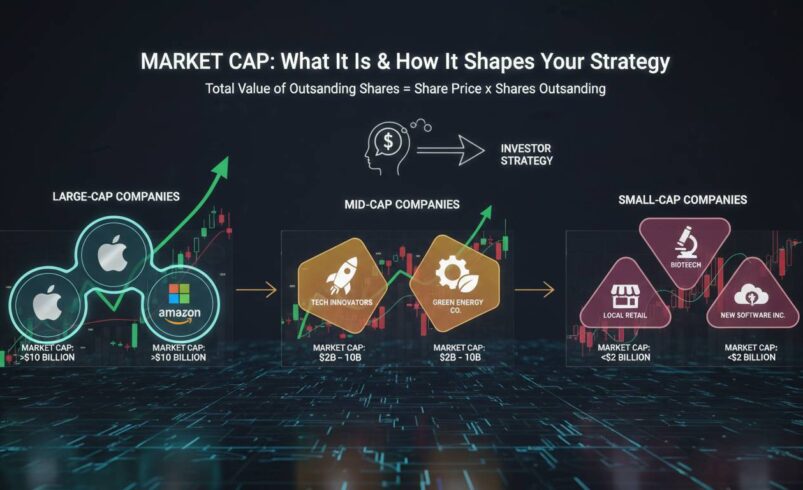
Market capitalization represents the total market value of a company’s outstanding shares of stock. You calculate it by multiplying the current share price by the total number of shares outstanding. If a company trades at $100 per share and has 500 million shares outstanding, its market cap is $50 billion. That’s it—though the implications of that number stretch far beyond the simple arithmetic.
The key insight that many investors miss is that market cap reflects what the market currently values a company at, not what the company is objectively worth. This distinction matters enormously. A company with a $10 billion market cap isn’t necessarily “worth” more than a company with a $500 million market cap—it’s simply valued at that price by current market participants. The market can be wrong, and it frequently is, especially over shorter time horizons.
What makes market cap particularly useful for strategy is its role as a relative measure. You can’t look at Apple’s $3 trillion market cap in isolation and draw meaningful conclusions. But when you compare it to the entire S&P 500’s composition, or when you track how a company’s market cap has evolved over ten years, you start getting actionable intelligence about where the market sees growth, stability, and risk.
The Three Tiers: Large, Mid, and Small Cap Explained
The investment world categorizes companies into three primary market cap tiers, and understanding the characteristics of each is essential for matching investments to your goals.
Large-cap stocks generally refer to companies with market caps above $10 billion. These are the household names—Apple, Microsoft, Johnson & Johnson, JPMorgan Chase. What you get with large caps is generally stability, brand recognition, and established business models. These companies have already captured significant market share and typically pay dividends. The trade-off is slower growth; a company Apple’s size simply cannot grow at 50% annually the way a smaller company can. If you’re building the foundation of a retirement portfolio, large-cap stocks are your load-bearing walls.
Mid-cap stocks sit in the $2 billion to $10 billion range. Think of companies like Etsy, Atlassian, or Square before it grew larger. This is where the balance gets interesting—you’re getting companies with proven business models that still have meaningful growth runway. Mid-caps often trade at premiums to large caps because the market prices in that growth potential, but they also carry more volatility. They’re the “best of both worlds” segment, though that phrase gets thrown around too casually.
Small-cap stocks cover companies from roughly $300 million to $2 billion. This includes hundreds of publicly traded companies you’ve likely never heard of—regional banks, niche manufacturers, growing tech startups. The small-cap universe is where you’ll find the biggest winners and losers. Many small caps will fail or get acquired for less than their current price. But the ones that work can deliver 10x or greater returns as they grow into mid-cap and large-cap territory. This is venture-capital-level risk with public-market liquidity, and the distinction matters.
There is no official cutoff line between these categories—different brokerages and index providers use slightly different thresholds. Some consider anything above $10 billion “large cap,” while others start the large-cap threshold at $20 billion. What matters isn’t memorizing the exact boundaries but understanding the risk-reward profile each tier represents.
Why Market Cap Should Change How You Think About Risk
Here’s where most beginner investors get it backwards: they assume bigger is safer, and smaller is riskier. That’s broadly true but dangerously incomplete. The relationship between market cap and risk is more complex than a simple size chart.
Large-cap stocks are less likely to go to zero. Apple’s market cap dropping 50% would be a $1.5 trillion wipeout—an extinction-level event for the broader economy. A small-cap biotech company with a $200 million market cap going to zero is tragic for its shareholders but barely registers as a rounding error in the broader market. This “too big to fail” dynamic is real, and it’s why pension funds and endowments load up on large caps.
But large-cap stability is a double-edged sword. When markets correct, large caps often decline less initially—but they also tend to underperform in the subsequent recovery. The 2008 financial crisis saw large banks get crushed alongside smaller financials. The 2020 pandemic selloff hit tech giants and small companies simultaneously. Market cap provides a rough proxy for volatility, not a guarantee of protection.
Small caps, despite their higher individual failure rate, have historically generated higher long-term returns. From 1926 through 2023, small-caps outperformed large-caps by approximately 2% annually—a premium that compensates investors for bearing that extra risk. This is called the size premium, and it’s one of the most persistent anomalies in finance. Most investors don’t capture it because they can’t stomach the volatility.
The practical implication: your risk tolerance shouldn’t just determine whether you “can handle” small caps. It should determine what percentage of your portfolio you allocate to each tier. A 30-year-old saving for retirement in 2065 has time to recover from small-cap crashes and should likely have a meaningful small-cap allocation. A 65-year-old drawing income next year probably shouldn’t.
Market Cap Versus What Actually Matters
Investors often conflate market cap with other metrics, and these confusions lead to bad decisions. Let me clear up the most common mix-ups.
Market cap is not share price. A stock trading at $1,000 per share might be a tiny company. A stock trading at $10 per share might be a giant. Tesla trades at around $250 per share as of early 2025, while Berkshire Hathaway’s Class A shares trade at over $400,000. Does that mean Berkshire is “more expensive” or a better investment? Of course not. Share price is arbitrary—it depends on how many shares the company chose to issue. Always look at market cap, not share price, when evaluating size.
Market cap is not enterprise value. Enterprise value adds debt to market cap and subtracts cash. A company with a $10 billion market cap but $5 billion in net debt has an enterprise value of $15 billion—and far more financial obligations than that number suggests. The 2008 crisis taught this lesson brutally: companies with seemingly reasonable market caps collapsed when their debt loads became unsustainable. If you’re evaluating a company for acquisition or deep value investing, enterprise value matters more than market cap.
Market cap is not revenue or earnings. A company can have $50 billion in revenue but a $20 billion market cap (think of a low-margin retailer). Another company might generate $2 billion in revenue with a $50 billion market cap (think high-margin software). Neither metric is inherently better—they measure different things. Market cap reflects what the market expects future cash flows to be, while revenue and earnings show what the business is actually generating today.
The most important limitation: market cap doesn’t reflect private company value. When you see “Apple has a $3 trillion market cap,” that only counts the publicly traded shares. Apple’s actual total enterprise value—including debt and excluding cash—is closer to $2.7 trillion because they hold massive cash reserves. And this public market cap tells you nothing about privately held competitors or the intrinsic value a skilled operator might extract from the business.
The Strategic Framework No One Teaches You
Now for the part that actually matters for your portfolio. How should you use market cap to make investment decisions?
Start with asset allocation, not stock picking. Before you buy any individual company, decide what percentage of your portfolio belongs in each market cap tier. This is more important than which specific stocks you choose. A portfolio of only small caps will behave differently than a portfolio of only large caps, regardless of which individual stocks you select. Your market cap allocation is your strategic bet on the risk-return tradeoff.
Most target-date funds use a “glide path” approach: they start with higher small-cap and mid-cap exposure and gradually shift toward large caps as the target date approaches. This isn’t arbitrary—it reflects the reality that younger investors can bear more volatility while those nearing retirement cannot. You don’t need a target-date fund to implement this logic. Simply ask yourself: when will I need this money, and how much volatility can I psychologically handle?
Use market cap for sector rotation timing. Different market cap tiers perform better at different points in the economic cycle. Small caps tend to lead coming out of recessions—they’re more sensitive to economic recovery and have more room to grow. Large caps tend to outperform during uncertainty periods when investors flock to stability. Mid caps often get squeezed in both directions, which is why they sometimes underperform both tiers over extended periods.
This doesn’t mean you should constantly rotate based on economic predictions—timing the cycle is notoriously difficult. But understanding which tier you’re overweight can help you set expectations. If you’re heavy in small caps heading into an economic slowdown, prepare yourself for volatility.
Consider the float. Market cap includes all outstanding shares, but not all shares trade freely. “Restricted” shares held by insiders, employees, or governments don’t move in the market. When a company with a small float experiences buying pressure, share prices can spike dramatically—which is why low-float stocks are famously volatile. This is a nuanced factor, but it’s one that explains why two companies with identical market caps can behave very differently.
The Honest Limitations You Need to Accept
I need to be direct with you: market cap has significant limitations that smarter investors account for.
First, market cap is a backward-looking metric. It tells you what the market valued the company at yesterday, not what it will value tomorrow. A company’s market cap can remain stagnant for years even as its underlying business improves or deteriorates. The market is efficient over long horizons but absurdly inefficient over short ones.
Second, share count manipulation happens. Companies can issue new shares (dilution) or buy back shares (reducing the float). A company executing aggressive buybacks can artificially inflate its market cap per share while the underlying business stagnates. Watch for the relationship between market cap growth and earnings growth—if earnings aren’t keeping up, the market cap is being inflated by financial engineering rather than business fundamentals.
Third, market cap says nothing about quality. A $10 billion market cap company might be generating stable cash flows—or it might be burning through capital with no path to profitability. The meteoric rise of many growth stocks during the 2020-2021 period showed how market caps can disconnect entirely from fundamentals. We’re still seeing the aftermath in companies that have seen 80-90% declines from their peaks.
Finally, cross-border comparisons are treacherous. A $1 billion market cap in the United States and a $1 billion market cap in an emerging market represent very different risk profiles. Accounting standards, shareholder protections, currency stability, and liquidity all vary by market. Don’t treat market cap as a universal metric across borders.
Practical Steps for Your Next Investment Decision
Before you buy any stock, ask these three market cap questions:
-
What tier does this company belong in, and do I have appropriate exposure to that tier already? If your portfolio is already heavy in large-cap tech, adding another large-cap tech name isn’t diversification—it’s concentration.
-
Does the company’s market cap make sense given its industry position and growth trajectory? A regional bank with a $50 billion market cap is an outlier that deserves extra scrutiny. A tech company with that market cap needs to be generating meaningful revenue and profits to justify its size.
-
Am I buying because of the story or the math? If you’re buying a small cap, you should have a thesis for why it will grow into a mid cap. If you’re buying a large cap, you should be confident the market isn’t overvaluing stability. The market cap itself doesn’t make a stock a buy or sell—it contextualizes your thesis.
The investors who use market cap well don’t treat it as a shortcut around fundamental analysis. They treat it as a framework for thinking about risk, growth expectations, and portfolio construction. That’s the difference between someone who understands the concept and someone who lets it shape their strategy.
Where This Leaves You
Market capitalization is simple arithmetic that most investors oversimplify. The formula takes seconds to learn, but the strategic implications take a career to master. You now know the categories, the risk profiles, the limitations, and how to think about allocation across tiers.
What remains is the harder work: applying this framework to your specific situation, your timeline, and your psychological tolerance for volatility. No article can tell you exactly what percentage should be in small caps versus large—that depends on factors only you can evaluate.
But start paying attention to market cap. When you read about a company, note its size. Compare it to competitors. Ask why it trades at its current valuation and what would need to happen for that valuation to grow. That habit alone will make you a more disciplined investor than most people reading the same news headlines.