

The distinction between revenue and profit isn’t just accounting trivia—it’s the foundation of how every successful business evaluates its performance. Here’s the uncomfortable truth most new entrepreneurs learn the hard way: you can generate massive revenue and still go bankrupt. Understanding the difference isn’t optional knowledge for business owners. It’s the difference between reading your financial statements correctly and making catastrophic decisions based on incomplete information.
This article breaks down exactly what revenue and profit mean, how they relate to each other, why both metrics matter, and how to use them properly when evaluating any business. You’ll find clear definitions, real-world examples, and a comparison table that makes the relationship impossible to misunderstand.
What Revenue Actually Means
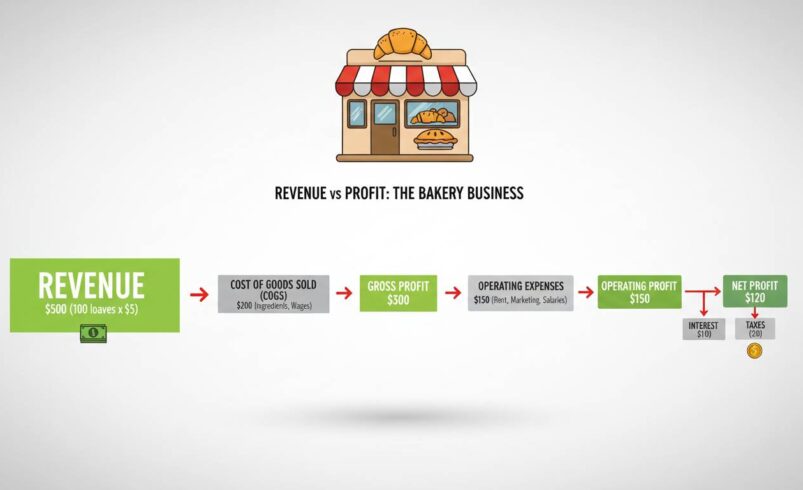
Revenue represents the total amount of money a business earns from its normal operations before subtracting any expenses. It’s sometimes called “gross income” or “top-line income” because it appears at the top of an income statement. If you run a bakery and sell 10,000 loaves of bread at $5 each, your revenue is $50,000—simple arithmetic, no complications.
The critical thing to understand about revenue is that it only counts money earned through your core business activities. A bakery that sells bread generates revenue from bread sales. If the same bakery also sells its old delivery truck, that money isn’t revenue—it’s a capital gain or non-operating income, and it gets recorded separately on financial statements.
Revenue tells you how much demand exists for your product or service. It answers the fundamental question: “Is anyone willing to pay us money for what we offer?” A business with growing revenue is acquiring customers and generating sales. A business with declining revenue is losing market share or failing to attract new buyers. This makes revenue an essential metric for understanding your market position and growth trajectory.
One common misconception is that revenue equals cash coming into the business. This isn’t always true. If you sell products on credit—meaning you allow customers to pay later—those sales count as revenue immediately, even though the cash might not arrive for 30, 60, or 90 days. This distinction matters enormously for cash flow management, which we’ll explore when discussing why profit matters more than revenue for survival.
What Profit Really Is
Profit is what remains after subtracting all expenses from revenue. Unlike revenue, which has a single definition, profit comes in several forms, each telling you something different about business performance. The three most important types are gross profit, operating profit, and net profit.
Gross profit is revenue minus the direct costs of producing what you sold. For that bakery, gross profit would be revenue minus the cost of flour, yeast, labor directly involved in baking, and packaging. If revenue is $50,000 and direct costs are $20,000, gross profit is $30,000. This metric shows you how efficiently you’re producing your product.
Operating profit—sometimes called earnings before interest and taxes (EBIT)—takes gross profit and subtracts operating expenses like rent, utilities, salaries for non-production staff, marketing costs, and equipment depreciation. Continuing our bakery example, if gross profit is $30,000 and operating expenses total $22,000, operating profit is $8,000. This number reveals whether your core business operations are profitable before considering financing decisions and taxes.
Net profit—the figure most people mean when they simply say “profit”—is what’s left after absolutely everything is paid: operating expenses, interest on debt, taxes, and all other costs. If our bakery pays $2,000 in interest and $1,500 in taxes, the $8,000 operating profit becomes $4,500 in net profit. This is the final answer to the question: “Did the business actually make money this period?”
Revenue vs Profit: The Key Differences Side by Side
Understanding the distinction requires seeing both concepts clearly compared. Here’s how they stack up against each other:
| Aspect | Revenue | Profit |
|---|---|---|
| Definition | Total income from sales before expenses | Income remaining after all expenses paid |
| Position on income statement | Top line | Bottom line |
| Calculation | Price × Quantity sold | Revenue − All expenses |
| Minimum value | Always zero or positive | Can be negative (loss) |
| What it reveals | Market demand and sales volume | Actual business viability |
| Decision-making use | Growth and marketing strategies | Survival and sustainability |
The most important takeaway from this comparison: high revenue means nothing if expenses are even higher. A business can generate $10 million in revenue and still lose money if its costs reach $11 million. Conversely, a business with modest revenue of $500,000 might thrive if it keeps expenses at $400,000, generating $100,000 in profit.
The Simple Formula: Revenue – Expenses = Profit
Every business, from a street vendor to a Fortune 500 company, operates on this fundamental equation. Revenue minus expenses equals profit. That’s it. Everything in accounting ultimately traces back to this simple math.
Let’s trace through a complete example to make this concrete. Imagine a software company with the following financial results for a quarter:
- Revenue from subscriptions: $2,000,000
- Revenue from professional services: $300,000
- Total revenue: $2,300,000
Now the expenses:
- Salaries for developers and support staff: $1,200,000
- Cloud hosting and infrastructure: $400,000
- Marketing and sales expenses: $350,000
- Office rent and utilities: $150,000
- Administrative and legal costs: $100,000
- Total expenses: $2,200,000
Revenue ($2,300,000) minus expenses ($2,200,000) equals profit ($100,000). This company made money, but not much—$100,000 on $2.3 million in revenue represents a profit margin of roughly 4.3%. That’s actually typical for many businesses, especially in competitive industries where thin margins are the norm.
Now imagine this same company experiences 20% revenue growth to $2,760,000 but fails to control expenses. If expenses rise to $2,600,000, profit becomes $160,000—a 60% increase in profit from just 20% more revenue. This demonstrates why profitable businesses often focus as much on expense management as revenue growth. The relationship between revenue growth and profit growth isn’t always proportional, which is exactly why you need to track both.
Why Revenue Matters
Revenue is your top-line metric, and it matters for several critical reasons beyond simply showing how much you’re selling.
First, revenue establishes your market position. A company generating $100 million in annual revenue operates fundamentally differently than one generating $100,000. The larger company has more bargaining power with suppliers, can afford more sophisticated talent, and has access to financing on better terms. Revenue scale often determines which opportunities are available to you.
Second, revenue growth signals product-market fit. If people are buying what you’re selling, revenue increases. If revenue is growing steadily—preferably year over year—you’re doing something right. Investors, boards, and experienced managers typically want to see consistent revenue growth before declaring a business successful.
Third, revenue provides the ceiling for profit. No matter how efficiently you operate, you cannot generate more profit than your revenue allows. A company with $1 million in revenue operating at a 10% profit margin will make $100,000. To make $200,000, that company must either increase revenue to $2 million or improve efficiency to reach a 20% margin. Understanding revenue helps you set realistic profit targets.
Finally, many business relationships depend on revenue figures. Bank loan approvals often consider revenue alongside profit. Enterprise customers frequently require vendors to meet minimum revenue thresholds. Partnership opportunities and acquisition interest correlate strongly with revenue size.
Why Profit Matters More Than You Think
If revenue answers “are we growing?”, profit answers “are we sustainable?” And sustainability beats growth every time, because a growing unprofitable business can collapse suddenly while a profitable business can survive almost anything.
Profit is the money you can actually keep and reinvest. Revenue pays salaries, suppliers, and landlords. Profit pays you—or rather, it pays the business owners or shareholders. Without profit, a business cannot distribute returns to owners, invest in new equipment, weather economic downturns, or accumulate the reserves needed for long-term success.
Consider what happens during an economic downturn. Businesses with high revenue but thin profit margins often struggle first. Their expenses consume nearly everything they earn, so even a modest revenue decline pushes them into losses. Businesses with healthy profit margins have a cushion. They can absorb revenue drops without immediately losing money.
Profit also attracts talent and investment. Quality employees want to work for companies that can afford competitive salaries and benefits, which require profit. Investors seek businesses that convert revenue into returns, not just businesses that generate sales. If you’re raising capital, demonstrating profit—even modest profit—ismore persuasive than showing massive revenue with nothing left over.
Here’s something many business articles won’t tell you: you can fake revenue relatively easily through aggressive sales tactics, deep discounting, or loose credit policies. Faking profit is much harder because the money either exists or it doesn’t. When I evaluate any business, profit tells me more about reality than revenue ever could.
Can You Have Revenue Without Profit?
Yes, and this situation is far more common than most people realize. Every unprofitable business generates revenue. That’s what makes them businesses—they sell things. They simply sell things for less than it costs to provide them.
Amazon provides the most famous example. For years, Amazon generated enormous revenue while deliberately reporting minimal or no profit. The company invested heavily in infrastructure, expansion, and research, choosing to spend revenue rather than keep it as profit. This strategy worked because investors understood Amazon was building long-term value, and the company had access to capital markets to fund its expansion.
New restaurants illustrate this pattern at a smaller scale. A restaurant might generate $50,000 in monthly revenue but, after paying food costs, staff, rent, and utilities, end up with $2,000 in profit—or nothing at all. The revenue is real. The profit isn’t. Many restaurants operate this way for years before closing, having generated plenty of revenue but never accumulating the profit needed to build reserves or reward owners.
The reverse—having profit without revenue—is theoretically impossible. You cannot subtract expenses from nothing and arrive at a positive number. However, a company could technically report profit from non-operating activities, such as selling assets or receiving investment income, even while its core operations generate no revenue. This is rare and usually temporary, but it demonstrates why financial analysis requires looking at the sources of profit, not just the total.
Real-World Example: Two Businesses, Two Stories
Two lemonade stands illustrate the revenue-versus-profit dynamic perfectly.
Stand A sets up at a busy park corner, sells 200 cups at $1 each, and earns $200 in revenue. Their costs: cups and lemons cost $120, sugar and water cost $30, and they pay a sibling $20 to help. Total expenses: $170. Profit: $30.
Stand B sets up in a less busy location, sells only 100 cups at $1 each, earning $100 in revenue. Their costs: cups and lemons cost $40, sugar and water cost $10, no helper needed. Total expenses: $50. Profit: $50.
Stand A has double the revenue but less profit than Stand B. Which business is better? The one making $30 or the one making $50? Any rational observer would choose Stand B because profit—not revenue—determines what the owner actually keeps.
This simple example scales up to massive proportions in real businesses. A company might celebrate crossing $100 million in revenue while investors recognize the 2% profit margin and question whether the business model makes sense. Another company might report $20 million in revenue while insiders know the 15% margin generates real wealth. Revenue impresses observers. Profit sustains businesses.
The Different Types of Profit You Should Know
We’ve already touched on gross profit, operating profit, and net profit, but understanding the differences fully unlocks real financial literacy.
Gross profit reveals production efficiency. It tells you whether your product or service costs are reasonable relative to your pricing. If gross profit is declining, either your costs are rising, your pricing is falling, or you’re mixing in lower-margin offerings. The bakery with 60% gross margin ($30,000 gross profit on $50,000 revenue) knows it can afford to spend more on marketing or equipment because production is highly efficient.
Operating profit reveals operational efficiency. This figure excludes financing costs and taxes, focusing purely on whether your business runs well. Two companies with identical gross margins can have dramatically different operating profits based on how efficiently they manage overhead. The bakery spending too much on administrative staff or unnecessary software will have lower operating profit despite healthy gross profit.
Net profit reveals total business performance. After everything—interest, taxes, depreciation, one-time charges—net profit shows what actually dropped to the bottom line. This is the number that matters for valuation, for owner distributions, and for assessing long-term viability.
Common Mistakes People Make With Revenue and Profit
The biggest mistake is conflating cash with profit. A business can be profitable on paper while running out of cash. This happens when revenue growth requires financing—selling to customers on credit, building inventory, hiring staff before payments arrive. The profit exists theoretically, but the cash doesn’t exist yet. Many profitable businesses fail not because they lose money but because they can’t pay bills while waiting for customers to pay them.
Another mistake: assuming high revenue means high profit. We’ve already established this isn’t true, but the temptation to celebrate revenue growth while ignoring profit decline persists everywhere. Business owners announce “we grew 50% this year!” while glossing over the fact that profit dropped from $100,000 to $20,000. Always ask: growth at what cost?
Finally, people sometimes treat revenue as a measure of success and profit as a measure of failure. Neither is accurate. Revenue growth can indicate smart reinvestment. Profit decline can reflect strategic spending on growth initiatives. The relationship between the two numbers matters far more than either number alone.
The Bottom Line: Why Both Metrics Matter
Revenue and profit serve different purposes in business analysis, and ignoring either one creates blind spots. Revenue tells you about market position, growth trajectory, and the scale of operations. Profit tells you about efficiency, sustainability, and actual value creation.
You need revenue to have profit—revenue is the raw material from which profit is carved. But you need profit to survive—revenue without profit is just activity, not achievement.
The businesses that thrive over decades understand this relationship intimately. They pursue revenue growth strategically, not blindly. They measure profit at every level—gross, operating, and net—to identify where value is created and where it’s destroyed. They recognize that sustainable businesses build profit first, then reinvest in revenue growth, rather than chasing revenue at all costs and hoping profit follows.
Your task, whether you’re evaluating a business, running one, or investing in one, is simple: never look at revenue without looking at profit. Never look at profit without understanding what drove it. Both numbers matter. Using them together—not in isolation—is what separates people who understand finance from people who just read headlines.