
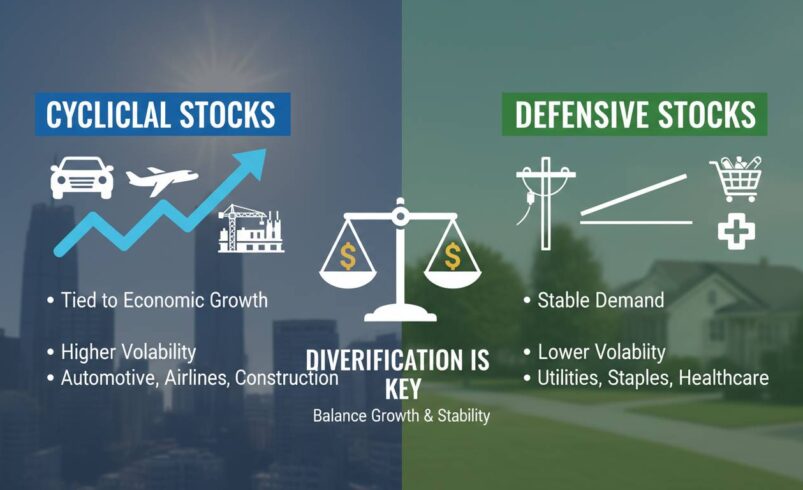

If you’re building a portfolio that can weather both boom and bust, understanding how cyclical and defensive stocks behave isn’t optional — it’s foundational. The allocation decision between these two categories isn’t about choosing winners; it’s about understanding how different parts of your portfolio respond to economic gravity. As we move through early 2025, with inflation moderating but interest rates still elevated and economic uncertainty persisting, the question of which belongs in your portfolio demands more than a textbook answer. It requires examining where we actually are in the cycle and what your specific financial situation demands.
This article gives you a framework for thinking about cyclical versus defensive stocks through the lens of current market conditions. I’ll explain what each category actually is, walk through concrete examples, and give you a practical allocation approach you can implement today.
What Are Cyclical Stocks?
Cyclical stocks are shares in companies whose revenue and earnings tend to fluctuate significantly with the broader economic cycle. When the economy expands, these companies thrive — consumers spend freely, businesses invest in growth, and demand surges across their product lines. When recession hits, these same companies see demand crater, often more severely than the overall market.
The sectors most closely associated with cyclical behavior tell the story. Consumer discretionary — think Amazon, Nike, and Tesla — rises and falls with household spending. Technology companies like Apple and Microsoft benefit when businesses and consumers upgrade equipment and devices during growth periods. Real estate investment trusts respond to property values and leasing demand. Industrials such as Caterpillar and Boeing follow capital spending by companies and governments. Financial institutions, particularly banks, earn more when credit demand is strong and suffer when it collapses.
The key characteristic of cyclical stocks isn’t just higher potential returns during expansions — it’s the amplitude of their swings. A well-positioned cyclical stock can double or triple during a bull market. It can also lose 50% or more when conditions reverse. This volatility is the price of admission for their growth potential.
Consider the 2023-2024 period. As the Federal Reserve raised interest rates and recession fears mounted, cyclical sectors lagged significantly. Technology and consumer discretionary pulled back while defensive sectors held steady. Then, as inflation eased and growth optimism returned in late 2024, cyclicals led the rebound. This rotation — defensive leadership during uncertainty, cyclical leadership during expansion — is the pattern you’re trying to time.
What Are Defensive Stocks?
Defensive stocks are companies whose products or services remain in demand regardless of whether the economy is growing or contracting. These businesses provide essentials people buy no matter their financial situation: electricity, water, healthcare, basic food products, and household goods. Their earnings are more stable because their revenue streams don’t depend on discretionary spending.
Utilities exemplify defensive stocks. Whether the economy is booming or in recession, people flip light switches, run water, and heat their homes. Companies like NextEra Energy and Duke Energy generate relatively predictable cash flows, which translates to steadier stock prices. Healthcare similarly provides non-discretionary services. Johnson & Johnson, Merck, and UnitedHealth Group all derive revenue from treatments and services people need regardless of economic conditions.
Consumer staples form another defensive pillar. Procter & Gamble, Costco, and Walmart sell products shoppers buy routinely — toilet paper, groceries, cleaning supplies. These purchases don’t disappear during downturns; they might shift slightly in terms of brand preferences, but the volume remains remarkably stable. Even during the 2008 financial crisis and the 2020 pandemic, consumer staples companies maintained revenues while other sectors collapsed.
The tradeoff is straightforward: defensive stocks offer stability and downside protection at the cost of lower long-term growth potential. During extended bull markets, they’ll likely underperform cyclical stocks. During recessions, they’ll either hold value better or decline less dramatically. For investors prioritizing capital preservation or those near retirement, this stability is valuable. For younger investors building long-term wealth, the lower growth rate can become a constraint.
Cyclical vs. Defensive Stocks: Key Differences
Understanding the distinction between these two categories requires examining several dimensions simultaneously. Here’s a comparison that captures the essential differences:
| Factor | Cyclical Stocks | Defensive Stocks |
|---|---|---|
| Economic Sensitivity | High — performance tracks GDP growth closely | Low — demand remains stable across cycles |
| Revenue Volatility | Significant — can swing 30-50% with economy | Minimal — typically varies less than 10% |
| Typical Sectors | Consumer discretionary, technology, industrials, real estate, financials | Utilities, healthcare, consumer staples, telecom |
| Growth Potential | Higher long-term upside during expansions | Lower but more consistent returns |
| Downside Risk | Larger drawdowns during recessions | Smaller drawdowns, better preservation |
| Dividend Yields | Variable — often lower, tied to performance | Generally higher and more reliable |
| Interest Rate Impact | More sensitive — higher rates hurt valuations | Less sensitive — often benefit from rate cuts |
The sectors in each category clarify this distinction. Cyclical sectors include consumer discretionary (retail, autos, leisure), technology (semiconductors, software, hardware), industrials (airlines, machinery, construction materials), real estate (developers, REITs), and financials (banks, brokerage firms). Defensive sectors include utilities (electric, water, gas providers), healthcare (pharmaceuticals, medical devices, insurance), consumer staples (food, household products, discount retailers), and telecommunications.
The critical insight isn’t that one category is superior — it’s that each serves a different function in a portfolio. A portfolio entirely composed of cyclical stocks will experience wild swings that test your emotional tolerance. A portfolio entirely of defensive stocks will feel safe but may underperform over decades. The art lies in finding the right balance for your situation.
Which Should Be in Your Portfolio Right Now?
This is where the “right now” in your search query becomes crucial. Generic advice tells you to hold both categories — which is technically correct but practically useless. What you actually need is a framework for deciding the appropriate allocation given current conditions and your personal circumstances.
As of early 2025, the economic landscape presents a mixed picture. Inflation has moderated substantially from its 2022 peak, settling around 2.5-3% annually. The Federal Reserve has signaled a patient approach to further rate cuts after reducing rates modestly in late 2024. Economic growth continues, though at a moderating pace — the consensus GDP growth forecast for 2025 sits around 2%, down from approximately 2.5% in 2024. Unemployment remains low, but job creation has slowed.
This environment creates a case for a weighted approach that tilts slightly defensive without abandoning cyclical exposure entirely. Here’s my take: if you’re younger than 50 with a long time horizon and high risk tolerance, a 60-40 or 55-45 split favoring cyclical stocks still makes sense. The economy isn’t in recession, and cyclical stocks tend to outperform during expansion phases. If you’re within 10 years of retirement or highly risk-averse, a 40-60 or even 30-70 split toward defensive stocks provides valuable downside protection against an economic slowdown that many analysts still consider possible.
The honest acknowledgment most articles avoid: no one consistently times this correctly. The best we can do is position ourselves appropriately for the most likely scenario while maintaining flexibility. A balanced approach — roughly equal exposure to both categories — remains sensible for most investors. The specific ratio depends on factors only you can evaluate: your age, income stability, risk tolerance, and other portfolio holdings.
Let me give you a practical way to think about this. If you have $100,000 investable, a moderate approach would allocate $50,000 to defensive stocks (utilities, healthcare, consumer staples) and $50,000 to cyclical stocks (technology, consumer discretionary, industrials). If you’re more conservative, shift to $65,000 defensive and $35,000 cyclical. More aggressive? $35,000 defensive and $65,000 cyclical. The exact numbers matter less than having meaningful exposure to both categories.
How to Balance Cyclical and Defensive Stocks
Building a portfolio that incorporates both cyclical and defensive stocks requires more than splitting money 50-50. The execution matters, and several strategies can improve your outcomes.
First, consider sector-level diversification within each category. Within cyclicals, technology carries different risk profiles than real estate or financials. Within defensives, utilities behave differently than healthcare. Holding multiple sectors within each category reduces concentration risk while maintaining your intended tilt.
Second, think about position sizing based on conviction. If you’re uncertain about the economic outlook — which, given conflicting indicators in early 2025, is entirely reasonable — consider a core-satellite approach. Hold 60-70% of each category in broad sector ETFs (like XLK for technology or XLU for utilities) and reserve 30-40% for individual stock selection where you have specific thesis.
Third, rebalancing discipline matters more than timing. When cyclical stocks surge during an expansion, they’ll naturally grow to represent a larger portion of your portfolio. Rebalancing annually — trimming winners and adding to underweight positions — enforces the discipline of buying low and selling high without pretending you can predict the exact top or bottom.
Fourth, consider the role of dividends. Defensive stocks, particularly utilities and consumer staples, often pay higher and more consistent dividends. If income matters to your strategy — perhaps you’re retired and drawing from the portfolio — defensive stocks can serve as an anchor while cyclical stocks provide growth.
Fifth, evaluate your other investments. If you hold significant positions in bonds, real estate through REITs, or international stocks, those allocations affect your optimal cyclical-defensive balance. A portfolio heavily weighted toward volatile assets might warrant more defensive stock exposure to balance overall risk.
The approach that serves most investors well: establish a target allocation based on your age and risk tolerance, implement it through a combination of broad sector ETFs and individual stocks where you have specific knowledge, and rebalance annually to maintain your intended exposure. This works even if it isn’t exciting.
One point worth noting: the conventional wisdom that you should “tilt defensive as you age” oversimplifies the decision. If you have substantial other assets — a pension, real estate, or business ownership — you might maintain a more aggressive stock allocation well into retirement. Conversely, if your portfolio represents your entire net worth and you have limited earning power left, defensive positioning makes sense earlier than traditional advice suggests.
Conclusion
The cyclical versus defensive stock decision ultimately reduces to understanding what you’re optimizing for and being honest about your ability to handle volatility. There’s no universally correct answer — only an answer that’s correct for your specific circumstances.
What I can tell you with confidence is this: ignoring one category entirely is a mistake. A portfolio of only cyclical stocks will keep you awake at night during the next recession. A portfolio of only defensive stocks will leave you frustrated during extended bull markets when your neighbors’ portfolios are growing faster than yours. The middle path — meaningful exposure to both — isn’t the most exciting advice, but it’s the advice that survives contact with actual market behavior.
As you build or adjust your portfolio, ask yourself what happens if the economy slows more than expected versus what happens if growth accelerates. Can you sleep if your portfolio drops 30% in a recession? If not, tilt toward defensives. Can you tolerate watching your more aggressive friends outperform during a boom? If not, accept that a defensive tilt will cost you some upside. These aren’t investment questions — they’re personal questions that only you can answer.
The market will do what the market does. Your job isn’t to predict it perfectly. Your job is to build a portfolio you can stick with through whatever comes, understanding that both cyclical and defensive stocks have a role to play in that equation.