
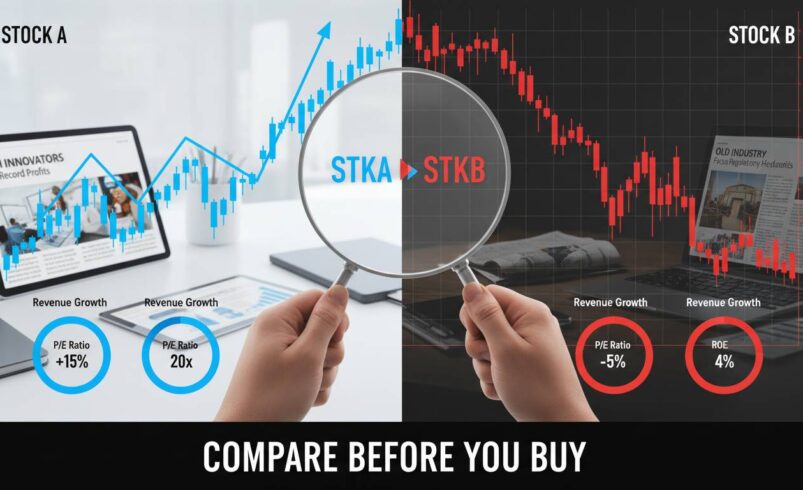

If you’re serious about investing, comparing stocks isn’t optional—it’s the entire point. Every stock you buy is a choice against every other stock you could have bought instead. The problem is that most investors don’t have a framework for making that choice systematically. They rely on tips, gut feelings, or the latest headline. That approach works until it doesn’t, and by then you’ve already lost money.
This guide gives you a practical, step-by-step process for evaluating any two stocks side by side. I’ve covered the metrics that actually matter, the tools that do the heavy lifting, and the mistakes that trip up even experienced investors. By the end, you’ll have a repeatable method you can apply to any pair of stocks—before you risk a single dollar.
The 10 Essential Metrics You Need to Know
Before comparing anything, you need to understand what you’re measuring. These ten metrics form the foundation of any serious stock comparison.
Price-to-Earnings Ratio (P/E)
The P/E ratio tells you how much investors are willing to pay for each dollar of earnings. A P/E of 20 means the stock trades at 20 times its earnings. Higher P/E typically suggests growth expectations; lower P/E often indicates value or problems.
Calculate it by dividing the stock price by earnings per share. But here’s what most articles won’t tell you: P/E alone is nearly useless. A P/E of 15 means something entirely different for a tech company versus a utility. Always compare within sectors, and even then, dig deeper.
Earnings Per Share (EPS)
EPS measures profitability on a per-share basis. You calculate it by dividing net income by outstanding shares. Higher EPS generally indicates a more profitable company—but look at the trend. A company with declining EPS despite a rising stock price is a warning sign that deserves attention.
Market Capitalization
Market cap equals share price multiplied by total shares outstanding. This classification matters more than most beginners realize. Large-cap stocks (typically $10 billion+) tend to be steadier. Mid-caps ($2-10 billion) offer growth potential with some stability. Small-caps ($300 million-$2 billion) carry higher risk but can deliver outsized returns. Your risk tolerance should dictate which category you’re shopping in.
Dividend Yield
Dividend yield shows annual dividends as a percentage of stock price. A yield of 3% means you receive $3 annually for every $100 invested. Higher yields look attractive, but beware—unsustainable yields often precede dividend cuts. The best approach is to examine the payout ratio (dividends divided by earnings) to determine whether the dividend is sustainable.
Return on Equity (ROE)
ROE measures how efficiently a company generates profits from shareholder equity. An ROE of 15% means the company generates $15 in profit for every $100 of shareholder money. Compare ROE within industries—banking norms differ dramatically from tech norms. Consistently high ROE often indicates a durable competitive advantage.
Debt-to-Equity Ratio
This ratio compares total debt to shareholder equity. Lower is generally better, but context changes everything. Retail companies can carry more debt than software firms. The real question is whether the company can service its debt comfortably. Interest coverage ratios (earnings divided by interest expense) reveal more than debt-to-equity alone.
52-Week Range
The 52-week range shows how the stock has traded over the past year. Knowing where a stock currently sits within this range prevents common emotional errors. Buying near the 52-week high requires optimism that the stock will continue climbing. Buying near the 52-week low requires understanding why the market has punished it.
Trading Volume and Liquidity
Volume indicates how actively a stock trades. Higher volume means easier entry and exit without moving the price. Low-volume stocks can trap you—you might struggle to sell when you want without accepting a discount. For most individual investors, sticking to stocks with average daily volume above one million shares avoids liquidity problems.
Revenue Growth
Revenue is the top line. Earnings can be manipulated; revenue is harder to fake. Look for consistent revenue growth over three to five years. A company that’s growing revenue at 20% annually while competitors grow at 5% likely has something worth owning. Also examine the trajectory—is acceleration slowing?
PEG Ratio
The PEG ratio adjusts P/E for growth by dividing it by expected earnings growth rate. A PEG of 1 is considered fairly valued. Below 1 suggests undervaluation; above 1 suggests you’re paying a premium for growth. This metric helps you compare a high-growth stock against a slow-growing one fairly. The limitation: it relies on growth estimates, which are often wrong.
Step-by-Step: How to Compare Any Two Stocks
Now that you understand the metrics, here’s the actual process. Use this framework every time you’re deciding between two stocks.
Step 1: Establish your criteria first. Before looking at any numbers, decide what matters most for this specific decision. Are you prioritizing growth? Income? Stability? Your criteria shape which metrics deserve the most weight. Writing these down prevents you from unconsciously favoring whichever stock looks better on surface-level metrics.
Step 2: Gather data systematically. Pull the ten metrics above for both stocks. Use consistent time periods—most platforms let you compare annualized figures. Don’t skip any metric because it makes one stock look unfavorable. That discomfort is exactly where valuable information lives.
Step 3: Normalize your comparison. A P/E of 25 means nothing in isolation. Compare it to the sector average, the company’s historical P/E, and the other stock’s P/E. Normalization is where most DIY investors fail. They see a P/E of 15 and think it’s cheap, without realizing the sector average is 12.
Step 4: Identify the asymmetry. One stock will likely have meaningful advantages in certain areas. Map these out. If Stock A has better margins but worse revenue growth, and Stock B has the reverse, you’ve found the trade-off you’re actually making. The decision then becomes: which advantage matters more for your goals?
Step 5: Check the story. Numbers don’t capture everything. What’s the competitive moat? What’s the management team like? What’s the growth roadmap? These qualitative factors often matter more than quantitative metrics over multi-year holding periods. The numbers tell you what happened; you need the story to understand what will happen.
Step 6: Stress test your choice. Imagine one piece of bad news hits each stock. Which one would hurt more? This exercise reveals risk factors that raw metrics miss. Perhaps one company has a key executive approaching retirement, or a patent expiring, or customer concentration that would crater earnings if lost.
Same Industry vs. Different Industry: What to Know
Here’s where conventional advice gets it wrong. You’re constantly told to compare stocks within the same sector. That’s good advice for metric interpretation—but it’s incomplete.
Comparing within the same industry is easier because the metrics are directly comparable. A P/E of 25 for a bank either looks cheap or expensive compared to other banks. Comparing a bank to a software company using P/E is comparing apples to airplanes.
However, the most powerful comparisons often cross sectors. If you’re choosing between buying a dividend aristocrat utility or a growth-stage software company, the comparison isn’t about which is cheaper. It’s about which better fits your portfolio construction. A utility might deliver 4% annual returns with minimal volatility. A software company might deliver 20% or lose 50%. The comparison isn’t about which is “better”—it’s about which matches your objectives.
The practical advice: use sector peers for valuation analysis, but use cross-sector comparison for portfolio allocation decisions. When deciding between two stocks in different sectors, the numbers matter less than the role each would play in your portfolio.
Best Free Tools for Stock Comparison
You don’t need expensive software to do serious stock analysis. These free tools cover 95% of what individual investors need.
Yahoo Finance remains the best free option for quick comparisons. Its comparison ticker feature lets you add multiple stocks and see key metrics side by side. The charts are solid, the news aggregation is comprehensive, and the screener lets you filter by the exact metrics discussed above. The mobile app works well for monitoring positions.
Finviz excels at visualization and screening. Its map view shows entire sectors color-coded by performance. The screener allows granular filtering—you can find all stocks with P/E between 10 and 20, dividend yield above 3%, and average volume above one million, then sort by any metric. For visual thinkers, Finviz is unmatched at free tiers.
Morningstar provides more analysis depth, though its best features require a paid subscription. The free sections still offer enough for serious comparison work: fair value estimates, economic moat ratings, and competitor comparisons. Their analyst reports, even in summary form, often catch details that pure quantitative analysis misses.
Seeking Alpha offers the most comprehensive user-generated content. You can find detailed bull and bear cases for almost any stock, plus quantitative ratings that aggregate thousands of investor opinions. The premium features add real-time alerts and deeper analysis, but the free tier provides substantial value for comparison work.
Alpha Vantage and Financial Modeling Prep offer API access if you’re interested in building your own analysis tools. These require some technical skill but let you pull raw data for custom comparison spreadsheets.
The tool matters less than your process. A disciplined investor with Yahoo Finance will outperform a scattered one with premium Bloomberg terminal access every time.
Common Mistakes to Avoid When Comparing Stocks
After years of reviewing investor decisions, certain errors appear repeatedly. Here’s how to avoid them.
Comparing based on price alone. A $50 stock isn’t cheaper than a $500 stock. Amazon trades at thousands of dollars per share; plenty of penny stocks are far riskier. What matters is market cap and what you’re getting for that price.
Ignoring the trend. A P/E of 15 looks reasonable. But if earnings have been declining for three years, you’re not buying at 15x earnings—you’re buying at a P/E that’s about to rise as earnings fall. Always examine multi-year trends, not just current snapshots.
Overweighting recent performance. The stock that doubled last year attracts attention. The stock that flatlined while peers surged gets ignored. Recent performance is the least predictive metric available. It’s backward-looking by definition.
Failing to normalize for risk. A stock that returned 30% with 40% volatility isn’t as good as one that returned 20% with 10% volatility. Risk-adjusted returns matter. Using the Sharpe ratio or simply comparing maximum drawdowns reveals true performance.
Chasing dividend yield without understanding sustainability. That 8% yield looks incredible until you realize the payout ratio is 150%. The dividend will be cut. You’ll end up with a lower yield and a capital loss. Always check whether the dividend is covered by earnings.
Real Example: Comparing Two Actual Stocks
Let’s apply this framework to two real stocks: Apple (AAPL) versus Microsoft (MSFT) as of early 2025. Both are large-cap tech giants, making for a legitimate comparison.
P/E Ratio: Apple trades around 28-32x forward earnings; Microsoft trades around 33-38x. Microsoft carries a premium, justified by its cloud business growth trajectory and higher revenue diversification.
Revenue Growth: Apple’s services revenue grows impressively, but overall revenue growth has moderated as the iPhone market matures. Microsoft’s Azure cloud business continues growing at rates that dwarf Apple’s overall growth.
Dividend: Apple pays a modest dividend with a yield under 0.5%. Microsoft pays a slightly higher yield but similarly low. Neither is a dividend investment—this is growth versus growth.
Moat: Apple has enormous brand loyalty and ecosystem lock-in. Microsoft has cloud infrastructure moats and enterprise relationships that create switching costs. Both have durable competitive advantages, but of different types.
The real difference: Apple’s valuation is more conservative, implying slightly lower future growth expectations. Microsoft’s premium reflects confidence in continued cloud expansion. Neither is objectively “better.” The choice depends on whether you prefer Apple’s balance of hardware and services at a modest valuation, or Microsoft’s cloud-first strategy at a premium.
This is what intelligent comparison actually looks like. Two excellent companies, neither a clear winner, with the decision resting on your assessment of future growth trajectories and what you’re willing to pay for each.
Conclusion: What Nobody Tells You
The honest truth about stock comparison is that the metrics only get you so far. Two intelligent investors can run identical analysis on the same two stocks and reach opposite conclusions. The numbers create a boundary for what’s reasonable—but within that boundary, judgment matters more than precision.
Don’t paralyze yourself trying to find the “perfect” stock. Focus instead on avoiding the clear mistakes: paying attention only to past returns, ignoring valuation entirely, or buying based on a product you personally like. Build a process, apply it consistently, and accept that good decisions sometimes produce bad outcomes in the short term.
The investors who do best over decades aren’t the ones who pick every winner. They’re the ones who systematically avoid the worst mistakes, compare their options honestly, and stick to their criteria when the market makes it uncomfortable to do so. That’s the entire game—and now you have the framework to play it.