

If you’ve ever looked at a cryptocurrency’s price and thought “this coin is cheap, it must be a bargain,” you’re exactly who needs to understand market cap. That single number—the price of one coin—tells you almost nothing useful about a cryptocurrency’s actual value, adoption, or potential. Market cap is the metric that matters, and once you understand why, you’ll stop making the mistake that catches most beginners.
What Is Crypto Market Cap?
Market capitalization, or market cap, represents the total market value of a cryptocurrency’s circulating supply. It answers a simple but important question: if you bought every single coin currently in circulation at its current price, how much would you spend? That’s the entire market saying “this much is this network worth.”
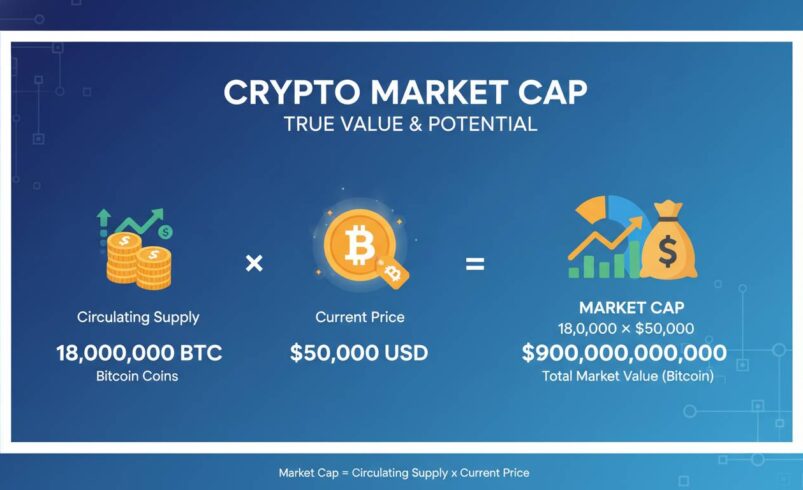
The formula is straightforward: Market Cap = Price × Circulating Supply
This calculation matters because it accounts for both how expensive an individual coin is and how many of those coins exist. A cryptocurrency with a price of $0.01 but a circulating supply of 100 billion has a market cap of $1 billion. A different cryptocurrency with a price of $1,000 but only 1 million coins in circulation has a market cap of $1 billion. Same market cap, completely different price per coin. This is precisely why comparing cryptocurrencies by price alone is like comparing books by their weight instead of their content.
How Market Cap Is Calculated
The calculation takes two inputs: the current price of a single coin and the number of coins circulating in the market.
Let’s use Bitcoin as of early 2025. Bitcoin’s circulating supply hovers around 19.6 million coins. If one Bitcoin trades at $67,000, the calculation becomes: $67,000 × 19,600,000 = approximately $1.31 trillion in market cap.
Now compare this to a hypothetical altcoin trading at $0.50 with a circulating supply of 2 billion coins: $0.50 × 2,000,000,000 = $1 billion market cap.
The price difference between these two cryptocurrencies is enormous—$67,000 versus $0.50—yet the second cryptocurrency is only slightly “smaller” in terms of total network value. This is the critical insight that most beginners miss. A “cheap” coin with a massive supply can be worth more than an “expensive” coin with limited supply.
One nuance worth understanding: circulating supply differs from total supply or max supply. Circulating supply refers to coins that are publicly available and trading. Total supply includes coins that exist but aren’t in active circulation (such as reserved tokens or unsold pre-mines). Max supply is the absolute ceiling—some cryptocurrencies, like Bitcoin, have a fixed maximum supply cap, while others can theoretically create unlimited tokens.
Why Market Cap Matters More Than Price
Here’s the thing: price is a vanity metric in most cryptocurrency comparisons. It looks important because exchanges display it prominently and media headlines scream about Bitcoin hitting $70,000 or some altcoin surging 500% in a day. But price without context is meaningless.
Market cap gives you context. It tells you how much the entire network is worth in aggregate, which correlates more closely with actual adoption, network effects, and institutional interest. When Bitcoin’s market cap exceeds $1 trillion, that reflects thousands of institutions, millions of users, and billions of dollars in infrastructure built around the network. When a cryptocurrency with a $5 million market cap spikes 50% in a day, that’s typically just speculative trading volume moving the price—no fundamental network growth required.
This becomes especially clear when comparing Bitcoin to altcoins. As of early 2025, Ethereum’s market cap sits around $300-400 billion, making it the second-largest cryptocurrency. Its price per coin is significantly lower than Bitcoin’s, but its market cap reflects a similarly massive ecosystem of developers, users, and applications. The lower price doesn’t make Ethereum “cheaper” or a better “deal”—it simply reflects more coins in circulation.
Consider this counterintuitive reality: a cryptocurrency with a price of $0.001 can actually be overvalued relative to a cryptocurrency trading at $1,000, if the first one has a market cap ten times larger. The price-per-coin is arbitrary. The market cap is not.
There’s also a practical reason professional investors focus on market cap: it helps assess liquidity and volatility. Large-cap cryptocurrencies like Bitcoin and Ethereum tend to have deeper order books, meaning large trades move the price less dramatically. Small-cap cryptocurrencies can experience astronomical price swings from relatively small trades—great for speculation, terrible for anyone storing significant value.
Real Examples: Market Cap in Action
Let’s look at concrete comparisons that demonstrate why market cap is the superior metric.
Bitcoin vs. a random “penny crypto”: Suppose a cryptocurrency trades at $0.0001—essentially “free” by any intuitive measure. If it has 10 trillion tokens in circulation, its market cap is $1 billion. That’s not a penny crypto; it’s a billion-dollar network. Meanwhile, Bitcoin at $67,000 with 19.6 million coins represents $1.3 trillion. The “penny crypto” isn’t cheaper—it costs roughly 1,300 times less per coin, but the networks aren’t comparable in actual value.
Ethereum vs. small-cap tokens: Ethereum’s market cap of roughly $350 billion reflects an entire world computer powering decentralized applications, stablecoins, DeFi protocols, and NFTs. A small-cap token with a $50 million market cap might have a price of $0.08 and seem “cheap,” but you’re comparing a global financial infrastructure to a token that might have a few thousand active users.
The 2021-2022 altcoin season pattern: During previous bull markets, many investors made the mistake of buying “cheap” coins simply because they cost pennies. They accumulated millions of tokens priced at $0.001, convinced they were getting in early on the next Bitcoin. When the market corrected, many of these tokens lost 90-99% of their value—not because the price dropped from $0.001 to $0.00001, but because the market cap was never supported by actual adoption. The “cheap” price masked an overvalued network.
This pattern repeats in every cycle. The lesson is clear: the number of coins you own matters far less than what those coins collectively represent in network value.
Limitations of Market Cap
I need to tell you something that many articles on this topic skip: market cap has significant limitations, and ignoring them makes you vulnerable to a different kind of mistake.
Supply manipulation is real. Teams behind cryptocurrencies can artificially inflate market cap by releasing tokens into circulation. If a token has a $1 billion market cap but the team holds 80% of supply in wallets they control, the actual traded network value is far lower. This is sometimes called “dumping” and it’s why you need to check the distribution of tokens before assuming a market cap reflects genuine value.
Fully diluted valuation tells a different story. Market cap uses circulating supply, but some cryptocurrencies have massive token supplies that haven’t entered circulation yet. Looking at “fully diluted market cap”—the value if all tokens were in circulation—can reveal a very different picture. A token might trade at $10 with a $100 million circulating supply, but have a max supply that would push its fully diluted value to $1 billion. That’s a 10x difference in theoretical valuation.
Market cap doesn’t measure utility or quality. A cryptocurrency can have a massive market cap and still be a terrible investment if the tokenomics are misaligned, the team is incompetent, or the technology is outdated. XRP has maintained a significant market cap for years despite ongoing regulatory battles and questions about its actual utility. Market cap reflects what the market currently prices in, not necessarily what should be priced in.
Trading volume matters more than people realize. A low-liquidity cryptocurrency can have a seemingly stable market cap because trades are infrequent. The price might look steady, but a larger investor could never actually exit at that price without moving the market dramatically. Always check trading volume alongside market cap.
Common Misconceptions About Market Cap
Most articles explain what market cap is and then stop. But the misconceptions surrounding this metric are worth addressing directly, because they’re what actually cost people money.
“Low price means room to grow” — This might be the most dangerous myth in crypto. A $0.001 token has the same “room to grow” as a $1,000 token if their market caps are identical. The percentage gain required to double the market cap is identical regardless of price. The only difference is psychological: humans perceive going from $0.001 to $0.01 as more exciting than going from $1,000 to $2,000, even though the math is identical.
“Market cap predicts price movement” — It doesn’t. A $10 billion market cap cryptocurrency doesn’t “need” to reach $100 billion any more than a $100 million token needs to reach $1 billion. Market cap growth requires actual adoption, capital inflows, and network value creation. There’s no gravitational force pulling smaller market caps toward larger ones.
“My coin is underpriced because Bitcoin dominance is high” — Bitcoin dominance simply measures what percentage of total crypto market cap belongs to Bitcoin. It doesn’t indicate that altcoins are automatically undervalued. In fact, periods of high Bitcoin dominance often precede altcoin rallies, but that’s correlation from market cycles, not a mathematical guarantee.
Should You Invest Based on Market Cap?
Let’s address the practical question everyone actually wants answered: does market cap tell you what to buy?
No. Market cap measures current market value, not future potential or fundamental quality. A cryptocurrency with a high market cap has already been adopted and valued by the market—its future upside might be limited compared to smaller networks with more room to grow. This is why some investors specifically seek lower market cap cryptocurrencies, accepting higher risk for potentially higher rewards.
Can market cap be manipulated? Yes, through various mechanisms. Coordinated buying in low-liquidity markets can push prices up significantly, artificially inflating market cap. Teams can also release large amounts of tokens onto exchanges, increasing circulating supply and market cap without genuine adoption. Always investigate token distribution and trading volume before assuming a market cap reflects real value.
Should you only invest in large-cap cryptocurrencies? Not necessarily. Large-cap cryptocurrencies like Bitcoin and Ethereum have proven track records, deeper liquidity, and lower volatility—but they also typically offer smaller percentage gains than smaller-cap alternatives. Many portfolios include a mix of large, mid, and small-cap allocations based on risk tolerance. The key is understanding that market cap size is one factor among many, not a guarantee of quality.
One more distinction worth knowing: market cap uses circulating supply—the tokens currently available for trading. Fully diluted valuation projects that calculation to include all tokens that will ever exist. If a cryptocurrency hasn’t yet released all tokens into circulation, its fully diluted valuation will be higher than its market cap. Comparing both metrics gives you a more complete picture.
Conclusion
Understanding market cap transforms how you evaluate cryptocurrencies. It moves you away from the surface-level thinking that makes “cheap” coins seem attractive and toward the harder but more valuable work of assessing actual network value. Price is the distraction. Market cap is the signal.
That said, I want to be honest: market cap alone won’t make you a successful crypto investor. It won’t tell you which team is competent, which technology will win, or which tokenomics are sustainable. It’s one tool in a larger toolkit—one that happens to be more useful than the number that exchanges blast across every screen.
Use market cap to quickly filter and compare. Use it to understand relative network sizes. But never mistake a low price for a good deal, and never assume a high market cap means a cryptocurrency can’t lose value. The crypto market has destroyed fortunes in exactly those assumptions.
If you’re serious about understanding this space, your next step is to learn how token supply works across different cryptocurrencies. Not all token supplies are created equal, and the difference between a fixed supply and an inflationary one matters enormously over time.