
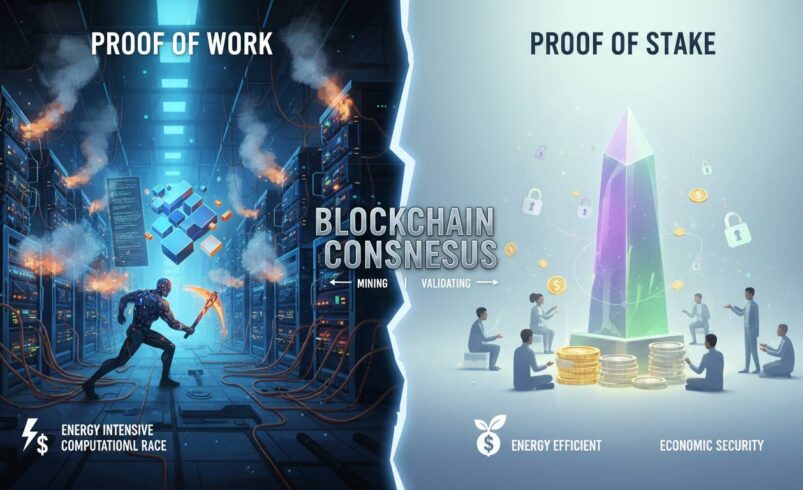

The distinction between Proof of Stake and Proof of Work is one of the most significant technical debates in blockchain technology. These two consensus mechanisms determine how cryptocurrency networks validate transactions, create new blocks, and maintain security. Understanding their differences isn’t just academic—it directly impacts energy consumption, network security, token economics, and the environmental footprint of digital currencies. With Ethereum completing its transition to Proof of Stake in 2022 and continued debates about which system better serves the future of decentralized finance, knowing how these mechanisms work has become essential for anyone engaging with cryptocurrency beyond simple buying and selling.
What is Proof of Work?
Proof of Work is the original consensus mechanism that powered Bitcoin since its inception in 2009. In this system, miners compete to solve complex mathematical puzzles using specialized computer hardware. The first miner to find a valid solution gets to add the next block of transactions to the blockchain and receives newly minted cryptocurrency as a reward.
The puzzles themselves serve a specific purpose—they’re intentionally difficult to solve but easy to verify once a solution exists. This asymmetry creates the security foundation of Proof of Work networks. An attacker would need to control more than 50% of the network’s total computing power to successfully reverse transactions or double-spend coins, making such attacks economically prohibitive on established networks like Bitcoin.
The mining process consumes substantial electricity because these mathematical problems require massive computational effort. Bitcoin’s network, for instance, currently operates with hash rates exceeding 500 exahashes per second, meaning miners collectively attempt 500 quintillion hash calculations every second. This competition creates a lottery-like system where probability determines who wins each block, with individual miners’ chances directly tied to their share of total network hashrate.
Proof of Work’s primary strength is its battle-tested security. Bitcoin has operated continuously since 2009 without any successful double-spend attacks on its main network—a track record spanning over 15 years. The mechanism rewards computational investment, meaning the more valuable a network becomes, the more expensive it theoretically becomes to attack. However, this security comes at a significant environmental cost, which has driven considerable interest in alternative consensus mechanisms.
What is Proof of Stake?
Proof of Stake emerged as an alternative approach that eliminates the need for energy-intensive computational competition. Instead of miners competing through processing power, Proof of Stake selects validators based on the amount of cryptocurrency they hold and are willing to “stake” as collateral. Think of it as requiring a security deposit—the more crypto you lock up, the higher your chance of being chosen to validate the next block.
When a validator is selected to propose a new block, they must attest to the validity of transactions within that block. Other validators then confirm these attestations. If a validator attempts to approve fraudulent transactions, they lose part or all of their staked holdings—this economic penalty creates the security mechanism rather than computational work.
Ethereum’s implementation, called Gasper, introduced several nuanced features beyond basic Proof of Stake. Validators are randomly assigned to committees that vote on block proposals, and the system includes “finality” guarantees where blocks become extremely difficult to reverse after passing certain checkpoints. The transition, called “The Merge,” completed in September 2022 and reduced Ethereum’s energy consumption by approximately 99.95%.
Cardano, Algorand, and Polkadot represent other prominent Proof of Stake implementations, each with slightly different approaches to validator selection, tokenomics, and governance. Some networks use delegated Proof of Stake, where token holders vote for a smaller set of validators to represent them—this reduces participation requirements while introducing different centralization trade-offs.
Energy Consumption: The Fundamental Divide
The most visible difference between these mechanisms involves electricity usage. Proof of Work networks like Bitcoin consume energy comparable to some small countries—approximately 150 terawatt-hours annually according to the Cambridge Bitcoin Electricity Consumption Index, though this figure fluctuates with price movements and network difficulty adjustments.
Proof of Stake networks require only a fraction of this energy. Ethereum’s transition reduced its annual energy consumption from roughly 70 TWh to approximately 0.01 TWh—a transformation that made the network’s energy use comparable to a small office building rather than a nation-state. This dramatic reduction addresses what had become a significant criticism of blockchain technology from environmental advocates.
Critics of Proof of Stake argue that energy consumption isn’t merely a negative characteristic but serves a security function. The argument holds that the immense computational resources required for mining make attacks prohibitively expensive. However, Proof of Stake advocates counter that staked cryptocurrency represents real economic value at risk, creating powerful financial incentives for honest behavior that don’t require wasting electricity on meaningless calculations.
The environmental argument remains contested. Some analysts note that Bitcoin mining has increasingly utilized renewable energy sources, with some estimates suggesting over 50% of mining occurs using renewable power. Others argue that the actual environmental impact depends on where mining occurs and what electricity sources dominate those regions. What’s undisputed is that Proof of Stake offers dramatically lower energy consumption as a structural feature rather than depending on miners’ location choices.
Security and Attack Resistance
Both mechanisms aim to prevent network attacks, but they achieve this goal through different economic incentives. In Proof of Work, attackers must physically acquire mining hardware and consume electricity—resources that become worthless if the network successfully defends against an attack. In Proof of Stake, attackers must accumulate significant amounts of the native cryptocurrency, which becomes economically valueless if the attack succeeds and destroys confidence in the network.
The 51% attack scenario differs substantially between mechanisms. A Proof of Work attacker needs to control majority hash rate and sustain that control long enough to reorganize the blockchain. This requires ongoing hardware investment and electricity costs. A Proof of Stake attacker needs to control majority staked tokens—which in practice means purchasing them on the open market, dramatically driving up prices and making the attack economically irrational on established networks.
Ethereum’s implementation includes additional security mechanisms. Validators that go offline without justification receive minor penalties, while those proposing contradictory blocks face “slashing” penalties that can confiscate significant portions of their stake. The system also implements “inactivity leaks” that gradually reduce the stake of validators preventing the network from reaching consensus, ensuring the chain can recover even if a large portion of validators go offline simultaneously.
However, Proof of Stake introduces its own security considerations. The concentration of stake among a relatively small number of validators creates potential attack vectors through coordination or social manipulation. Critics note that wealthy token holders naturally accumulate more stake over time, potentially leading to plutocratic rather than democratic governance. These concerns aren’t merely theoretical—debates about validator centralization on Ethereum continue among security researchers.
Centralization Tendencies and Decentralization
Decentralization represents a core philosophical principle for cryptocurrency advocates, yet both consensus mechanisms exhibit tendencies toward concentration that don’t always receive adequate attention.
Proof of Work creates hardware-based centralization. Mining operations have migrated toward regions with cheap electricity, with industrial-scale operations dominating hash rate distribution. China’s mining crackdown in 2021 demonstrated how regulatory action could suddenly shift majority hash rate to other countries. Today, major mining pools control substantial portions of Bitcoin’s hashrate—the top four pools consistently exceed 50% of total network hash rate, raising questions about actual decentralization.
Proof of Stake creates stake-based centralization. While anyone can theoretically become a validator by staking 32 ETH (approximately $50,000 at current prices), most participants delegate to staking services or staking pools. This creates a smaller set of entities controlling validation duties. Ethereum currently has around 1 million validators, but the distribution of staked ETH shows significant concentration among major exchanges and staking services.
The debate over which mechanism better preserves decentralization often misses the point. Both systems create economic barriers to participation—Proof of Work through hardware and electricity costs, Proof of Stake through capital requirements. The meaningful question becomes whether those barriers differ substantially in practice and whether the resulting centralization creates meaningful security or governance risks.
Decentralization exists on a spectrum rather than as a binary state. Neither mechanism achieves perfect decentralization in practice, and both require ongoing vigilance against concentration of power among a small number of influential participants.
Economic Incentives and Tokenomics
The reward structures within each mechanism create different economic dynamics for token holders and network participants.
Proof of Work creates a continuous sell pressure from miners who must cover electricity and hardware costs. Bitcoin miners collectively sell significant portions of their mined coins to remain profitable, creating ongoing market pressure that can affect price dynamics. However, this same pressure ensures that mining rewards distribute broadly rather than accumulating entirely among early holders.
Proof of Stake creates more favorable tokenomics for holders. Validators earn staking rewards without requiring ongoing operational expenses beyond initial capital. This can reduce sell pressure while increasing token scarcity through staking lock-ups. Ethereum’s staking yield currently hovers around 3-4% annually, creating an incentive to hold rather than sell that contrasts with the mining-driven sell pressure in Proof of Work systems.
The distribution of new tokens also differs significantly. Proof of Work networks like Bitcoin have predetermined inflation schedules that gradually reduce block rewards over time through “halving” events. Proof of Stake networks often implement different emission models—Ethereum, for instance, issues new ETH to validators but burned transaction fees create deflationary pressure that can offset or exceed issuance.
These tokenomic differences affect network security funding, wealth distribution, and long-term sustainability. Proof of Work networks must eventually rely entirely on transaction fees once block rewards reach zero, raising questions about security incentives in mature networks. Proof of Stake networks face different questions about whether staking rewards adequately incentivize security participation as issuance decreases.
Pros and Cons Comparison
Proof of Work offers genuine advantages beyond its energy consumption. The mechanism has proven itself over more than fifteen years of continuous operation without successful major attacks. The computational work provides a tangible, verifiably difficult barrier against spam and attacks. Hardware requirements, while creating centralization, also create geographic distribution tied to electricity availability rather than pure capital.
However, Proof of Work’s energy consumption has become increasingly difficult to defend as climate concerns intensify. The mechanism’s vulnerability to ASIC centralization and mining pool concentration raises legitimate questions about true decentralization. Transaction throughput limitations on Proof of Work networks like Bitcoin create scalability challenges that proponents argue require layer-two solutions rather than base-layer modifications.
Proof of Stake offers clear advantages in energy efficiency and environmental impact. The mechanism enables broader participation through lower hardware requirements. Native support for smart contracts—as demonstrated by Ethereum—creates more flexible development environments. The economic security model through staked collateral appeals to those who find the physical resource consumption of Proof of Work philosophically troubling.
Yet Proof of Stake faces its own challenges. The “nothing at stake” problem—where validators face no cost for supporting multiple blockchain versions during a fork—required solutions like slashing penalties. Wealth concentration remains a concern, as those with more capital naturally accumulate more influence. The relative youth of major Proof of Stake networks means less real-world stress testing compared to Bitcoin’s proven track record.
Which Consensus Mechanism is Better?
The honest answer depends entirely on what you’re optimizing for. There is no objectively correct consensus mechanism—only different trade-offs that serve different priorities.
If environmental sustainability ranks as a primary concern, Proof of Stake wins decisively. The energy reduction is so dramatic that comparing the two on environmental grounds feels almost unfair to Proof of Work advocates.
If maximizing proven security through time-tested mechanisms matters most, Proof of Work networks like Bitcoin retain meaningful advantages. Fifteen years of uninterrupted operation with no successful double-spend attacks represents a track record that Proof of Stake networks simply cannot match yet.
If you prioritize transaction capabilities and programmability, Proof of Stake networks offer more flexibility. Ethereum’s transition enabled functionality that would have been extremely difficult to implement on a Proof of Work base layer.
If you care about the philosophical argument that computational work creates inherent value, Proof of Work aligns with that worldview. Whether you find that argument persuasive depends on deeper questions about economic value that extend well beyond technical mechanisms.
What’s clear is that both mechanisms will continue coexisting. Bitcoin shows no signs of abandoning Proof of Work, while numerous Proof of Stake networks compete for adoption across different use cases. The debate isn’t about which mechanism will “win” but rather which serves specific applications better.
Frequently Asked Questions
What is the main difference between Proof of Stake and Proof of Work?
Proof of Work requires computational competition where miners solve mathematical puzzles to validate transactions and earn rewards. Proof of Stake selects validators based on how much cryptocurrency they hold and stake as collateral, eliminating the need for energy-intensive computation.
Why did Ethereum switch to Proof of Stake?
Ethereum transitioned to Proof of Stake to reduce its energy consumption by approximately 99.95%. The network also aimed to improve scalability and introduce new functionality through the same upgrade. The transition, called “The Merge,” completed in September 2022.
Does Proof of Stake use less energy?
Yes, dramatically so. Proof of Stake networks require only a tiny fraction of the electricity that Proof of Work networks consume. Ethereum’s energy usage after the transition is comparable to a small building rather than a small country.
Is Proof of Stake more secure than Proof of Work?
This question lacks a definitive answer. Proof of Work has a longer proven track record, while Proof of Stake offers different economic security guarantees through staked collateral rather than computational work. Both can be secured against attacks when properly implemented, though each has different vulnerability profiles.
Which cryptocurrencies use Proof of Stake?
Ethereum, Cardano, Algorand, Polkadot, Solana, Avalanche, and Tezos all use Proof of Stake or variants like Delegated Proof of Stake. Ethereum represents the largest Proof of Stake network by total value secured.
Conclusion
Understanding Proof of Stake versus Proof of Work matters because these mechanisms shape everything from environmental impact to security guarantees to who participates in network governance. The choice between them involves genuine trade-offs rather than simple optimization.
What continues to fascinate me about this space is how the debate often reveals underlying values rather than purely technical assessments. Someone who views computational resource consumption as inherently wasteful will likely favor Proof of Stake. Someone who believes that demonstrated work creates genuine security will likely favor Proof of Work. Both perspectives have merit.
The technology continues evolving. Research into alternative consensus mechanisms like Proof of History, Proof of Space and Time, and various hybrid systems suggests the debate hasn’t reached its final form. What remains clear is that consensus mechanisms represent fundamental architectural choices that propagate through every aspect of how blockchain networks function—and understanding those choices empowers better decisions whether you’re building applications, investing, or simply learning.