
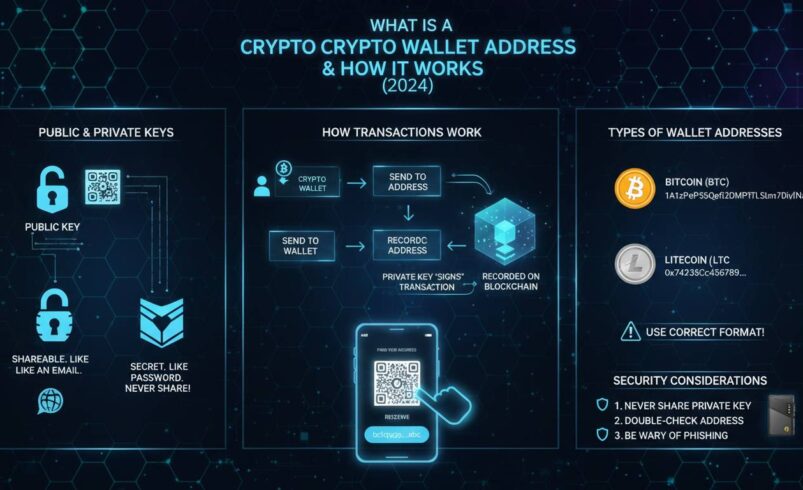

If you’ve ever sent or received cryptocurrency, you’ve interacted with a wallet address—but chances are you barely understood what was happening on the screen. That string of letters and numbers looks like random gibberish, yet it represents something remarkably precise: a mathematical representation of your access to funds on a decentralized network. Most people treat wallet addresses like email addresses, and that analogy gets you close enough to function. But it obscures everything that actually matters for security and understanding how blockchain transactions work.
This article covers what crypto wallet addresses actually are, how the cryptography works, the key differences between wallet types, and the practical steps for handling them safely. I’ll also point out where conventional wisdom about wallet security gets things wrong—because the most common advice isn’t always the most accurate.
What Is a Crypto Wallet Address?
A crypto wallet address is a unique identifier that points to a specific location on a blockchain where cryptocurrency can be sent or stored. Think of it as a cross between a bank account number and a postal address: it tells the network where to deliver your funds, and it lets others send crypto to you without needing to know anything else about you.
Every address consists of a string of characters—typically 26 to 35 characters for Bitcoin, longer for some other blockchains. These characters are generated through cryptographic mathematics from a corresponding public key. The address itself is safe to share publicly, much like you might share your email address or your home mailing address. When someone wants to send you Bitcoin, Ethereum, or any other cryptocurrency, they enter your address in their wallet’s send field, and the network uses that information to route the transaction to the correct destination.
The crucial detail that trips people up: a wallet address is not your wallet. The address is merely a doorway—a destination point generated from the mathematical keys that actually control your funds. Lose those keys, and no address in the world will help you recover your crypto. This distinction becomes critical when understanding wallet security, and it’s where many beginners make their first serious mistake.
For Bitcoin, addresses typically start with 1, 3, or bc1. Ethereum addresses always start with 0x. These prefixes aren’t arbitrary—they indicate which blockchain the address belongs to and which format was used to generate it. Sending Bitcoin to an Ethereum address, or vice versa, is a common error that results in permanently lost funds. The networks are fundamentally incompatible, and no amount of customer support can reverse such a transaction.
How Does a Crypto Wallet Address Work?
The technical foundation of a wallet address begins with something called a private key—a randomly generated number that serves as the ultimate proof of ownership for your crypto. This private key generates a corresponding public key through elliptic curve cryptography, a mathematical process that’s easy to compute in one direction but practically impossible to reverse. From that public key, a hash function produces your final wallet address.
Here’s where it gets interesting. The relationship between your private key and your address is deterministic but one-way. Anyone can derive your address from your private key, but no one can work backward from your address to discover your private key. This asymmetry is what makes blockchain transactions secure. When you sign a transaction with your private key, the network verifies that you control the funds at that address without ever exposing the key itself.
When you initiate a transaction, your wallet software creates a message containing three key pieces of information: which address the funds are coming from, which address they’re going to, and how much cryptocurrency is being transferred. You authorize this transfer by signing it with your private key. The signature proves you control the sending address without revealing the private key. Nodes across the network verify this signature and, once confirmed, add the transaction to the blockchain.
One thing most articles don’t explain clearly: your “wallet” doesn’t actually store cryptocurrency. Nothing moves except records on a distributed ledger. The blockchain records that a certain number of coins now belong to the address you control, and your private key gives you the exclusive ability to sign a future transaction moving those coins elsewhere. The coins themselves exist only as ledger entries. This conceptual shift—from storing value to controlling a mathematical claim on value—is fundamental to understanding how cryptocurrency differs from traditional finance.
Types of Crypto Wallet Addresses
Not all wallet addresses are created equal, and understanding the distinctions matters more than most people realize. The three main categories are single-signature addresses, multi-signature addresses, and derived addresses from hierarchical deterministic wallets.
Single-signature addresses are the most common. One private key controls the address, and any transaction requires only one signature. These are simple to use but create a single point of failure. If someone obtains your private key, they control your funds. Period.
Multi-signature addresses require multiple private keys to authorize a transaction. A 2-of-3 multi-sig wallet, for example, might require any two of three designated keys to approve a transfer. This setup is popular for corporate treasuries, family accounts, and anyone wanting redundancy or distributed control. It also provides protection against theft— even if one key is compromised, the attacker can’t move the funds alone.
Hierarchical deterministic (HD) wallets generate a tree of addresses from a single seed phrase, typically 12 or 24 words. This matters practically because you can generate unlimited addresses from one backup phrase. Most modern wallets are HD wallets, and they solve a real problem: address reuse. Each transaction ideally uses a fresh address, which improves privacy. With an HD wallet, you need only remember your seed phrase to recover every address you’ve ever created.
The critical limitation people overlook: not every cryptocurrency uses the same address format. Bitcoin and its variants use one system. Ethereum uses a different one entirely. Solana, Polygon, and other chains each have their own conventions. Some wallets handle multiple blockchains, generating the appropriate address format for each network. Others are single-chain only. When you download a wallet, check which blockchains it supports before assuming you can receive everything in one place.
Hot Wallets vs Cold Wallets
The hot versus cold wallet distinction comes down to one factor: internet connectivity. A hot wallet is connected to the internet—your exchange account, a mobile wallet app, a browser extension. A cold wallet is offline, typically a hardware device or paper document, never touching an online environment unless deliberately connected for a transaction.
Hot wallets offer convenience. You can trade instantly, access your funds from anywhere, and move quickly during market opportunities. Exchange hot wallets, where most casual users keep their crypto, provide the smoothest experience. But that convenience comes with attack surface. Every device with internet access is potentially vulnerable to malware, phishing, exchange hacks, or simple human error. The history of cryptocurrency is littered with stories of people losing life-changing sums because their hot wallet was compromised.
Cold wallets provide substantially stronger security by isolating your private keys from any network. A hardware wallet like those made by Ledger or Trezor stores your keys in secure elements that never expose them to your computer or phone. When you want to send funds, the hardware device signs the transaction internally and transmits only the signature—not the key—to your connected device. Even if your computer is compromised with malware, the attacker cannot access your keys.
Here’s the uncomfortable truth that security purists often gloss over: for most people holding modest amounts, a well-configured hot wallet on a reputable exchange is probably fine. The largest risk for most users isn’t sophisticated hacking—it’s forgetting passwords, losing access to 2FA devices, or sending funds to the wrong address. Exchanges provide account recovery mechanisms that cold wallet owners can never access. If you lose your hardware wallet and seed phrase, no one can help you. That tradeoff between security and recoverability isn’t obvious until you’re staring at a lost fortune.
The practical middle ground many experts actually recommend: keep small amounts for trading in hot wallets, store larger holdings in hardware cold wallets, and never keep more on any single exchange than you can afford to lose. The definition of “large” varies by your total net worth and risk tolerance, but most financial planners suggest treating crypto exchanges as you would any high-risk holding—not as a savings account.
How to Find Your Crypto Wallet Address
Finding your wallet address depends on which wallet you’re using, but the process follows predictable patterns across most platforms. Understanding where to look—and confirming you’ve found the right thing—prevents costly mistakes.
On a cryptocurrency exchange like Coinbase, Binance, or Kraken, you navigate to your wallet or account section, select the specific cryptocurrency you want to receive, and look for a “deposit,” “receive,” or “receive funds” button. The screen will display your unique address for that blockchain, often with a copy button for easy transfer. Most exchanges also show a QR code version of the address, useful for mobile transactions.
For software wallets like MetaMask, Trust Wallet, or Exodus, the process is similar: open the app, select the specific cryptocurrency, and look for a receive or deposit option. MetaMask displays your address prominently at the top of the account view. Tap or click to copy it, or use the QR icon for mobile scanning.
Hardware wallets connect to companion software on your computer. Ledger Live, for example, shows each account’s address within the account view. Always verify the address shown on your hardware device matches what’s displayed on your screen—this prevents malware from intercepting and modifying addresses during the copy process.
Always test with a small amount first. Send a tiny transaction to confirm the address works before moving significant funds. Wait for confirmation on the blockchain. This practice catches mistakes before they become disasters. You’d rather lose $1 in network fees learning you copied the wrong address than lose your entire holding.
One more thing: double-check the blockchain network. Many exchanges and wallets support the same cryptocurrency on multiple networks—Ethereum’s mainnet, Polygon, Arbitrum, Optimism, and so on. Each network has its own address format. Sending USDT on the Ethereum network to an address meant for the Tron network will lose your funds. The address might look valid, but it won’t work on the wrong chain. When in doubt, check the wallet or exchange documentation about which networks they support for each asset.
Is It Safe to Share Your Wallet Address?
The straightforward answer: yes, sharing your wallet address is safe, and you must share it to receive cryptocurrency. The address reveals nothing about your private keys, your identity (unless you’ve linked it to personally identifiable information elsewhere), or your complete holdings. It functions more like a PO box number than a bank account—people can send you things, but they cannot access what’s inside.
What you might not have considered: wallet addresses are public by design. Every transaction involving your address is visible on the blockchain explorer. Anyone who knows your address can see its entire history—the source of every deposit, the destination of every withdrawal, and the current balance. This transparency is a feature of blockchain networks, not a bug, but it has privacy implications.
Professional crypto users often generate fresh addresses for each transaction specifically to prevent others from linking their activities or seeing their total holdings. HD wallets make this practical by generating unlimited addresses from one seed. If you’ve shared one address publicly—on a website for receiving donations, for example—anyone can monitor that address indefinitely. They know exactly how much you’ve received over time, even if they can’t spend it.
The more nuanced question is whether sharing your address creates risk beyond privacy. In practice, the main danger isn’t someone stealing your funds with your address alone— that’s mathematically impossible. The danger is targeted attacks based on knowledge of your holdings. If a malicious actor knows you hold a large balance, you become a phishing target. They’ll impersonate support staff, send convincing fake websites, or develop sophisticated social engineering campaigns. High-balance addresses are collected and monitored by data analytics companies, and that data gets sold.
So share your address freely to receive funds, but think twice before associating it with your identity in public places. Use fresh addresses for large or sensitive transactions. And never, under any circumstances, share your seed phrase or private key—those actually control your funds.
Common Mistakes to Avoid
The cryptocurrency community has accumulated years of horror stories, and almost every catastrophic loss traces back to a handful of predictable errors. Learning these lessons from others rather than experience will save you significant grief.
Sending to the wrong blockchain is the most common expensive mistake. You’re trying to move Ethereum to a friend, but you accidentally selected the Polygon network in your wallet. The transaction broadcasts successfully—then disappears. Your funds exist on a chain your wallet doesn’t support. There’s no recovery. Triple-check the network matches before every send, especially when dealing with cross-chain transfers or Layer-2 networks.
Falling for phishing continues to drain wallets at an alarming rate. You’ll receive an email or DM appearing to come from your exchange or wallet provider, asking you to “verify your account” or “resolve a security issue.” The link leads to a perfect replica of the real site. You enter your credentials, and the attackers drain everything. The defense is simple but requires constant vigilance: never click links in unexpected messages, always navigate to exchanges by typing the URL directly, and enable 2FA using a hardware token or authenticator app rather than SMS.
Losing access to recovery phrases is exactly as bad as it sounds. Paper and seed phrases are vulnerable to fire, water, simple misplacement, and inheritance issues. People have thrown away hard drives containing millions in Bitcoin. Others have written their seed phrases on paper that disintegrated. Store seed phrases in multiple secure locations—metal backups protect against fire, and geographic redundancy protects against single-point disasters. But don’t store them in a safe deposit box at the same bank where you have your only identity documents, because banks can seize or freeze those.
Address typos seem impossible, but they happen more than you’d think. Cryptocurrency addresses include checksums—mathematical verification that the address is valid—but if you typo a character and produce a different but technically valid address, the funds go to a valid but incorrect destination. Always copy and paste when possible, always verify the first and last few characters match, and always send a test transaction first.
One counterintuitive point worth emphasizing: you don’t actually need a hardware wallet to be reasonably secure. What you need is good operational security practices. Using a reputable exchange with strong 2FA, keeping your software devices malware-free, never clicking suspicious links, and never sharing your seed phrase are more important than which wallet you choose. Hardware wallets are excellent tools, but they create a false sense of security if paired with poor judgment elsewhere.
Frequently Asked Questions
Can I have the same wallet address for different cryptocurrencies?
Generally no. Each blockchain uses different address formats, so a Bitcoin address cannot receive Ethereum, and vice versa. Some wallets generate different addresses for different chains from the same seed phrase, which is convenient, but the addresses themselves remain chain-specific. Some projects have created “wrapped” tokens that represent one cryptocurrency on another chain, but these are separate assets requiring separate addresses.
What happens if I send crypto to the wrong address?
In most cases, nothing can be done. Transactions on decentralized networks are irreversible. If you sent to an address you control but on the wrong chain, your funds may exist on that other chain but be inaccessible from your wallet. If you sent to a completely random wrong address, your funds are likely gone forever—the address exists mathematically, but no one has the private key to access it.
How many characters is a crypto wallet address?
Bitcoin addresses range from 26 to 35 characters, depending on the format. Ethereum addresses are always 42 characters including the “0x” prefix. Other blockchains vary. The length is determined by the encoding scheme and checksum mechanisms specific to each protocol.
Can someone steal my crypto with just my wallet address?
No. A wallet address is public information that must be shared to receive funds. The private key or seed phrase is required to move funds, and that information should never be shared. Knowing your address reveals nothing about your keys.
Conclusion
The fundamental thing to internalize about crypto wallet addresses is that they represent a new paradigm for financial ownership—one where you are your own bank, for better and for worse. The address you see on your screen is just the visible manifestation of cryptographic keys that give you exclusive control over your funds. That control is powerful but unforgiving.
Most people don’t need to understand the elliptic curve mathematics behind their addresses. But everyone who holds cryptocurrency should understand the practical implications: that addresses can be shared safely, that private keys and seed phrases must be protected absolutely, that different blockchains require different addresses, and that mistakes are permanent.
As the ecosystem matures, we’re seeing more attempts to make this space friendlier—recovery options, centralized custodians, and simplified interfaces. These make crypto more accessible but at the cost of the core promise: direct ownership without intermediaries. The tradeoff isn’t resolved, and it may never be. What matters most is that you understand what you’re actually controlling when you hold crypto, and that you protect it accordingly. The blockchain remembers everything. Make sure it remembers you as someone who took security seriously.