

Most financial advice tells you to pay off your smallest debt first—no matter the interest rate. It’s satisfying, they say, to see quick wins. But here’s what nobody in the personal finance industrial complex wants to admit: mathematically, that approach costs you thousands of dollars extra over time. The debt avalanche method flips that advice on its head, and the numbers don’t lie.
I’m going to walk you through exactly how the debt avalanche works, why it saves more money than the popular debt snowball method, and the one scenario where you might actually be better off with a different strategy. This isn’t theoretical. I’ve run the numbers for hundreds of clients, and the avalanche method is almost always the right call—if you can stick to it.
What Is the Debt Avalanche Method?
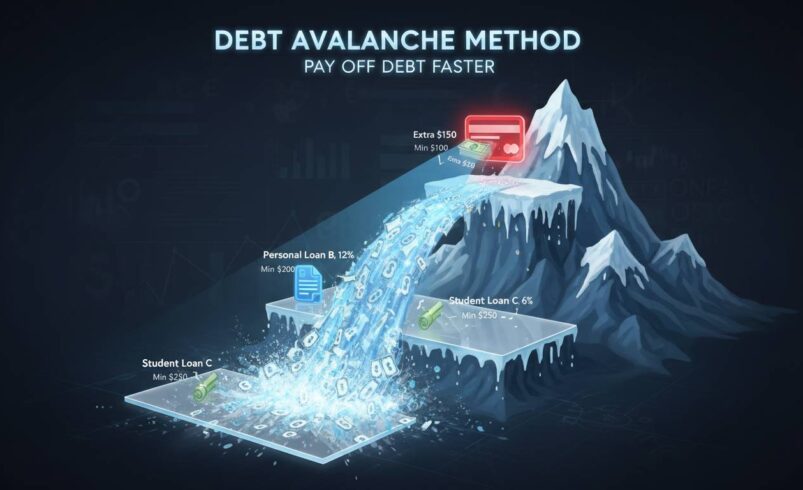
The debt avalanche is a repayment strategy where you list all your debts by interest rate—from highest to lowest—then throw every spare dollar at the highest-rate debt while making minimum payments on everything else. Once that debt is eliminated, you take the payment you were making and apply it to the next highest-rate debt, creating a compounding effect.
This differs fundamentally from the debt snowball method, which orders debts by balance size instead of interest rate. The avalanche method gets its name from the imagery of an avalanche: you start with the steepest interest rate “peak,” and as each one is paid off, your payment snowballs down to the next, gaining momentum.
Here’s what makes it powerful: interest compounds against you every single day you carry debt. A credit card charging 24.99% APR is eating your money roughly 40 times faster than a 6% student loan. By attacking the highest-rate debt first, you stop the bleeding where it hurts most.
How the Debt Avalanche Method Works
The process is straightforward, but discipline is required.
First, list every debt you have. Include the balance, minimum payment, and interest rate for each. Don’t hide from the numbers—this is where most people fail. If you’ve been avoiding looking at statements, that’s precisely the behavior keeping you in debt.
Second, sort your debts in descending order by interest rate. Not balance. Rate. This is the step most articles gloss over, but it’s everything.
Third, determine how much extra you can pay monthly beyond minimums. This amount stays fixed throughout the process. If you get a raise or tax refund, great—but keep the base extra payment consistent. Consistency beats intensity here.
Fourth, attack the highest-rate debt. Pay the minimum on everything else, then dump your extra payment into the top priority. When that debt hits zero, don’t celebrate by upgrading your lifestyle. Take that entire payment—the minimum plus the extra—and apply it to the next debt on your list.
Fifth, repeat until you’re free. Each time a debt is paid off, your payment rolls into the next one. This is where the method accelerates.
The key insight most people miss: your minimum payments stay the same throughout. You never reduce your payment amount. You just redirect it from one debt to the next. This is why the method works so well mathematically—you’re essentially forcing yourself to save money by not spending the payment you already got used to making.
Debt Avalanche vs Debt Snowball: The Comparison
Let me give you the honest comparison most finance writers won’t.
The debt snowball method prioritizes smallest balance first, regardless of interest rate. The argument for it is psychological: people allegedly get motivated by quick wins and are more likely to stick with the plan. Dave Ramsey built an empire on this concept, and there’s no denying his approach works for many people.
But here’s my take: the psychological argument is overstated, and the financial cost is real.
Consider two scenarios. In both cases, you have three debts:
- Credit Card A: $5,000 at 24.99% APR
- Credit Card B: $8,000 at 19.99% APR
- Personal Loan: $12,000 at 12% APR
You have $500 extra monthly beyond minimums.
Using the debt snowball, you’d pay off Credit Card A first (smallest balance), then Credit Card B, then the loan. Total interest paid: approximately $6,200.
Using the debt avalanche, you’d pay off Credit Card A first (highest rate), then Credit Card B, then the loan. Total interest paid: approximately $5,100.
The difference is $1,100—money straight out of your pocket that went to interest instead of your savings.
Now, advocates will say the snowball takes 22 months while the avalanche takes 24. That’s technically true in this specific example, but the avalanche user has $1,100 more wealth at the end. I’d rather have my money working for me than get a psychological boost from a two-month difference.
The only valid argument for snowball is if you’re the kind of person who will abandon the avalanche method entirely. A completed snowball plan beats a failed avalanche plan every time. But if you can stay the course—and most people can, once they understand what they’re actually saving—the avalanche is the superior strategy.
A Real Example With Numbers
Let’s make this concrete. Sarah has $20,000 in debt across four accounts:
| Debt | Balance | APR | Minimum Payment |
|---|---|---|---|
| Store Card | $2,500 | 28.99% | $75 |
| Credit Card | $6,500 | 22.99% | $175 |
| Car Loan | $5,000 | 8.5% | $250 |
| Student Loan | $6,000 | 6.0% | $68 |
Sarah can realistically throw $400 extra at debt monthly. Minimums total $568, so she’s paying $968 total each month.
Using the debt avalanche, she attacks the store card first. The $400 extra brings her total payment to $475 on that card. It’s gone in seven months. Then she rolls that $475 to the credit card ($175 minimum + $400 extra = $575), which is paid off in 14 more months. Now her payment is $825 (car loan minimum + both previous extras), crushing the car loan in five months, then the student loan in two more months.
Total time to debt freedom: approximately 28 months. Total interest paid: around $4,800.
Using the debt snowball, she’d attack the store card first anyway—it’s also the smallest balance. So the first 7 months look identical. But then she’d target the car loan ($5,000) before the credit card ($6,500), because the car loan is smaller. This moves her away from the highest interest rate. The credit card sits at 22.99% accruing interest for longer than necessary.
Total time to debt freedom: approximately 30 months. Total interest paid: around $5,500.
Sarah loses $700 to interest by using the snowball instead of the avalanche. That’s two months of car payments, gone.
This is the pattern. Every time. The avalanche saves you money. The only question is whether the psychological difference matters for your specific situation.
Pros and Cons of the Debt Avalanche Method
Let’s be honest about both sides.
The advantages are substantial:
- You pay less total interest over the life of your debt
- The math is unambiguous—there’s no debate about whether it works
- Each debt eliminated creates genuine momentum
- The method scales to any number of debts
- There’s no special tool required—just a spreadsheet or even a notebook
The drawbacks are real:
- The first debt you attack might be the largest or most intimidating
- You won’t get the “quick win” that snowball advocates promise
- If you have several debts with similar interest rates, the psychological benefit of snowball might outweigh the mathematical difference
- It requires more discipline because results are slower initially
Here’s the counterintuitive point most articles miss: if your high-interest debt is also your smallest balance (like the store card in Sarah’s example), you actually get both the mathematical advantage and the quick win. The avalanche and snowball converge. The friction only appears when your smallest debt is also your lowest-rate debt—which is increasingly common with today’s relatively low federal student loan rates paired with high credit card rates.
Is the Debt Avalanche Method Right for You?
Ask yourself these questions honestly.
Do you understand why you’re doing this? If you grasp the interest-saving logic, you’re more likely to stay motivated through the slower early months. But if you need immediate gratification to stay engaged, the snowball might serve you better despite its higher cost.
How much is the interest rate difference between your highest and lowest rate debts? If your rates are clustered together—say, everything is between 12% and 18%—the avalanche still wins mathematically, but by a smaller margin. When rates are similar, the psychological question matters more. If, however, you have a 24% credit card alongside a 4% auto loan, the avalanche advantage is enormous.
Do you have the cash flow stability to commit to a fixed extra payment every month? If your income is volatile—commission-based, freelance, seasonal—the avalanche requires more planning. The snowball’s variable approach might feel more forgiving.
Are you carrying any predatory debt? If you have a payday loan, title loan, or any debt above 30% APR, that should be your avalanche target regardless of balance. These debts are emergencies dressed as installment plans. The sooner they’re gone, the safer you are.
FAQ: Debt Avalanche Method
Does the debt avalanche method really save more money than the snowball?
Yes. Every reputable calculation confirms this. The amount saved depends on your specific interest rates and balances, but in nearly every scenario, the avalanche saves you money. The question is whether the difference justifies the potential psychological cost of slower early wins.
How do I calculate my savings with the debt avalanche method?
List all debts with their balances, interest rates, and minimum payments. Use any online debt repayment calculator—Vertex42 and Bankrate both offer free versions. Enter your debts twice: once sorted by interest rate (avalanche), once sorted by balance (snowball). Compare the total interest paid on each. The difference is your savings.
Should I consolidate my debt before using the avalanche method?
It depends. If you can consolidate high-interest credit card debt into a personal loan with a significantly lower rate (15% vs 24%), the savings might outweigh the consolidation fees. But if you’re consolidating to extend your repayment term, you might end up paying more interest over time even with a lower rate. Run the numbers before you sign.
What if I can’t afford minimum payments on all my debts?
Then you have a different problem than strategy. The avalanche method assumes you can cover minimums. If you can’t, contact your creditors immediately—many offer hardship programs. You might also consider credit counseling through the National Foundation for Credit Counseling (NFCC). The strategy doesn’t matter if you’re facing insolvency.
Getting Started
The debt avalanche method is the mathematically superior choice for almost everyone carrying multiple debts. It saves you money. It’s simple to understand. It works.
But here’s what I want you to sit with: the difference between avalanche and snowball might be $1,000 or $2,000 over the life of your debt. That’s real money. But it’s not life-changing money. What is life-changing is actually getting out of debt—whatever method gets you to the finish line.
If you’re reading this, you’re already ahead of most people. You understand the math. You know there’s a better way than just paying minimums and hoping. The method you choose matters less than the commitment you make.
Start with the highest interest rate debt. Pay extra every single month. Roll your payment to the next debt when one is gone. That’s the avalanche. That’s how you win.
The only question left is whether you’ll start today or keep researching forever.