
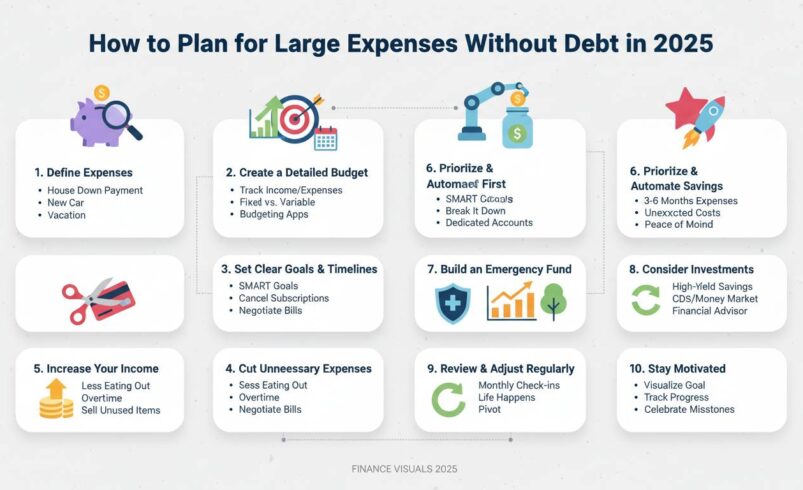

The moment you realize you need $12,000 for a new roof, or $8,000 for your daughter’s wedding, or $15,000 to finally get that kitchen renovation you’ve been dreaming about—your heart sinks. Not because the number is impossible, but because your brain immediately goes to the easy path: credit cards, home equity loans, or worse, financing through the contractor at 19% interest. You’ve been conditioned to believe that big expenses require big debt. They don’t. What separates people who build wealth from those who stay trapped in the debt cycle isn’t income—it’s a systematic approach to saving for things they want before they buy them.
Calculate Your Target Amount and Timeline
Before you save a single dollar, you need to know what you’re saving for and when you need it. This sounds obvious, but most people skip this step entirely and wonder why their savings feel aimless.
Break down your large expense into its components. That kitchen renovation isn’t just “kitchen”—it’s cabinets, countertops, appliances, labor, permits, and a 15% contingency for things you haven’t anticipated. I worked with a client last year who budgeted $25,000 for a bathroom remodel, finished at $31,000 because she hadn’t accounted for plumbing repairs behind the walls. The contingency buffer alone saved her from putting that $6,000 shortfall on a credit card.
Once you have your target number, work backward from your deadline. If you need $10,000 in 18 months, that’s $556 per month. If that number feels crushing, you have three choices: extend your timeline, reduce your scope, or find ways to increase your monthly savings. Most people give up at this stage because the math feels discouraging. Don’t. The math is just information. It’s telling you exactly what needs to happen, and now you can make informed decisions rather than flying blind.
Open a Dedicated Savings Account
This is the single most underrated strategy in personal finance, and almost no one does it. When you mix your large expense savings with your regular checking account or even your emergency fund, the money gets eaten by everyday spending. It vanishes quietly, and you tell yourself you’ll “make it up next month.” You won’t.
Open a separate high-yield savings account specifically designated for this expense. Many banks now offer 4.5% APY or higher as of early 2025—significantly better than the 0.01% your standard checking account earns. The account should have no debit card, no transfer limits that make it too easy to access, and ideally, no connection to your spending apps. You’re building a small wall between yourself and impulse access.
Name the account something specific. “Kitchen Fund” or “Roof Replacement 2026” does psychological work that “Savings” doesn’t. When you log in and see “$4,327.84 toward my kitchen,” that progress feels tangible in a way that a combined balance never does. I’ve seen clients save 30% faster simply by renaming their accounts—it’s a small behavioral tweak with outsized impact.
Set Up Automatic Transfers
If you’re relying on willpower to move money into savings each month, you’ve already lost. Willpower is a finite resource that depletes throughout the day, especially around money decisions. Automation removes the decision entirely.
Set up an automatic transfer from your checking account to your dedicated savings account on the same day you get paid—preferably the same day, before the money has a chance to “feel” available. Treat your savings payment like a bill that must be paid. Because it is.
The amount should be whatever your calculation from Step One determined, but here’s a counterintuitive point: start smaller than that number. If you need to save $600 per month but you’ve never successfully saved consistently, start with $200. Build the habit first. Once you’ve completed three consecutive months of automatic transfers, increase it to $350. Another three months, bump to $500. Gradually working up beats failing dramatically out of the gate.
Most banks let you set up recurring transfers in under five minutes. There’s no excuse not to do this today.
Create a Sinking Fund Strategy
A sinking fund is a dedicated savings pot for a specific future expense, and it’s one of the most effective tools that financially comfortable people use without ever calling it by name. The concept has been around for decades—it’s how people saved for Christmas presents before credit cards made it “easier” to carry debt into January.
The beauty of a sinking fund is that it separates your “spending money” from your “future self’s money.” You’re not saving in abstract—you’re saving for something specific, which makes the deprivation feel meaningful rather than endless.
To build a sinking fund, take your annual irregular expenses—car insurance premiums twice per year, annual subscription renewals, holiday gifts, annual membership fees—and divide them by 12. Save that amount monthly into a separate bucket. When the expense hits, you’re not scrambling. You’re not putting it on credit. You’re simply paying with money you already set aside. One client of mine discovered she was spending $3,400 annually on irregular expenses she had never budgeted for—car registration, pet veterinary bills, home maintenance. Once she started sinking-funding these, she eliminated the credit card usage that used to follow each unexpected bill.
Cut Unnecessary Expenses—But Be Strategic About It
Here’s where most advice gets it wrong. They tell you to cut your morning coffee, as if that’s what’s preventing you from saving $10,000. It’s not. The $5 coffee is a rounding error in a budget that needs to find $600 monthly. What you need to cut are the expenses that actually move the needle: housing, transportation, food, and subscriptions.
Housing should be no more than 30% of your gross income. If you’re spending 40% on rent or mortgage, everything else becomes a struggle. I understand that moving isn’t free and can be disruptive—but if you’re serious about building wealth, your housing cost is the lever that makes everything else possible or impossible.
Transportation is the second biggest drain. The average American spends $10,000 annually on car payments, gas, insurance, and maintenance. If you have a car that’s worth more than half your annual income, that’s a problem. One of the most effective money moves you can make is downsizing to a reliable used car paid in cash, then redirecting what you used to spend on car payments into your savings fund.
For subscriptions, conduct an audit. Most households have $100-200 in recurring subscriptions they forgot they had—streaming services they don’t watch, apps they don’t use, memberships they never access. Cancel them. Redirect that money immediately to your dedicated account. The subscription audit alone can find $150 monthly for most families, and that’s $1,800 per year toward your large expense.
Increase Your Income
This is the part of the conversation that makes people uncomfortable, so let me be direct: if your expenses and your income aren’t aligned with your goals, cutting expenses has limits. You can only reduce your lifestyle so much before it impacts your wellbeing or happiness. Increasing your income doesn’t necessarily mean switching jobs or getting a promotion—though those are valid paths. It means finding money that wasn’t already in your equation.
Side income is the great equalizer. Even 10 hours per month at $25 per hour adds $3,000 annually to your savings capacity. That’s $3,000 toward your roof, your wedding, your renovation—debt-free. I worked with a couple last year who each picked up a weekend side project: he did handyman work on weekends, she taught piano lessons online. Together they generated an extra $1,100 per month. In 14 months, they had enough for a used car without touching their regular budget.
If you have a skill—anything from accounting to photography to project management—you can monetize it. Platforms like Upwork, Fiverr, and TaskRabbit make it easier than ever to find paying work on your own schedule. The key is treating this money differently: it doesn’t go into your regular checking account. It goes directly to your dedicated savings account, untouched by your regular budget.
Track Your Progress Weekly
You cannot manage what you don’t measure. This isn’t a cliché—it’s the operational reality that determines whether you succeed or fail. When you track your progress weekly, you catch slips early, before they become patterns. You celebrate small wins, which builds momentum. And you stay connected to your goal in a way that monthly check-ins can’t replicate.
Set a weekly calendar reminder for 20 minutes—Sunday evenings work well. Log into your dedicated account, record your balance, compare it to your target, and adjust if needed. If you’re behind by $100 this month, where can you find $25 extra per week? Maybe that’s one less restaurant meal. Maybe it’s selling something on Facebook Marketplace. The point isn’t to feel guilty—it’s to stay in control of the trajectory.
One client told me that the weekly tracking ritual became her favorite part of the week. She could literally watch her kitchen coming into existence, dollar by dollar. That psychological connection to progress is what transforms saving from deprivation into anticipation.
Build an Emergency Fund First—Yes, Before You Start
Here’s one important limitation: you should not start saving for a large expense until you have a basic emergency fund. Without three months of living expenses set aside, any unexpected job loss, medical bill, or car breakdown will force you to raid your dedicated savings or go into debt anyway—undoing all your progress.
This is the sequence that works: emergency fund first, then your large expense fund. If you try to do both simultaneously, you’ll fail at both. The emergency fund is your insurance policy that lets all your other savings survive real life.
The Debt-Free Path Is Slower—And That’s the Point
Here’s the honest truth that nobody wants to hear: planning for large expenses without debt is slower. It takes longer. You won’t get the kitchen or the roof or the wedding as quickly as if you financed it. You will have to wait.
But here’s what you gain: no interest payments, no monthly obligations that trap you, no anxiety about debt-to-income ratios, and the financial discipline that comes from actually saving rather than borrowing. The average American pays $1,500 annually in credit card interest alone—that’s money gone forever, money that could have been savings. People who finance their lives stay poor. People who save for their lives build wealth. The speed difference is made up for by the interest you don’t pay.
I’m not going to pretend this is easy. It’s not. It requires saying no to immediate gratification, delaying satisfaction, and watching others get things “faster” while you wait. But I’ve yet to meet someone who regretted the patience. I’ve met plenty who regret the debt.
Conclusion
The systems I’ve outlined here aren’t complicated, but they require doing things differently than you’ve been doing them. Automate your savings. Separate your accounts. Name your goals specifically. Cut what actually costs you money. Earn more if you need to. Track your progress. Build your emergency fund first. And accept that the slower path is the sustainable path.
The question isn’t whether you can afford to save for large expenses without debt. The question is whether you’re willing to do what most people aren’t willing to do—which is plan systematically, stay consistent, and prioritize long-term security over short-term convenience. You can. The money is already in your life. You’re just not directing it with intention yet. Start today. Your future self will thank you.